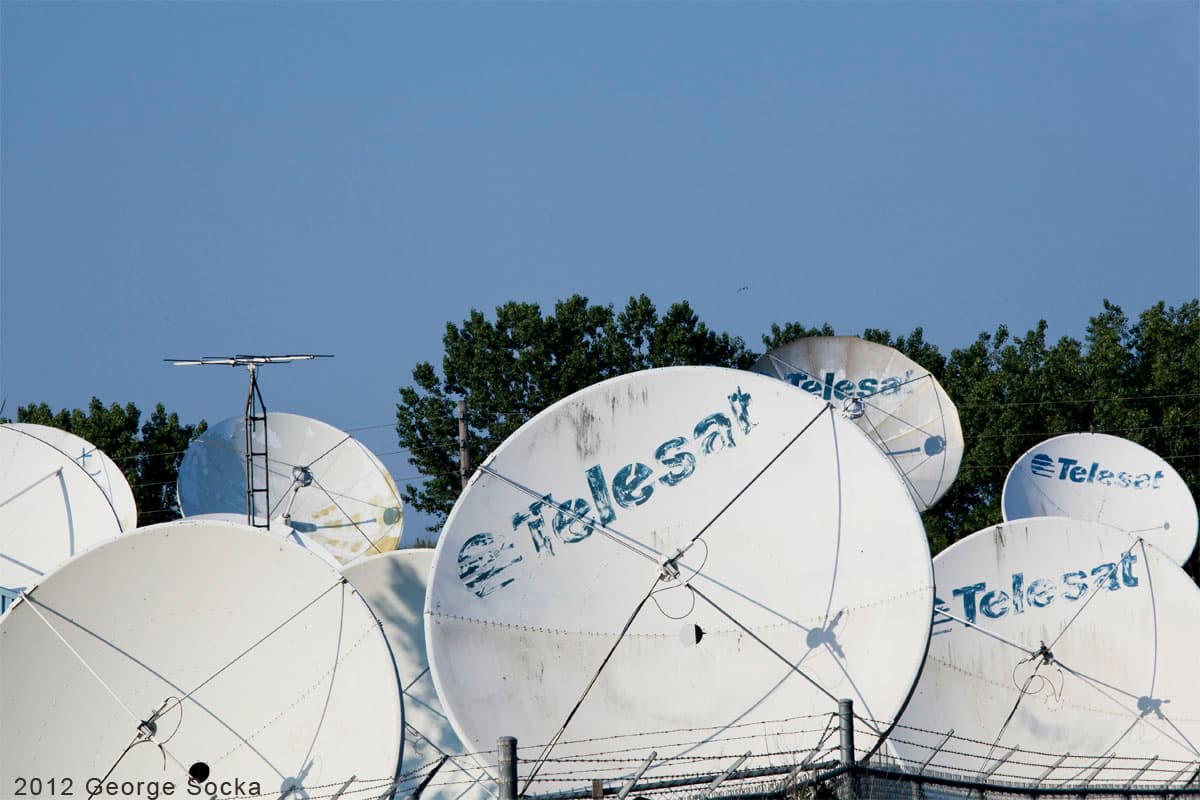
Telesat is a Canadian satellite operator running a declining legacy GEO business while building Telesat Lightspeed, an LEO network now growing from 198 to 225 satellites.
Q2 2026 consolidated revenue fell 25% YoY to CAD $79.5M (H1 2026 CAD $167M, also -25%) and full-year 2026 GEO guidance remains CAD $300M-$320M. The first two Lightspeed production satellites remain on track for December 2026, with full commercial service expected at end of Q1 2028; FY2026 Lightspeed investment guidance was raised to $1.3B-$1.5B (from $1.0B-$1.2B) to fund the accelerated 156-to-225-satellite build-out. On August 4, 2026 Telesat signed a definitive 15-year, CAD $2.3B contract (up to CAD $2.7B with options) with Canada's Defence Investment Agency to deliver Military Ka-band Arctic connectivity to the Canadian Armed Forces under the ESCP-P program - the largest contract in the company's history - and combined with an April 2026 Northwestel rural-broadband deal for Nunavut, it lifted pro forma LEO backlog from about US$1.1B to roughly US$5.6B. On September 2, 2026 Farcast completed an over-the-air electronically steered antenna demonstration on Telesat's LEO 3 satellite, the next step toward a fully integrated Lightspeed user terminal. On September 9, 2026 Telesat was named to the TSX30, TMX Group's ranking of the top 30 Toronto Stock Exchange performers, after a 475% dividend-adjusted share-price gain over the three years ended June 30, 2026. On September 17, 2026 Telesat and Orange commissioned the first European Lightspeed gateway at Orange's Tier-4 teleport in Bercenay-en-Othe, France, with Orange backhaul to a planned Paris point of presence. Telesat still faces an acute debt crisis: Q2 2026 net loss widened to CAD $559M largely on non-cash Lightspeed warrant and FX losses, roughly $2.1B of Telesat Canada debt matures over the following 14 months, Telesat drew a further $120M loan on August 13, 2026 and disclosed a going-concern warning, and lenders holding 90% of the December 2026 debt are still litigating the September 2025 Lightspeed equity transfer. As of September 13, 2026 refinancing talks remain ongoing with no deal reached; NASDAQ: TSAT closed at $49.75 on September 11.
Evaluate Cailabs optical space-to-ground links for government missions
Telesat Government Solutions and Cailabs US announced on September 1, 2026 a strategic collaboration to explore integrating Cailabs optical ground terminals with the Lightspeed LEO network for jam-resistant, high-capacity space-to-ground links on US government and allied missions, as an alternative to traditional radio-frequency satcom.
Finish the Papineauville, Quebec landing station in Q3 2026 and the Saskatchewan sites (Estevan, Shaunavon) by year-end so the terrestrial network is ready for initial satellite operations and customer trials. Intellian gateway antennas at Papineauville were installed by June 2026 and were tracking Telesat's LEO 3 test satellite in July; Telesat still described the site as nearing completion in mid-July and has not issued a formal completion notice as of September 18, 2026, with the Q3 window still open through September 30. Saskatchewan year-end targets were reaffirmed on the August 20 Q2 call. The September 17 commissioning of the first European Lightspeed gateway at Orange's Bercenay-en-Othe teleport does not close the Canadian sites.
Refinance US$1.7B of Telesat Canada debt before December 2026
Telesat's own Q2 2026 results, reported August 13, disclosed that consolidated cash resources alone remain insufficient to pay the roughly $2.1B of Telesat Canada debt maturing over the next 14 months, including a $1.32B term loan and a $387M note due December 2026, and that talks with lenders are continuing with no deal yet reached. CEO Daniel Goldberg again rejected Chapter 11 speculation on the Q2 call and said the focus remains a consensual refinancing before the maturities. As of September 13, 2026 Telesat has issued no refinancing close; the September 1 Cailabs, September 2 Farcast, and September 9 TSX30 announcements did not address the debt wall. NASDAQ: TSAT closed at $49.75 on September 11, 2026.
Launch the first two Lightspeed pathfinder satellites on a SpaceX Falcon 9 in December 2026 - the opening flight of a 14-launch Falcon 9 agreement that will carry up to 18 satellites per launch from California and Florida - then use that in-orbit test campaign (which carries a roughly three-month schedule cushion) to clear the way for the heavy 2027 deployment cadence. Telesat's September 9, 2026 TSX30 announcement still pointed to Lightspeed global service in Q1 2028 and the expanded 225-satellite build, and no first-launch slip has been announced since the August 4 ESCP-P contract. The date remains contingent on the December 2026 debt situation being resolved.
Reach initial coverage and move into commercial service
Begin the heavy Lightspeed launch cadence around mid-2027, get at least 96 satellites in orbit for global coverage by the end of 2027, and transition into full global commercial service around the end of Q1 2028 after orbit raising and testing. This timeline was reaffirmed in Q1 2026 earnings and again in the August 4, 2026 ESCP-P announcement - the 27 additional Mil-Ka satellites added by that contract extend the constellation to 225 but do not change the 96-satellite initial-coverage threshold or the Q1 2028 full-service date, assuming Telesat successfully navigates the debt restructuring.
On September 17 Telesat LEO ULC and Orange said they had commissioned the first European gateway for the Telesat Lightspeed constellation, hosted at Orange's World Teleport Association Tier-4 certified teleport in Bercenay-en-Othe, France. Orange is supplying a secure high-speed terrestrial link from the landing station to Telesat's planned Paris point of presence, and the site uses Intellian gateway antennas sized for the planned initial 225-satellite Lightspeed network. Telesat chief commercial officer Glenn Katz tied the build-out to an anticipated global in-service date of Q1 2028 and said the companies would look at further collaboration, including for Orange customers in Europe, Africa and elsewhere.
Telesat Government Solutions and Cailabs US announced on September 1, 2026 a strategic collaboration to explore integrating secure, high-capacity optical space-to-ground connectivity into Telesat's Lightspeed network for U.S. government and allied military missions. The agreement pairs Cailabs' optical ground terminal technology with Telesat's low Earth orbit constellation to evaluate resilient, jam-resistant links as an alternative to traditional radio-frequency satellite communications for defense customers.
Telesat drew a $120 million loan on August 13 to fund near-term GEO operations and disclosed a going-concern warning over its ability to meet roughly $2.1 billion in debt maturities over the next 14 months, including a $1.32 billion term loan and a $387 million note due in December 2026. Shares fell 13% on the news, reversing part of the gain from its $2.3 billion Canadian Arctic military contract signed August 4, even as Telesat points to its growing Lightspeed LEO backlog as evidence the underlying business is expanding.
Telesat reported Q2 2026 results on August 13: consolidated revenue fell 25% year over year to CAD $79.5 million and adjusted EBITDA dropped 62% to $22 million, while net loss widened to $559 million from a $76 million gain a year earlier, driven mainly by non-cash losses on Lightspeed financing warrants and foreign-exchange effects on USD-denominated debt. Management said talks with lenders over the $1.7 billion of Telesat Canada debt maturing in December 2026 are continuing, with no deal yet reached.
Telesat signed a definitive 15-year, $2.3 billion contract (up to $2.7 billion with options) with Canada's Defence Investment Agency on August 4 to deliver Military Ka-band Arctic connectivity to the Canadian Armed Forces under the Enhanced Satellite Communications Project - Polar program, the largest contract in the company's 60-year history. The deal expands the Lightspeed constellation from 198 to 225 satellites and grows its Mil-Ka-equipped satellite count 44% from 156 to 225, with MDA Space adding 27 satellites to its production order and service starting in 2028.
Telesat said on July 27 it is preparing to execute a transition plan under the FCC's newly adopted Upper C-band order, which repurposes 160 MHz of spectrum for terrestrial wireless use. Telesat GEO Inc is eligible for roughly $189 million in incentive payments contingent on meeting transition deadlines of December 31, 2030 and June 30, 2031, with satellite operators required to submit formal transition plans by November 5, 2026. The payment would offer a partial cash cushion for a company facing a $1.7 billion debt maturity in December 2026.
Telesat announced on July 8 an agreement in principle with Canada's Defence Investment Agency to supply secure Military Ka-band connectivity across the Arctic (65°N to 90°N) for the Canadian Armed Forces' Enhanced Satellite Communications Project – Polar. The deal, which builds on a 2025 partnership among the agency, Telesat and MDA Space, would use Telesat's low-Earth-orbit Lightspeed constellation, with a definitive contract expected in the coming weeks. Telesat said the award does not change Lightspeed's targeted first-quarter 2028 global service start.
CAD $79.5M in Q2 2026 consolidated revenue (-25% YoY; H1 2026 CAD $167M, -25% YoY); 2026 full-year GEO guidance remains CAD $300M-$320M revenue and CAD $210M-$230M adjusted EBITDA; Lightspeed remains pre-revenue (FY2025 was CAD $418M). Following the Aug 4, 2026 ESCP-P Arctic Mil-Ka contract, Telesat raised its 2032 Lightspeed revenue forecast to US$4.9B (from US$3.2B), with defense expected to contribute ~46% of that revenue.
Planned Constellation
225 satellites
(up from 198); still the company's public Lightspeed plan as of the Sept. 9, 2026 TSX30 announcement
Mil-Ka Deployment
225 satellites (up 44% from 156)
ESCP-P Arctic Mil-Ka Contract
CAD $2.3B
(up to CAD $2.7B with two five-year options), 15-year term, CAF service starting 2028; amounts in Canadian dollars per Telesat's Aug. 4, 2026 release
Lightspeed Total Program Cost
Total committed investment now expected to reach ~US$5.2B (incl. a $500M contingency), up from a prior ~US$3.8B estimate (incl. $300M contingency), per CFO Donald Tremblay; ~US$2B invested as of Mar 31, 2026, with the remaining ~US$3.2B funded via cash on hand, Canada/Quebec government financing, vendor financing, and ~US$1.5B of contract milestone payments
LEO Backlog
~US$1.1B as of Jun 30, 2026
pro forma for the Aug 4, 2026 ESCP-P Arctic Mil-Ka contract and other recent Lightspeed contracts (incl. the Apr 2026 Northwestel Nunavut broadband deal), backlog rises to ~US$5.6B
FY2026 Lightspeed Investment Guidance
Raised to $1.3B-$1.5B
(from $1.0B-$1.2B) after accelerating the constellation build-out from 156 to 225 satellites; incremental spend funded by pre-service payments from the Government of Canada
Share Price (NASDAQ: TSAT)
$49.75 close on Sept 11, 2026
market cap about $3.31B
FY2025 Revenue
CAD $418M
Q1 2026 Revenue
CAD $87M (-25% YoY)
Q2 2026 Revenue
CAD $79.5M
(-25% YoY); adjusted EBITDA CAD $22M (-62% YoY); net loss CAD $559M (vs. CAD $76M gain a year earlier); still the latest reported quarter as of Sept. 13, 2026
Credit Rating
S&P 'CC'
(Telesat Geo, cut from 'CCC-' in mid-2026 on near-certain default); Moody's Caa2 secured / Ca unsecured. No newer rating action published as of Sept. 13, 2026
2032 Lightspeed Revenue Forecast
Raised to US$4.9B
(from US$3.2B); defense customers now expected to contribute ~46% of that revenue (up from ~14%)
FCC C-band Clearing Incentive
Telesat GEO Inc eligible for ~US$189M
($147.4M at the Dec 31, 2030 primary deadline, $41.58M at the Jun 30, 2031 final deadline) under the FCC's Upper C-band order; transition plan due to the FCC by Nov 5, 2026
06
Operations & revenue
Operating status
Active
Legacy GEO fleet is operational but declining rapidly - Q2 2026 consolidated revenue fell 25% YoY to CAD $79.5M as broadcast contracts lapsed, and 2026 full-year GEO guidance remains CAD $300M-$320M. Lightspeed program remains technically on track: first two production satellites still targeted December 2026, heavy 2027 launch cadence, and full commercial service end of Q1 2028; FY2026 Lightspeed investment guidance was raised to $1.3B-$1.5B (from $1.0B-$1.2B) to fund the accelerated 156-to-225-satellite build-out, funded by Government of Canada pre-service payments. On August 4, 2026 Telesat signed a definitive 15-year, CAD $2.3B (up to CAD $2.7B with options) ESCP-P Arctic Mil-Ka services contract with Canada's Defence Investment Agency - its largest contract ever - expanding Lightspeed from 198 to 225 satellites and lifting its 2032 Lightspeed revenue forecast to US$4.9B (from US$3.2B, with defense now ~46% of that revenue). Combined with other recent Lightspeed wins (including an April 2026 Northwestel rural-broadband deal for Nunavut), pro forma LEO backlog rose from ~US$1.1B to ~US$5.6B. Milestone-based government payments toward the expansion begin in Q3 2026. On September 9, 2026 Telesat was named to the TSX30 after a 475% three-year share-price gain, and NASDAQ: TSAT closed at $49.75 on September 11. Despite this, Telesat still faces an acute financial crisis: Q2 2026 net loss widened to CAD $559M (from a CAD $76M gain a year earlier) largely on non-cash Lightspeed warrant fair-value and FX losses, roughly $2.1B of Telesat Canada debt matures over the following 14 months (including a $1.32B term loan and $387M note due December 2026), management's cash flows remain insufficient to cover it, Telesat drew a further $120M loan on August 13, 2026 and disclosed a going-concern warning, and as of September 13, 2026 refinancing talks with lenders are ongoing with no deal yet reached. Creditors holding ~90% of the December 2026 debt continue to litigate the September 2025 Lightspeed equity transfer (62% moved to an indirect subsidiary) in New York and Ontario courts, and S&P's 'CC' rating on Telesat Geo (cut from 'CCC-' in mid-2026) still reflects near-certainty that the company cannot repay the December 2026 maturities in full. The Papineauville, Quebec landing station has not received a formal completion notice with Q3 2026 still running through September 30.
Revenue streams
GEO Satellite Services (Legacy)
Broadcast distribution, enterprise connectivity, and managed network services from Telesat's legacy GEO fleet. Revenue is declining rapidly - Q2 2026 consolidated revenue fell 25% YoY to CAD $79.5M (H1 2026 CAD $167M, -25% YoY) - with full-year 2026 GEO guidance of CAD $300M-$320M as the company harvests cash flow while Lightspeed is built.
Enterprise Connectivity (Lightspeed)
Carrier-Ethernet-style LEO services for telecom operators and enterprises, including LTE/5G backhaul, broadband expansion, and public or private interconnect into terrestrial networks. Pre-revenue pending first service; customer agreements include Viasat and an April 2026 rural-broadband deal with Northwestel for Nunavut, and pro forma LEO backlog (combined with the Aug 2026 ESCP-P contract) rose from ~US$1.1B to ~US$5.6B. Full commercial service is targeted for the end of Q1 2028.
Government & Defense (Lightspeed)
Mission-critical sovereign and defense connectivity through Telesat Government Solutions and Lightspeed, including Mil-Ka-enabled services, interoperable allied communications, and Arctic-focused military satcom. On August 4, 2026 Telesat signed a definitive 15-year, CAD $2.3B contract (up to CAD $2.7B with options) with Canada's Defence Investment Agency to deliver Lightspeed Mil-Ka Arctic connectivity (65°N-90°N) to the Canadian Armed Forces under the ESCP-P program, the largest contract in company history, with service starting in 2028.
07
Timeline17
2026
Commissions first European Lightspeed gateway with Orange
On September 17, 2026 Telesat LEO ULC and Orange announced they had commissioned the first European gateway for the Telesat Lightspeed constellation, hosted at Orange's World Teleport Association Tier-4 certified teleport in Bercenay-en-Othe, France. Orange is supplying a secure high-speed terrestrial network from the landing station to Telesat's planned Paris point of presence. The gateway uses Intellian antennas and is sized for the planned initial 225-satellite Lightspeed network. Telesat chief commercial officer Glenn Katz tied the terrestrial build-out to an anticipated global in-service date of Q1 2028 and said the companies would explore further collaboration, including for Orange customers in Europe, Africa and other locations.
Named to the TSX30 after a 475% three-year share-price gain
On September 9, 2026 Telesat said it had been named to the 2026 TSX30, TMX Group's annual ranking of the top 30 Toronto Stock Exchange performers by dividend-adjusted share-price performance over the three years ended June 30, 2026. Telesat's share price grew 475% over that window, adding about $2.97 billion of market capitalization including partnership units. CEO Dan Goldberg tied the listing to Lightspeed progress; the company still pointed to Q1 2028 global service and the expanded 225-satellite constellation. The ranking does not change the December 2026 Telesat GEO debt wall.
Farcast completes Lightspeed ESA user-terminal demonstration on LEO 3
On September 2, 2026 Telesat LEO ULC and Farcast announced they had completed a multi-year electronically steered antenna demonstration, including an over-the-air test on Telesat's LEO 3 satellite that established and held end-to-end connectivity with measured performance matching predicted link budgets. The next phase is a fully integrated Lightspeed user terminal combining Farcast's shared-aperture antenna with the Lightspeed modem.
Draws $120M loan, flags going-concern doubt as debt wall nears
Telesat drew a $120 million loan on August 13, 2026 to fund near-term GEO corporate needs and disclosed a going-concern warning over its ability to meet roughly $2.1 billion in debt maturities over the following 14 months, including a $1.32 billion term loan and a $387 million note due in December 2026. Shares fell 13% on the news, reversing part of the gain from the August 4 Canadian Arctic Mil-Ka contract; management said it believes the obligations will be addressed but cautioned there is no guarantee.
Q2 2026: net loss widens to $559M on non-cash warrant and FX losses
Reported August 13, 2026: consolidated revenue fell 25% YoY to CAD $79.5M (from CAD $106.1M) and adjusted EBITDA dropped 62% to CAD $22M, driven by non-renewal of broadcast contracts and softer fixed-broadband demand, partly offset by new aviation contracts. Net loss widened sharply to CAD $559M from a CAD $76M gain a year earlier, mainly on non-cash losses from a fair-value increase in the Lightspeed financing warrants and FX effects on USD-denominated debt. H1 2026 revenue was CAD $167M (-25% YoY). Management said talks with lenders over the US$1.7B of Telesat Canada debt maturing December 2026 are continuing, with no deal yet reached. On the Q2 earnings call CFO Donald Tremblay disclosed that Lightspeed's total committed investment is now expected to reach roughly US$5.2B (including a $500M contingency), up from a prior ~US$3.8B estimate, with about US$2B invested as of March 31, 2026.
Signs definitive $2.3B ESCP-P Arctic Mil-Ka contract, largest in company history
On August 4, 2026, Telesat LEO ULC signs a definitive 15-year, $2.3B services contract (up to $2.7B with two five-year options) with Canada's Defence Investment Agency, converting the July 2026 agreement in principle into a firm deal to deliver secure Military Ka-band Arctic connectivity to the Canadian Armed Forces under the Enhanced Satellite Communications Project - Polar program. The contract expands the Lightspeed constellation from 198 to 225 satellites and its Mil-Ka-equipped count from 156 to 225 (a 44% capacity increase), with MDA Space adding 27 satellites to its existing production order; service is set to begin in 2028. Telesat says the contract is expected to add roughly US$3.3B to its backlog and, following the deal, raised its 2032 Lightspeed revenue forecast to US$4.9B (from US$3.2B), with defense customers now expected to contribute about 46% of that revenue (up from a prior 14% estimate). Telesat shares jumped as much as 45-47% on the news, and Stifel initiated coverage with a buy rating citing the defense opportunity.
Canadian Armed Forces select Lightspeed for ESCP-P Arctic Mil-Ka program
On July 8, 2026 Telesat LEO ULC announced an agreement in principle with Canada's Defence Investment Agency to supply Telesat Lightspeed Military Ka-band (Mil-Ka) connectivity to the Canadian Armed Forces under the Enhanced Satellite Communications Project – Polar (ESCP-P). The deal would deliver secure Mil-Ka coverage across Canada's Arctic from 65°N to 90°N and builds on the late-2025 Strategic Partnership Agreement between the Defence Investment Agency, Telesat, and MDA Space. Telesat says it does not change Lightspeed's Q1 2028 global-service timing; the agreement is subject to a definitive contract expected in the coming weeks, after which Telesat intends to disclose the financial impact.
Shareholders re-elect full board at 2026 AGM
At its virtual Annual General Meeting on June 3, 2026, Telesat shareholders approved every item of business - re-electing all ten directors (including CEO Daniel S. Goldberg and chair Michael Targoff) and reappointing Deloitte LLP as auditor. Goldberg drew 47.3M votes for against only 0.1M withheld, signaling continued shareholder backing for management as the company navigates its December 2026 debt maturities and creditor litigation.
2026
Northwestel signs multi-year Lightspeed rural broadband deal for Nunavut
On April 2, 2026, Northwestel formalizes a multi-year contract for Telesat Lightspeed LEO capacity, drawing on the Government of Canada's Lightspeed capacity pool to deliver broadband (minimum 50 Mbps down / 10 Mbps up, unlimited usage) to an estimated 11,650 households across all 25 communities in Nunavut once Lightspeed enters service. The deal is one of the contracts underlying the Lightspeed backlog growth reported with Q2 2026 results.
Q1 2026: revenue -25%, creditor lawsuits escalate over Lightspeed equity transfer
Q1 2026 consolidated revenue fell to CAD $87M (down 25% YoY) and adjusted EBITDA to CAD $35M (down 48%), while net loss widened to CAD $151M (partly from a non-cash goodwill impairment). Lightspeed cumulative spend reached ~CAD $2.7B. Concurrently, creditors holding ~90% of the US$1.7B Telesat Canada debt maturing in December 2026 escalated lawsuits in New York and Ontario, alleging the September 2025 transfer of 62% of Lightspeed's equity to an indirect subsidiary moved the 'crown jewels' out of creditors' reach for zero consideration. Telesat disputes the claims; the first two production satellites remain on track for December 2026.
Mil-Ka added and service timing slips into 2028
Telesat adds 500 MHz of military Ka-band capacity to the initial 156 Lightspeed satellites without changing the first-launch target. Management says the first two production satellites are still planned for late 2026, but full global commercial service has slipped to around the end of Q1 2028 because of ASIC readiness.
2025
Commercial backlog and sovereign-defense partnerships expand
Telesat signs a substantial multi-year Lightspeed services agreement with Viasat, announces a strategic Canadian military satcom partnership with the Government of Canada and MDA Space, distributes 62% of the Lightspeed business to an indirect subsidiary, and ends the year with about CAD $1.0 billion of LEO backlog.
2024
CAD $2.54B government funding secured
Completes CAD $2.54B in government funding agreements - CAD $2.14B from the Government of Canada and CAD $400M from Quebec - covering over 50% of the $3.5B program cost.
2023
Switches to MDA and resets Lightspeed around a 198-satellite design
Telesat selects MDA as prime contractor for a redesigned 198-satellite Lightspeed constellation, cuts expected capital cost by roughly US$2 billion versus the prior plan, and says the program is funded through global service delivery.
2018
Phase 1 pathfinder satellite launched
Launches a pathfinder test satellite to validate LEO constellation technology, including optical inter-satellite links and Ka-band connectivity.
2016
Lightspeed LEO constellation announced
Telesat announces plans for a LEO broadband constellation, initially envisioned as 120 satellites. The program would later grow to 298 before being optimized to 198 satellites.
1969
Founded as Canadian Crown corporation
Telesat Canada is established as a Crown corporation to operate Canada's domestic satellite communications system - one of the world's first national satellite operators.
08
Funding
RoundAmountInvestors
Government of Canada Loan
Sep 2024
CAD $2.14B
Government of Canada (15-year loan at CORRA + 4.75%)