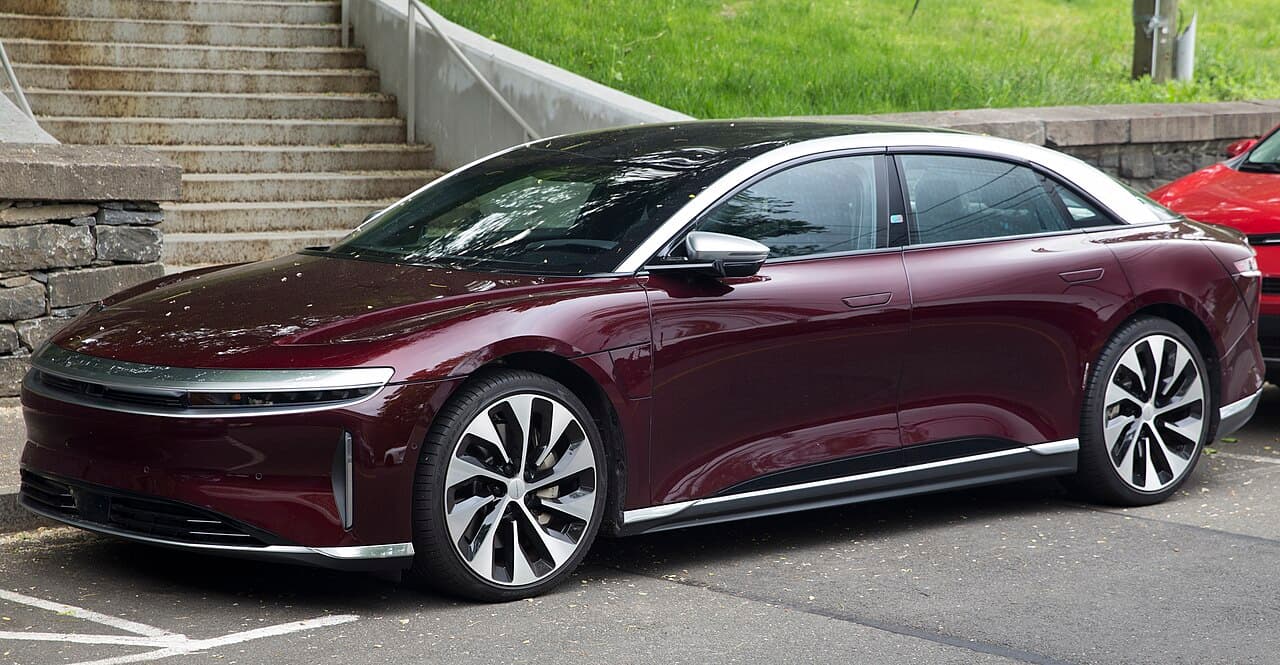
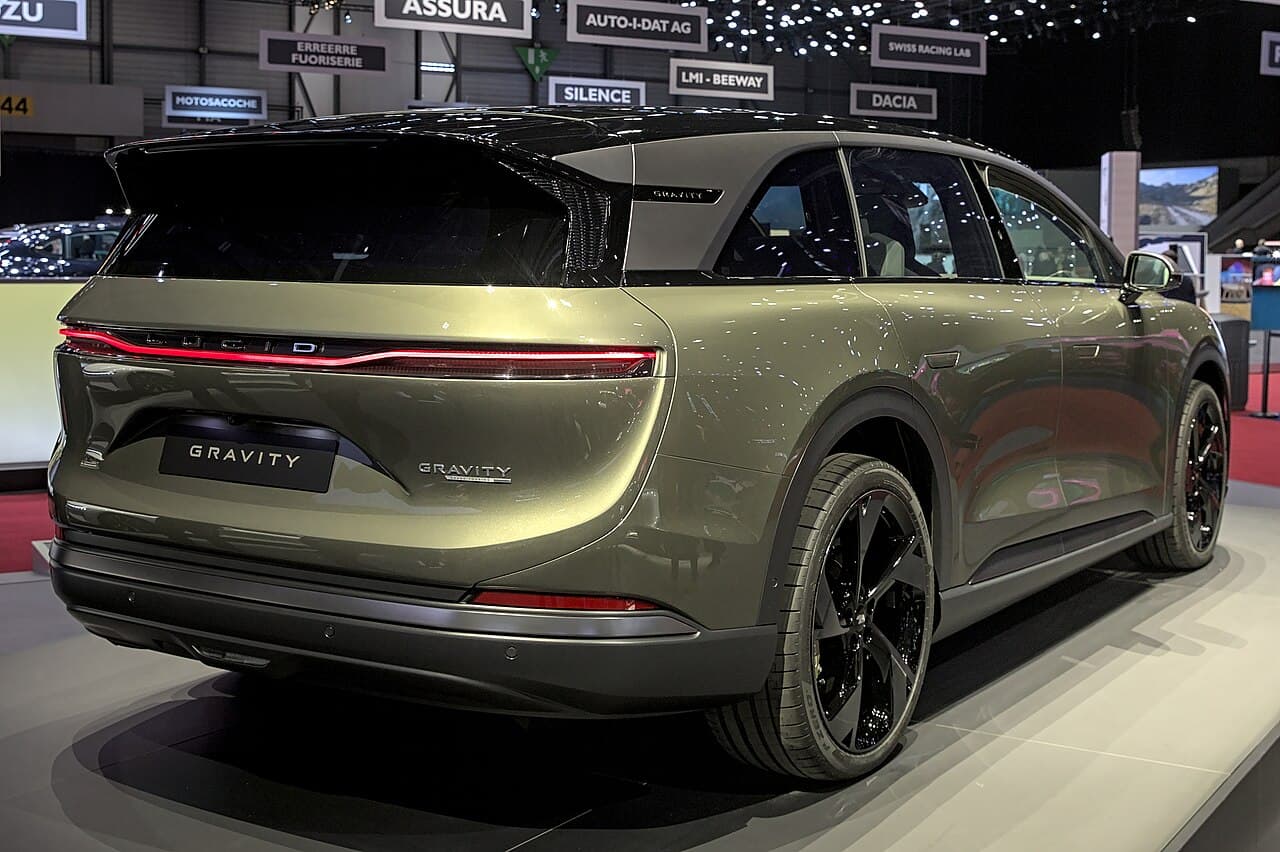
Lucid Group is a Silicon Valley EV and technology company building the Lucid Air sedan and Lucid Gravity SUV around proprietary software-defined vehicle architectures focused on range, efficiency, and performance.
Silvio Napoli became permanent CEO on June 1, 2026; on June 22 he cut about 18% of US staff and eliminated the COO role, and on July 2 named Alexander De Bock incoming CFO and Raja Ramana Macha CTO. On August 4, 2026 Lucid reported Q2 revenue of $405M on 4,774 vehicles produced and 3,953 delivered, a $1.26B attributable net loss (diluted EPS -$3.30), and an operational reset targeting $1.4B of 2026 cash savings, delaying Cosmos midsize production to the second half of 2027 at AMP-2 in Saudi Arabia. On October 5, 2026 Lucid reported Q3 production of 2,954 vehicles and deliveries of 3,806 for the quarter ended September 30; deliveries exceeded production as the company reduced inventory after eliminating AMP-1's second shift in June, and it said Gravity demand continued to regain momentum. Q3 financial results, including net income and cash flow, and a progress update on key priorities are scheduled for November 9, 2026 at 2:30 p.m. PT. That October 5 production and delivery print is not a financial result. As of October 18, 2026 the November 9 call had not occurred, and Lucid had not published a dollar tally against the $1.4B cash-savings target, a named Gravity backlog, mix, or ASP, a start of regular Gravity robotaxi production, paying-passenger Bay Area service, or a post-cut global headcount. On October 12, 2026, in a release datelined Paris, Lucid said its first three French retail and service locations will open in the first quarter of 2027, with a planned network of more than 16 partner locations by the end of 2027, and that French vehicle orders are expected to open in Q1 2027. On October 6, 2026 Lucid drew a further $400M on the unsecured PIF-backed DDTL, taking approximate principal outstanding to $2.1B with about $400M remaining capacity (facility matures August 4, 2029). The Lucid-Nuro-Uber robotaxi program is testing Gravity vehicles in the Bay Area and Houston, with regular robotaxi production still targeted for Q4 2026; a September 17 Bolt partnership aims to deploy at least 25,000 Level 4 Midsize vehicles in Europe with no order or public date. Official Air pricing remains from $70,900 and Gravity from $79,900 (GT-S $125,900). LCID closed at $3.89 on October 7, 2026 (market cap about $1.53B on 394.07M shares). Wikipedia still lists 6,800 employees (2024); Lucid has not disclosed a post-cut global census after the June 2026 US workforce reduction from about 9,000 at year-end 2025.
Execute the $1.4B 2026 operational reset and grow Gravity, the delayed Cosmos/Earth midsize platform, and the expanded Uber robotaxi partnership, along with software, services, and powertrain-licensing revenue, into sustainable profitability and positive free cash flow. Q2 2026 free cash flow was still negative $1.48B and management has not given an explicit profitability date; on the Q2 earnings call it said a formal outlook, grounded in market-calibrated demand and disciplined cash management, will come once it is confident it can deliver on it, with the next checkpoint - a progress update on the $1.4B cash-improvement plan and liquidity - due alongside Q3 2026 results (StockAnalysis lists November 4, 2026). As of September 18, 2026 Lucid has issued no interim cash-savings update and LCID last closed at $4.28 on September 17 (market cap about $1.69B).
Execute the $1.4B operational reset and stabilize Gravity
Following the August 4, 2026 'operational reset' announcement, clear the bloated Gravity inventory left after the Q1 supplier disruption and 4,476-unit seatbelt recall, restore delivery cadence, and deliver on the $1.4B 2026 cash-savings plan (~$600-800M inventory, ~$500M capex, ~$200M opex) across the rest of the year. Management has guided Q3-Q4 2026 production below Q2 levels, running Casa Grande, Arizona on a single shift through year-end to better align output with deliveries. As of September 18, 2026 no interim progress update has been issued; the next scheduled checkpoint is the Q3 2026 earnings report (StockAnalysis lists November 4, 2026).
Launch the Lucid-Nuro-Uber robotaxi service in the Bay Area
Complete validation and launch the first commercial Lucid-Nuro-Uber robotaxi service in the San Francisco Bay Area in late 2026. As of September 18, 2026 the program remains on track and not yet launched: Napoli said on the August 4 earnings call that Lucid began delivering production-validation Gravity robotaxis from Coolidge, Arizona in July, with regular vehicle production targeted for Q4 2026 ahead of paying-passenger service before year-end. Nuro holds a California DMV Driverless Testing Permit for Gravity and a May 8, 2026 CPUC Drivered Pilot Permit that allows passenger-carrying tests with a safety driver; neither permit authorizes paid rides. The partners describe an engineering fleet of nearly 100 vehicles operating in the Bay Area and Houston, with Houston still targeted for mid-2027, then scaling toward the expanded ≥35,000-vehicle Uber commitment.
Begin Cosmos midsize production at AMP-2 (delayed to H2 2027)
Lucid's stated plan, pushed back roughly a year during the August 4, 2026 operational reset, is to begin Cosmos production at its AMP-2 plant in King Abdullah Economic City, Saudi Arabia in the second half of 2027, with early production batches shipped to the U.S.; Casa Grande, Arizona (AMP-1) production of Cosmos is set to follow roughly 6-12 months later. As of August 2026 AMP-2 has moved from construction into the industrialization phase, with stamping, body, paint and final-assembly systems being installed and commissioned toward a targeted early-2027 production readiness. CEO Silvio Napoli said the midsize platform will launch only once quality and process requirements are met. The Gravity-based robotaxi remains on track for production later in 2026, and the September 17 Bolt partnership would also ride this delayed Midsize start. No later public change to the H2 2027 AMP-2 target as of September 18, 2026.
Co-develop Level 4 Midsize vehicles with Bolt for Europe
On September 17, 2026 Lucid and Bolt announced a strategic partnership to co-develop SAE Level 4 ADS-ready vehicles on Lucid's delayed Midsize platform, expected to use NVIDIA Hyperion. Bolt aims to deploy at least 25,000 fully autonomous Lucid vehicles across multiple European cities toward a 100,000-vehicle-by-2035 ambition, and intends to own and operate the fleet through Bolt Autonomous Driving Solutions. The announcement disclosed no investment, vehicle order, or public deployment timeline, so the program still depends on the H2 2027 Midsize start at AMP-2.
Debut Air and Gravity in France at the Paris Motor Show
Introduce the Lucid Air and Lucid Gravity to French customers at the Paris Motor Show (Mondial de l'Auto) from October 12-18, 2026, using the September 3, 2026 Emil Frey France operational partnership to support import and local customer operations while Lucid retains brand and commercial control.
Lucid said on Oct. 5 it produced 2,954 vehicles and delivered 3,806 in the quarter ended Sept. 30, 2026. Deliveries exceeded production as the company reduced existing inventory under its operating reset targeting $1.4 billion of cash-flow improvements in 2026, after eliminating a second shift at AMP-1 in June. The production release does not include revenue, net income, or cash-flow results; Lucid set a Nov. 9, 2026 earnings call for those figures.
CEO Silvio Napoli told Bloomberg Television on September 17 that Lucid has finished its work with restructuring adviser AlixPartners, which was hired to help the company hit $1.4 billion of 2026 cash savings. Napoli said the engagement focused on cutting inventory, capital spending, and operating costs as he reviews operations ahead of the delayed midsize-vehicle launch. The confirmation is separate from Lucid's same-day partnership with Bolt to develop at least 25,000 Level 4 vehicles for Europe.
Lucid Group and Bolt said on September 17 they will co-develop an SAE Level 4 autonomous platform based on Lucid's upcoming Midsize vehicle and deploy at least 25,000 fully autonomous Lucid cars across major European cities. Bolt intends to own and operate the fleet as part of a plan to grow to 100,000 autonomous vehicles by 2035, and the cars are expected to use Nvidia's Hyperion architecture. The deal sets no order volume, investment or start date, and sits alongside Lucid's separate US robotaxi pact with Uber and Nuro for at least 35,000 vehicles.
Lucid announced September 3, 2026 an operational partnership with Emil Frey France to support its entry into France, keeping import, brand and customer experience in-house while Emil Frey supplies local operational services. The Lucid Air sedan and Gravity SUV will make their French public debut at the Paris Motor Show from October 12-18, 2026. Lucid Europe president Lawrence Hamilton called France a key pillar of the company's European expansion.
Lucid drew $400 million on August 24 from its delayed-draw term loan with Ayar Third Investment Company, an affiliate of Saudi Arabia's Public Investment Fund, taking DDTL principal outstanding to $1.7 billion after earlier $500 million and $800 million draws, with about $800 million of capacity still unused. In an 8-K filed August 28, Lucid also announced Shawn Mirabal as President of North America Commercial, Mike Molino as Vice President of Finance, and Angela Zepeda as Vice President of Global Marketing. The draw is a further liquidity backstop from Lucid's majority shareholder as the company runs its $1.4 billion operational reset.
NHTSA said on August 28 that Lucid is recalling 27,185 model-year 2022-2026 Air sedans because a low-voltage exterior lighting circuit can overheat, raising the risk of a vehicle fire or a loss of exterior lights. Lucid reported three related fires, four smoke incidents, and 33 warranty reports of damaged center-high-mounted stop-lamp wiring; an over-the-air software update has already reached 20,719 vehicles, and owners still awaiting the fix are told to park outside and away from structures until it is installed.
Lucid unveiled the Gravity GT-S on August 13 at Monterey Car Week, a performance-tuned variant of its three-row Gravity SUV producing 1,070 horsepower and reaching 0-60 mph in 3.1 seconds, which the company calls America's most powerful three-row SUV. Orders opened with pricing starting at $125,900 before destination and options, giving Gravity a new range-topping trim alongside the existing Touring version as Lucid works through its August 4 operational-reset plan.
Lucid Motors reported Q2 2026 revenue of $405 million and 4,774 vehicles produced on August 4, and CEO Silvio Napoli unveiled an operational reset targeting $1.4 billion in 2026 cash savings across inventory, capital expenditures, and operating costs. The plan is built around four priorities: cost discipline, the Uber and Nuro robotaxi program now testing Gravity-based vehicles in the Bay Area and Houston, the AMP-2 Saudi Arabia factory, and a delayed midsize vehicle.
Prince Alwaleed bin Talal filed a Schedule 13G with the SEC on July 28 disclosing ownership of 19,513,000 Class A shares of Lucid Group, exactly 5% of shares outstanding, a stake worth roughly $150 million. The passive filing states the shares carry no intent to influence company control and follows a recent slump in Lucid's stock price. Lucid shares jumped about 20% on the news, adding to a month in which the stock has outperformed Tesla and Rivian.
Lucid Group shares rose about 14% on July 17, extending a three-day rebound to roughly 60% and clawing back a mid-week rout of as much as 57% that was triggered by a report the EV maker was weighing options including bankruptcy or going private. Lucid rejected the report as 'completely false,' with the denial issued in a public statement and filed with the SEC on Form 8-K, and told investors its pro forma total liquidity stands at about $4.7 billion with its Public Investment Fund-backed term-loan backstop still intact. The whipsaw underscored investor nerves about a company still burning more than $1 billion a quarter while delivering fewer than 4,000 vehicles.
Lucid Group shares cratered on July 14, closing down about 16% after briefly falling roughly 50% intraday and triggering three trading halts within an hour, following a Bloomberg report that the EV maker was weighing options including bankruptcy or a going-private deal. Lucid publicly rejected the report, calling the rumors of a Chapter 11 filing 'completely false.' Trading volume spiked to more than 150 million shares - around seven times its three-month average - as the turmoil rippled across EV peers Rivian and NIO.
Lucid is offering 0% APR financing for up to 72 months on unsold 2026 Gravity Touring and Grand Touring SUVs, its most aggressive terms yet on the model, with vehicles required to be delivered by July 31. The push, paired with $3,000 loyalty and trade-in credits, comes as Lucid works down inventory of the 2026 build after introducing the 2027 version. It lands as the automaker - fresh off a second-quarter delivery miss and a leadership overhaul - prepares to reveal its sub-$50,000 Cosmos SUV later this summer.
Lucid Group produced 4,774 vehicles and delivered 3,953 in the second quarter of 2026, alongside a leadership shake-up under CEO Silvio Napoli aimed at simplifying the company and halving the number of executives reporting directly to him. Alexander De Bock will join as chief financial officer, succeeding Taoufiq Boussaid, who is departing after a handover. The moves follow an 18% workforce cut in late June and precede Lucid's Q2 financial results on August 4.
Lucid Group is laying off about 18% of its workforce - roughly 1,500 jobs - in its second mass cut of 2026, with new CEO Silvio Napoli framing the move as a bid to 'simplify the company' and sharpen execution. The reductions are concentrated on the factory floor at the Casa Grande, Arizona plant, where Lucid is eliminating its second production shift in response to weaker-than-expected demand. The automaker expects roughly $158 million in annual savings against about $32 million in severance, with the restructuring set to complete by the third quarter of 2026.
Uber, Nuro and Lucid named Houston as the second market for their joint robotaxi program on June 17, targeting a mid-2027 launch offered exclusively through the Uber app. The service will use Lucid Gravity SUVs equipped with Nuro's autonomous-driving system, with Uber securing a 50,000-square-foot Houston depot and Nuro already running on-road testing using safety operators; the San Francisco Bay Area remains the program's first market, slated for later in 2026. The expansion deepens the multiyear partnership in which Uber committed to invest in Lucid and deploy tens of thousands of Lucid robotaxis over six years.
Lucid cut about 18% of its US workforce on June 22, 2026 and has not disclosed a post-cut census
Est. annual revenue
$405 million
2025 Production
17,840 vehicles
2025 Deliveries
15,841 vehicles
Q1 2026 Production
5,500 vehicles
Q1 2026 Deliveries
3,093 vehicles
Q2 2026 Production
4,774 vehicles (+24% YoY)
Q2 2026 Deliveries
3,953 vehicles
Range Record
749 miles / 1,205 km on a single charge
(Guinness World Record, St. Moritz to Munich); still the company's published record as of Sept. 18, 2026
Liquidity (Q2 2026 end)
$3.0B total as of June 30, 2026
($800M cash and investments plus $2.2B available borrowing capacity); subsequent PIF-backed DDTL draws of $800M on July 6 and $400M on August 24 took principal outstanding to $1.7B with about $800M remaining capacity; runway still guided well into 2027. No newer liquidity figure as of Sept. 18, 2026
Uber Robotaxi Vehicle Commitment
≥35,000
(Gravity + Midsize) with Uber/Nuro; plus a Sept. 17, 2026 Bolt partnership aiming to deploy at least 25,000 Level 4 Midsize vehicles in Europe (no order or deployment date disclosed). Nuro still holds a California DMV Driverless Testing Permit and a May 8, 2026 CPUC Drivered Pilot Permit for Gravity robotaxis, neither of which authorizes paid rides
2026 Production Guidance
Withdrawn
replaced by an operational reset targeting $1.4B in 2026 cash savings (Aug 4, 2026). Q3 production of 2,954 was below Q2 as guided after the AMP-1 second-shift cut; Q4 still guided below Q2. Q3 financial results scheduled Nov 9, 2026.
Q2 2026 Revenue
$405M
still the latest reported revenue quarter. Q3 2026 financials scheduled Nov 9, 2026 (production and deliveries already printed Oct 5).
2026 Operational Reset - Cash Savings Target
$1.4B
(~$600-800M inventory, ~$500M capex, ~$200M opex). Oct 5 production print said inventory reduction is underway; a cash-savings progress update is scheduled with Q3 results on Nov 9, 2026.
Q2 2026 Net Loss
$1.26B
(diluted EPS -$3.30); still the latest reported quarter as of Sept. 18, 2026
Q2 2026 Gross Margin
-105%
(vs -110% in Q1 2026), including a $300M inventory impairment; still the latest reported quarter as of Sept. 18, 2026
Gravity GT-S Horsepower
1,070 hp
0-60 mph in 3.1 s; from $125,900. Re-verified Sept. 18, 2026 on Lucid's Gravity page
Q2 2026 Stockholders' Equity
-$1.06B
(deficit), down from +$717.3M at year-end 2025; accumulated deficit $17.7B. Still the latest 10-Q as of Sept. 18, 2026
Air Fire-Risk Recall
27,185 model-year 2022-2026 Air sedans
(overheating exterior-lighting circuit); OTA software 2.10.0 is the remedy (about 20,719 already updated at filing). Remaining owner notices due by October 16, 2026; unupdated owners are still advised to park outside. No later NHTSA completion figure as of Sept. 18, 2026
Q2 2026 Consolidated vs Attributable Net Loss
Consolidated net loss $1.035B in Q2 2026 and $2.063B YTD; net loss attributable to common stockholders $1.259B in Q2 (diluted EPS -$3.30) and $2.394B YTD after preferred-stock adjustments. The $1.26B already on the profile is the attributable-to-common amount, not the consolidated statement-of-operations loss.
Q3 2026 Production
2,954 vehicles
Q3 2026 Deliveries
3,806 vehicles
Market cap
About $1.53B
Oct 7, 2026 close; LCID $3.89 on 394.07M shares
PIF-backed DDTL outstanding
Approximately $2.1B principal outstanding as of October 6, 2026 after a $400M draw; approximately $400M remaining capacity
France retail and service plan
First three locations in Q1 2027
more than 16 partner sites by the end of 2027
06
Operations & revenue
Operating status
Operational; Q3 results still Nov. 9; France stores planned Q1 2027
As of October 18, 2026 the November 9, 2026 earnings call had not occurred. Lucid had not published a dollar tally against the $1.4 billion 2026 cash-savings target, a named Gravity backlog, mix, or ASP, a start of regular Gravity robotaxi production, paying-passenger Bay Area service, or a post-cut global headcount. The October 5 production print of 2,954 vehicles and 3,806 deliveries is not a financial result. On October 12, 2026 Lucid said its first three French retail and service locations will open in Q1 2027, with more than 16 partner locations planned by the end of 2027.
Revenue streams
Vehicle Sales
Sales of the Lucid Air sedan and Lucid Gravity SUV remain Lucid's core revenue driver, with Gravity now the main near-term growth lever.
Powertrain Technology Licensing
Lucid licenses and supplies proprietary EV powertrain, battery, and charging technology to commercial partners, most notably through its long-term strategic technology agreement with Aston Martin.
Software, Services, and Autonomy
Management is building recurring revenue around software features, services, platform licensing, and robotaxi partnerships as part of Lucid's path to scale and profitability. ADAS monetization is now live via the $6,750 DreamDrive 2 Pro package, which unlocks hands-free highway Drive Assist and Lane Change Assist (rolled out to Gravity by OTA in June 2026). The robotaxi program with Uber and Nuro remains pre-revenue pending a late-2026 Bay Area launch. The September 17 Bolt partnership would add a second Europe autonomy offtake on the delayed Midsize platform, also still pre-revenue.
07
Track record
How past announced dates turned out.
0/1announced date hit on time
0 Hit
1 Slipped
0 Missed
Slipped
Start Cosmos midsize production at AMP-2
Target End of 2026 · Resolved Aug 4, 2026
Lucid pushed the Cosmos production start back roughly a year as part of its August 4, 2026 operational reset. Production now targets the second half of 2027 at AMP-2 in Saudi Arabia, with Casa Grande, Arizona production following 6-12 months later; CEO Silvio Napoli said the midsize platform will launch only once quality and process requirements are met, to avoid repeating past quality mistakes.
On October 12, 2026, in a release datelined Paris, Lucid said its first three French retail and service locations will open in the first quarter of 2027. They are in late-stage planning and are the start of a planned network of more than 16 partner locations by the end of 2027. French vehicle orders are expected to open in Q1 2027, and reservations for priority ordering are open on lucidmotors.com/fr-fr. The release does not say the Paris Motor Show appearance itself is complete.
Draws a further $400M on the PIF-backed DDTL, taking principal to about $2.1B
On October 6, 2026 Lucid drew $400 million under its unsecured Delayed Draw Term Loan with Ayar Third Investment Company, an affiliate of Saudi Arabia's Public Investment Fund. Combined with the $500 million April draw, the $800 million July draw and the $400 million August draw, aggregate principal outstanding is approximately $2.1 billion, with approximately $400 million of additional borrowing capacity remaining. The facility matures August 4, 2029. This is a debt draw, not new equity.
Q3 2026 production 2954 and deliveries 3806
On October 5, 2026 Lucid reported it produced 2,954 vehicles and delivered 3,806 in the quarter ended September 30, 2026. Deliveries exceeded production as the company reduced existing inventory. Sequential production declined, consistent with the June elimination of a second shift at AMP-1. Q3 financial results are scheduled for November 9, 2026.
Registers April 2026 PIF and Uber shares for resale; no new capital
On August 12, 2026 Lucid filed a prospectus supplement registering for resale 55,000 Series C convertible preferred shares issued to Ayar, up to 51,651,489 Class A shares issuable on conversion as of June 30, 2026, and 24,038,462 Class A shares issued to Uber subsidiary SMB Holding Corporation. Lucid said no new shares would be issued or sold by the company. SMB transfer restrictions run until October 2027 and Ayar restrictions until April 2027. This fulfills contractual registration rights from the April 14, 2026 private placements and is not incremental cash raised.
Principal accounting officer Gagan Dhingra departs
Lucid's Senior Vice President of Finance and Accounting and principal accounting officer, Gagan Dhingra, left effective August 14, 2026 to pursue another opportunity. The Q2 2026 Form 10-Q said the departure was not related to disagreements on operations, policies, practices, financial disclosures, accounting or legal matters. An August 28, 2026 Form 8-K said Lucid entered a separation agreement allowing him to retain his company vehicle and waiving certain tuition repayment obligations, to be filed with the Q3 2026 Form 10-Q. This is a second senior finance-function exit alongside the CFO transition during the operational reset.
Former CFO Taoufiq Boussaid retained as Senior Advisor through year-end
On September 4, 2026 Lucid entered a Transition Agreement with former CFO Taoufiq Boussaid. He will serve as a Senior Advisor through December 31, 2026 at a monthly salary of $10,000, with employee benefits and continued equity vesting. Subject to remaining in good standing through that date and executing a release, he is eligible for Executive Severance Plan and offer-letter amounts, a prorated 2026 annual bonus of $156,390, and his company vehicle. Lucid said the agreement will be filed as an exhibit to the Q3 2026 Form 10-Q.
Napoli says AlixPartners operational-review work has concluded
On September 17, 2026 CEO Silvio Napoli told Bloomberg Television that Lucid's work with restructuring adviser AlixPartners had been concluded. That matches Lucid's July 14 position that AlixPartners was engaged only to help improve operational efficiency around the $1.4B 2026 cash-savings plan, not to advise on bankruptcy or a take-private deal.
Partners with Bolt on a 25,000-vehicle Europe autonomy aim
On September 17, 2026 Lucid and Bolt announced a strategic partnership to co-develop SAE Level 4 ADS-ready vehicles on Lucid's upcoming Midsize platform, expected to use NVIDIA Hyperion. Bolt aims to deploy at least 25,000 fully autonomous Lucid vehicles across multiple European cities toward a 100,000-vehicle-by-2035 ambition, and intends to own and operate the fleet through Bolt Autonomous Driving Solutions. Lucid's side is led by Lucid Technologies. The announcement disclosed no investment, vehicle order, or public deployment timeline, so the program still depends on the delayed H2 2027 Midsize start at AMP-2.
2026
Partners with Emil Frey France for French market entry
On September 3, 2026 Lucid announced an operational partnership with Emil Frey France to support its entry into France. Lucid will keep import operations, brand, commercial strategy and customer experience in-house, while Emil Frey France Import Division provides local operational services. The Lucid Air sedan and Gravity SUV will make their French public debut at the Paris Motor Show from October 12-18, 2026 at Porte de Versailles.
Shares fall 42% since the reset as Q2 10-Q shows negative stockholders' equity
Lucid's Form 10-Q for the quarter ended June 30, 2026 shows stockholders' equity swung to a deficit of $1.06B, down from positive $717.3M at year-end 2025, as the company's accumulated deficit passed $17.7B. Combined with lingering investor skepticism about the operational reset, LCID shares fell from an August 4 close of $7.78 to a $4.55 close on September 1, 2026 - a 42% decline that pushed market capitalization down to roughly $1.8-2.0B, a small fraction of the more than $9.5B Saudi PIF and its affiliates have committed to Lucid since 2018.
Adds commercial, finance and marketing leaders
On August 28, 2026 Lucid announced Shawn Mirabal as President of North America Commercial, Mike Molino as Vice President of Finance, and Angela Zepeda as Vice President of Global Marketing. Mirabal and Zepeda report to Chief Customer Officer Billy Hayes; Molino reports to CFO Alexander De Bock. The appointments continue CEO Silvio Napoli's leadership rebuild around cash and cost, customer and quality, and culture and team.
Draws a further $400M on the PIF-backed DDTL
On August 24, 2026 Lucid drew $400 million under its Delayed Draw Term Loan with Ayar Third Investment Company, an affiliate of Saudi Arabia's Public Investment Fund. Combined with the $500 million April draw and the $800 million July draw, principal outstanding is now $1.7 billion, with about $800 million of additional borrowing capacity remaining.
Recalls 27,185 Air sedans over exterior-lighting fire risk
On August 28, 2026 NHTSA said Lucid is recalling 27,185 model-year 2022-2026 Air sedans because a low-voltage exterior lighting circuit can overheat, raising the risk of fire or a loss of exterior lights. Lucid reported three related fires, four smoke incidents, and 33 warranty reports of damaged center-high-mounted stop-lamp wiring; an over-the-air software update (version 2.10.0 or later) had already reached 20,719 vehicles, and remaining owners are advised to park outside and away from structures until the update is installed.
Names Munsterhuis Autobedrijven first Dutch retail partner
On August 20, 2026 Lucid announced Munsterhuis Autobedrijven, a family-owned Dutch automotive group operating for more than 60 years, as its first retail partner in the Netherlands. Munsterhuis will run a dedicated Lucid sales location in Hengelo plus authorized aftersales and service, complementing Lucid's existing studio and service center in Hilversum as part of its hybrid direct-plus-retail-partner strategy in Europe (following an earlier partnership with Germany's Wackenhut).
Unveils 2027 Air lineup with new Stealth & Sound Package
On August 19, 2026 Lucid revealed the 2027 model-year Lucid Air lineup, keeping US and Canadian pricing unchanged across all four trims (Pure, Touring, Grand Touring, Sapphire) while adding a new Stealth & Sound Package for the Air Pure - $4,500 for 19-inch Aero Range Stealth wheels with darkened exterior trim and a 21-speaker Surreal Sound Pro Dolby Atmos system, or $6,250 with 20-inch Aero Lite Stealth wheels - bundling Lucid's most popular options into a single configuration.
Launches performance-flagship Gravity GT-S
On August 13, 2026 Lucid unveiled the Gravity GT-S, a performance-tuned variant of the three-row Gravity SUV producing 1,070 horsepower and reaching 0-60 mph in 3.1 seconds, which Lucid calls America's most powerful three-row SUV. It uses the same dual-motor AWD powertrain as the Gravity Dream Edition with the Dynamic Handling Package (independent rear-wheel steering) standard. Orders opened at Monterey Car Week with pricing starting at $125,900 before a $1,850 destination fee (5-seat standard, 7-seat +$2,900), positioning GT-S as the range-topping Gravity trim alongside the existing Touring and Grand Touring versions, with deliveries beginning in Q4 2026.
Announces 'operational reset' targeting $1.4B in 2026 cash savings
On August 4, 2026 Lucid reports Q2 2026 revenue of $405M and 4,774 vehicles produced (+24% YoY), alongside a widened net loss and Q2 free cash flow of negative $1.48B, ending the quarter with $3.0B in total liquidity ($800M cash and investments plus $2.2B available borrowing capacity). CEO Silvio Napoli unveils an 'operational reset' plan targeting $1.4B of 2026 cash savings: roughly $600-800M from inventory reduction, $500M from capital expenditures, and $200M from operating expenses (including the $158M in annualized savings already flagged from June's workforce cut). The plan is built around four 'must-win' priorities - cost and cash discipline, the Lucid-Nuro-Uber robotaxi program (Gravity-based PV units now testing in the San Francisco Bay Area and Houston), the AMP-2 Saudi Arabia factory, and the delayed midsize vehicle - and includes pushing Cosmos production back about a year to the second half of 2027 at AMP-2, with Casa Grande, Arizona production to follow 6-12 months later.
Hugo Martinho joins as Chief Transformation Officer
Effective August 1, 2026, Hugo Martinho joins Lucid as Chief Transformation Officer, leading a newly created Business Process function and enterprise-wide transformation initiatives under CEO Silvio Napoli. Martinho spent more than two decades at Schindler Group, most recently as its global head of HR, continuing the wave of Schindler veterans Napoli has brought into Lucid's leadership since the July 2 C-suite overhaul.
Prince Alwaleed discloses 5% passive stake
On July 28, 2026 Saudi billionaire Prince Alwaleed bin Talal filed an SEC Schedule 13G disclosing ownership of 19,513,000 Class A shares, exactly 5% of Lucid's shares outstanding, worth roughly $150M. The filing states the stake is passive, with no intent to influence company control, and follows a recent slump in Lucid's share price. Shares jumped about 20% on the disclosure, adding a second prominent Saudi investor alongside majority shareholder PIF.
On July 14, 2026 Lucid shares briefly plunged as much as 57% to a record intraday low of $2.37 - with trading halted multiple times for volatility - before recovering to close down about 16% at $4.62. The sell-off followed an EV-industry report, subsequently amplified by Bloomberg, claiming restructuring adviser AlixPartners had recommended the board consider a Chapter 11 filing or going private. Lucid rejected the report as 'completely false,' stating that AlixPartners was engaged only to help improve operational efficiency and execution and 'has not recommended bankruptcy,' that no special board committee had been formed, and that its roughly $4.7B of pro forma liquidity was sufficient to fund operations into late 2027. The company reiterated the denial in an SEC 8-K. Shares rebounded sharply once the denial landed - spiking about 29% on July 15 and rising a further ~14% on July 17 to notch their best week in a year - though analysts remained cautious, with only one of 14 covering the stock rating it a buy and several warning that the midsize launch and the August 4 Q2 report are the real tests.
Draws $800M on PIF-backed delayed-draw term loan
On July 6, 2026 Lucid drew $800M under its Delayed Draw Term Loan (DDTL) facility with Ayar Third Investment Company, an affiliate of Saudi Arabia's Public Investment Fund, following a $500M initial draw on April 1. The move - LCID shares jumped about 10% on the news - reinforces continued PIF backing as Lucid funds the Gravity ramp and midsize program; the DDTL had been upsized to roughly $2B in late 2025, leaving additional undrawn capacity, and a refreshed total-liquidity figure is due with Q2 results on August 4.
Q2 deliveries of 3,953; C-suite overhaul with new CFO and CTO
On July 2, 2026 Lucid reported it produced 4,774 vehicles and delivered 3,953 in the second quarter, and announced a sweeping leadership overhaul under CEO Silvio Napoli aimed at simplifying the organization and halving the number of executives reporting directly to him. Alexander De Bock, a two-decade automotive finance leader, joins as chief financial officer, succeeding CFO Taoufiq Boussaid, who departs after a handover; and Raja Ramana Macha - previously executive vice president and chief technology officer at Eaton, with more than three decades in automotive engineering, electrification and digital transformation - joins as chief technology officer, leading Lucid's global technology strategy, software platforms and next-generation vehicle engineering. Full Q2 financial results are scheduled for August 4.
18% layoffs, COO role eliminated, and second production shift cut
On June 22, 2026 Lucid announced it is cutting about 18% of its workforce - roughly 1,500 jobs, with 705 affected at the Casa Grande, Arizona plant - its second mass layoff of 2026 after a ~12% cut earlier in the year. The reductions are concentrated on the factory floor, where Lucid is eliminating its second production shift amid weaker-than-expected demand. As part of the same restructuring Lucid eliminated the Chief Operating Officer position, and Marc Winterhoff - who had run the company as interim CEO for ~15 months before resuming the COO role on June 1 - departed effective immediately, flattening the leadership structure under new CEO Silvio Napoli. Napoli cast the move as a step to 'simplify the company' and sharpen execution; Lucid expects roughly $158M in annual savings against about $32M in severance, with the restructuring expected to complete by Q3 2026.
Securities class actions filed over concealed Gravity delivery halt
Through June 2026 multiple shareholder securities class actions are filed against Lucid covering a February 25–April 13, 2026 class period, alleging the company failed to disclose that an unauthorized supplier change for second-row Gravity seats produced sub-standard seatbelt anchor welds, triggering a 29-day delivery halt that materially hit Q1 results - 3,093 deliveries versus roughly 5,237 expected and revenue of about $282.5M versus a ~$434M consensus. The lead-plaintiff deadline is set for July 28, 2026.
Houston named second robotaxi market for 2027
On June 17, 2026 Uber, Nuro and Lucid name Houston as the second market for their robotaxi program - after a San Francisco Bay Area launch slated for later in 2026 - targeting a mid-2027 launch offered exclusively through the Uber app. The service will use Lucid Gravity SUVs equipped with Nuro's autonomous-driving system, with Uber securing a 50,000-square-foot Houston depot and Nuro running on-road testing with safety operators.
Hands-Free Drive Assist rolls out to Gravity via OTA
On June 9, 2026 Lucid began rolling out an over-the-air update bringing Hands-Free Drive Assist and Hands-Free Lane Change Assist to the Lucid Gravity in North America, extending the DreamDrive Pro capability already on the Air. The feature manages steering, acceleration and braking on compatible divided highways and changes lanes on driver turn-signal activation; it requires the $6,750 DreamDrive 2 Pro package (LiDAR plus full sensor suite, no subscription). The same update adds Google Maps Places integration, improved real-time charging-station availability, and adaptive driving beam headlights. The package remains Lucid's live ADAS monetization offer as of September 13, 2026.
Leadership shakeup: Emad Dlala departs, VPs to report directly to Napoli
On June 9, 2026, senior executive Emad Dlala - who had been elevated to a leading vehicle engineering strategy role - departs Lucid, the first major leadership exit under CEO Silvio Napoli. As part of Napoli's organizational reset, the vice presidents of vehicle engineering and software will now report directly to him, shortening the product chain as Lucid executes on its robotaxi program and the Atlas-based midsize vehicle.
Silvio Napoli takes over as CEO on June 1
Silvio Napoli assumes the CEO role at Lucid effective June 1, 2026, ending the 16-month interim leadership of Marc Winterhoff, who continues as Chief Operating Officer. Napoli inherits the Gravity ramp, midsize platform launch, and robotaxi commercialization as his core priorities.
Q1 earnings: $1B net loss, 2026 production guidance suspended
On May 5, 2026 Lucid reports Q1 revenue up 20% YoY to $282.5M on 5,500 vehicles produced and 3,093 delivered, but with a roughly $1B net loss, bloated Gravity inventory after the seatbelt recall, and suspended 25,000-27,000 vehicle 2026 production guidance pending the incoming CEO's review. Pro forma liquidity is approximately $4.7B after the April raise and an expanded delayed draw term loan.
$1.05B raise, 35,000-vehicle Uber deal, and new CEO announced
On April 14, 2026 Lucid announces a $1.05B capital raise - $550M of Series C convertible preferred from Ayar/PIF (9% PIK dividend, $10.8160 conversion price), $300M registered common stock, and $200M new equity from Uber that brings Uber's cumulative stake to $500M. Same day, the Uber/Nuro/Lucid robotaxi partnership is expanded to at least 35,000 Gravity and Midsize vehicles and Lucid names Schindler veteran Silvio Napoli as incoming CEO, with Marc Winterhoff returning to COO.
Gravity recall and supplier seat-bracket production hit
Lucid recalls 4,476 Gravity SUVs built before mid-February over improperly welded second-row seatbelt anchor brackets after a Camaco manufacturing change. A related supplier quality issue with second-row seats halts Gravity deliveries for 29 days during Q1 2026.
Investor Day unveils midsize platform and robotaxi push
At Investor Day, Lucid detailed its Atlas drive unit, introduced the Cosmos and Earth midsize vehicles priced to start below $50,000, highlighted recurring software and mobility revenue plans, and expanded its robotaxi roadmap with Uber.
2025
Gravity ramp and stronger delivery growth
Lucid ramped Gravity production and finished 2025 with 17,840 vehicles produced, 15,841 delivered, and $1.35B in revenue, while outlining robotaxi and midsize programs as its next growth platforms.
CEO transition
Peter Rawlinson stepped aside in February 2025 and moved into a Strategic Technical Advisor role to the chairman, with Marc Winterhoff appointed interim CEO as Lucid entered its next operating phase.
2023
Saudi Arabia factory opens
Opens AMP-2 factory in Saudi Arabia for semi-knockdown assembly. Unveils the Lucid Gravity SUV at the LA Auto Show.
2021
SPAC IPO and first deliveries
Goes public on NASDAQ via SPAC merger with Churchill Capital Corp IV at $24B implied valuation, raising ~$4.4B. Begins Lucid Air production at the Casa Grande, Arizona factory (AMP-1) in September and first customer deliveries in October.
2019
Saudi PIF $1B investment
Saudi Arabia's Public Investment Fund (PIF) commits to a >$1 billion investment in Lucid via an agreement executed in September 2018 and funded in April 2019, becoming the majority shareholder. Peter Rawlinson is named CEO.
2016
Rebranded to Lucid Motors
Atieva rebrands as Lucid Motors in October, pivoting from a powertrain supplier to a full luxury EV manufacturer with plans for a flagship sedan.
2007
Founded as Atieva
Bernard Tse and Sam Weng found Atieva to develop EV batteries and powertrains, initially focused on supplying technology to other automakers.
09
Funding
$10.5Bdisclosed across 7 rounds with a stated amount
Cumulative disclosed raise · dated rounds
RoundAmountInvestors
PIF Investment
April 2019
$1B
Saudi Arabia Public Investment Fund (PIF)
SPAC Merger (IPO)
July 2021
~$4.4B
Churchill Capital Corp IV, PIF retained ~60%
2030 Convertible Notes
April 2025
$1.1B
Qualified institutional buyers; supported by PIF prepaid forward structure
2031 Convertible Notes
November 2025
$875M
Qualified institutional buyers; Ayar/PIF support via prepaid forward transaction
Series C Convertible Preferred (PIF) + Common Offering + Uber Equity
April 2026
~$1.05B total
Ayar Third Investment (PIF) $550M Series C convertible preferred at $10.8160 conversion price with 9% PIK dividend; $300M registered common stock offering; Uber $200M equity (cumulative Uber investment now $500M)
PIF-backed DDTL draws
April, July & August 2026
$1.7B drawn ($500M on Apr 1 + $800M on Jul 6 + $400M on Aug 24); ~$800M remaining capacity
Ayar Third Investment Company (Saudi PIF affiliate) - delayed-draw term loan facility
PIF-backed DDTL draw
October 6, 2026
$400M
Ayar Third Investment Company (Saudi PIF affiliate)