Active
Apollo Go Robotaxi
Baidu's fully driverless autonomous ride-hailing service, deployed across China and expanding internationally through direct apps and mobility-platform partners.

DivisionHKEX: 9888Founded 2017🇨🇳Beijing, ChinaCEO Robin Li (Baidu CEO); Yunpeng Wang (Intelligent Driving Group President)
Baidu Apollo is Baidu's autonomous-driving platform and the operator of Apollo Go, one of the world's largest fully driverless robotaxi networks.
Latest update Oct 19, 2026
01
On its August 18, 2026 Q2 earnings call Baidu disclosed Apollo Go has delivered more than 23 million cumulative public rides and over 350 million autonomous kilometers across a 28-city global footprint (including a first Asian expansion beyond China and Hong Kong, into South Korea, in February 2026), with roughly 1 million fully driverless rides in the quarter alone and a safety record of one airbag deployment per 14.4 million km, with management saying Apollo Go has reached unit-economics breakeven in its largest China operating city. Q3 2026 results, the next official ride-volume update, have not been published as of September 20 and are expected around November 17, 2026. That international growth came alongside a rockier domestic quarter: a March 31, 2026 mass system failure stranded over 100 Apollo Go vehicles on elevated highways in Wuhan (no injuries), prompting Chinese regulators to pause new robotaxi permits nationwide for several months; Baidu said the resulting operational adjustments weighed on ride volume in certain domestic cities before operations began resuming on a stronger footing in August. The same Q2 quarter, China's Ministry of Industry and Information Technology issued GB 44721-2026, the country's first mandatory national safety standard for L3/L4 automated driving, taking effect July 1, 2027. Apollo Go runs fully driverless commercial service in China, Dubai, and on Abu Dhabi's Yas Island, began Level 4 open-road trials in eastern Switzerland (AmiGo, with PostBus) on June 1, 2026, and has kept widening its Hong Kong testing scope - an August 14 approval added the Southern District to its North Lantau driverless zone. On August 19-20 it also began an MTR/Airport Authority road trial of four RT6 vehicles shuttling between West Kowloon high-speed-rail station and the Airport Express Kowloon Station, still in empty, safety-operator testing as of late August, with passenger air-rail service targeted for Q2 2027. It also runs safety-operator road testing in London with Freenow/Lyft and Uber, begun July 28, and in July 2026 signed an MoU with Kazakhstan's Turlov Private Holding to explore autonomous mobility services.
ir.baidu.comUpdated Sep 20, 2026
Analysis · 4 min read · Jun 19, 2026The long view on Baidu Apollo: strategy, technology and what to watch02
2026-2028
The Uber-platform rollout, the direct Apollo Go app launch with Dubai Taxi Company (DTC), and fully driverless rides on Uber itself across Umm Suqeim and Jumeirah with New Horizon Luxury Transport as fleet operator remain live as of September 2026, making Dubai the first market running Apollo Go's own app and a third-party platform in parallel. The next step is turning these zones into broader commercial service and scaling the fleet from its initial tens of vehicles toward the announced target of more than 1,000 vehicles over the next few years. No further zone-expansion date has been disclosed since the August 20 launch.
2026-2027
AmiGo with PostBus is still in safety-driver open-road trials across eastern Switzerland under the June 2026 FEDRO Level 4 permit. Baidu's June 12, 2026 release still stands as the latest official roadmap: a closed-group user trial next, then initial rides without safety operators once remaining safety evidence is filed, and regular fully driverless operations targeted for early 2027. London safety-operator testing with Freenow/Lyft and Uber continues, with public rides still 2027-targeted pending approval. A July 2026 exploratory MoU with Kazakhstan's Turlov Private Holding remains without a launch date.
Nov 17, 2026
Target2026-11-17 (Q3 results); 2027-07-01 (GB 44721-2026 in force)
Q2 2026 results (August 18) remain the latest disclosed totals: 23 million-plus cumulative rides and 350 million autonomous kilometers across 28 cities, with unit-economics breakeven already reached in its largest China operating city. Baidu's Q3 2026 results, expected around November 17, 2026, are the next data point on whether driverless ride growth is recovering domestically after the Wuhan stall and the multi-month permit pause. Separately, China's GB 44721-2026 mandatory L3/L4 automated-driving safety standard still takes effect July 1, 2027 and requires a China-specific third-party test regime.
Q2 2027
Apollo Go is the contractor on MTR's West Kowloon Air-Rail Intermodal Service: four RT6s began empty, safety-operator road tests on August 19-20, 2026 between Hong Kong West Kowloon Station and Airport Express Kowloon Station, after a Transport Department pilot licence issued August 11. Late-August coverage (China Daily HK, Timeout, The Standard) still describes empty runs with a backup operator, a later passenger-trial phase, and a Q2 2027 public-service target. In parallel, the July 27 Airport Island fully driverless trial and the August 14 Southern District expansion still have no disclosed commercial-service date.
03
Baidu's Apollo Go launched fully driverless rides on the Uber app in Dubai on August 20, which Uber calls the first live deployment of its multi-partner autonomous network on public roads. The service uses Apollo Go's sixth-generation RT6 robotaxi across the Umm Suqeim and Jumeirah areas, with riders on UberX or Uber Comfort matched to an autonomous vehicle or able to pick the autonomous option directly. Dubai becomes Apollo Go's first market running both its own app and a third-party platform in parallel.
Baidu's Q2 2026 earnings on August 18 showed Apollo Go now operating in 28 cities worldwide with more than 23 million cumulative robotaxi rides and over 350 million autonomous kilometers driven, including about 1 million fully driverless rides in the quarter alone. Baidu also cited a safety record of one airbag deployment per 14.4 million kilometers, as China issued its first mandatory national safety standard for L3/L4 automated driving during the quarter.
Hong Kong's Transport Department approved Baidu's Apollo Go on August 14 to expand its fully driverless robotaxi testing into the Southern District of Hong Kong Island, its third expansion of that testing scope within about six months since first receiving a Hong Kong pilot license in November 2024. The new route adds a mixed business and residential district to Apollo Go's existing North Lantau driverless zone, pushing the company's cumulative safe fully driverless testing distance in the city past 20,000 km.
Baidu's Apollo Go began fully driverless testing on Hong Kong's Airport Island on July 27, after the city's Transport Department granted the first permit for a trial with no on-board safety operator on July 23. It is Hong Kong's first Level 4 autonomous trial without a safety driver and is reported to be the first fully driverless public-road test in any right-hand-drive, left-hand-traffic market, distinct from Apollo Go's separate safety-driver testing that began in London the same week.
Baidu's Apollo Go started road testing its sixth-generation RT6 robotaxi in London on July 28, partnering with Freenow (owned by Lyft) and with Uber, in the borough of Brent. Vehicles operate with safety drivers on board covering a mix of urban and suburban routes, with public rides targeted for 2027 pending regulatory approval. The launch makes Apollo Go the first Chinese autonomous-driving operator tested on UK roads, joining Waymo and an Uber-Wayve partnership already trialing in the city.
Baidu said on June 12 that AmiGo - its on-demand autonomous mobility service run with Swiss Post's PostBus - received a special permit from Switzerland's Federal Roads Office (FEDRO) for Level 4 driverless operations in Eastern Switzerland, marking Apollo Go's first European regulatory approval of its kind. Open-road trials began June 1 across roughly 80 square kilometers in the cantons of St. Gallen, Appenzell Ausserrhoden, and Appenzell Innerrhoden, with regular fully driverless service targeted for early 2027 in what the partners call Europe's largest planned automated public-transport operation. The expansion adds to Apollo Go's roughly 3.2 million driverless rides in Q1 2026 and more than 22 million cumulative rides across over 27 cities.
04
Baidu's fully driverless autonomous ride-hailing service, deployed across China and expanding internationally through direct apps and mobility-platform partners.
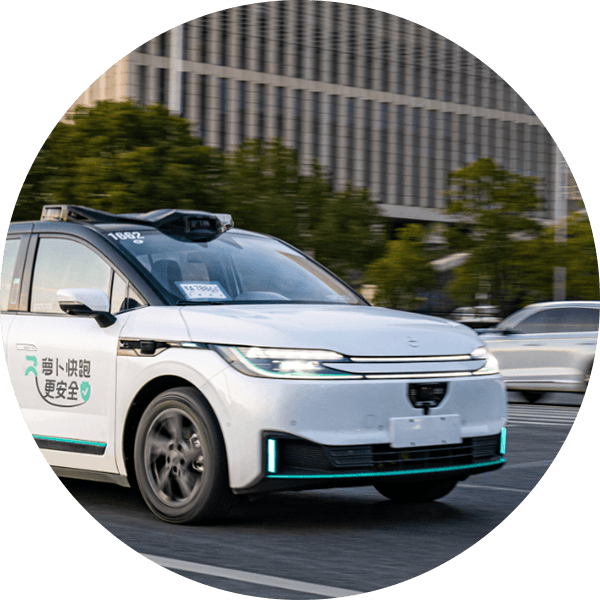
Baidu Apollo's sixth-generation purpose-built robotaxi vehicle, used for international deployments and designed around fully autonomous ride-hailing.

A low-speed autonomous shuttle platform developed through Baidu Apollo's ecosystem, used as an early Apollo robobus product and smart-mobility demonstrator.
05
on the Q2 2026 call (Aug 18, 2026) management reiterated that Apollo Go had reached unit-economics breakeven in its largest China operating city despite very low fares, with stronger margins seen overseas, and flagged that China issued its first mandatory national safety standard for L3/L4 automated driving during the quarter. No later financial breakout has been published as of September 20, 2026; Q3 2026 results are expected around November 17, 2026.
06
Operating status
Operational
Apollo Go operates fully driverless ride-hailing at scale in China and internationally, with commercial service running across multiple zones in Dubai (own app plus Uber as of August 20) and on Abu Dhabi's Yas Island, plus a South Korea deployment begun in February 2026. Q2 2026 earnings (August 18) still stand as the latest disclosed totals: 28 cities, 23 million-plus cumulative public rides, 350 million-plus autonomous kilometers, and unit-economics breakeven in its largest China operating city, after a March 31 Wuhan mass stall and a multi-month nationwide pause on new Chinese robotaxi permits. Hong Kong is now a second, transit-led front: besides the July 27 Airport Island driverless trial and the August 14 Southern District expansion, Apollo Go is the contractor on MTR's West Kowloon air-rail shuttle, which began testing four RT6s on August 19-20 toward a Q2 2027 passenger service and was still in empty, safety-operator runs as of late August. AmiGo in eastern Switzerland remains in safety-driver open-road trials under the June 2026 FEDRO Level 4 permit, with regular fully driverless operations targeted for early 2027. London safety-operator testing with Freenow/Lyft and Uber continues.
Fully driverless autonomous ride-hailing fares and partner-distributed robotaxi trips through Apollo Go, Uber, AutoGo, and local mobility partners.
City and fleet partnerships for RT6 deployment, including Dubai's plan to scale to more than 1,000 fully driverless vehicles by 2028.
Apollo Platform and Smart Transportation
Baidu's broader Apollo platform, autonomous driving technology, and smart transportation infrastructure work within Baidu Core AI-powered businesses.
07
2026
Schedules a free supervised Tung Chung community trial
On 13 October 2026 Dimsum Daily reported that Hong Kong's Transport Department had backed a free Apollo Go community trial in Tung Chung. Public rides for Islands District residents are scheduled from 21 October through 3 November, from 2pm to 6pm, on a roughly 5.1 km out-and-back loop of about 15 minutes with a backup operator in the vehicle. Six hundred tickets are available. The report describes a supervised, free, closed-loop trial, not a fare-charging service and not a new city in the August global footprint.
MTR starts West Kowloon air-rail robotaxi trial with four RT6s
Hong Kong's Transport Department issued a pilot AV licence on August 11, 2026 for a West Kowloon Air-Rail Intermodal Service, and on August 19-20 MTR began road-testing four sixth-generation Baidu Apollo RT6 vehicles between Hong Kong West Kowloon Station (Express Rail Link) and Airport Express Kowloon Station. Apollo Go is the contractor. Early runs carry no passengers and keep a backup operator on board; MTR and Airport Authority Hong Kong are targeting a passenger-and-baggage shuttle in the second quarter of 2027, cutting the current Elements-mall walk.
Goes fully driverless on Uber in Dubai
On August 20, 2026 Apollo Go launched fully driverless rides on the Uber app in Dubai, which Uber calls the first live deployment of its multi-partner autonomous network on public roads. The service uses Apollo Go's sixth-generation RT6 robotaxi across the Umm Suqeim and Jumeirah areas, with New Horizon Luxury Transport as fleet operator, and riders on UberX or Uber Comfort matched to an autonomous vehicle or able to pick the autonomous option directly. Dubai becomes Apollo Go's first market running both its own app and a third-party platform in parallel, with plans to scale to thousands of vehicles.
Hong Kong testing expands to Southern District
Hong Kong's Transport Department approves Apollo Go on August 14, 2026 to expand fully driverless testing into the Southern District of Hong Kong Island, adding a mixed business and residential district to the existing North Lantau driverless zone - the third expansion of testing scope in about six months since Apollo Go's first Hong Kong pilot license in November 2024 - and pushing cumulative safe driverless testing distance in the city past 20,000 km.
Q2 2026 earnings: 23M+ cumulative rides, 28-city footprint
Baidu's August 18, 2026 Q2 earnings disclose Apollo Go has delivered more than 23 million cumulative public rides and 350 million-plus autonomous kilometers across 28 cities worldwide, including roughly 1 million fully driverless rides in the quarter, a safety record of one airbag deployment per 14.4 million km, and unit-economics breakeven in its largest China operating city despite low fares.
China issues first mandatory national L3/L4 safety standard
China's Ministry of Industry and Information Technology approves GB 44721-2026, the country's first mandatory national safety standard for L3 and L4 automated driving systems, on July 30, 2026, taking effect July 1, 2027. It sets minimum performance requirements for dynamic driving tasks and driver takeover monitoring for M- and N-category vehicles, applies to Apollo Go's own fleet as well as every automaker selling L3/L4 systems in China, and requires a China-specific third-party test regime that EU or US certification does not automatically satisfy.
Signs Kazakhstan MoU - first Chinese robotaxi in Central Asia
On July 16, 2026, ahead of the World Artificial Intelligence Conference (WAIC 2026) in Shanghai, Apollo Go signed a strategic cooperation memorandum with Kazakhstan's Turlov Private Holding (part of Freedom Holding) to jointly explore introducing autonomous-driving technology and mobility services in the country. Witnessed by Zhaslan Madiyev, Kazakhstan's Deputy Prime Minister and Minister of AI and Digital Development, the agreement marks the first entry of a Chinese robotaxi operator into Central Asia. No launch timetable, target city or fleet size was disclosed, so the partnership remains exploratory.
Begins London robotaxi road testing with Uber and Lyft
On July 28, 2026, Apollo Go started road testing its sixth-generation RT6 robotaxi in London, partnering with Freenow (owned by Lyft) and with Uber. Testing began in the borough of Brent with safety operators on board covering a mix of urban and suburban routes, marking the first time a Chinese autonomous-driving operator has been tested on UK roads, alongside Waymo and an Uber-Wayve partnership already trialing in the city. Public rides are planned for 2027 pending regulatory approval.
2026
Begins fully driverless testing on Hong Kong's Airport Island
On July 27, 2026, Apollo Go began fully driverless testing on Hong Kong's Airport Island after the city's Transport Department granted the first permit for a trial with no on-board safety operator on July 23. It is Hong Kong's first Level 4 autonomous trial without a safety driver and is reported to be the first fully driverless public-road test in any right-hand-drive, left-hand-traffic market, distinct from Apollo Go's separate safety-driver testing that began in London the same week.
Switzerland open-road trials begin under Level 4 permit
AmiGo - Apollo Go's on-demand robotaxi service with Swiss Post's PostBus - receives a special permit for Level 4 autonomous operations from Switzerland's Federal Roads Office (FEDRO) and begins open-road autonomous trials on June 1, 2026 across an ~80 km² area spanning the cantons of St. Gallen, Appenzell Ausserrhoden and Appenzell Innerrhoden. Baidu's June 12, 2026 launch release says the fully electric RT6 vehicles seat up to three passengers, with a closed-group user trial next and regular fully driverless operations targeted for early 2027 in what is billed as Europe's largest planned automated public-transport operation. As of September 20, 2026 no later AmiGo commercial-service date has been announced.
Baidu reports that Apollo Go delivered 3.2 million fully driverless rides in Q1 2026 and exceeded 22 million cumulative public rides by April.
Fully driverless service launches on Abu Dhabi's Yas Island
Apollo Go and UAE partner AutoGo (K2) commence fully autonomous ride-hailing on Yas Island, Abu Dhabi's leisure and entertainment hub, and announce a phased geographic roll-out across the emirate beginning with Reem Island, Al Maryah Island, and Saadiyat Island - one of Apollo Go's largest overseas commercial deployments. Baidu's January 17, 2026 launch release remains the latest official description of the Yas Island commercial start; no later expansion-complete date for Reem, Al Maryah, or Saadiyat has been disclosed.
Apollo Go app launches directly in Dubai with Dubai Taxi Company
On April 1-2, 2026, Apollo Go commenced fully driverless commercial ride-hailing in Dubai directly through its own Apollo Go app - separate from the Uber-platform rollout - in partnership with Dubai Taxi Company (DTC), the emirate's largest taxi and limousine fleet operator. It is Apollo Go's first international deployment of its own app, launching with an initial fleet of 50 vehicles and a phased plan to scale to more than 1,000 driverless vehicles over the following years, supporting Dubai's Self Driving Transport Strategy goal of making 25% of trips autonomous by 2030.
Dubai fully driverless commercial service
Baidu and Uber bring Apollo Go to the Uber platform in Dubai, with fully autonomous vehicles available across select Jumeirah service areas.
China pauses new robotaxi permits after Wuhan incident
Following the March 31 Wuhan mass stall, China's Ministry of Industry and Information Technology, Ministry of Public Security, and Ministry of Transport held a joint meeting in mid-April 2026 ordering autonomous-driving operators to self-inspect and rectify safety processes. Regulators stopped issuing new autonomous-vehicle testing and pilot permits nationwide starting April 29, 2026, blocking Apollo Go and rivals from adding vehicles, starting new pilots, or entering new domestic cities. After an industry-wide safety review concluded in late June, regulators began resuming permit issuance in selected cities from July 23, 2026 - a roughly three-month freeze - with Apollo Go vehicles reported back on Wuhan streets (some running with safety drivers) from early July. Baidu's Q2 2026 earnings (August 18) confirmed the resulting operational adjustments in certain domestic cities weighed on Apollo Go's ride volume during the quarter, with operations beginning to resume on a stronger footing in August.
Mass system failure strands Apollo Go passengers in Wuhan
On the evening of March 31, 2026, more than 100 Apollo Go robotaxis in Wuhan suddenly stopped responding and halted on elevated highways and major roads, stranding passengers for up to about two hours before everyone safely disembarked with no injuries reported. Wuhan traffic police attributed the incident to a system/network failure; the stalling issue was resolved and service resumed within days.
Apollo Go enters South Korea, first Asian market beyond China and Hong Kong
In February 2026 Apollo Go begins operating in South Korea, its first commercial expansion into an Asian market outside mainland China and Hong Kong. Baidu discloses the service has passed 20 million cumulative public rides and 190 million-plus fully driverless kilometers, with a weekly ride peak above 300,000 trips and a footprint spanning 26 cities worldwide.
RoboSense wins exclusive LiDAR deal for next-generation robotaxi
On March 12, 2026, RoboSense announces an exclusive design win to supply the factory-installed digital LiDAR suite - its high-channel EM4 as the primary sensor paired with the solid-state E1 for blind-spot coverage - for Apollo Go's next-generation robotaxi, the first disclosed hardware step beyond the RT6. No name, production timeline, or launch date has been disclosed for the vehicle itself.
2025
Wins inaugural Abu Dhabi fully driverless permit
Apollo Go and UAE partner AutoGo (K2) secure one of Abu Dhabi's first fully driverless commercial robotaxi permits and agree to scale to hundreds of vehicles, targeting the emirate's largest fully driverless fleet and one of Apollo Go's biggest overseas commercial deployments.
Dubai trials begin with RT6 fleet
Apollo Go receives Dubai's first autonomous-driving trial permit and the first batch of 50 test licenses, beginning open-road RT6 trials in designated urban areas.
2022
Baidu unveils the sixth-generation Apollo RT6, a purpose-built autonomous vehicle intended for large-scale Apollo Go robotaxi deployment, with a bill of materials cut to roughly RMB 250,000 (~$37,000) at unveiling.
First fully driverless commercial permits in China
Apollo Go receives permits to collect fares for fully driverless robotaxi rides without human drivers in Chongqing and Wuhan.
2020
2017