The key race: Amazon commits to a sixfold jump in reach as Uber's capital turns Zipline's roadmap into a 230-fold scale-up target
Amazon moved from incremental metro-by-metro launches to a single sector-defining commitment on August 19, 2026: Prime Air will expand to nearly 500 US cities and towns by the end of the year, roughly a sixfold jump from its prior footprint of about a dozen live locations across seven states. New markets named in the announcement include Tolleson, Arizona; Ruskin, Florida; Kansas City, Kansas; Papillion, Nebraska; Baton Rouge, Louisiana; Hazel Park and Pontiac, Michigan; and Richmond, San Antonio, Richardson, and Waco, Texas, with metro Atlanta, Chicago, Cleveland, Boise, and Syracuse expected to follow soon after. Orders under five pounds arrive in as fast as 30 minutes, free for Prime members on orders over $50 and $2.99 otherwise; Prime Air vice president David Carbon framed it as giving customers 'an even speedier option' rather than a replacement for standard shipping.
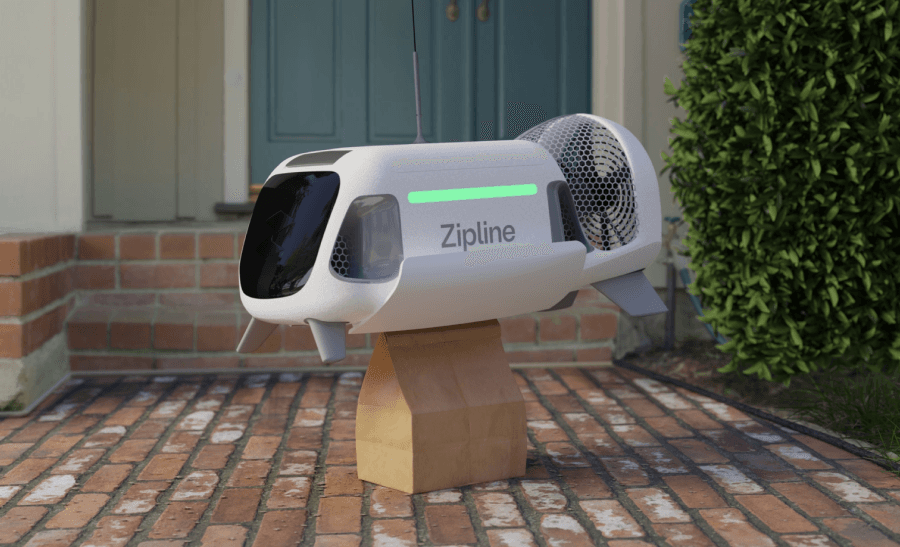
Zipline gained its own step change five days earlier. Uber announced a strategic investment in Zipline on August 17 alongside a nationwide Uber Eats drone-delivery partnership, with the two companies setting a joint target of 1 million drone deliveries a day by 2029, a roughly 230-fold increase from Zipline's current throughput of about 4,320 deliveries a day. First deployments begin in Dallas-Fort Worth and Houston, both existing Zipline markets, before expanding to dozens more US cities. The deal lands the same month DoorDash Air, which earned FAA Part 135 air-carrier certification on July 29 as the eighth US operator to hold it, is still working toward its own targeted fall 2026 commercial launch, meaning three of the sector's four biggest US distribution channels, Amazon, Uber Eats, and DoorDash, are now either live or imminent within the same few months.
Who's ahead: Zipline and Wing keep compounding, Meituan still dwarfs them on volume, and heavy-lift cargo eVTOLs open a parallel front
Zipline remains the largest autonomous delivery network by history and reach, having flown more than 135 million autonomous miles and completed over 2.5 million commercial deliveries worldwide, and the new Uber Eats channel now sits alongside its existing Walmart, health-system, and international work, including its Karongi distribution center in Rwanda expected online in August 2026. Wing, still funded entirely from Alphabet's balance sheet, opened its first Florida market in Greater Orlando on July 29 and grew its Houston network to 13 Walmart stores, but the seven-metro Walmart wave it announced in June, including its long-promised San Francisco Bay Area homecoming, remained entirely unlaunched as of this update with no store-by-store dates published.
China's Meituan continues to operate at a different order of magnitude: its Keeta Drone network passed full commercial operation in May 2026 with cumulative orders surpassing 900,000 under an unrestricted, full-territory CAAC delivery license, dwarfing the combined US volume even as Zipline and Wing still lead on total historical deliveries. A second front is opening in heavy-lift industrial cargo rather than last-mile parcels: AutoFlight, whose 2-ton CarryAll already holds a complete CAAC certificate set, was selected in July for two of the four approved projects in Hong Kong's inaugural Regulatory Sandbox X, aiming to fly the city's first unmanned two-ton eVTOL within six months hauling construction materials to remote New Territories sites, and in mid-August the company's data was updated to reflect its largest order to date, a 50-aircraft deal signed in October 2025 with Emirati operator Falcon Aviation Services (15 CarryAll cargo and 35 Prosperity passenger units) supporting Abu Dhabi National Oil Company offshore operations.
What decides it: Part 108's OIRA clock is close to running out, unit economics are the real test, and China keeps tightening compliance while it scales
In the United States, FAA Part 108 remains the single rule every operator, Zipline, Wing, Amazon, Uber, and DoorDash alike, is waiting on. The rule has sat with the White House Office of Information and Regulatory Affairs since July 10, 2026, and OIRA's review of significant rules can run up to 90 days, a window that closes around early October 2026; publication could land inside that window or slip into early 2027, and it remains hung up in part on the contested question of which aircraft yields when a drone and a crewed plane share low-altitude airspace. Until it publishes, every US operator, including the two, Amazon and DoorDash, now moving fastest, keeps scaling on metro-by-metro beyond-visual-line-of-sight waivers rather than a standardized federal framework.
China is moving the opposite direction on the same axis, from loosely policed local approvals toward mandatory nationwide compliance, even as its low-altitude economy scales. Two mandatory national standards for civil drones, covering real-name registration and continuous transmission of identification, location, speed, and status data to regulators, took effect May 1, 2026, and a revised Civil Aviation Law took effect July 1, 2026 requiring CAAC airworthiness certification and stricter operator accountability for medium and large civil drones. Meituan's nationwide license removed route-by-route friction, but every operator using it now has to clear a harder compliance bar than the one that let China's low-altitude logistics sector outrun the US waiver system in the first place.
The money and the market: the forecast holds, Uber breaks the self-funding pattern, and regulatory sandboxes become the preferred route into new countries
Market-size estimates still vary widely by methodology, from roughly 1.5 billion to 4.2 billion dollars for 2026 depending on the tracker, but MarketsandMarkets reaffirmed on August 14, 2026 its forecast of 7.65 billion dollars by 2031 at a 21.6 percent compound annual growth rate, with North America still expected to hold the largest regional share. Amazon and DoorDash are both still building out their programs from existing balance sheets rather than raising dedicated rounds, but Uber's undisclosed strategic investment in Zipline breaks that self-funding pattern, marking the first time a major platform company has put real capital behind a specialist drone operator rather than building in-house, mirroring the earlier logic of its own ride-hailing and delivery buildouts.
Internationally, regulatory sandboxes are emerging as the sector's preferred route into new countries when a full national framework is not yet ready. EHang unveiled a Global Fast Track Program on August 19 with Sri Lanka's Ministry of Ports and Civil Aviation as first adopter, targeting sandbox commercialization within four months in a Colombo Port City zone and extending its commercial footprint to 23 countries, the same sandbox-first playbook AutoFlight is now running in Hong Kong. That stands in contrast to Ireland-based Manna, which paused delivery operations in Dublin and Cork earlier in 2026 citing the lack of any clear national regulatory framework at all, and has pivoted its growth toward the US, the UK, and the UAE, where it already holds operational authorization, while keeping Ireland only as its research and engineering base.
What to watch through 2027
Watch whether OIRA's review of Part 108 concludes within its up-to-90-day window, closing around early October 2026, and whether the FAA publishes a final rule on that timeline or slips into 2027. Watch Amazon's rollout actually reach its stated nearly-500-location footprint by year-end, watch DoorDash Air convert its fall 2026 target into a real commercial launch, and watch Uber and Zipline's first Dallas-Fort Worth and Houston deployments land this year as the opening move toward their 1-million-a-day 2029 goal. Watch whether Wing's Bay Area launch and the rest of its seven-metro Walmart wave finally convert from announcement to live service.
Watch whether Meituan holds its two-to-three-year profitability target as it scales its newly commercial nationwide network. Watch AutoFlight's Hong Kong Sandbox X cargo trials get off the ground within the stated six-month window and its ADNOC-linked deliveries in the UAE begin under the Falcon Aviation order, and watch whether EHang's four-month Sri Lanka sandbox timeline holds as a template for further international expansion. The throughline is unchanged: drone delivery has proven the demand is real, and the next eighteen months are about whether standardized regulation, in the US and in China alike, catches up to let it scale beyond the handful of dense metros and sandboxed cities where it already works.
Sources
- About Amazon - Prime Air drone delivery expanding to nearly 500 US cities and towns (Aug 19, 2026)
- Uber Investor Relations - Uber and Zipline partner to bring drone delivery to millions of Americans
- DoorDash - DoorDash Air, in-house drone delivery program (FAA certified July 29, 2026)
- Table.Briefings - Meituan authorized to use commercial drones nationwide
- South China Morning Post - Hong Kong to test first flying cars carrying heavy cargo within six months
- MarketsandMarkets - Delivery drone market worth $7.65B by 2031 (reaffirmed August 2026)