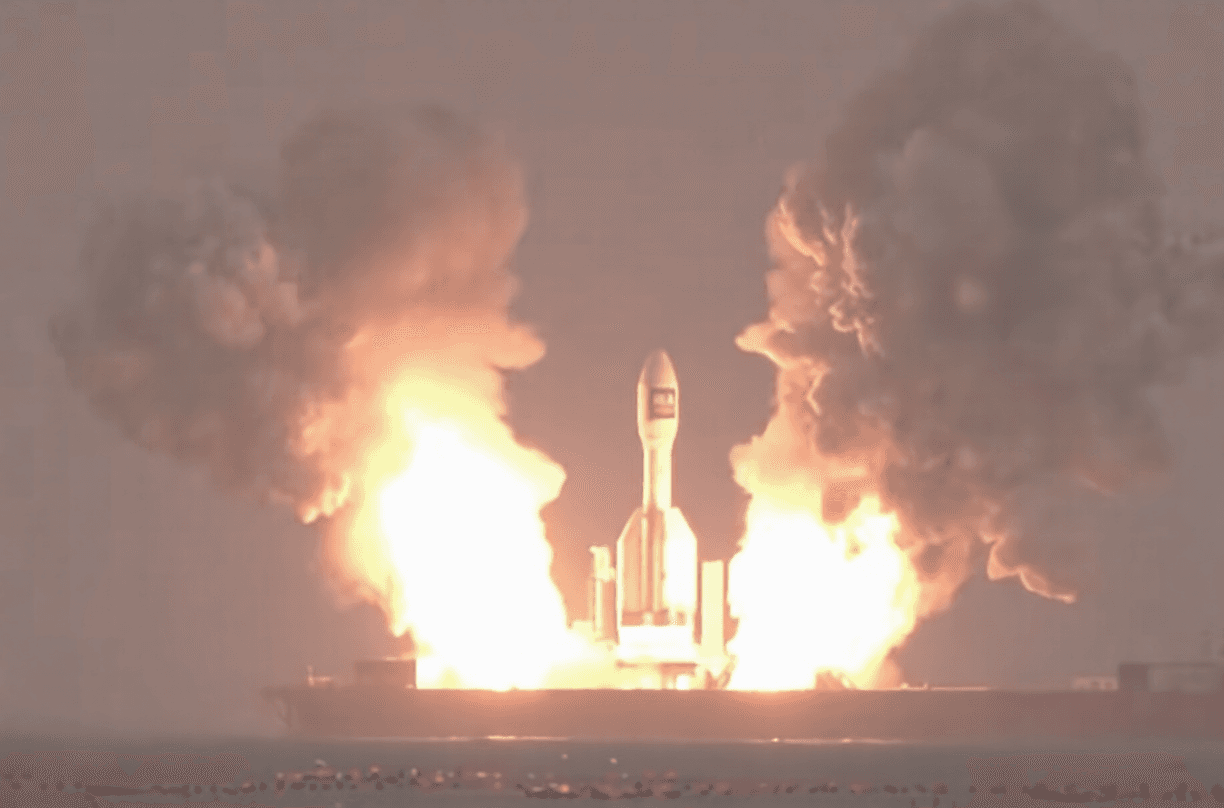
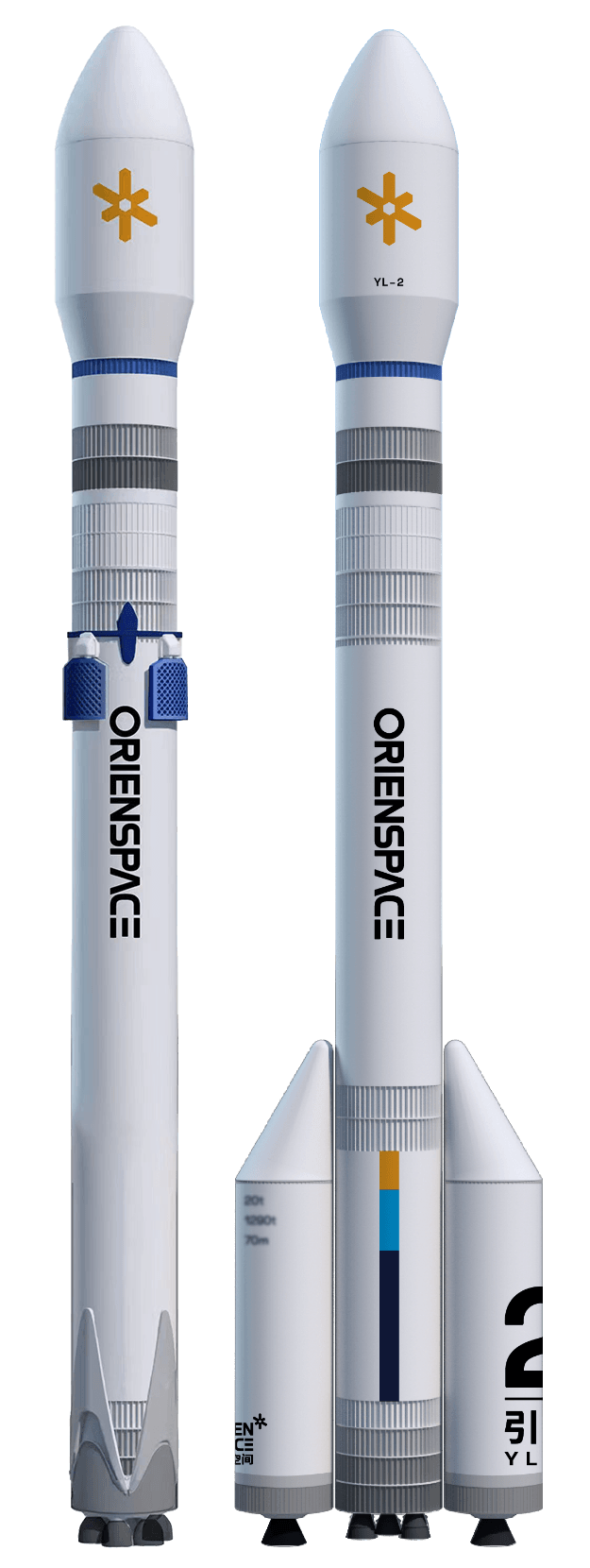
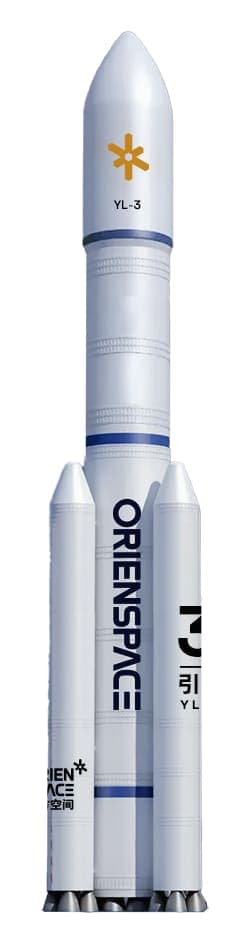
Its solid-propellant Gravity-1 is the world's largest solid-fuel carrier rocket - sea-launched and capable of 6,500 kg to LEO - and is now four-for-four after Gravity-1 Y3 lifted off at 06:00 Beijing time on September 16, 2026 (22:00 UTC on September 15) from waters off Shanghai and placed eight Qianfan networking satellites plus an EUHT technology-test satellite into an about 800 km orbit. Xinhua said the mission set Chinese sea-launch records for payload mass (more than three tonnes) and insertion altitude, and was Gravity-1's first giant-LEO constellation networking flight. Gravity-2, a reusable kerolox heavy-lift with nine Yuanli-110 engines, remains aimed at a Q4 2026 debut; Orienspace's own about page says large-scale ground tests are underway and the vehicle is expected to be ready for first flight in Q4 2026. The company's own product page now specifies Gravity-3 as an 81-meter, 100-tonne-to-LEO super-heavy with full-vehicle recovery. Orienspace was one of four commercial firms shortlisted in June 2026 to launch CAS's Qingzhou space-station cargo craft (first docking targeted January 2027). It closed a pre-C round of several hundred million yuan on August 5, 2026 and has begun IPO coaching toward a Shanghai STAR Market listing.
Close Series C and advance toward a Shanghai STAR Market IPO
TargetLate 2026 (shareholding restructuring); IPO coaching to follow
After the August 5, 2026 pre-C close, SpaceNews reported Orienspace was close to a Series C and would complete a shareholding restructuring before year-end 2026 as groundwork for a Shanghai STAR Market listing, the same path as LandSpace, CAS Space, Space Pioneer and Galactic Energy. No Series C close or formal IPO filing had been announced as of September 15, 2026.
Complete Yuanli-110 engine and stage testing and fly the reusable kerolox Gravity-2 for the first time. Orienspace's own about page says large-scale ground tests are underway and the vehicle is expected to be ready for first flight in Q4 2026. SpaceNews restated the same Q4 2026 debut target on August 6, 2026. As of September 15, 2026 the vehicle has not flown.
Gravity-1 Y3 lofted eight Qianfan networking satellites and one EUHT technology-test satellite from waters off Shanghai at 06:00 Beijing time on September 16, 2026 (22:00 UTC September 15), the vehicle's fourth success and its first giant-LEO constellation networking mission. Orienspace told CCTV it wants two more batch missions before 2027 after that Q3 flight. Gravity-2 has not flown, so Gravity-1 remains the company's only operational launcher.
Win a Qingzhou cargo launch award and develop Gravity-3
Convert the June 2026 shortlist (with Galactic Energy, CAS Space and LandSpace) into a contract to launch CAS's Qingzhou cargo craft to Tiangong, tentatively first docking in January 2027. In parallel, advance Gravity-3 from the company product-page specification (100 t to LEO, full-vehicle recovery) toward a first flight after Gravity-2. Gravity-2 has not flown as of September 15, 2026, so no recovery attempt has been made.
Orienspace closed a pre-C funding round worth several hundred million yuan on August 5, with investors including Vertex Capital, Shanghai STVC, AVIC Honghua and Yuanyou Ruize, and began IPO coaching procedures toward a planned Shanghai STAR Market listing. The capital funds continued development of Gravity-2, a roughly 70-meter reusable kerosene-liquid oxygen rocket that Orienspace is now targeting for a fourth-quarter 2026 debut.
Orienspace's solid-fuel Gravity-1 rocket lifted off from a service ship in the East China Sea off Shanghai on July 22, 2026, its third flight and first fully commercial mission. The launch deployed nine satellites, including six Dongpo satellites for the Huantian constellation, and set a new national record for combined payload weight delivered into orbit by a Chinese private rocket, marking China's first far-sea commercial launch.
commercial launch services; Gravity-1 now flying fully commercial missions
World Record
World's largest and most powerful solid-fuel rocket (Gravity-1); Y3 on Sept 16, 2026 set Chinese sea-launch records for payload mass (more than 3 tonnes) and insertion altitude (about 800 km)
Gravity-1 Launches
4 launches, 4 successes
Gravity-1 Y3 flew Sept 16, 2026 (06:00 Beijing / 22:00 UTC Sept 15) from waters off Shanghai with 8 Qianfan satellites plus 1 EUHT test craft
Gravity-1 Payload to LEO
6,500 kg
(200 km); 4,200 kg to 500 km SSO. Y3 on Sept 16, 2026 carried more than 3 tonnes of net payload to about 800 km
Valuation
~$823M-960M
(6-7B yuan) as of the Aug 2025 Series B+; no new post-money figure published after the Aug 5, 2026 pre-C close
Total Funding
More than 1.7 billion yuan
(~$250M) across five funding rounds as of August 2026, plus a pre-C of several hundred million yuan closed August 5, 2026; SpaceNews said a Series C was close and more capital was imminent
06
Operations & revenue
Operating status
Operational
Gravity-1 is operational at 4-for-4 after Y3 on September 16, 2026 placed eight Qianfan networking satellites plus an EUHT technology-test satellite into an about 800 km orbit from waters off Shanghai, the vehicle's first giant-LEO constellation networking mission. Orienspace previously told CCTV it wanted the Q3 flight plus two more batch missions before 2027. Gravity-2 is still targeted for a Q4 2026 debut: Orienspace's about page says large-scale ground tests are underway and the vehicle is expected to be ready for first flight in Q4 2026. Orienspace was shortlisted in June 2026 as one of four commercial providers for the Qingzhou Tiangong cargo craft (first docking targeted January 2027). IPO coaching toward a Shanghai STAR Market listing is underway after the August 5 pre-C close.
Revenue streams
Gravity-1 Launch Services
Dedicated solid-fuel launches of the sea-launched Gravity-1, primarily for Chinese commercial Earth-observation and constellation customers - as of the July 22, 2026 third flight, launches now originate from a service ship off Shanghai as well as the original barge off Haiyang.
Gravity-2 Reusable Launch Services
Planned low-cost, high-cadence reusable kerolox heavy-lift launches sized for China's satellite-internet mega-constellations once first-stage recovery is demonstrated.
Qingzhou space-station cargo launches (pursued)
Potential launch services for the Chinese Academy of Sciences Qingzhou cargo spacecraft to Tiangong. Orienspace was one of four commercial firms shortlisted in June 2026; a final provider had not been named and the first docking is tentatively January 2027.
07
Timeline12
2026
Gravity-1 Y3 flies first Qianfan sea-launch batch
On September 16, 2026 at 06:00 Beijing time (22:00 UTC on September 15), Gravity-1 Y3 lifted off from waters off Shanghai under Taiyuan Satellite Launch Center direction and placed nine satellites into planned orbit: eight Qianfan networking satellites plus one EUHT technology-test satellite. Orienspace said the mission carried more than three tonnes of net payload to about 800 km, setting Chinese records for a single sea launch in payload mass and orbital altitude, and was Gravity-1's first giant-LEO constellation networking flight. It was the vehicle's fourth success in four sea launches.
Pre-C round and STAR Market IPO coaching
On August 5, 2026 Orienspace closed a pre-C round of several hundred million yuan from Vertex Capital, Shanghai STVC, AVIC Honghua and Yuanyou Ruize for Gravity-2 development, and began IPO coaching toward a Shanghai STAR Market listing. SpaceNews reported the company has raised more than 1.7 billion yuan across five funding rounds, is close to a Series C close, and plans a shareholding restructuring before year-end 2026.
Shortlisted to launch Qingzhou space-station cargo craft
On June 5, 2026 China's national tendering platform named Orienspace one of four commercial launch firms shortlisted to fly the Chinese Academy of Sciences Qingzhou cargo spacecraft, alongside Galactic Energy, CAS Space and LandSpace. The first full-scale Qingzhou docking at Tiangong is tentatively scheduled for January 2027. The notice did not pick a final provider.
Gravity-1 completes first far-sea commercial launch
After a nine-month gap since its October 2025 second flight, Gravity-1 launched from a service ship in the East China Sea off Shanghai on July 22, 2026 (02:54 UTC) - its third flight, its first fully commercial mission, and China's first long-range/far-sea commercial rocket launch. The mission deployed nine satellites, including six Dongpo satellites (two optical, four SAR) for the Huantian constellation plus three rideshare payloads (Xiguang-2(01), Tianyi-49, Zidingxiang-3), a smaller batch than the roughly 30-satellite mission originally previewed for the flight.
Establishes Shanghai subsidiary ahead of planned IPO
On June 23, 2026, Orienspace (Shandong) Technology wholly establishes a new subsidiary, Orienspace (Shanghai) Aerospace Technology, with 30M yuan in registered capital, in Minhang District, Shanghai - part of the run-up to a planned Shanghai STAR Market listing. Co-founder Peng Haomin, the company's actual controller and the technical lead behind most of its rocket-engine patents, is named legal representative of the new entity.
Gravity-2 debut slips to end of 2026
An Orienspace official confirms the reusable kerolox Gravity-2 will now make its debut flight at the end of 2026 - a slip from earlier 2025/early-2026 targets - with the larger triple-core Gravity-3 to follow in 2027. The Yuanli-110 engine has completed initial and nozzle-less restart firings, and the company is targeting up to four Gravity-1 flights in 2026 on a quarterly cadence.
2025
Series B+ round and Gravity-2 test-flight push
In August 2025 Orienspace closes a Series B+ financing round earmarked mainly for follow-up development and mass production of the medium-lift, reusable Gravity-2, as it targets a first test flight of the rocket. The round adds to the more than $150M raised across earlier rounds plus the January 2024 Series B.
Gravity-1 second flight
On October 11, 2025, Gravity-1 flies successfully for a second time, placing a Jilin-1 satellite and test payloads into a 539 km low Earth orbit nearly two years after its debut.
2025
Yuanli-110 engine tests
Orienspace completes the first proper test firing of its Yuanli-110 kerolox engine in September 2025 and, in November 2025, runs a nozzle-less Yuanli-110 test demonstrating clean autonomous start/restart and shutdown - a key step toward booster recovery on Gravity-2.
2024
Gravity-1 maiden flight and $83.5M Series B
On January 11, 2024, Gravity-1 reaches orbit on its debut from a sea platform off Haiyang, deploying Yunyao-1 weather satellites and becoming the world's largest solid-fuel carrier rocket. That same month Orienspace closes an $83.5M (600M yuan) Series B to accelerate Gravity-2.
2023
Raises over $150M across four rounds
By late 2023 Orienspace completes four financing rounds totaling more than $150M to fund Gravity-1 and develop the reusable Gravity-2.
2020
Founded
Orienspace is founded in June 2020 in Yantai, Shandong, by a team including Bu Xiangwei and Peng Haomin to build large solid and reusable liquid launch vehicles for China's commercial market.
08
Funding
$1.1Bdisclosed across 3 rounds with a stated amount
Cumulative disclosed raise · dated rounds
RoundAmountInvestors
Early venture rounds
2020-2023
Over $150M (four rounds)
Chinese venture and strategic investors backing Gravity-1 and Gravity-2 development
Series B
2024-01
$83.5M (600M yuan)
Liangxi Sci-Tech Innovation Fund of Funds, Hongtai Fund, Xin Ding Capital, CMBC International, Shanhang Capital, Shenyin & Wanguo
Series B+
2025-08
Undisclosed (contributed to a ~6-7B yuan / $823M-960M valuation)
Chinese institutional investors (follow-on to the January 2024 Series B)