The thesis
Zipline is betting that the future of logistics is autonomous, electric, and measured in minutes rather than days. The company operates what is today the world's largest autonomous delivery service, having flown more than 130 million autonomous miles and completed over 2.3 million commercial deliveries. Where most of the drone-delivery field has stalled in pilots, Zipline has spent a decade quietly proving that instant aerial logistics can run at national scale, every day, in real weather, for real customers.
Its early customers were not retailers but health systems: the bet was that if drones could reliably carry blood and vaccines across a country, the same network could later carry a burrito across a suburb. That sequencing - hardest, highest-stakes use case first - is what separates Zipline from competitors that began with consumer convenience and never escaped the demo stage.
From Rwandan blood banks to a global network
Founded in 2014 by Keller Rinaudo Cliffton, Will Hetzler, and Keenan Wyrobek, Zipline launched the world's first national-scale drone delivery service in Rwanda in 2016, parachuting blood and medical supplies to remote clinics from centralized distribution centers. Ghana followed in 2019, turning a single-country proof point into a genuine logistics network and giving Zipline years of operational data no competitor could match.
A decade on, that public-health backbone now serves more than 5,000 hospitals and health centers, and Rwanda - Zipline's first home - has signed a fresh agreement covering nationwide autonomous logistics, a third distribution center, and the company's first overseas AI and robotics testing hub.
Two platforms, one autonomy stack
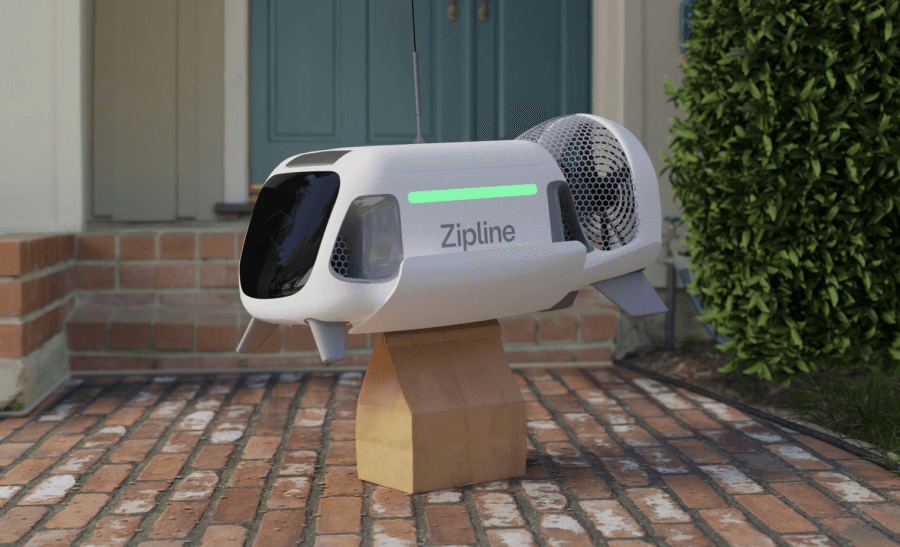
Zipline runs two complementary systems on a shared autonomy stack. Platform 1, the original fixed-wing aircraft, launches from distribution centers and air-drops packages by parachute - ideal for long-range medical and rural delivery. Platform 2, introduced commercially in 2025, is a quieter home-delivery system designed for dense suburban and urban environments, lowering packages precisely enough to land on a doorstep or a small patio.
It is Platform 2 that opens the consumer market: it is the piece that lets Zipline deliver from a restaurant or a Walmart to a home address, not just from a warehouse to a clinic drop zone.
The pivot to mainstream consumer delivery
In 2025 Zipline commercially launched Platform 2 in Pea Ridge, Arkansas and more than 20 Dallas-Fort Worth communities, pairing anchor partner Walmart with more than a dozen restaurant brands. The North Texas network has since become the company's flagship consumer market: by April 2026 it spanned 16+ restaurant and retail brands - including Popeyes, Hawaiian Bros, and Taco Bueno - and more than 25 public delivery locations such as parks, a university campus, and a public library. Urban flight volumes grew roughly 50x year over year.
Early 2026 added two major metros: Houston, in partnership with Memorial Hermann Health System, and Phoenix. Together they mark the start of a planned rollout to at least four additional U.S. states in 2026, with Seattle named as the next launch.
The money and the moat
Zipline has raised steadily from blue-chip investors - Sequoia Capital, Andreessen Horowitz, and Google Ventures early on, followed by a $250M Series E in 2021 and a $330M Series F in 2023 that valued it at $4B. In 2026 it closed an $800M Series H in two tranches at a $7.6B post-money valuation, backed by Fidelity, Baillie Gifford, Valor Equity Partners, Tiger Global, and new investor Paradigm.
The capital is less interesting than what it buys: a regulatory and operational head start. Years of FAA-sanctioned beyond-visual-line-of-sight flights and 130M+ autonomous miles compound into a safety record and a permitting position that a newly funded rival cannot simply purchase. That, more than any single aircraft, is the moat.
What to watch
The open question is whether suburban consumer delivery can match the unit economics Zipline proved in healthcare. Watch the 2026 multi-state expansion (Seattle first), how quickly new metros reach the flight density of North Texas, and whether Walmart deepens from anchor partner into something closer to a category-defining channel. On the international side, Rwanda's push toward nationwide and urban coverage is the template Zipline will try to export.