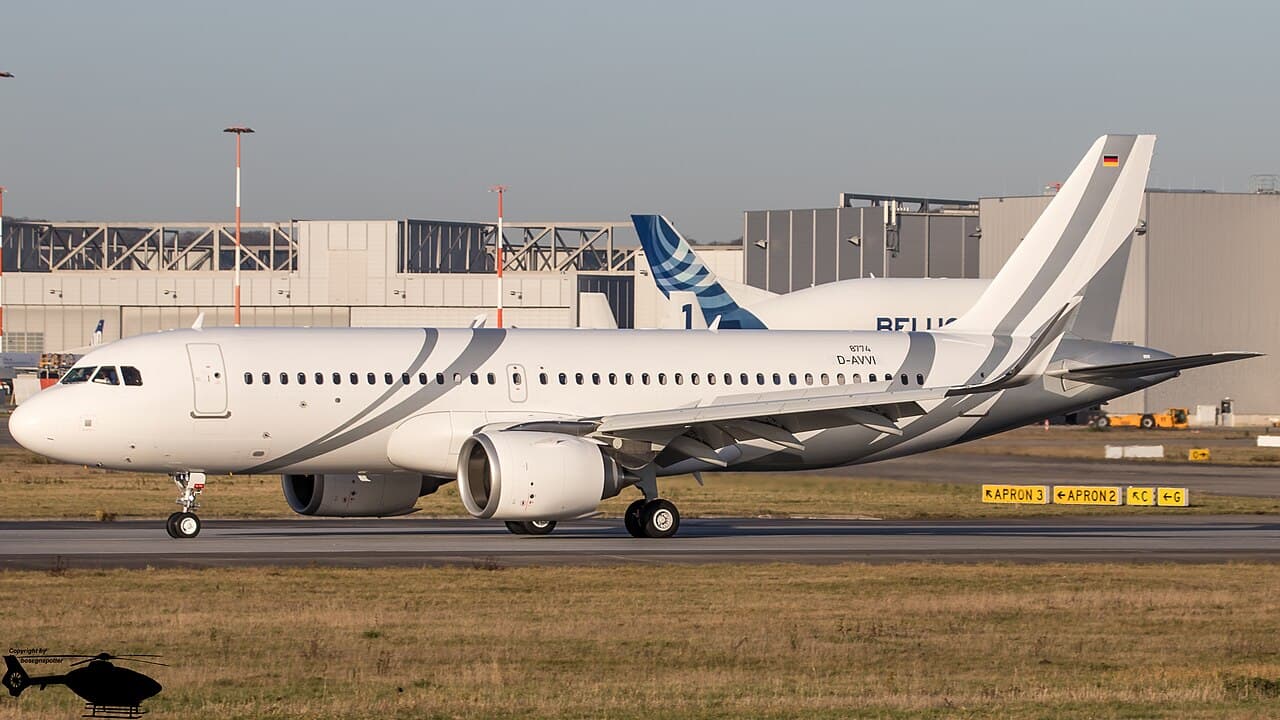
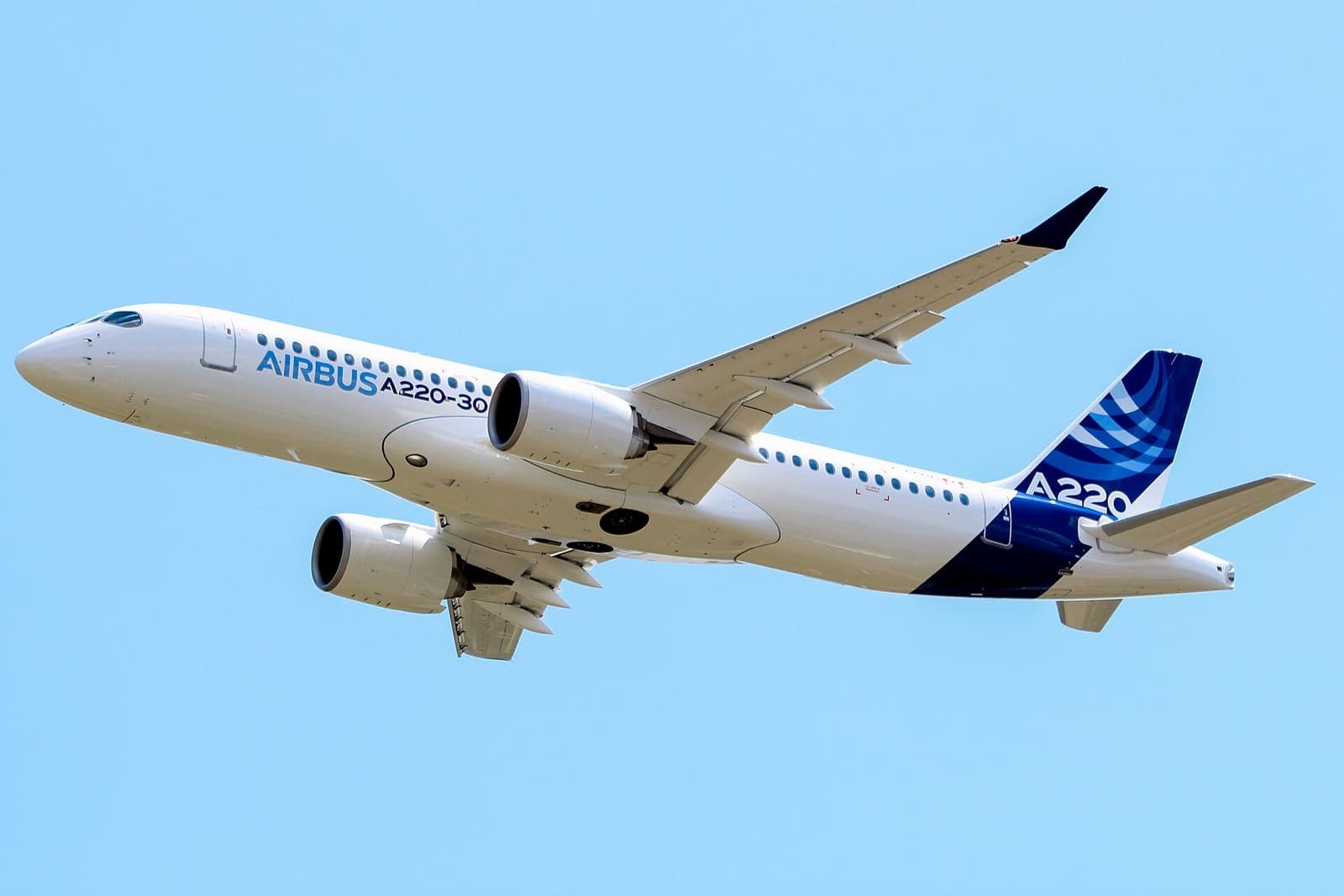
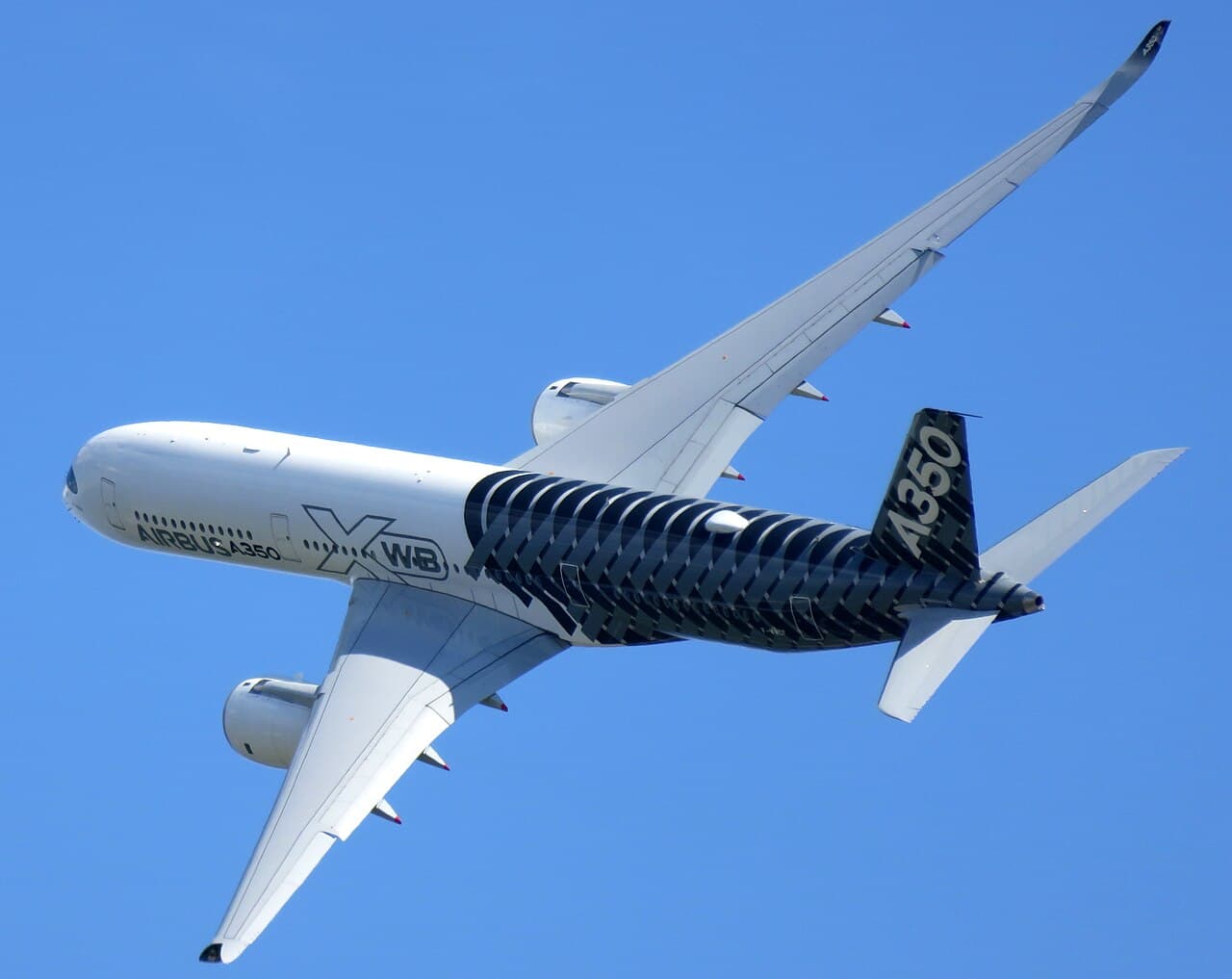
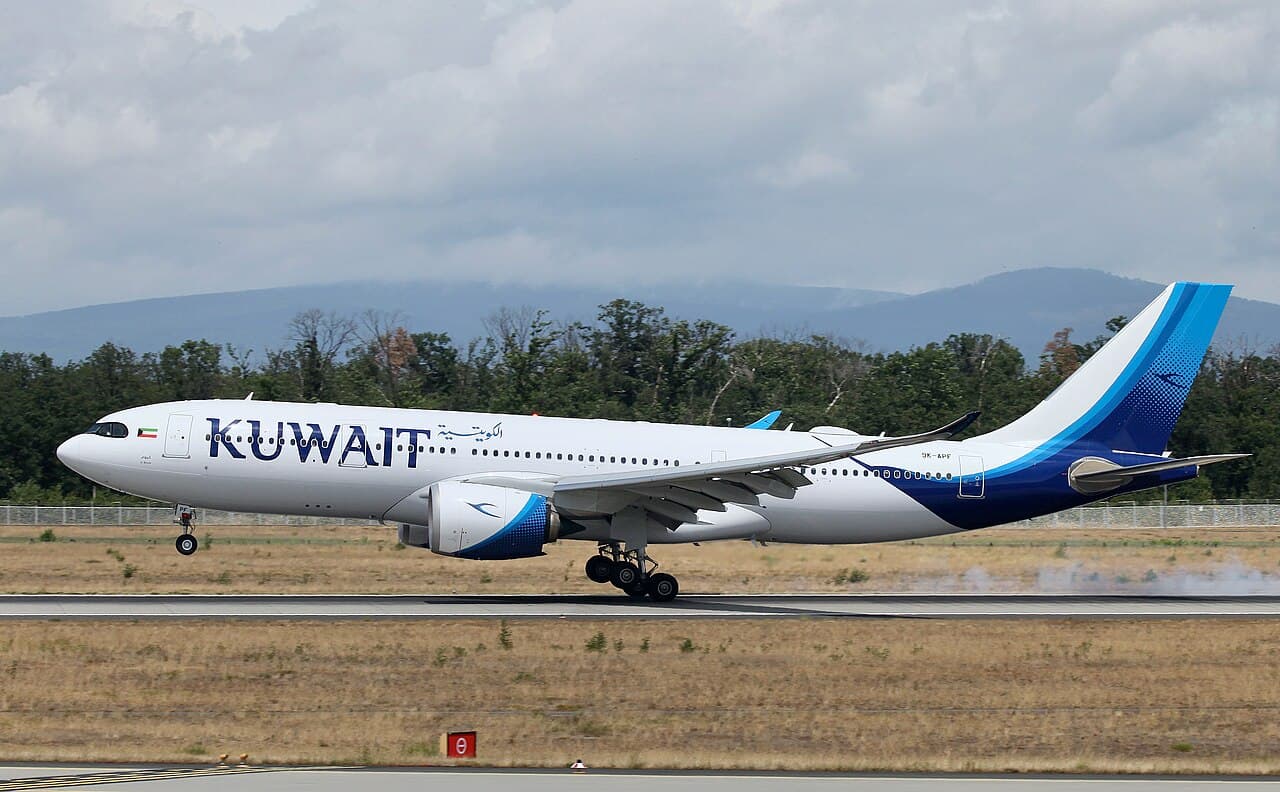
In civil aviation it remains Boeing's only true peer at global scale and is pairing near-term production growth with longer-term work on lower-carbon aircraft technologies, future single-aisle designs and hydrogen propulsion. H1 2026 results on 29 July showed revenue EUR 33.2B (+12% YoY) on 351 deliveries, including a record Q2 of 237, and reaffirmed around 870 deliveries, EUR 7.5B adjusted EBIT and EUR 4.5B free cash flow before customer financing. The official September 2026 orders-and-deliveries bulletin, posted 8 October, lists 72 commercial deliveries to 37 customers, 17 gross orders, and 547 deliveries year to date to 84 customers, leaving 323 aircraft for the fourth quarter versus the around-870 target. Aerospace Global News, from the same bulletin, split September as 59 A320 family (37 A321neo, 21 A320neo, one A319neo), eight A220s, two A330neos and three A350-900s, with 1,105 net orders after 69 cancellations and a 9,310 backlog. A350F prototype MSN700 first flew from Toulouse on 29 September (official 4 hours 10 minutes, 25,000 feet); the over-9-month / about 400-hour campaign is under way, with first delivery still targeted H2 2027. Amparo Moraleda assumed Board Chair on 1 October, succeeding Rene Obermann; the same meeting co-opted ASML CEO Christophe Fouquet and named Mark Dunkerley lead independent director. Spain workers approved the ministry-mediated labor proposal on 30 September-1 October (union figures 10,269 yes / 76.76%). On 2 October Airbus Defence and Space delivered the first 32 next-generation OneWeb satellites to Eutelsat from Toulouse, the first of 669 refresh spacecraft. Airbus called Avolon's 9 October 110-jet package (35 A330-900s and 75 A320neo Family) a firm order; Avolon's same-day note said it remains subject only to Bohai Leasing shareholder approval expected before the end of October. The 7 October Biman firm order for four A350-900s and six A321neos did not state delivery years. Airbus still has not named the A321neo stringer-coatings supplier on its own site; a 28 September Reuters reprint said Airbus declined to name suppliers while attributing work at TESI and a 500-aircraft alert including 250 still in production. 9m 2026 results are due 28 October.
Convert Vietnam Airlines MoU and Vietravel LOI into firm orders
Target2026-2027 (conversion); 2029 (Vietravel deliveries if firmed); 2033-2034 (Vietnam Airlines A350s if firmed)
On September 10, 2026 in Paris, Vietnam Airlines signed a memorandum of understanding for five A350-900s with deliveries planned for 2033-2034, part of a stated priority to acquire 30 widebodies beyond 2030. Vietravel Airlines signed a letter of intent for 20 A220s and 30 A321-family jets, with deliveries expected from 2029. Neither instrument is a firm order. Watch whether purchase contracts follow, which is what would add the 55 aircraft to Airbus's backlog rather than leaving them as diplomatic paper.
TargetContract negotiations following August 2026 framework approval; Polish deliveries targeted by 2030
Spain's Council of Ministers approved a EUR 5.4 billion (~$6.3B) seven-year framework agreement on August 25, 2026 for the joint procurement of seven A330 MRTT tankers with Poland (three for Spain, four for Poland), financed in part via the EU's SAFE loan instrument and assembled at Airbus's Getafe site. The framework sets the stage for definitive contract negotiations between the two governments and Airbus; Poland's four tankers are targeted for delivery by 2030. As of September 13, 2026 no definitive contract signature had been announced.
TargetHearing September 24, 2026; vote date TBD if the court later permits; trial November 4, 2026
Spain's Audiencia Nacional provisionally suspended Airbus's binding Spain-workforce referendum on September 18, 2026, granting CGT's emergency precautionary measures. The vote that had been set for September 24-25 across Getafe, Illescas, Albacete, Cadiz, Tablada and San Pablo is frozen until a hearing on Thursday September 24; the full strike-rights trial is listed for November 4, 2026. If the court later permits a vote, Airbus would have to set a new date. The ministry-mediated proposal with UGT, ATP, CCOO and SIPA still restores real-IPC pay and a 7.95% purchasing-power recovery through 2029. Pickets have been paused since September 9; the indefinite strike call remains in force. Airbus has said that if the proposal is not ratified, the April framework that triggered the dispute would apply and it is not in a position to reopen talks.
TargetFirst flight tentatively September 24, 2026 (could slip into early October); first delivery still targeted H2 2027
Airbus rolled the first A350F flight-test aircraft out of the paint shop at Toulouse on August 19, 2026 in a parcel-liveried scheme, with Reuters reporting the company is targeting late September for first flight, centered on a preferred date around September 24, and able to slip into early October on technical issues or weather. Airbus's own public guidance remains the broader 'later in 2026' window. As of September 19, 2026 no first-flight announcement had been made. Airbus still expects first customer delivery in the second half of 2027, though commercial-aircraft flight-test campaigns typically run 12-15 months, putting that target at the far end of the range if certification is to be completed before the planned delivery window. The firm backlog grew to 115 A350F aircraft after eight August 2026 orders from an undisclosed customer, still led by Atlas Air's 20-aircraft order from March 2026.
AD 2026-18-09 takes effect October 22, 2026 for all Airbus A330-243, A330-243F, A330-341, A330-342, and A330-343 airplanes. Operators of the estimated 70 US-registered jets must modify certain nacelle inlet cowls and run repetitive borescope inspections of others after cracked anti-ice piccolo-tube restraint brackets were found in maintenance, following EASA AD 2025-0164. Watch whether the inspections turn up a wider fleet finding and whether the work overlaps the A330neo delivery recovery after the Getafe tail-plane quality halt.
After a soft Q1 (114 deliveries), Airbus delivered 351 aircraft in H1 2026 (237 of them in a record Q2, +39% YoY) - its best first half since 2019 - and reaffirmed the 870-aircraft target, EUR 7.5B adjusted EBIT and EUR 4.5B free cash flow guidance when it reported H1 results on July 29 (H1 revenue EUR 33.2B, +12% YoY); management is internally aiming beyond 900. July's official tally showed 67 deliveries and 204 gross orders (YTD 418). The August monthly bulletin, reported September 7, showed 57 deliveries and 67 gross orders, taking YTD deliveries to 475, up 9% from 434 a year earlier and 57 jets ahead of Boeing's 418 - still requiring about 99 aircraft a month over September-December, well above anything Airbus has sustained in 2026. Part of the late-summer shortfall traces to a production quality issue on the A330neo's horizontal tail plane that all but halted A330neo deliveries for three months (zero in June and July, one in August) before Airbus said in early September the root cause was identified and deliveries had resumed. The Spain labor risk is now dated: after a 51.23% to 48.77% assembly vote on September 8 to keep the indefinite strike (a 67-vote margin), the strike committee paused pickets on September 9 but kept the call in force. Airbus had set a binding referendum for September 24-25, 2026, but Spain's Audiencia Nacional provisionally suspended that vote on September 18 pending a hearing on September 24; the full trial is listed for November 4. CEO Guillaume Faury has said agreed Pratt & Whitney engine volumes for 2026-2027 support the guidance - but the back-half acceleration needed to hit 870 still depends on Spanish plants staying productive.
TargetBroughton jigs operational by end of 2026; 70-75/month by end of 2027; rate 75 stabilization shortly after start of 2028
Airbus still plans to raise A320 Family output materially from roughly 60 aircraft per month today, but the rate-75 milestone has slipped: management now expects to reach about 70-75 per month by the end of 2027, with the full rate-75 stabilization now pushed to shortly after the start of 2028 rather than firmly within 2027. On September 21, 2026 Airbus said it is investing 150 million pounds to convert Broughton's former A380 wing shop into an A321 line with six jigs; the first wing is already in work and all jigs are targeted operational by year-end. CEO Guillaume Faury reaffirmed at the July 29 H1 results briefing that this ramp-up schedule is unchanged from the pace set out in February, and said Pratt & Whitney's PW1100G-JM engine deliveries - which power roughly 40% of A320neo family jets - should reach a 'much more normalized situation' by 2028. The Pratt & Whitney dispute has hardened past mere 'weighing' a claim: Faury said in February 2026 that Pratt was 'not respecting their contractual obligations' by diverting engines and parts to its maintenance/overhaul business for in-service fleets instead of new-aircraft deliveries, and Reuters reported in March 2026 that Airbus is formally pursuing damages from Pratt & Whitney, a dispute that could escalate into arbitration. The build-out is spread across ten final assembly lines worldwide, including Mobile and Tianjin. The second Tianjin line, inaugurated in October 2025, made its first delivery on September 16, 2026 - an A320neo for China Eastern Airlines - which Airbus called a critical facilitator of the rate-75 trajectory. On September 15 Airbus also opened a new more-than-35,000 square meter A320 Family delivery centre at the Jean-Luc Lagardere site in Toulouse, with 16 aircraft positions next to the final assembly line. Airbus's Asia-Pacific president said on September 15 that deliveries are up 9% year to date with no sign of demand softening.
TargetIntegrated ground testing in 2027; Airbus-MTU fuel-cell engine JV to start operating in 2027
Airbus has confirmed the feasibility of its 100-seat hydrogen fuel-cell ZEROe concept at TRL 3 and still plans integrated ground tests at the Electric Aircraft System Test House in Munich in 2027, combining hydrogen storage, distribution, and the fuel-cell propulsion stack into one validation setup. On July 7, 2026 Airbus and MTU Aero Engines announced plans to form a joint venture dedicated to developing and commercializing a fully electric hydrogen fuel-cell engine - Airbus taking on liquid-hydrogen storage and aircraft integration, MTU leading the engine, fuel-cell stack, and certification - with the venture targeted to start operating in 2027, pending regulatory approvals and European labor consultations.
Deliver U050 Capa-X systems to the French Navy and Army
The September 10, 2026 DMAé follow-on covers four U050 Capa-X systems (eight aircraft), two for the Navy and two for the Army, with deliveries scheduled for 2027. The order follows a late-2025 evaluation system that completed land and sea trials.
Airbus and Thales Alenia Space are building the first LEO layer of Europe's IRIS2 constellation, at least 66 satellites, after the September 10, 2026 initial contract. Airbus produces platforms and integrates Thales payloads in Toulouse. Delivery is targeted for 2029, the sovereign military Ka-band pillar of the SpaceRISE programme.
TargetLaunch decision targeted 2030; service entry second half of the 2030s
Airbus is maturing the engine, wing, battery, materials and systems choices for a next-generation single-aisle aircraft (internally referred to as 'eAction') targeting 20-30% better fuel efficiency and 100% SAF capability, with service entry in the second half of the 2030s. CEO Guillaume Faury has reaffirmed the company remains 'very committed' to a formal launch decision in 2030, with engine-selection decisions expected around 2027. At the July 21, 2026 Farnborough Airshow, Airbus launched a new multi-year flight-test campaign, part of its Wing of Tomorrow research program, to evaluate high-span wing extensions (broadening the current 34m span by roughly 4-5m per side) on an A321neo testbed, with flight testing set to begin in the second half of 2027; in parallel, the shape-changing eXtra Performance WING demonstrator is nearing assembly completion in Cazaux, France, targeting a remotely piloted maiden flight by the end of 2026.
France's DGA awarded Airbus and Unseenlabs the CASSIOPÉE space SIGINT system on September 11, 2026. Airbus integrates S250-based satellites and the control centre; Unseenlabs supplies the payload. The system is to succeed CERES by 2032 as the sovereign core of the CELESTE programme.
Rene Obermann will step down as Chair of the Airbus Board of Directors effective October 1, 2026, after informing the Board he will not seek a new mandate at the 2027 AGM. The Board has designated Amparo Moraleda, a board member at A.P. Moller-Maersk, CaixaBank and Vodafone and former COO of Iberdrola's international division, to succeed him as Chair from that date. Re-verified September 19, 2026: no later change to the succession date has been announced.
Airbus said that during NATO exercise SPARTAN ARROW 26 on Crete it connected a German IRIS-T SLM and a Swedish Patriot to the German SAMOC command post for the first time, and also linked the German Army's short-range LeFlaSys. Airbus called the all-German crew's first IRIS-T live firing a prerequisite for NATO certification and said Sweden's first independent Patriot firing through the network marked NATO certification of those Swedish systems. Janes reported that the German defence ministry announced the IRIS-T live firing on Oct. 14 and that the Swedish Armed Forces called the Patriot shots their first live-fire exercise.
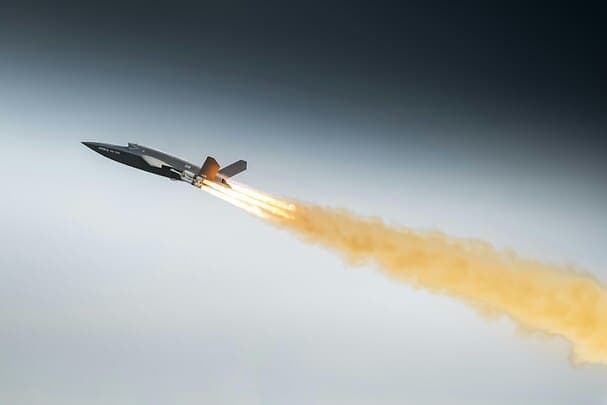
Airbus said on 12 October 2026 that it and Kratos completed the first European flight of the U740 Valkyrie, including a rocket-assisted takeoff and speeds up to Mach 0.8. Airbus Defence and Space CEO Michael Schoellhorn told Reuters the flight was on 29 September over northern Europe and that Airbus's MARS mission system was not yet on board, with the next MARS test aimed at the first quarter of 2027. The companies said they are targeting a combat-ready collaborative combat aircraft by 2029; no order was disclosed.
On Oct. 2, 2026 Airbus Defence and Space said it delivered the first 32 next-generation OneWeb LEO satellites to Eutelsat from Toulouse. Eutelsat said the batch is the first of 669 refresh satellites and is being prepared for shipment to an upcoming SpaceX launch in the United States, without naming a launch date. The spacecraft will replace aging first-generation OneWeb satellites.
Airbus confirmed a surface-protection shortfall on stringers in the lower forward fuselage of A321neo aircraft, affecting more than 500 jets including about 250 still in production, and said safety is unaffected. Reuters reported on September 28 that Airbus and Leonardo are investigating coatings supplier TESI, a Leonardo subcontractor near Naples; Airbus declined to name suppliers, and Leonardo confirmed TESI is a supplier without saying it is involved. Airlines taking delivery get two years to complete a repair that sources said can take up to nine days; Airbus reaffirmed its 2026 delivery target.
Airbus said September 21 it is investing 150 million pounds to convert the former A380 wing plant at Broughton, Wales into an A321 wing line with six jigs, an equipping line and a paint shop, feeding a backlog of around 7,500 A320 Family aircraft. The first wing is already in work, all jigs are due to be operational by year-end, and Airbus said the project supports the ramp toward rate 75. UK reporting put about 480 new Broughton jobs in 2026, including 250 in the refurbished factory.
The FAA published Airworthiness Directive 2026-18-09 in the September 17 Federal Register, covering all Airbus A330-243, A330-243F, A330-341, A330-342, and A330-343 airplanes after cracked and broken anti-ice piccolo-tube restraint brackets were found on certain nacelle inlet cowls. The rule, which adopts EASA AD 2025-0164, requires modification of some affected parts and repetitive borescope inspections of others, estimates 70 US-registered jets, and takes effect October 22, 2026. The FAA said an unaddressed failure could let the thermal anti-ice feed pipe disengage, allowing ice on the inlet lip that could damage the engine and reduce control of the airplane.
Airbus delivered the first A320neo assembled at its second A320 Family final assembly line in Tianjin to China Eastern Airlines on September 16, about 11 months after the line was inaugurated. Programmes and services executive vice president Philippe Mhun called the second Chinese line a critical facilitator of the global ramp toward 75 A320 Family aircraft a month and said it adds flexibility to meet demand. Tianjin now holds two of the ten Airbus final assembly lines worldwide and has built and delivered more than 800 A320 Family jets since the first line opened in 2008.
Airbus and Thales Alenia Space signed the first IRIS2 development contracts with Eutelsat for at least 66 Ka-only first-layer LEO satellites, with delivery targeted for 2029. Airbus will supply the satellite platforms and Thales the digital payloads, with assembly in Toulouse. Thales also signed a roughly 500 million euro tranche to supply governmental payloads on all 330 IRIS2 LEO satellites; Aerospacelab holds the remaining 264-satellite layer.
Eutelsat said September 10, 2026 it signed an authorization to proceed with Airbus Defence and Space for 229 additional OneWeb LEO satellites, about 1 billion euros, on top of 440 already procured for a 669-satellite Airbus refresh. The order does not change Eutelsat's capex plan through fiscal 2029 and is meant to replenish the constellation through 2034 while supporting IRIS2 continuity. Manufacturing is planned in Toulouse.
Vietnam Airlines signed a memorandum of understanding in Paris for five Airbus A350-900s with deliveries planned for 2033-2034, during Vietnamese Communist Party chief To Lam's visit with President Emmanuel Macron. Vietravel Airlines signed a letter of intent for 20 A220s and 30 A321s, with deliveries from 2029. Neither deal is a firm order.
Airbus said Egypt's Air Cairo placed a firm order for 15 A320neo aircraft at the El Alamein International Airshow, the carrier's first direct purchase from Airbus after building its fleet through leases. Air Cairo has grown from seven aircraft five years ago to more than 45 today and is targeting a fleet of more than 130 by 2034.
Airbus trimmed its 20-year China single-aisle forecast to 7,480 aircraft from 7,950 a year earlier, citing high-speed rail on journeys under about six hours that it now puts at roughly a 10% drag on domestic air demand. The company still sees China as the world's largest aviation market, with total 20-year demand of 8,830 passenger and cargo aircraft.
Airbus said it delivered 475 commercial jets in the first eight months of 2026, up 9 percent from 434 a year earlier, including 57 in August, leaving it broadly on track for its 870-delivery target. A330 deliveries resumed with one handover in August after a June-July halt over a lost tool in a tail section; year-to-date A330 deliveries are 11, down 31 percent. The company sold 67 planes in August, including eight A350F freighters to an undisclosed customer.
Airbus said on September 4, 2026 that it and unions UGT, ATP, CCOO and SIPA, representing about 88% of union representatives, had reached a Ministry of Industry-mediated proposal of understanding after weeks of strikes in Spain. The company said the proposal will go to a binding referendum of Airbus Spain employees in September. UGT later said it had not signed a pre-agreement and would debate the proposal in assembly before any vote.
Airbus said deliveries of its A330neo widebody have resumed after a quality lapse in the tail section, a tool left inside a horizontal tail plane during production, brought handovers to a near standstill for three months, Bloomberg reported September 3, 2026. The manufacturer delivered zero A330neos in June and July and just one in August, versus a typical pace of about four a month, before calling the root cause identified and the issue isolated. Airbus still aims to ramp output to five A330neos a month by 2029 as it works toward roughly 870 total aircraft deliveries in 2026.
(-7% YoY); adjusted EBIT EUR 300M (-52%); free cash flow before customer financing EUR -2,485M, mainly reflecting the low delivery volume and planned inventory build-up
Employees
168,754 as of 30 June 2026
+2% vs 165,294 at FY 2025 year-end
Q1 2026 Commercial Deliveries
114 aircraft
19 A220, 81 A320 Family, 3 A330, 11 A350
Commercial Backlog (Aug 2026)
A320 Family outstanding backlog 7,577 at end-August 2026 (including 5,691 A321neos), per Airbus's Sept 15 Toulouse delivery-centre announcement; group commercial backlog was 9,352 at end-July
August 2026 Deliveries (official)
57 aircraft in August
(10 A220-300, 1 A319neo, 16 A320neo, 26 A321neo, 1 A330-900, 3 A350-1000) to 31 customers; YTD deliveries 475 (+9% vs 434 a year earlier). 67 gross orders in August incl. eight A350F freighters that lifted the A350F firm backlog from 107 to 115. Still below the roughly 99/month pace needed through year-end to hit the 870-aircraft target
2026 Delivery Guidance
~870 commercial aircraft
~EUR 7.5B adjusted EBIT; ~EUR 4.5B FCF (reaffirmed at Q1, at Farnborough in July, and again with H1 results on July 29; still the official target as of September 19, 2026)
Q2 2026 Standalone Results
237 aircraft delivered
(+39% YoY vs. 170 in Q2 2025); revenue EUR 20.53B (+28% YoY); adjusted EBIT EUR 2.43B (+54% YoY); net income EUR 1.66B (+126% YoY), EPS EUR 2.10 - the quarter that pulled H1 back on track after the weak Q1
2026 Deliveries (H1)
351 aircraft in H1 2026
(89 in June) - up about 15% YoY (306 in H1 2025) and the strongest first half since 2019, with 886 gross / 821 net orders logged through June per official H1 2026 results. Airbus is internally targeting 900+ deliveries for the full year, above its official 870 guidance.
June 2026 Orders/Deliveries
89 deliveries in June
(82 single-aisle incl. 73 A320neo family + 9 A220; 7 A350 widebody); 351 delivered in H1. May had 81 deliveries / 379 gross orders.
July 2026 Deliveries (official)
67 aircraft to 39 customers
(6 A220-300, 18 A320neo, 37 A321neo, 4 A350-900, 2 A350-1000) and 204 gross orders; down from June's 89 and below the ~85-90/month pace needed to hit the 870-aircraft full-year target. YTD deliveries reached 418 to 82 customers, ahead of 373 at the same point in 2025
A220 Family Orders
1,100+ firm orders as of end-June 2026
(surpassed 1,000 in May 2026 after AirAsia's landmark 150-aircraft order; BermudAir joined as the newest A220 customer with a 10-aircraft A220-300 order at Farnborough in July), growing further after airBaltic firmed 10 more A220-300s in August 2026
A320 Family Lifetime Orders
20,378 total orders as of end-July 2026
(up from 20,169 at end-May), with 12,798 delivered and 11,308 currently in service; 7,739 of the total are A321neos, the most-ordered single variant
2026 Net Orders (YTD)
1,091 net commercial orders through August 2026 (1,157 gross orders less 66 cancellations). August added 67 gross orders, including eight A350F freighters that lifted the A350F firm backlog from 107 to 115
Farnborough 2026 Orders
~157 firm Airbus commercial orders plus commitments (of a show-wide $84.7B / 353 firm aircraft across all OEMs), headlined by SMBC Aviation Capital's 100 A320neo family and Vietjet's 20 A330neo (~$7.4B); plus Riyadh Air 6 + Philippine Airlines 9 A350-1000, flynas 20 A321neo + 5 A330-900, and BermudAir 10 A220-300 (new customer)
(free cash flow); EUR -1,166M before customer financing (H1 2025: EUR -1,610M) - mainly working-capital and inventory build-up ahead of the H2 delivery ramp needed to still hit the ~EUR 4.5B full-year FCF-before-customer-financing guidance
Share Buyback (Jul 2026)
EUR 5B
(~$5.7B) programme announced July 26, 2026 alongside raised medium-term financial targets
China 20-year demand forecast (GMF 2026)
7,480 single-aisle jets
(down from 7,950 a year earlier) and 8,830 passenger plus cargo aircraft in total; Airbus cites high-speed rail as about a 10% drag on domestic journeys under six hours
OneWeb refresh satellites (Airbus-built)
669 new satellites after the Sept 10, 2026 Eutelsat ATP for 229 more on top of 440 already procured; built in Toulouse
A321neo stringer coating scope (Sep 2026)
Reuters: 500 aircraft quality alert, 250 still in production, TESI unnamed by Airbus; around-870 2026 deliveries reaffirmed 25 Sep. Industry sources: about 50 September deliveries so far, up to 20 slipped into Q4.
A350F MSN700 first flight
Flown 29 Sept 2026 from Toulouse: 4 hours 10 minutes, 25,000 feet. Over-9-month / about 400-hour campaign begun. First delivery still targeted H2 2027.
Spain labor referendum (1 Oct 2026)
Proposal approved: 10,269 yes
(76.76%), 2,710 no (20.26%), 399 abstentions; about 87% turnout. Airbus: clear path, still much to do after the 20% no vote.
September 2026 deliveries (official)
Unpublished as of 4 Oct 2026
O&D page still August: 57 deliveries, 475 YTD. Bulletin due 8 Oct. Wagner very confident of around 870. Airbus declined to comment on provisional totals.
September 2026 deliveries (official)
72 aircraft to 37 customers
17 gross orders; 547 year to date to 84 customers. 323 still needed in Q4 versus around-870.
Avolon 110-jet Airbus order (9 Oct 2026)
Airbus: firm order for 35 A330-900s and 75 A320neo Family jets (Avolon A330-900 total 114; A320 Family some 650). Avolon: plus 100 options; remains subject only to Bohai Leasing shareholder approval expected before end-October.
06
Operations & revenue
Operating status
Operating; SAMOC linked German and Swedish defenses in Crete
On 14 October 2026 Airbus said it connected a German IRIS-T SLM and a Swedish Patriot to SAMOC during NATO exercise SPARTAN ARROW 26 in Crete, and linked the German Army LeFlaSys. Airbus called the German live firing a prerequisite for NATO certification and said the Swedish Patriot firing marked NATO certification of those systems. The U740 Valkyrie European flight reported on 12 October, the 547 deliveries through September, and Avolon's Bohai shareholder condition remain on the record.
Revenue streams
Commercial Aircraft
Design, manufacturing, and support for the A220, A320 Family, A330neo, A350 and freighter derivatives. This remained Airbus's largest business in 2025 with EUR 52.6 billion in revenue.
Defence and Space
Military aircraft, satellites, launch-related systems, secure communications and other sovereign aerospace capabilities. Airbus Defence and Space generated EUR 13.4 billion of revenue in 2025. In September 2026 the unit added an Eutelsat ATP for 229 more OneWeb satellites (669 refresh total), the IRIS2 first-layer start (66+ LEO satellites for 2029 delivery), and France's CASSIOPÉE SIGINT-satellite award with Unseenlabs.
Helicopters
Civil and military rotorcraft plus aftermarket services, with products spanning light utility, offshore, emergency medical, law-enforcement and military missions. Helicopters generated EUR 9.0 billion of revenue in 2025.
07
Track record
How past announced dates turned out.
3/4announced dates hit on time
3 Hit
1 Slipped
0 Missed
Hit
Publish official September 2026 deliveries and whether around-870 guidance changes
Target Airbus monthly industrial bulletin scheduled 8 October 2026 · Resolved Oct 8, 2026
Official Airbus orders-and-deliveries page posted the September 2026 bulletin: 72 commercial deliveries to 37 customers, 17 gross orders, and 547 deliveries year to date to 84 customers. IR guidance still around 870, so 323 remain for Q4.
Hold Spain workforce referendum on the labor proposal
Target 30 September-1 October 2026 · Resolved Oct 1, 2026
Binding referendum 30 Sept-1 Oct closed at 17:00. Union figures: 10,269 yes (76.76%), 2,710 no (20.26%), 399 abstentions, about 87% turnout. Airbus said the result sets a clear path while the 20% no vote shows more work remains. Strike pickets paused since 9 Sept; Airbus did not announce that the indefinite call was lifted.
Target September 24-25, 2026 · Resolved Sep 18, 2026
Spain's Audiencia Nacional provisionally suspended the binding September 24-25 referendum on September 18 after granting CGT's emergency precautionary measures. A hearing is set for September 24 and the full strike-rights trial for November 4. If the court later permits a vote, Airbus would have to set a new date. The nextSteps entry has been re-dated to that court calendar.
Aviation Capital Group firms 75 A320neo Family jets
On 16 October 2026 Airbus said Aviation Capital Group signed a firm order for 75 A320neo Family aircraft, taking its historical total for the type to 190. The release states no delivery year and no contract value. Chief executive Thomas Baker called it the largest order in the company's nearly 40-year history.
Links German and Swedish air defenses in Crete
On 14 October 2026 Airbus said that during NATO exercise SPARTAN ARROW 26 in Crete it connected a German IRIS-T SLM and a Swedish Patriot to the German SAMOC command post for the first time, and networked the German Army's LeFlaSys short-range system. Airbus said an all-German crew's first IRIS-T SLM live firing was a prerequisite for official NATO certification, and that Sweden's first independent Patriot live firing through the network marked NATO certification and validation of the Swedish systems. Janes reported that the German defence ministry announced the IRIS-T live firing the same day and that Swedish commanders described a full operational capability.
Flies U740 Valkyrie in Europe
On 12 October 2026 Airbus said it and Kratos completed the first European flight of the U740 Valkyrie, including a rocket-assisted runway-independent takeoff and speeds up to Mach 0.8. CEO Michael Schoellhorn told Reuters the flight was on 29 September over northern Europe and that the MARS mission system was not yet aboard. He said the next MARS test is aimed at the first quarter of 2027, with Eurofighter teaming later that year. Airbus is targeting a combat-ready collaborative combat aircraft by 2029. No order was disclosed.
Completes acquisition of Quarkslab
On 1 October 2026 Airbus Defence and Space said it had finalised the acquisition of French cybersecurity company Quarkslab after regulatory approvals. Quarkslab has about 100 employees, mainly in Paris and Rennes. The transaction follows Infodas in Germany in 2024 and Ultra Cyber Ltd in the UK in March 2026.
Avolon orders 110 jets; Biman firms four A350-900s and six A321neos
On 9 October 2026 Airbus said Avolon placed a firm order for 110 aircraft: 35 A330-900s and 75 A320neo Family jets, taking Avolon's A330-900 total to 114 and A320 Family total to some 650. Avolon's own same-day note said the Airbus package, plus 140 Boeing 737 MAX jets, remains subject only to Bohai Leasing shareholder approval expected before the end of October. On 7 October Airbus said Biman Bangladesh Airlines signed a firm order for four A350-900s and six A321neos; the release did not state delivery years or value.
Publishes September 2026 orders and deliveries
On 8 October 2026 Airbus's orders-and-deliveries page listed 72 September commercial deliveries to 37 customers, 17 gross orders, and 547 deliveries year to date to 84 customers. Aerospace Global News, from the same bulletin, said the A320 family accounted for 59 of the 72 (37 A321neos, 21 A320neos, one A319neo), plus eight A220s, two A330neos and three A350-900s, with 1,105 net orders after 69 cancellations, a 9,310 backlog, and 323 still needed in the fourth quarter versus around 870.
Delivers first 32 OneWeb refresh satellites to Eutelsat
On Oct. 2, 2026 Airbus Defence and Space said it delivered 32 latest-generation OneWeb LEO satellites to Eutelsat from its Toulouse constellation line, the first wave of Eutelsat's 669-satellite refresh. The satellites were being prepared for shipment ahead of an upcoming launch in the United States. Eutelsat named SpaceX as the launcher without a date.
Amparo Moraleda becomes Board Chair
On 1 October 2026 Amparo Moraleda assumed the role of Chair of the Airbus Board of Directors, succeeding Rene Obermann, as previously announced. The same board meeting co-opted ASML CEO Christophe Fouquet to complete Obermann's remaining term and designated Mark Dunkerley as Chair of the Remuneration, Nomination and Governance Committee and Lead Independent Director.
2026
Spain workforce approves labor proposal
On 30 September-1 October 2026 Airbus Spain workers approved the ministry-mediated labor proposal. Union figures reported 10,269 votes in favor (76.76%), 2,710 against (20.26%) and 399 abstentions, with about 87% turnout and voting closed at 17:00. Airbus said the result sets a clear path to a solid competitive position in Spain while the 20% no vote shows more work remains. Cinco Dias said the final text still has to be drafted before BOE publication. The indefinite strike had been paused since 9 September.
A350F MSN700 maiden flight
On 29 September 2026 Airbus A350F prototype MSN700 completed its maiden flight from Toulouse. The official release said the aircraft flew 4 hours 10 minutes and reached 25,000 feet, starting an over-9-month flight-test campaign. MSN701 was at an advanced stage of final assembly and due in the paint shop in the next few weeks. Aviation Week reported takeoff at 10:30 local and said Airbus still targets certification in mid-2027 with first customer deliveries in the second half of 2027. Firm backlog was 115 at end-August.
A321neo stringer coating deviation identified
On 24 September 2026 Airbus confirmed to The Air Current that a surface-protection deviation on stringers in the lower front fuselage was identified during standard rework, affecting a number of A321 aircraft and originating with an undisclosed Tier 2 supplier. People familiar with the matter told TAC it is not a safety issue but is understood to affect more than 500 aircraft, including roughly 250 still in the supply chain. Reuters sources said a cumulative 20 A321neos have been pushed into the fourth quarter; Airbus declined to comment on incomplete September totals but said on 26 September there was no change to full-year targets. Official September deliveries had not been published as of 30 September.
A350F MSN700 completes first flight
Airbus flew A350F prototype MSN700 (test registration F-WXLD) from Toulouse Blagnac on 29 September 2026, opening the freighter flight-test program. Air Cargo News, from Airbus's livestream, timed takeoff at 10:31 local with a Dassault Falcon chase aircraft. Aviation Week reported a 4 hour 11 minute first flight after a 10:30 a.m. local departure from runway 14R. Airbus said a nine-month campaign with a second test aircraft later in 2026 is aimed at simultaneous EASA and FAA certification; it has 115 A350F orders from at least 14 customers. Second-half-2027 first delivery remains the target on the company record.
Schedules A350F maiden flight for 29 September after RTO tests
Airbus said on X that A350F prototype MSN700 (F-WXLD, Trent XWB-97) would make its maiden flight at 10:20 GMT+2 on 29 September 2026, subject to weather and operational requirements, after two high-speed rejected-takeoff tests in Toulouse on 24 September. Certification flight testing is planned at about 400 hours on two aircraft, with certification and first delivery still targeted in the second half of 2027. As of 01:00 UTC on 29 September the flight had not yet occurred.
Spain labor referendum rescheduled after court lifts freeze
Spain's Audiencia Nacional lifted the precautionary freeze on 24 September after the 18 September halt of the 24-25 September vote. Airbus confirmed on 28 September that the binding Spain-workforce referendum on the 4 September labor proposal will run 30 September-1 October, with online voting both days and in-person voting on 1 October, supervised by PwC. CGT's merits trial on strike-rights claims remains listed for 4 November.
Investigates A321neo coatings supplier without naming it
Reuters reported on 28 September that Airbus and Leonardo are investigating a coatings glitch on 500 A321neo jets, with engineers at privately held TESI south of Naples. Airbus declined to name suppliers. Leonardo confirmed TESI supplies Airbus-related work but not whether it is this case. Reuters attributes to Airbus a split of 250 of the 500 still in production and no safety risk; ch-aviation says Airbus has not publicly confirmed the count. Airbus reaffirmed the around-870 2026 delivery goal on 25 September. Industry sources said September deliveries are slow, with about 50 handed over so far and up to 20 jets slipped into Q4. In-service repairs would have a two-year window rather than the usual four-year cycle.
A321neo stringer coating defect on about 500 aircraft
On September 24, 2026 The Air Current reported, and Airbus confirmed, a surface-protection deviation on stringers in the lower front fuselage of A321neo aircraft, affecting more than 500 jets including about 250 still in the production system in Europe, the US and China. Airbus said safety is unaffected and it still expects no change to 2026 delivery guidance. Reuters reported on September 28 that Airbus and Leonardo are investigating coatings supplier TESI south of Naples; Airbus declined to name suppliers, and Leonardo confirmed TESI is a supplier without saying it is involved in the Airbus work. Airlines taking delivery will have two years rather than four to complete a repair that sources said can take up to nine days, including two to three days for the core job.
Converts Broughton A380 wing shop to an A321 line
On September 21, 2026 Airbus said it is investing 150 million pounds to convert the former A380 wing production facility at Broughton, Wales into an A321 wing line with six production jigs, an equipping line and a paint shop, feeding a backlog of around 7,500 A320 Family aircraft. The first wing is already in work and all jigs are expected to be operational by year-end; Airbus said the project supports the global ramp toward rate 75. UK reporting put about 480 new Broughton jobs in 2026, including 250 in the refurbished factory.
FAA issues A330 anti-ice piccolo-tube bracket AD
The FAA published Airworthiness Directive 2026-18-09 on September 17, 2026, covering all Airbus A330-243, A330-243F, A330-341, A330-342, and A330-343 airplanes after cracked and broken restraint brackets of the anti-ice piccolo tube were found on certain nacelle inlet cowls. The rule adopts EASA AD 2025-0164, requires modification of some affected parts and repetitive special detailed inspections of others, estimates 70 US-registered airplanes, and takes effect October 22, 2026. The FAA said an unaddressed failure could let the thermal anti-ice feed pipe disengage, allowing ice build-up on the inlet lip that could damage the engine and reduce control of the airplane.
Delivers first jet from the second Tianjin A320 line
On September 16, 2026 Airbus delivered the first A320neo assembled at its second A320 Family final assembly line in Tianjin, China to China Eastern Airlines, about 11 months after the line was inaugurated in October 2025. Programmes and services executive vice president Philippe Mhun called the second Chinese line a critical facilitator of the global A320 Family ramp toward rate 75 a month. Tianjin now hosts two of Airbus's ten final assembly lines, alongside four in Hamburg, two in Toulouse and two in Mobile, and has assembled and delivered more than 800 A320 Family aircraft since 2008.
Opens a second Toulouse A320 Family delivery centre
On September 15, 2026 Airbus inaugurated a new more-than-35,000 sq m A320 Family delivery centre at its Jean-Luc Lagardere site in north-west Toulouse, with sixteen aircraft positions next to the final assembly line plus a dedicated hall for single-aisle technical adjustments. The site works alongside the existing Henri Ziegler delivery centre and is meant to speed A320 and A321 handovers as Airbus targets 70-75 A320 Family aircraft a month by the end of 2027. Airbus said the A320 Family backlog stood at 7,577 aircraft at the end of August, including 5,691 A321neos.
Selects Indamer Technics for South Asia's first radome repair hub
On September 3, 2026 Airbus designated Indamer Technics in Nagpur, India as an authorised facility for repair, storage and exchange of A320, A330, A350 and A380 radomes, the first comprehensive radome MRO hub in South Asia. Indamer is a wholly owned subsidiary of Horizon Aero Solutions, a 50-50 venture between Adani Defence & Aerospace and Prime Aero. Airbus did not disclose a commissioning date.
Starts a limited ESOP share buyback of up to 4.1 million shares
On September 11, 2026 Airbus began an open-market buyback of up to 4.1 million shares running through November 6, 2026, to support future employee share-ownership plans and equity-based compensation and to avoid dilution. The programme is separate from the EUR 5 billion buyback announced on July 26 and is run independently by a mandated investment firm under the April 2026 AGM authority.
French armed forces order eight U050 Capa-X drones
On September 10, 2026 France's Aeronautical Maintenance Directorate ordered four U050 Capa-X systems (eight aircraft) from Airbus Helicopters, two for the Navy and two for the Army under the Light Tactical Drone System evaluation programme, with deliveries in 2027. The follow-on comes after a late-2025 evaluation system completed land and sea trials, including seven-hour endurance with dual payloads and a 100 km range. Airbus said the order moves Capa-X into its operational phase.
France awards Airbus and Unseenlabs the CASSIOPÉE SIGINT satellites
On September 11, 2026 France's DGA awarded the CASSIOPÉE contract to Airbus Defence and Space as lead contractor with Unseenlabs as co-contractor, renewing France's space-based signal-intelligence capability. Airbus will integrate the system and supply S250-based satellites plus the control centre; Unseenlabs supplies the payload and mission processing. CASSIOPÉE is to succeed the CERES constellation by 2032 as the sovereign core of the CELESTE programme.
Starts IRIS2 first-layer satellite development for Eutelsat
On September 10, 2026 Airbus Defence and Space signed the initial contract to design and build the first LEO layer of Europe's sovereign IRIS2 constellation on behalf of Eutelsat and the SpaceRISE consortium. Airbus and Thales Alenia Space are responsible for at least 66 satellites, to be delivered in 2029. Airbus will produce the platforms and integrate Thales payloads at the Toulouse line that is also building next-generation OneWeb satellites.
Eutelsat ATP for 229 more OneWeb satellites, 669 total refresh
On September 10, 2026 at the International Space Summit in Paris, Eutelsat signed an authorization to proceed with Airbus Defence and Space for 229 additional OneWeb satellites on top of 440 already procured, bringing Airbus's new OneWeb build to 669. The satellites will be produced at Airbus's Toulouse serial-production facility, which is already delivering the prior batch.
Vietnam Airlines MoU for 5 A350s; Vietravel LOI for 50 jets
On September 10, 2026 in Paris, during Vietnamese Communist Party chief To Lam's visit with President Emmanuel Macron, Vietnam Airlines signed a memorandum of understanding for five Airbus A350-900s with deliveries planned for 2033-2034. Vietravel Airlines signed a letter of intent for 20 A220s and 30 A321s, with deliveries from 2029. Neither instrument is a firm order.
Cuts China 20-year narrowbody demand forecast to 7,480 jets
Airbus trimmed its 20-year China single-aisle forecast to 7,480 aircraft from 7,950 a year earlier, citing high-speed rail on journeys under about six hours that it now puts at roughly a 10% drag on domestic air demand. The company still sees China as the world's largest aviation market, with total 20-year demand of 8,830 passenger and cargo aircraft.
Air Cairo places a firm order for 15 A320neo aircraft
On September 8, 2026 Airbus said Egypt's Air Cairo signed a firm order for 15 A320neo aircraft at the El Alamein International Airshow, the carrier's first direct purchase from Airbus after building its fleet through leases. Air Cairo has grown from seven aircraft five years ago to more than 45 today and is targeting a fleet of more than 130 by 2034.
Audiencia Nacional provisionally suspends the Spain workforce referendum
On September 18, 2026 Spain's Audiencia Nacional (Sala de lo Social) granted CGT's emergency precautionary measures and provisionally suspended the binding Airbus Spain workforce referendum that had been set for September 24-25. The vote is frozen until a hearing on Thursday September 24. The full collective-conflict trial is listed for November 4, 2026. If the court later allows a vote, Airbus would have to set a new date. The indefinite strike call remains in force; pickets have been paused since September 9.
Spain workforce votes to keep the strike, then pickets pause
On September 8, 2026, Airbus Spain employees voted 51.23% to 48.77% to keep the indefinite strike, a 67-vote margin, even after a ministry-mediated proposal of understanding. On September 9 the strike committee (UGT, CGT and UTIL) said it would pause pickets because the result was so tight, while keeping the strike call in force ahead of the binding September referendum. CGT asked Spain's Constitutional Court for precautionary measures including suspending that vote.
Puts Spain labor proposal to a binding September referendum
On September 4, 2026, Airbus said it and unions UGT, ATP, CCOO and SIPA, representing about 88% of union representatives, had reached a Ministry of Industry-mediated proposal of understanding after weeks of strikes in Spain, to be put to a binding referendum of Airbus Spain employees in September. Industry Minister Jordi Hereu said the proposal includes recovery of lost purchasing power plus items on mobility, canteen and flexibility. UGT later said it had not signed a pre-agreement and would debate the proposal in assembly before any vote; CGT and UTIL said they were kept out of the ministry meeting.
August deliveries of 57 take YTD to 475 as 870 target tightens
Airbus's August 2026 monthly bulletin, reported September 7, showed 57 commercial deliveries and 67 gross orders, taking year-to-date deliveries to 475, up 9% from 434 a year earlier and 57 jets ahead of Boeing. Hitting the reaffirmed 870-aircraft full-year guidance still requires about 99 aircraft a month over September-December, a pace Airbus has not held in 2026.
A330neo deliveries nearly halted for three months by a tail-plane quality issue
Airbus discovers a production quality lapse, including a stray tool left inside an A330neo horizontal tail plane (assembled at its Getafe plant near Madrid), that forces added inspections and drops A330neo handovers to zero in June and July and just one (to Starlux Airlines) in August. Airbus says the root cause is identified, calls the issue isolated and unrelated to the concurrent Spain labor dispute, and confirms deliveries resumed in early September with no inspection required on A330neos already in airline service.
Reviews possible sale of US satellite manufacturing business
The Financial Times reported on August 29, 2026 that Airbus has opened a strategic review of its US small-satellite manufacturing operation at Merritt Island, Florida, with a sale among the options under consideration. The site employs more than 200 people, generates several hundred million dollars in annual revenue, and produced more than 600 first-generation OneWeb satellites before Airbus moved next-generation OneWeb production to Toulouse. Airbus confirmed the review and said it is separate from the planned combination of its European space activities with Leonardo and Thales; no decision or buyer has been disclosed.
Spain's Council of Ministers approves a EUR 5.4 billion (~$6.3B) framework agreement on August 25, 2026 for the joint procurement of seven Airbus A330 MRTT tankers with Poland - three for Spain and four for Poland - financed in part through the EU's Security Action for Europe (SAFE) loan instrument. The tankers will be assembled at Airbus's Getafe conversion center near Madrid; the seven-year framework sets up subsequent contract negotiations, with Polish deliveries targeted by 2030.
Airbus Helicopters and Terma sign Danish defence MoU
Airbus Helicopters and Danish defense contractor Terma A/S sign a Memorandum of Understanding on August 19, 2026 to deepen their industrial partnership, covering advanced manufacturing of composite and metal parts, integration of Terma's electronic-warfare systems, joint research and technology development, and MRO services aimed at building Danish operational sovereignty and high-tech manufacturing jobs.
Wins $115M U.S. Army UH-72B Lakota helicopter contract
Airbus is awarded a $115 million U.S. Army contract on August 14, 2026 for 10 new UH-72B Lakota helicopters, with an option for two more (total value up to $140.7M). The aircraft support Army National Guard missions including homeland defense, search and rescue, disaster relief, surveillance and MEDEVAC, extending production of the UH-72 - the Army's third-largest rotor-wing fleet - with deliveries running from 2027 through 2029.
Spain workers resume an indefinite strike
Thousands of Airbus workers in Spain resumed strike action the week of August 24, 2026 after rejecting the company's latest pay and conditions offer, unions said August 26, describing Tuesday's stoppage as the start of an indefinite strike after 22 days of industrial action in July. Unions said about 90% of eligible workers took part; French unions briefed on the dispute said the three striking Spanish unions represent about 40% of Airbus Spain's roughly 14,000 employees. Airbus has frozen planned hiring in Spain for the duration of the strike; unions said military and commercial production had already slowed, while Airbus said last week that disruption to administrative and support functions had not yet affected production.
Breaks ground on Belfast A220 wing facility expansion
Airbus began construction around August 20, 2026 on a 6,221 sq m extension to its Belfast site, the sole global source of A220 wings, adding a third autoclave plus specialized tooling and cranage to support ramping A220 wing output toward 13 aircraft a month by 2028. The project also adds new security infrastructure, high-voltage electrical substations, an office block, a 650-space car park and 40 new apprenticeships, with completion targeted for the first half of 2028.
Hisdesat names Airbus Defence and Space prime contractor (with Thales Alenia Space) to design, build and test SpainSat NG-III, a next-generation secure communications satellite for the Spanish Armed Forces and NATO allies under the GOVSATCOM initiative, announced July 31, 2026. Launch is planned for Q3 2030 with entry into service in early 2031, extending Airbus's secure-satcom franchise into the 2030s.
Matthieu Louvot becomes Airbus Helicopters CEO
Airbus appoints Matthieu Louvot Chief Executive Officer of Airbus Helicopters effective April 1, 2026, succeeding Bruno Even, who leaves the company.
Lars Wagner becomes Commercial Aircraft CEO
Lars Wagner, previously CEO of MTU Aero Engines, takes over as CEO of Airbus's Commercial Aircraft business on January 1, 2026, succeeding Christian Scherer after more than 40 years at Airbus. Group CEO Guillaume Faury remains unchanged.
A350F completes Ground Vibration Testing ahead of first flight
Airbus completes a three-day Ground Vibration Test (GVT) campaign on the first A350F flight-test aircraft at Toulouse-Blagnac, reported August 3, 2026 - one of the final structural-validation milestones required before first flight. The test excites the airframe with controlled vibrations to confirm that Airbus's aeroelastic models accurately predict the aircraft's real in-flight structural behavior, feeding directly into the certification campaign as the programme works toward its targeted first flight before the end of 2026.
Delivers first special-operations NH90 to France
Airbus Helicopters delivers the first NH90 Standard 2 special-operations variant to France's DGA armament directorate on July 30, 2026, fitted with a Safran Euroflir 410D electro-optical system, a new digital map generator, and provisions for a third crew member. France has ordered 18 of the type for its special forces squadron at Pau, with deliveries running through mid-2029; Spain joined the program in December 2025 with an order for 31 units of a similar standard.
Launches Wing of Tomorrow flight-test campaign on A321neo
At the Farnborough Airshow on July 21, 2026 Airbus launched a new multi-year flight-test campaign under its Wing of Tomorrow research program, the next phase of its work toward a next-generation single-aisle aircraft. Over the following three years Airbus will design, build and flight test full-scale, high-aspect-ratio wing extensions - broadening the current 34m span by roughly 4-5m per side, similar in concept to a folding wing - installed on an A321neo testbed, with actual flight testing set to begin in the second half of 2027. In parallel, Airbus UpNext's shape-changing eXtra Performance WING demonstrator is targeting a remotely piloted maiden flight by the end of 2026.
Airbus and MTU Aero Engines plan hydrogen fuel-cell engine joint venture
On July 7, 2026 Airbus and MTU Aero Engines announced plans to form a joint venture dedicated to developing and commercializing a fully electric hydrogen fuel-cell aircraft engine, following a Memorandum of Understanding signed at the Paris Air Show in June 2025. Airbus will handle liquid-hydrogen storage and overall aircraft integration; MTU will lead the engine, fuel-cell stack, and certification and maintenance. The venture is targeted to start operating in 2027, subject to regulatory approvals and European labor consultations.
EUR 5B buyback and raised targets ahead of H1 results
On July 26, 2026 Airbus announced a EUR 5 billion (~$5.7B) share buyback programme and raised its medium-term financial targets, signaling confidence in the second-half delivery ramp. Airbus then reported H1 2026 results on July 29: consolidated revenue rose 12% year over year to EUR 33.2B, on 351 commercial aircraft delivered in the half (up from 306 in H1 2025) comprising 44 A220s, 271 A320-family jets, 10 A330s and 26 A350s, with the order backlog at 9,222 aircraft (886 gross / 821 net orders logged through June).
Airbus anchors new E2D European defence-tech fund at Farnborough
At the Farnborough Airshow on July 21, 2026 Airbus Defence and Space became an anchor investor in E2D, a new European dual-use and defence technology growth fund targeting around EUR 500 million, aimed at scaling promising European defence-tech startups amid the continent's rearmament cycle. The move deepens Airbus's push into venture-style backing of sovereign defence innovation, alongside its Aeolus-2 satellite win, 'Team Gen 6' next-generation fighter bid, and expanding uncrewed-systems portfolio.
Airbus wins ESA Aeolus-2 wind-sensing satellite contract
On July 2, 2026 Airbus Defence and Space signed the initial contract with the European Space Agency to design and build Aeolus-2, at a ceremony at ESA's ECSAT UK headquarters in Harwell. Successor to the pioneering 2018 Aeolus mission, Aeolus-2 carries a Doppler wind lidar with ultraviolet lasers that will profile winds from the ground up to 30 km and add an aerosol-measuring detector, delivering data to weather centres including the UK Met Office and ECMWF within about 120 minutes. Developed by ESA with EUMETSAT, the ~450 km-orbit satellite has a planned 5.5-year life and reinforces the strength of Airbus's Defence and Space division in Earth-observation.
Romania orders 12 Airbus helicopters under EU SAFE programme
On June 10, 2026 Romania's Ministry of Internal Affairs signed a contract for 12 Airbus multirole helicopters - seven H160s and five H145s - funded under the European Union's Security Action for Europe (SAFE) instrument. The H160s go to civil protection, disaster relief, public order and aerial surveillance roles, while the five H145s equip Romania's SMURD emergency-rescue and mountain-rescue services, reinforcing Airbus Helicopters' order intake at the start of the SAFE-driven European defence and public-safety procurement wave.
Unveils U760 Ravenstorm combat drone at ILA Berlin
At the ILA Berlin air show on June 11, 2026 Airbus unveiled the U760 Ravenstorm, an uncrewed collaborative combat aircraft, or 'loyal wingman,' designed to fly alongside crewed fighters for air-to-air combat, air-to-ground strike, and electronic-warfare missions. The reveal headlined an expanded Airbus uncrewed-systems portfolio that also included the U145, an autonomous version of its H145 helicopter, positioning Airbus to compete in the fast-growing market for autonomous combat drones paired with next-generation fighters.
Airbus launches 'Team Gen 6' fighter plan after FCAS split
Days after France and Germany agreed on June 8, 2026 to scrap their joint FCAS next-generation fighter over an unresolved Airbus-Dassault workshare deadlock, Airbus Defence and Space and seven other German firms (Autoflug, Diehl Defence, Hensoldt, Liebherr, MBDA Deutschland, MTU Aero Engines and Rohde & Schwarz) signed a 'Team Gen 6' strategic positioning paper at the ILA Berlin air show on June 11. The consortium proposed taking responsibility for the sixth-generation fighter at the core of a realigned Future Combat Air System and urged Berlin to award contracts in full by the second half of 2026.
Leads Farnborough 2026 order haul led by SMBC's 100 jets
At a measured Farnborough International Airshow (July 20-24, 2026) - a subdued show whose all-OEM total reached about $84.7B and 353 firm aircraft orders - Airbus booked roughly 157 firm commercial orders plus commitments, options and freighter conversions. The headline deal was lessor SMBC Aviation Capital's firm order for 100 A320neo-family aircraft (65 A321neo and 35 A320neo). Widebody demand was strong: VietJet firmed an order for 20 A330neos worth about $7.4B at list prices on July 22 (its first widebody type, firming a May 2025 MoU); Philippine Airlines signed an MoU for nine more A350-1000s (doubling its A350-1000 order book to 18); Riyadh Air firmed six additional A350-1000s (taking its commitment to 31); and Saudi low-cost carrier flynas added 20 A321neos and five A330-900s while BermudAir joined as a new customer with 10 A220-300s. Airbus went into the show having already banked a roughly $12.4B China deal (Air China 15 A350-900s, Shenzhen Airlines 40 A320neos), and CEO Guillaume Faury reaffirmed the ~870-aircraft 2026 delivery guidance.
Best first half since 2019 with 351 H1 deliveries
Airbus's official first-half figures, reported July 10, 2026, showed 351 commercial aircraft delivered in H1 2026 - 89 of them in June - up about 15% from 306 in H1 2025 and its strongest first half since 2019, as A320-family output recovered from the Pratt & Whitney geared-turbofan engine shortage that dragged on Q1. Airbus logged 887 gross orders (822 net after cancellations) through June and expects to hand over about 80 jets in July, keeping it on track toward reaffirmed full-year guidance of ~870 deliveries - with an internal ambition to exceed 900.
SAS orders up to 40 A330 widebodies in $10B fleet renewal
On June 30, 2026 Scandinavian Airlines announced the largest investment in its history: a commitment for up to 40 Airbus A330-family widebodies, valued at more than $10 billion at list prices, to renew and expand its long-haul fleet. The deal comprises a firm order for 18 A330-900neo aircraft plus additional used A330-300s to be leased or acquired for interim capacity. With only about 14 long-haul jets today, the order could roughly triple SAS's intercontinental fleet, with new-generation deliveries expected from the early 2030s.
AirAsia and China Southern drive 379-order May haul
Airbus's May 2026 monthly report (published June 5) logs 81 commercial deliveries and 379 gross orders for the month, paced by AirAsia X's firm order for 150 A220-300s - the largest single-customer A220 deal ever, at a ~$19B list-price tag and launching a new 160-seat A220 cabin - and a 102-jet order from China Southern Airlines (23 A320neos, 79 A321neos), with subsidiary Xiamen Airlines taking a further 35 A320neo-family jets for a 137-aircraft group total. The orders push the A220 family past 1,000 firm orders and the A320 family past 20,000 lifetime orders.
Soft Q1 amid engine shortages and China disruptions
Airbus reports Q1 2026 with 114 deliveries (vs. 136), EUR 12.65B revenue (-7%) and adjusted EBIT halved to EUR 300M - held back by Pratt & Whitney engine shortages on the A320 line and administrative delivery disruptions for nearly 20 aircraft destined for Chinese customers. Full-year guidance of ~870 deliveries is reaffirmed.
Atlas Air becomes A350F largest customer
Atlas Air signs a firm order for 20 A350F freighters with options for 20 more in March 2026 - its largest order ever - pushing the A350F backlog above 100 aircraft and making Atlas the type's largest customer globally.
2025
Global A320 software recall over solar-radiation flight-control risk
On November 28, 2025 Airbus and EASA (Emergency Airworthiness Directive 2025-0268-E) ordered urgent precautionary software - and in some cases hardware - changes across roughly 6,000 A320-family aircraft, one of the largest fleet actions in Airbus history. Analysis of an October 30, 2025 JetBlue A320 uncommanded-pitch event found that intense solar radiation could corrupt data in the Elevator Aileron Computer (ELAC) - a 'single event upset' that could trigger uncommanded elevator movement. Most jets needed only a roughly two-hour reversion to earlier, radiation-resilient software, but ~1,000-2,000 required hardware changes, causing significant late-November flight disruption before the fleet action was largely completed.
Record financial performance with 793 deliveries
Airbus closes 2025 with 793 commercial aircraft deliveries, EUR 73.4 billion in revenue, and a record commercial aircraft backlog of 8,754 units, while guiding to around 870 deliveries in 2026.
2024
A321XLR enters airline service
Airbus delivers the first A321XLR to Iberia, putting its extra-long-range narrow-body into airline service and extending the A320 Family into thinner long-haul routes.
2019
A380 production ended
Airbus announces the end of A380 production due to insufficient demand, with the last delivery in 2021.
2016
A320neo enters service
The A320neo (new engine option) family enters service with Lufthansa, offering 15-20% fuel savings over the previous A320ceo.
2014
Rebranded as Airbus Group
EADS is renamed Airbus Group SE, consolidating all operations under the Airbus brand.
2013
A350 XWB maiden flight
The A350 XWB, Airbus's newest wide-body aircraft featuring a composite fuselage and wings, completes its maiden flight.
2005
A380 maiden flight
The Airbus A380, the world's largest passenger airliner with a full double-deck configuration, makes its first flight.
2001
EADS restructuring
Airbus Industrie is reorganized into Airbus SAS, a joint subsidiary of the newly formed European Aeronautic Defence and Space Company (EADS).
1988
A320 enters service
The A320 enters commercial service, becoming the first commercial airliner with digital fly-by-wire flight controls, revolutionizing aircraft design.
1972
A300 maiden flight
The Airbus A300, the world's first twin-engine wide-body aircraft, makes its maiden flight from Toulouse.
1970
Airbus Industrie formed
Airbus Industrie is established as a consortium (GIE) between Aerospatiale (France) and Deutsche Airbus (Germany) to develop the A300.