Vertical Aerospace logo

Vertical Aerospace

Public (NYSE: EVTL)Founded 2016🇺🇰Bristol, United Kingdom
CEO

Stuart Simpson

Data verified as of Aug 27, 2026

Summary

Vertical Aerospace is a Bristol, UK-based eVTOL developer building Valo, a piloted electric air taxi, and is the last major independent European player after the collapses of Lilium and Volocopter. Founded in 2016 by OVO Energy's Stephen Fitzpatrick, it listed on the NYSE in 2021 and survived a 2024 financial restructuring that made Mudrick Capital its controlling shareholder. In April 2026 its VX4 prototype completed the world's first piloted two-way eVTOL transition flight under civil DOA regulatory oversight - only the second company globally to achieve piloted transition - and its third full-scale prototype joined the test campaign in June 2026. The production aircraft, unveiled as Valo in December 2025, is backed by ~1,500 conditional pre-orders worth ~$6B from American Airlines, Avolon, Bristow, GOL, and Japan Airlines. On July 13, 2026 Vertical re-baselined its UK CAA/EASA type certification target from 2028 to 2029, and it is also developing a hybrid-electric Valo variant with up to 1,000 miles of range for defense and logistics markets.

/ Recent News

View all →
  • View all news

    Browse the daily archive

Main Products

Valo (VX4)

Valo (VX4)

In Development

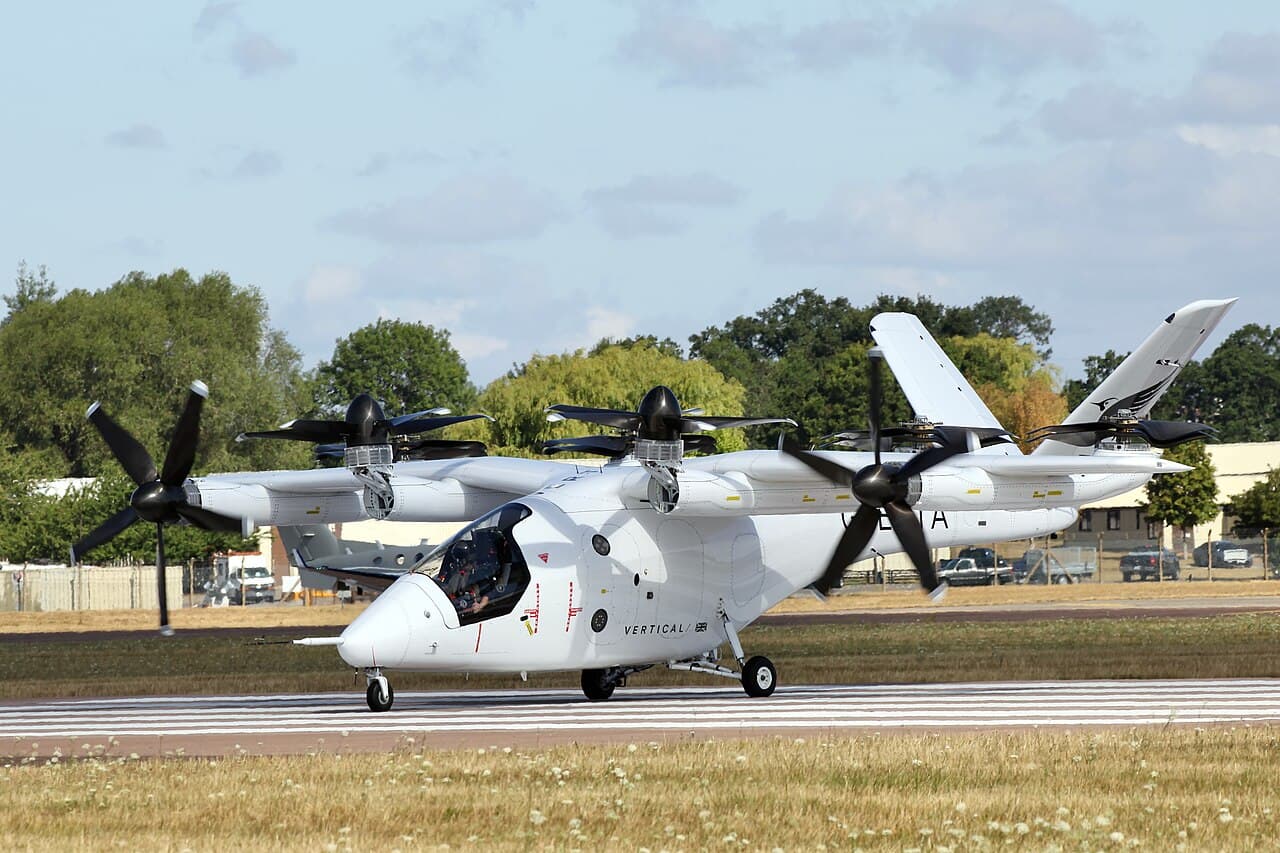
Piloted tilt-rotor eVTOL with eight propellers (four tilting front, four rear) and zero operating emissions. The production design, unveiled as Valo in December 2025, evolves the VX4 prototype with a more aerodynamic airframe and under-floor liquid-cooled batteries - freeing a cabin that seats up to six passengers (four in premium layout) plus a pilot. VX4 prototypes continue to fly the certification test campaign.


Three full-scale VX4 prototypes in piloted flight testing at Cotswold Airport, with two-way transition flights achieved since April 2026. Seven certification-conforming aircraft to be built in the UK; type certification targeted for 2029.

PassengersUp to 6 + 1 pilot
RangeUp to 100 miles
Top SpeedUp to 150 mph
NoiseQuieter than a helicopter

Hybrid-electric version of the Valo airframe for defense, logistics, and wider commercial markets - up to 1,000 miles of range, up to 1,100 kg payload, and a low acoustic and thermal signature, in crewed and uncrewed configurations.

Powertrain ground testing underway on the HYPER rig; turbogenerator supplier selection during 2026; first flight targeted for H1 2027. Uncrewed operations to be developed with Near Earth Autonomy.

RangeUp to 1,000 miles
PayloadUp to 1,100 kg

What's Next

Complete Critical Design Review and stand up early production

Vertical expects to complete the Critical Design Review by the end of 2026, locking the certifiable design baseline for Valo. In parallel, an early production aircraft assembly facility comes online in Q3 2026 and the expanded Vertical Energy Centre battery facility in Q4 2026 - the industrial base for the seven UK-built certification aircraft. As of the August 13, 2026 H1 business update, the UK government remains in advanced discussions on a further grant of up to £10M toward the first full-scale UK production site (not yet finalized; would bring total direct UK government support to up to £48M/$64M), and Vertical has signed a non-binding MOU with UK Export Finance on export-linked customer financing. Vertical aims to select preferred sites before end of 2026.

Q4 2026

Fly the hybrid-electric Valo variant

The hybrid-electric defense/logistics variant is in ground testing on the HYPER rig, with turbogenerator supplier selection during 2026 and first flight targeted for the first half of 2027. The uncrewed configuration is being developed with Near Earth Autonomy under a partnership announced July 16, 2026, which also integrates Honeywell's Anthem digital cockpit already onboard Valo.

H1 2027

Achieve type certification of Valo

Type certification under the UK CAA and EASA's concurrent SC-VTOL Enhanced pathway is now targeted for 2029, re-baselined from 2028 in the July 13, 2026 business update, with entry into service to follow - including announced London routes such as a 12-minute Canary Wharf–Heathrow connection.

2029

Operations & Revenue

StatusFlight testing - piloted transitions achieved; certification 2029

Vertical is flight-testing intensively at Cotswold Airport with three full-scale VX4 prototypes, having completed multiple piloted two-way transition flights since April 2026 and flown public demonstration flights at the Farnborough Airshow (July 20-24, 2026) under an expanded CAA Permit to Fly. Type certification of the production Valo aircraft remains targeted for 2029 (re-baselined from 2028 on July 13, 2026), with Critical Design Review expected by end-2026, an early production assembly facility due Q3 2026, and an expanded Vertical Energy Centre battery facility due Q4 2026. On July 21, 2026 Vertical and Honeywell joined Project VERTI-GO, a 12-partner consortium funded by the EU's SESAR Joint Undertaking to integrate eVTOL and cargo-drone operations into European airspace, with Vertical as the piloted-eVTOL demonstration partner for flights targeted between Malaga and Marbella, Spain in 2028. The UK government remains in advanced discussions on a further grant of up to £10M toward Vertical's first full-scale UK production site (not yet finalized, subject to legal and subsidy-control approval), which would bring total direct UK government support to up to £48M ($64M); Vertical has also signed a non-binding MOU with UK Export Finance on export-linked customer financing, with the wider package expected to support 700 direct jobs outside London by 2030. Vertical's ~$100M August 2026 financing package (Mudrick convertible notes, Yorkville preferred equity, and an underwritten equity offering) closed around August 13, 2026, lifting cash to roughly $134M/£99M (pro forma ~$148M) against a guided ~£110M ($150M) of net cash outflow over the next 12 months and a runway now guided to roughly the end of Q3 2027.

Revenue Streams

Valo Aircraft Sales

Planned sales of the all-electric Valo to airlines, lessors, and operators - anchored by ~1,500 conditional pre-orders worth ~$6B from American Airlines, Avolon, Bristow, GOL, and Japan Airlines across four continents.

Hybrid-Electric Defense & Logistics Variant

A hybrid-electric Valo with up to 1,000 miles of range and 1,100 kg payload targeting defense, logistics, and special missions - in both crewed and uncrewed configurations, the latter developed with Near Earth Autonomy (partnership announced July 16, 2026).

Batteries, Maintenance & Lifecycle Services

Recurring higher-margin revenue from proprietary battery supply, maintenance, and lifecycle services around the Valo fleet, built on Vertical's in-house battery and propeller technology.

Key Metrics

Employees

~450

Est. Annual Revenue

Pre-revenue; H1 2026 net cash used in operations $112M; Q2 2026 EPS -$0.31 (beat -$0.42 est.); guided to ~£110M ($150M) of net cash outflow over the next 12 months, with runway now guided to roughly the end of Q3 2027

Conditional Pre-Orders

~1,500 aircraft (~$6B est. value) - American Airlines, Avolon, Bristow, GOL, Japan Airlines, JetSetGo (India, 50 aircraft MoU); Sigma Air Mobility (Luxaviation Group) added as a new Valo customer via MoU on July 19, 2026 (aircraft count/value undisclosed, not yet folded into the ~1,500 total). No newer customer additions confirmed as of late August 2026.

Certification Target

2029 (UK CAA + EASA concurrent, SC-VTOL Enhanced) - re-baselined from 2028 in July 2026

Flight-Test Campaign

3 full-scale prototypes; piloted two-way transitions since April 2026

Cash Position

~$134M / £99M (Aug 13, 2026 H1 2026 Business Update); pro forma ~$148M after the ~$100M Aug 2026 financing package closed around the same date

Market Cap

~$0.84/share (Aug 13, 2026); market cap ~$115M as of mid-August 2026 - down from ~$165M on Aug 1 amid dilution from the new financing package

Timeline

2026World-first piloted two-way transition under DOA oversight

On April 14, 2026, test pilot Simon Davies flies the VX4 through a piloted two-way transition - vertical takeoff, wingborne cruise, and vertical landing - at Cotswold Airport, making Vertical the second company globally (after Joby) to achieve piloted eVTOL transition and the first to do so under civil Design Organisation Approval regulatory oversight. A $60M equity raise in March anchors an up-to-$850M financing package with Mudrick Capital and Yorkville Advisors.

2026Third prototype flies; Hyundai WIA joins supplier ecosystem

Hyundai WIA is selected as landing-gear partner on May 21, 2026, joining Honeywell (fly-by-wire/avionics), Aciturri (structures), Evolito (motors), and Astronics (power distribution). On June 5, the third and final full-scale prototype (G-EVTB) completes its first piloted flight, doubling flight-test capacity.

2026Certification re-baselined to 2029; public demo flights cleared

On July 13, 2026, Vertical announces it now expects type certification of Valo in 2029, slipping from the prior 2028 target. The same update confirms an expanded CAA Permit to Fly (granted July 10) authorizing the company's first public demonstration flights away from Cotswold Airport, ahead of the Farnborough Airshow, plus program gates: Critical Design Review by end-2026 and an early production assembly facility in Q3 2026.

2026First eVTOL to fly in the Farnborough Airshow flying display

At the Farnborough International Airshow (July 20-24, 2026), Vertical flew public piloted demonstration flights of its full-scale VX4 prototype - the first time an eVTOL has flown in the show's flying display - and exhibited a full-scale model of its production aircraft, Valo. The appearance, enabled by the expanded CAA Permit to Fly granted July 10, marked Vertical's first public flights away from its Cotswold Airport test base.

2026Sigma Air Mobility signs as new Valo customer

On July 19, 2026, Sigma Air Mobility - a Luxaviation Group subsidiary - signs a memorandum of understanding to purchase Valo aircraft and enter Vertical's support-services network; aircraft count and deal value are undisclosed and not yet reflected in the company's ~1,500-aircraft conditional pre-order total.

2026ECLiPSE charging-technology programme launched

On July 24, 2026, Vertical is announced as lead partner on ECLiPSE, a UK government-backed programme (up to £1.75M in Department for Transport funding within a £3.4M total) developing high-power charging and thermal-management technology for electric aircraft, alongside the University of Bath and InnCat Ltd.

2026Joins Project VERTI-GO, Europe's eVTOL airspace-integration consortium

On July 21, 2026, at the Farnborough International Airshow, Vertical Aerospace and Honeywell Aerospace join Project VERTI-GO, a 12-partner consortium funded by the EU's SESAR Joint Undertaking to safely integrate piloted eVTOL and remotely operated cargo-drone operations into European airspace - Europe's counterpart to the FAA's eVTOL Integration Pilot Program. Vertical is the consortium's piloted-eVTOL demonstration partner, with flight demonstrations targeted between Malaga and Marbella, Spain in 2028.

2026H1 2026 results: cash rises to ~$134M as financing package closes

Vertical reports H1 2026 results on August 13, 2026, posting a narrower-than-expected loss (EPS -$0.31 vs. -$0.42 estimated) on H1 net cash used in operations of $112M. Cash on hand rose to roughly $134M (£99M), with pro forma cash of about $148M after the ~$100M August 2026 financing package (Mudrick convertible notes, Yorkville preferred equity, and an underwritten equity offering) closed around the same date. Vertical guided to roughly £110M ($150M) of net cash outflow over the next 12 months and now expects its cash runway to extend to around the end of Q3 2027.

2025Piloted flight campaign accelerates - Europe's first piloted wingborne eVTOL flight

Piloted thrustborne (hover) testing begins in January 2025. On May 27, 2025, the VX4 completes Europe's first piloted wingborne flight of a winged eVTOL in open airspace. By September the campaign had logged 250+ miles piloted, reached 120 knots and 2,000 feet, and moved into final pre-transition testing.

2025Hybrid-electric variant announced for defense and logistics

In May 2025, Vertical announces a hybrid-electric variant of its aircraft with up to 1,000 miles of range and 1,100 kg payload, aimed at defense, logistics, and wider commercial markets - a second product line sharing the same airframe, with ground testing on the HYPER rig.

2025Production aircraft unveiled as Valo

On December 10–11, 2025, Vertical unveils Valo - the production evolution of the VX4 - at an event in Canary Wharf, London. The certification-intent design features a more aerodynamic airframe, under-floor liquid-cooled battery packs freeing cabin space for up to six passengers, and updated propellers and landing gear. Seven certification aircraft are to be built in the UK, and planned London routes include a 12-minute Canary Wharf–Heathrow hop.

2024Financial restructuring - Mudrick Capital takes control

Stuart Simpson, previously CFO, becomes CEO in May 2024. In December, Vertical finalizes a rescue package: Mudrick Capital provides $50M in new funding and converts $130M of debt to equity at $2.75/share, becoming the controlling shareholder as founder Stephen Fitzpatrick cedes control.

2023VX4 prototype damaged in uncrewed test

On August 9, 2023, the full-scale VX4 prototype is damaged during an uncrewed test flight at Cotswold Airport after a propeller-blade fault - a setback that pushes the flight-test program onto a rebuilt, upgraded prototype.

2021NYSE listing via SPAC at $2.2B valuation

Lists on the NYSE on December 16, 2021 through a SPAC merger with Broadstone Acquisition Corp at a $2.2B valuation, raising over $300M gross including a $94M PIPE from American Airlines, Avolon, Honeywell, Rolls-Royce, and Microsoft's M12 - on top of a $205M convertible note round led by Mudrick Capital in October.

2016Founded by Stephen Fitzpatrick

OVO Energy founder and former F1 team owner Stephen Fitzpatrick founds Vertical Aerospace in Bristol, UK, to build electric vertical take-off and landing aircraft. Its first prototype, the 750 kg VA-X1 quadcopter, flies at Cotswold Airport in June 2018.

Funding

Cumulative disclosed raise · dated rounds

$250M$500M$750M20222023202420252026$715M raised
RoundDateAmountInvestorsSource
Convertible Senior Secured NotesOctober 2021$205MMudrick Capital (lead)
SPAC IPO (Broadstone Acquisition Corp)December 2021$300M+ gross (incl. $94M PIPE)Public offering (NYSE: EVTL); PIPE: American Airlines, Avolon, Honeywell, Rolls-Royce, Microsoft M12
Restructuring - New Funding & Debt ConversionDecember 2024$50M new + $130M debt-to-equityMudrick Capital (becomes controlling shareholder)
Equity Raise + Financing PackageMarch 2026$60M gross + up to $850M facilitiesPublic offering at $5.00/share; Mudrick Capital and Yorkville Advisors (incl. $500M standby equity purchase agreement)
Additional Financing CommitmentsAugust 2026~$100MMudrick Capital ($40M convertible note draws), underwritten equity offering ($35M at $1.05/unit), Yorkville Advisors preferred-equity facility ($25M)

/ Related Companies

All eVTOL
Airbus logo

Airbus

eVTOL +1

Airbus is Europe's largest aerospace company, spanning commercial aircraft, helicopters, defence and space. In civil aviation it remains Boeing's only true peer at global scale and is pairing near-term production growth with longer-term work on lower-carbon aircraft technologies, future single-aisle designs and hydrogen propulsion. The company combines a mature global airliner business with broader aerospace capabilities across defence, space and rotorcraft. Q1 2026 was unusually weak - 114 deliveries (vs. 136 a year earlier), revenue down 7% to EUR 12.65B and adjusted EBIT halved to EUR 300M due to Pratt & Whitney engine shortages and Chinese delivery disruptions - but Airbus reaffirmed full-year 2026 guidance of ~870 deliveries, EUR 7.5B adjusted EBIT and EUR 4.5B free cash flow, with a record commercial backlog above 9,000 aircraft. Output recovered strongly through mid-year: official figures reported July 10 showed 351 deliveries in H1 2026 (up ~15% YoY), Airbus's best first half since 2019, and the backlog stood at 9,216 aircraft at end-June. At a measured Farnborough Airshow (July 20-24, 2026) Airbus booked roughly 157 firm commercial orders plus commitments (of a show-wide $84.7B / 353 firm aircraft), headlined by SMBC Aviation Capital's 100 A320neo-family jets, VietJet's 20 A330neos (~$7.4B), and new A350-1000 orders from Riyadh Air and Philippine Airlines, with CEO Guillaume Faury reaffirming the ~870-delivery full-year target. On July 26 Airbus announced a EUR 5B share buyback and raised medium-term targets, and on July 29 it reported H1 2026 results: revenue up 12% YoY to EUR 33.2B on 351 deliveries, powered by a record Q2 (237 deliveries, +39% YoY). Airbus's official July tally, published August 7, showed the delivery pace cooling further to 67 aircraft (39 customers) and 204 gross orders, taking YTD deliveries to 418 versus 373 at the same point in 2025 - still 51 aircraft ahead of Boeing (367 YTD) but below the roughly 85-90/month cadence needed to reach the 870-aircraft target. August's official tally showed a further cooldown to 47 aircraft delivered to 31 customers and 46 gross orders (including airBaltic firming 10 more A220-300s), taking YTD deliveries to 465 - now requiring an average of roughly 100 aircraft a month over the final four months of the year to hit the 870-aircraft guidance. Part of the August softness traces to a production quality issue on the A330neo: Airbus found a stray tool and other quality lapses on the horizontal tail plane (assembled at its Getafe plant) that nearly halted A330neo deliveries for three months - zero handed over in June and July, just one in August, to Starlux Airlines - before Airbus said in early September the root cause was identified, the issue was isolated and unrelated to the Spain labor dispute, and deliveries had resumed. Two other supply and schedule risks continue to shadow the ramp: Airbus's dispute with Pratt & Whitney over shorted A320neo engine deliveries has hardened into a formal damages claim that could go to arbitration, and the A350F freighter has now penciled in a tentative first-flight date around September 24, 2026 (reports August 19-20), with first delivery still targeted for the second half of 2027 - a tight but so-far-unrevised schedule given typical 12-15 month flight-test campaigns. Airbus also confirmed two divisional leadership changes already in effect this year (Lars Wagner as Commercial Aircraft CEO since January, Matthieu Louvot as Airbus Helicopters CEO since April) and a board chair transition, with Amparo Moraleda succeeding Rene Obermann on October 1, 2026. Thousands of Airbus workers in Spain resumed an indefinite strike the week of August 24 after rejecting a pay offer; on August 31 workers voted 81% to keep striking rather than suspend it, and on September 1 SIMA-mediated talks with the three unions leading the walkout (CGT, UGT, UTIL) broke down without agreement, so Airbus shifted to a parallel negotiating track with non-striking unions (CCOO, SIPA, ATP) while the indefinite strike, and its drag on production, continued into early September with no resolution yet. On the defense side, Airbus also picked up two notable wins in mid-to-late August: a $115 million U.S. Army contract (option for two more) for 10 UH-72B Lakota helicopters announced August 14, and a EUR 5.4 billion (~$6.3B) Spain-Poland framework agreement approved by Spain's Council of Ministers on August 25 for the joint procurement of seven A330 MRTT tankers (three for Spain, four for Poland) under the EU's SAFE instrument, to be assembled at Airbus's Getafe site with Polish deliveries targeted by 2030 and definitive contracts still to be negotiated. Airbus's stock has held up despite the noise, with a market cap of roughly $190B in mid-August 2026. Separately, on August 29, 2026 the Financial Times reported that Airbus is reviewing its US small-satellite manufacturing business at Merritt Island, Florida (more than 200 staff and several hundred million dollars in annual revenue), with a sale among the options; Airbus confirmed the review and said it is separate from its planned European space combination with Leonardo and Thales.

Archer Aviation logo

Archer Aviation

eVTOL +1

Archer Aviation is an electric aircraft company building Midnight, a piloted four-passenger eVTOL for short urban trips, while expanding into defense, powertrain sales, and aviation software. As of Q1 2026 Archer had passed 700 Midnight test flights, completed 70% of for-credit FAA flight-test points, and formally closed FAA Phase 3 in April 2026 - the first eVTOL company to do so - unlocking Type Inspection Authorization (TIA) and entering Phase 4 (formal compliance testing). In the UAE, the GCAA transitioned Midnight to a Restricted Type Certificate (RTC) program on May 7, 2026, targeting initial commercial certification as early as Q3 2026 - meaning Abu Dhabi is likely to see the first Midnight passenger flights before the U.S. The critical remaining FAA milestone is a publicly demonstrated piloted transition flight (VTOL→forward-flight mode), which is slated for H2 2026 and had still not been publicly demonstrated as of August 30, 2026. U.S. operations are targeted for H2 2026 in Florida, New York, and Texas under the eIPP. Archer is also the named official air taxi provider of the 2028 LA Olympics. On July 15, 2026, Archer unveiled Zee, an aviation-specific AI foundation model trained on ADS-B, air-traffic, and flight data, extending its ambitions beyond air taxis into aviation software. On July 20, 2026 at the Farnborough Airshow, Archer and Anduril unveiled a jointly-developed autonomous, series hybrid-electric tilt-rotor VTOL platform - a defense variant, Anduril's Group 5 'Thunder' attack rotorcraft, and Archer's commercial 'Halo' variant - sending Archer shares up about 20%. On August 3, 2026, Korean Air - which agreed in October 2025 to become Archer's exclusive commercialization partner in South Korea for up to 100 Midnight aircraft - said it will lead conversion and systems integration of a militarized Midnight variant for South Korea's Advanced Air Mobility defense program, extending Archer's defense ambitions into an international export partnership. On August 10, 2026 Archer reported Q2 2026 revenue of $5M (up 213% sequentially, beating estimates) but a wider-than-expected GAAP loss of $0.34/share on a one-time litigation settlement; Adjusted EBITDA loss was $177M and total liquidity fell to about $1.6B, and the company held Q3 2026 Adjusted EBITDA guidance at a loss of $170-200M. Archer also disclosed that during the quarter the FAA approved its quality management system, enabling FAA-creditable conformity findings across the aircraft, its components, and systems - Archer says this makes it the only eVTOL OEM in Phase 4 of type certification with an accepted means of compliance, on top of more than 150 piloted Midnight test flights completed (some exceeding 50 miles). The same day, Archer announced a deal to acquire Boeing's Wisk Aero, Insitu and SkyGrid businesses in exchange for a Boeing equity stake of up to 19.75%, a transaction still subject to Hart-Scott-Rodino antitrust review and expected to close by year-end 2026.

Beta Technologies logo

Beta Technologies

eVTOL +1

Beta Technologies is an electric aerospace company building the ALIA aircraft family, electric propulsion systems, charging infrastructure, batteries, and flight-critical systems for cargo, passenger, medical, and defense markets. Founded in 2017 by Kyle Clark, the company went public on the NYSE in November 2025 and uses a stepwise commercialization path centered on certifying its conventional ALIA CTOL aircraft first while scaling motor, charger, and engineering services. By Q1 2026, Beta had grown its aircraft backlog to 991 units worth $3.9 billion, and by Q2 2026 had logged over 190,000 nautical miles of flight testing across a 138-site charging network (targeting 250,000 nautical miles by year-end 2026). Beta was selected for seven of the eight U.S. eIPP launch programs and flew the program's first operational missions on July 10, 2026, using the ALIA CX300 to carry United Therapeutics' manufactured organs across a ~275-nautical-mile Virginia-Maryland corridor, and by August 2026 was running eIPP cargo and medical-logistics missions with partners in New York, Texas, Utah, Maryland/Virginia, and Louisiana. At the July 2026 Farnborough Airshow, Beta unveiled the MV250 - a hybrid-electric autonomous VTOL for military logistics built around a GE Aerospace CT7/T700 turbine and Sikorsky's MATRIX autonomy stack - helped GE, NASA, and Boeing complete the first hybrid-electric flight above 30,000 feet, and signed a term sheet with UK carrier Loganair for up to 10 ALIA CTOL aircraft, positioning Loganair to become Europe's first electric-aircraft airline. Q2 2026 revenue was $14.7 million (up 146% year over year, beating guidance), with FY2026 guidance raised to $42-$50 million and $1.48 billion in cash as of June 30, 2026. H500A motor certification has slipped past its original H1 2026 target, though Beta reported in its Q2 2026 results that it reached agreement with the FAA on the motor's continued-rotation compliance approach and has formal FAA testing underway; CEO Kyle Clark still targets ALIA CX300 type certification in the second half of 2027 (down from an original late-2025 goal), with the A250 eVTOL following around 2028.

Joby Aviation logo

Joby Aviation

eVTOL +1

Joby Aviation is a California-based transportation company developing a piloted, all-electric air taxi for commercial passenger service. The company completed FAA Stage 4 certification in late March 2026 and is now in Stage 5 (Type Inspection Authorization), the final gate before U.S. commercial type certification, which analysts expect in late 2026 - Q2 2026 was its strongest quarter of certification progress yet, with five conforming aircraft flying and 12 more in production. On July 7, 2026 the UAE's GCAA certified its flagship Dubai vertiport (VDX at DXB) as the world's first certified commercial eVTOL vertiport, clearing the network for a public launch directed before year-end, and in early August 2026 Joby established a U.S. hub at Perot Field Fort Worth Alliance Airport ahead of planned eIPP demonstration flights there in September 2026. The company reported Q2 2026 revenue of $38.6M (beating estimates), ended the quarter with $2.3B in cash and short-term investments, and raised full-year 2026 revenue guidance to $115M-$125M. On August 11, 2026 Joby agreed to acquire Ohio-based defense firm Resonant Sciences for about $500M to build a dedicated defense business, and launched a $750M at-the-market equity program to help fund its growth. Joby expects to carry its first paying passengers in the UAE and through the White House-backed eIPP program in the U.S. in 2026.

Aridge logo

Aridge

eVTOL

Aridge - known as XPeng AeroHT until an October 2025 rebrand - is the Guangzhou-based flying-car affiliate of EV maker XPeng, majority-owned by XPeng and its CEO He Xiaopeng. Its flagship Land Aircraft Carrier pairs a six-wheel hybrid van with a detachable two-seat eVTOL air module that the van stores, recharges, and auto-launches. The company has taken 7,000+ pre-orders at under RMB 2M apiece (including a 600-unit Middle East bulk order), completed the world's first flying-car mass-production factory in Guangzhou (first module off the line November 2025, 10,000 units/year design capacity), and has raised roughly $1B in equity - with first customer deliveries targeted for late 2026 pending CAAC certification and a confidential Hong Kong IPO filed in January 2026. A six-seat hybrid tiltrotor, the A868, is in flight testing.

AutoFlight logo

AutoFlight

eVTOL

AutoFlight (Shanghai Fengfei Aviation Technology) is a Shanghai-based eVTOL developer founded by Yuneec founder Tian Yu, with R&D and certification outposts in Augsburg, Germany and Shenzhen. It leads the world in cargo eVTOL: its autonomous 2-ton CarryAll (V2000CG) holds the complete CAAC certificate set - the world's first ton-class eVTOL type certificate (March 2024), production certificate (December 2024), and airworthiness certificate with first customer delivery (July 2025) - plus the world's first overseas eVTOL type-certificate validation, from Indonesia's DGCA in June 2026. CarryAll flies real missions, from offshore oil-platform resupply with CNOOC to mountain tea logistics in Guizhou. The passenger Prosperity, which set a 250.3 km world-record eVTOL flight in 2023 and flew the first cross-sea Shenzhen–Zhuhai demo in 2024, is in CAAC type certification, and a 5.7-ton, 10-seat V5000 'Matrix' platform entered certification in 2026. Backed by ~$100M from Team Global and a strategic investment of 'hundreds of millions of dollars' from battery giant CATL.