Independent reporting says the 10-14 September Dallas-Fort Worth eIPP week flew AFW, DFW Corporate Aviation, Arlington, and Toyota Plano as piloted, no-passenger demonstrations, and no later U.S. eIPP passenger-carrying flights have been reported. The Q2 letter still targets first passengers in 2026 without specifying paying U.S. service by year-end. The Toyota exclusive manufacturing supply agreement and second $250 million tranche remain unsigned. Joby posted that the J208 reached Portland International and that the coast-to-coast-to-coast tour is complete, but the Electric Skies page checked 15 October 2026 still describes the 2 October Portland stop as upcoming, and no independent source confirmed that KPDX demo flights flew. A Middle District of Florida jury verdict of about $116.9 million for Aerosonic on 2 October 2026 (No. 8:25-cv-00554) is not a final judgment. The stock closed at $5.99 on 29 September 2026 (market cap about $5.92 billion).
Complete FAA Stage 5 (TIA) and receive U.S. type certificate
Joby is in Stage 5 - the final FAA certification gate. As of the July 31, 2026 shareholder letter, Stage 5 Show & Verify stood at Joby 20% / FAA 10%. Five conforming aircraft are now flying and 12 more are in production, with at least two more expected off the line in the second half of 2026, validating range, speed, and energy management under operational conditions ahead of FAA-pilot 'for credit' TIA inspection flights at Joby's Marina, California facility. Analysts still expect the U.S. type certificate by late 2026, which would be the first ever granted to a commercial eVTOL in U.S. history. As of September 9, 2026, that 'for-credit' testing had still not been reported as complete, and Joby holds a narrow lead over rival Archer Aviation in the certification race.
Complete the J208 10-state supervised-autonomy tour
Joby's converted Cessna 208B J208 completed the eastbound transcontinental leg on September 18, 2026, a 3,199-mile flight from Concord, California to Dare County, North Carolina with zero onboard safety-pilot inputs. The westbound return is still ahead: Raleigh, Fredericksburg/Washington (KRMN), Louisville, Wichita, Oklahoma City, Salt Lake City and Portland. Watch whether those stops run as supervised operations with a remote Pilot in Command and generate usable airspace-integration data for freight, medical transport, disaster response and defense logistics.
Sign Toyota exclusive manufacturing supply agreement and close second $250M tranche
Joby and Toyota's Delaware manufacturing joint venture, formed June 29, 2026, still needs an exclusive manufacturing supply agreement granting the JV exclusive rights to build the S4 - the companies have only agreed to negotiate one so far. Joby has said it expects to secure Toyota's next $250M investment tranche before the end of 2026, contingent on finalizing that supply agreement and hitting related regulatory milestones. Re-verified September 14, 2026: neither the exclusive MSA nor the second $250M tranche has been announced as signed.
Begin first passenger operations in UAE and U.S. eIPP markets
TargetYear-end 2026 (paying passengers)
Joby's Dubai vertiport network cleared a decisive hurdle on July 7, 2026 when the GCAA certified the flagship VDX vertiport at DXB - the world's first certified commercial eVTOL vertiport - with public service across the four-node network (VDX/DXB, American University of Dubai, Palm Jumeirah, Dubai Mall) still directed to launch before the end of 2026, subject to Joby completing final GCAA operational certification. In the U.S., Joby said on September 10, 2026 that Texas kicked off its first White House-backed eIPP demonstration flights, a week-long Dallas-Fort Worth campaign through September 14 from the Perot Field Fort Worth Alliance Airport hub, including planned routes into DFW Corporate Aviation, Arlington, and Toyota's Plano campus. Those flights are demonstrations, not paying passenger service. First paying U.S. passengers remain targeted before year-end under the program.
Joby's agreement to acquire Ohio-based defense firm Resonant Sciences is subject to regulatory review and customary closing conditions. Closing is still expected in the first half of 2027; as of September 9, 2026 the deal remains unclosed and Resonant's results are not in Joby's numbers. Closing would give the combined company about 1 million square feet of manufacturing, integration and testing space around Dayton, Ohio, and formally stand up Resonant as Joby's dedicated defense business alongside its air-taxi program.
Scale manufacturing at Ohio and California facilities
Bring Joby's expanded Dayton, Ohio footprint online - including the second, 700,000+ sq ft Ohio facility it agreed to acquire in January 2026 - and ramp propeller blade and component manufacturing across both California and Ohio sites, now backed by the Joby-Toyota manufacturing joint venture formed June 29, 2026. The composites team is producing roughly 2.5x more parts than a year earlier, and Q2 2026 output reached five conforming aircraft flying with 12 more in production, supporting a plan to roughly double U.S. capacity to four aircraft per month by 2027. Re-verified September 14, 2026: no new capacity figure since the Q2 letter.
A Tampa federal jury found Joby Aero liable for breaching a 2021 nondisclosure agreement and willfully misappropriating Aerosonic trade secrets about air-data probes, awarding about $116.9 million ($68.6 million for the NDA, $29.9 million for misappropriation, and $18.3 million in exemplary damages). Joby said the verdict is not a final judgment, that it independently developed its air-data system, and that it has asked the court to overturn the verdict and will appeal. The verdict was entered Friday, Oct. 3.
On Sept. 29, 2026 the U.S. District Court for the Northern District of California ruled on motions to dismiss in Joby Aero v. Archer Aviation, Case No. 5:25-cv-10703-SVK. Archer's Oct. 2 Form 8-K said the court dismissed certain trade-secret and contract claims against Archer and an employee, some with leave to amend, while other claims proceed. The court dismissed Archer's Lanham Act and California Unfair Competition Law counterclaims against Joby Aero and Joby Aviation without leave to amend.
Joby Aviation said on September 18 that its autonomous J208, a converted Cessna Caravan, completed a 3,199-mile flight from Concord, California to Dare County Regional Airport in North Carolina's Outer Banks with zero control inputs from the onboard safety pilot. The aircraft taxied, took off, navigated and landed under remote supervision from Joby's California headquarters and Shaw Air Force Base, up to 2,323 miles away. The eastbound Electric Skies tour is done; the aircraft now turns west through Raleigh, Fredericksburg/Washington, Louisville, Wichita, Oklahoma City, Salt Lake City and Portland.
Joby Aviation said on September 10, 2026 that its autonomous J208, a converted Cessna 208B Grand Caravan flying the Xwing autonomy stack, has begun a month-long coast-to-coast tour with stops across 10 states. The company said the aircraft has logged more than 400 flights and 800 automated hours and is demonstrating supervised autonomy for freight, medical transport, disaster response and defense logistics under the White House-backed eIPP. A remote pilot remains Pilot in Command, and a monitoring pilot is onboard for select operations.
Joby Aviation said on September 10, 2026 that Texas is kicking off its first White House-backed eVTOL Integration Pilot Program flights, with a week-long Dallas-Fort Worth campaign through September 14. Routes include Perot Field Fort Worth Alliance Airport, DFW Corporate Aviation, Arlington, and Toyota's Plano campus, from a new 45,000-square-foot AFW hub. FAA Administrator Bryan Bedford and Transportation Secretary Sean P. Duffy both commented on the demonstrations. Paying passenger service is still targeted before year-end.
Joby Aviation agreed on August 11, 2026 to acquire Resonant Sciences, a Dayton, Ohio-based defense technology company, for about $500 million in a mix of cash and stock. Resonant makes radomes, antennas, and stealth-testing products for active U.S. national security programs, employs about 250 people, and has grown revenue roughly 40% year over year to more than $100 million. The deal creates a dedicated Joby defense business alongside its air taxi program and is expected to close in the first half of 2027.
Joby Aviation signed a definitive agreement on August 10-11 to acquire Ohio-based defense technology company Resonant Sciences for about $500 million, funded with roughly $450 million in cash and $50 million in Joby common stock. Resonant, which designs radio-frequency and mission systems for U.S. national security customers and reports $100 million in trailing 12-month revenue, will become Joby's dedicated defense business upon closing, expected in the first half of 2027, expanding Joby's push beyond air taxis into hybrid aircraft, autonomy and classified government programs.
Joby Aviation said on August 6, 2026 that it signed a lease for a 45,000-square-foot facility at Perot Field Fort Worth Alliance Airport, its first major hub in North Texas. The site will support Joby's piloted S4 test flights across the Dallas-Fort Worth Metroplex planned for September 2026 under the federal eVTOL Integration Pilot Program.
Joby Aviation reported Q2 2026 revenue of $38.6 million on August 5, well ahead of the roughly $31 million analyst estimate, driven mainly by its Blade passenger business, which contributed $36.2 million on its best second quarter on record. The company raised its full-year 2026 revenue guidance to $115-125 million from $105-115 million and said it expects to begin eIPP demonstration flights in Texas in September, still targeting its first paying passengers before the end of 2026.
Joby Aviation and Atoms, led by former Uber CEO Travis Kalanick, announced a definitive agreement on August 4 to acquire and develop a network of vertiport sites across the U.S., anchored by Joby's open-source Global Electric Aviation Charging System. The partnership starts in Florida, New York and Texas, the markets where Joby is preparing early eVTOL Integration Pilot Program operations, as well as California, with the vertiports designed as multimodal hubs linking air taxis, autonomous ground vehicles and ridesharing.
Joby Aviation and Virgin Atlantic signed a definitive agreement at the Farnborough International Airshow on July 22, converting their 2025 partnership into a binding, multi-year commercial framework that names Virgin Atlantic as Joby's exclusive UK airline partner for air taxi service. Joby will operate its all-electric aircraft and secure UK Civil Aviation Authority approvals while Virgin integrates bookings into its website and app, with initial hubs planned in London and Manchester and early routes such as an eight-minute Heathrow-to-central-London hop. The deal deepens Joby's ties to the Delta-Virgin group, since Delta owns 49% of Virgin Atlantic and is already Joby's U.S. airline partner.
Joby Aviation subsidiary Joby Aero and Toyota Motor Corporation incorporated a Delaware joint venture on June 29 to manufacture Joby's S4 eVTOL aircraft, with Toyota holding 51% and Joby 49% and a five-member board split three-to-two in Toyota's favor. The parties intend to sign an exclusive manufacturing supply agreement granting the JV exclusive rights to build the S4, tied to regulatory milestones and a future $250 million Toyota investment tranche. The move deepens a partnership under which Toyota has already committed roughly $894 million to Joby.
A ruling in the trade-secrets fight between eVTOL rivals Joby Aviation and Archer Aviation, reported June 18, allowed Joby's core misappropriation claim - tied to a confidential real-estate developer partnership - to move forward while dismissing several broader claims and throwing out all of Archer's counterclaims alleging fraud and import misclassification. U.S. Magistrate Judge Susan van Keulen issued the order in the Northern District of California, giving both sides limited windows to amend their claims. Joby first sued Archer and a former Joby employee in November 2025 over allegedly stolen confidential information.
A federal magistrate judge, Susan van Keulen, ruled in early June that the core of Joby Aviation's trade-secret lawsuit against rival Archer Aviation and former Joby employee George Kivork can proceed - centered on a confidential real-estate developer agreement - while dismissing Archer's counterclaims in their entirety as 'impermissible shotgun pleadings,' with leave to amend by June 29. Both eVTOL developers claimed partial victory; Joby may amend its complaint by June 22, and the procedural reset keeps the closely watched corporate-espionage fight between the two leading U.S. air-taxi companies alive. The ruling lands as both race through FAA type certification ahead of planned 2026 commercial launches.
(beat ~$31M estimate, Blade contributed $36.2M); Q1 2026: $24.2M; 2026 guidance raised to $115M-$125M (from $105M-$115M); 2025 actual: $53.4M. Still the latest reported quarter as of Sept. 14, 2026.
Flight-Test Miles
50,000+
Certification Progress
FAA Stage 5
(TIA) underway. As of the July 31, 2026 shareholder letter, Stage 5 Show & Verify stood at Joby 20% / FAA 10%. Fleet stands at five conforming aircraft flying and 12 more in production, with at least two more expected off the line in H2 2026. Joby established a hub at Perot Field Fort Worth Alliance Airport in early August 2026 and on September 10, 2026 said Texas kicked off the first White House-backed eIPP demonstration flights, a week-long Dallas-Fort Worth campaign through September 14. Dubai vertiport (VDX) GCAA-certified July 2026. No U.S. type certificate yet; Joby remains narrowly ahead of rival Archer Aviation in the FAA race.
Top Speed
200 mph (322 km/h)
Market Cap
~$6.32B
September 11, 2026 close; $6.39/share; 989.12M shares
In Aerosonic LLC v. Joby Aero, Inc., No. 8:25-cv-00554-VMC-AAS (M.D. Fla.), a jury on 2 October 2026 returned a verdict awarding Aerosonic about $116.9 million after finding Joby Aero liable for NDA breach and willful trade-secret misappropriation on air-data probes. The public docket, updated 13 October 2026, shows that jury verdict (Doc. 543) and pending post-trial motions, including Joby Aero motion for judgment as a matter of law. No final judgment, stay, or reduction appears. Joby told AVweb the verdict is not a final judgment and that it has asked the court to overturn it. Joby remains in FAA Stage 5 (TIA). The 31 July 2026 shareholder letter is still the latest Stage 5 print (Joby 20 percent / FAA 10 percent), and for-credit TIA has not been reported complete. No U.S. eIPP passengers, paying or non-paying, have been reported after the 10-14 September Texas demonstration week. The Toyota exclusive manufacturing supply agreement and second $250 million tranche remain unsigned. The 30 June 2026 8-K is still the latest Toyota agreement, and EDGAR shows no Joby 8-K after 11 September 2026.
Revenue streams
Passenger Air Mobility Services
Current passenger revenue comes from Blade's helicopter and charter network, which Joby acquired in 2025 (heliports served over 90,000 Blade passengers in 2025). Blade drove $36.2M of Joby's $38.6M Q2 2026 revenue, its best second quarter on record, with seats sold up more than 50% year over year - aircraft availability, not passenger demand, is now the binding constraint on many routes. Joby plans to use that operating base and customer demand to transition key corridors over time to its own all-electric aircraft.
Aircraft Sales and Partner Services
Joby intends to both operate its own air taxi network and sell aircraft to other operators and partners, using airline partnerships to seed early markets and fold air-taxi booking into partner apps. Its July 2026 deal naming Virgin Atlantic as exclusive UK airline partner is the template: Joby keeps aircraft operations, route management, and regulatory approvals, while the airline partner handles infrastructure integration and customer acquisition.
U.S. Department of Defense Contracts
Agility Prime work and newer hybrid-aircraft programs support defense, logistics, autonomy, and mission-demonstration use cases with U.S. government customers and partners such as L3Harris, leveraging the Xwing 'Superpilot' autonomy platform. The Joby/L3Harris turbine-electric autonomous VTOL demonstrator, announced August 2025, completed its first flight on November 7, 2025, and is slated for government-exercise demonstrations in 2026. Joby agreed on August 10-11, 2026 to acquire radio-frequency and mission-systems maker Resonant Sciences for about $500 million to scale this business into a dedicated defense unit, pending a close expected in the first half of 2027.
07
Timeline31
2026
Joby posts J208 Portland arrival; Electric Skies page still future tense
Joby public posts say the J208 last tour stop brought the aircraft to PDX, with Mount Hood on the approach, and that the coast-to-coast-to-coast tour is complete. Checked 15 October 2026, the Electric Skies page still says electric skies are headed to Oregon and that the J208 makes its way to Portland for autonomous demo flights on 2 October. This check found no independent confirmation that Portland KPDX demo flights flew.
Aerosonic jury verdict is not yet a judgment
On 2 October 2026 a Middle District of Florida jury in Aerosonic LLC v. Joby Aero, Inc., No. 8:25-cv-00554-VMC-AAS, returned a verdict awarding Aerosonic about $116.9 million. The public docket updated 13 October 2026 shows Doc. 543 as the jury verdict and the Joby Aero motion for judgment as a matter of law still pending, with no final judgment, stay, or reduction entered. Joby told AVweb the verdict is not a final judgment.
Tampa jury awards Aerosonic $116.9M in probe case
A federal jury in Tampa found Joby Aero liable for breaching a 2021 NDA and willfully misappropriating Aerosonic air-data-probe trade secrets, awarding about $116.9 million. The award included $68.6 million for the NDA, $29.9 million for misappropriation and $18.3 million in exemplary damages. Joby said the verdict is not a final judgment, that it independently developed its air-data system, and that it has asked the court to overturn it.
Electric Skies page features Portland October 2 stop
Joby's Electric Skies tour page now leads with Hello, Oregon and autonomous demo flights October 2, saying the J208 makes its way to Portland via Idaho. The copy remains future-tense (headed your way). This run found no independent confirmation that Portland International (KPDX) demo flights actually flew.
J208 westbound tour flies Salt Lake City
On September 30, 2026 UDOT said it welcomed Joby as the company remotely operated its supervised autonomous J208, with Superpilot, in Utah on the Electric Skies tour. UDOT called Utah the second-to-last stop on a coast-to-coast journey covering a dozen cities and 5,541 nautical miles.
Some Joby claims proceed after Archer MTD ruling
On Sept. 29 the Northern District of California narrowed Joby Aero's trade-secret and contract claims against Archer and an employee while letting other claims proceed, and dismissed Archer's Lanham Act and UCL counterclaims without leave to amend, according to Archer's Oct. 2 8-K.
J208 westbound tour features Oklahoma City
Joby's Electric Skies tour page now features Oklahoma City autonomous J208 demo flights on September 29, 2026, at the FAA technical training hub. This is westbound progress after the September 18 eastbound Concord-to-Dare County arrival. The Sept 18 release listed remaining stops as Raleigh, Fredericksburg/Washington (KRMN), Louisville, Wichita, Oklahoma City, Salt Lake City and Portland. Intermediate landings between Raleigh and Oklahoma City are not independently confirmed as flown. J208 remains a converted Cessna 208B autonomy demonstrator, not S4 type certification.
Independent coverage dated September 14 says Joby's week-long Dallas-Fort Worth eIPP campaign ran September 10-14 and flew the planned legs: AFW kickoff with Beta, a round trip into DFW Corporate Aviation, a low-noise Arlington/Stockyards round trip, and the AFW-to-Toyota Plano corridor. Flights were piloted demonstrations with no passengers and generated no air-taxi revenue. Joby's own Sept 10 release listed those routes as the campaign schedule. This is S4 eIPP work, not the J208 autonomy tour, though J208 stopped at AFW on September 10.
2026
Issues 2.42M shares for Blade passenger EBITDA earnout
Joby filed a prospectus supplement covering resale of 2,419,801 shares of common stock issued to the selling stockholder after the acquired Blade passenger operations (Strata Critical Medical, Inc., f/k/a Blade Air Mobility, Inc., and related entities) achieved specified EBITDA milestones in the 12 months after closing. The issuance is incremental consideration on the 2025 Blade passenger-business acquisition, not a new cash raise.
J208 completes first fully autonomous transcontinental US flight
On September 18, 2026 Joby said its autonomous J208, a converted Cessna Caravan flying the Xwing stack, completed a 3,199-mile flight from Buchanan Field in Concord, California to Dare County Regional Airport in North Carolina's Outer Banks with zero control inputs from the onboard safety pilot, including autonomous taxi, takeoff, cruise and landing. Remote supervision came from Joby's Autonomy Headquarters in California and Shaw Air Force Base in South Carolina, up to 2,323 miles away. Eastbound stops included Phoenix Deer Valley, Fort Worth Alliance, Shaw AFB and the Outer Banks, with a low pass near the First Flight Monument at Kitty Hawk. The aircraft now begins the westbound tour through Raleigh, Fredericksburg/Washington, Louisville, Wichita, Oklahoma City, Salt Lake City and Portland.
J208 autonomous Caravan begins 10-state cross-country tour
On September 10, 2026 Joby said its autonomous J208, a converted Cessna 208B Grand Caravan flying the Xwing autonomy stack acquired in 2024, had begun a month-long coast-to-coast tour with stops across 10 states as part of the 2026 Electric Skies tour and eIPP. Joby said the aircraft has accumulated more than 400 flights and 800 automated hours under a supervised-autonomy model, with a ground-based remote pilot as Pilot in Command and a monitoring pilot onboard for select operations. Stops include Phoenix, Fort Worth Alliance, Shaw Air Force Base, the Outer Banks, Raleigh, Stafford/Washington, Louisville, Wichita, Oklahoma City, Salt Lake City and Portland, aimed at freight, medical transport, disaster response and defense logistics.
Begins Texas eIPP demonstration flights across Dallas-Fort Worth
On September 10, 2026 Joby said Texas kicked off its first White House-backed eVTOL Integration Pilot Program flights, opening a week-long Dallas-Fort Worth campaign through September 14. Planned routes include Perot Field Fort Worth Alliance Airport, DFW Corporate Aviation, Arlington, and Toyota Motor North America headquarters in Plano, operating from a new 45,000-square-foot AFW facility. FAA Administrator Bryan Bedford and Transportation Secretary Sean P. Duffy both commented. The flights are demonstrations under TxDOT's Project Nexus, not paying passenger service.
Agrees to acquire defense firm Resonant Sciences for $500M
On August 10-11, 2026, Joby signs a definitive agreement to acquire Ohio-based Resonant Sciences, a designer of radio-frequency and mission systems for U.S. national security customers with $100 million in trailing 12-month revenue, for about $500 million (roughly $450 million cash, $50 million in Joby stock). Upon closing, expected in the first half of 2027, Resonant becomes Joby's dedicated defense business, combining with Joby's hybrid-aircraft and autonomy technologies and adding about 1 million square feet of manufacturing, integration and testing space across the Dayton, Ohio region.
Establishes Texas hub at Perot Field Fort Worth Alliance Airport
In early August 2026 Joby signs a lease at Perot Field Fort Worth Alliance Airport, its first Texas presence, to serve as the base for eIPP demonstration flights across the Dallas-Fort Worth area planned to begin in September 2026. The move follows Joby, Archer Aviation, Beta Technologies, and Wisk Aero all being selected for the federal eVTOL Integration Pilot Program, under which regional flights are planned to connect Dallas, Austin, and San Antonio before expanding to Houston.
Q2 2026 results beat estimates; guidance raised
Joby reports Q2 2026 revenue of $38.6M on August 5, 2026, well ahead of the ~$31M analyst estimate, with Blade's passenger business contributing $36.2M on its best second quarter on record (seats sold up more than 50% year over year). The company raises full-year 2026 revenue guidance to $115-125M from $105-115M and says it expects to begin eIPP demonstration flights in Texas in September 2026, still targeting first paying passengers before year-end.
Partners with Atoms to build U.S. vertiport network
On August 4, 2026 Joby and Atoms - the vertiport-development venture led by former Uber CEO Travis Kalanick - signed a definitive agreement to acquire and develop a network of vertiport sites across the U.S., anchored by Joby's open-source Global Electric Aviation Charging System (GEACS). Work starts in Florida, New York and Texas, the states where Joby is preparing early eIPP operations, plus California, with the sites designed as multimodal hubs linking air taxis, autonomous ground vehicles and ridesharing.
Virgin Atlantic named exclusive UK airline partner
On July 22, 2026 at the Farnborough International Airshow, Joby and Virgin Atlantic signed a definitive agreement converting their 2025 partnership into a binding, multi-year commercial framework that names Virgin Atlantic as Joby's exclusive UK airline partner for air taxi service. Joby retains responsibility for aircraft operations, route management and UK Civil Aviation Authority approvals, while Virgin Atlantic supports infrastructure integration and customer acquisition and folds air-taxi booking into its website and app. Initial hubs are planned in London and Manchester, with early routes including an eight-minute Heathrow-to-central-London hop and a roughly 15-minute Manchester Airport-to-Leeds link. The tie-up deepens Joby's ties to the Delta-Virgin group, as Delta owns 49% of Virgin Atlantic and is Joby's U.S. airline partner.
Dubai certifies world's first commercial air-taxi vertiport for Joby's network
On July 7, 2026 the UAE's General Civil Aviation Authority (GCAA) certified VDX - a purpose-built four-storey vertiport next to Dubai International Airport (DXB) developed by Skyports Infrastructure - as the world's first certified commercial vertiport for eVTOL operations. The ~3,100 sq m flagship hub has two take-off/landing pads, rapid charging, and passenger facilities designed to handle up to 170,000 passengers and 42,000 aircraft movements a year. It anchors the four-node Dubai network that Joby's S4 air taxi will fly, with public service directed to launch before the end of 2026.
Joby and Toyota form JV to manufacture the S4
On June 29, 2026, Joby subsidiary Joby Aero and Toyota Motor Corporation incorporated a Delaware joint venture to manufacture the S4 eVTOL, with Toyota holding 51% and Joby 49% and a five-member board split three-to-two in Toyota's favor. The companies intend to sign an exclusive manufacturing supply agreement granting the JV exclusive rights to build the S4, tied to regulatory milestones and a future $250 million Toyota investment tranche, deepening a partnership under which Toyota has already committed roughly $894 million.
Trade-secret case against Archer advances; Archer's counterclaims dismissed
In mid-June 2026 a U.S. federal court let the core of Joby's trade-secret suit against rival Archer Aviation and a former employee proceed - centered on a confidential real-estate developer agreement - while dismissing Archer's counterclaims (which alleged Joby concealed Chinese-supplier ties) as impermissible 'shotgun pleadings,' both with leave to amend. The ruling, in a case Joby filed in November 2025, marks an early procedural win for Joby in an escalating legal battle between the two leading U.S. eVTOL developers. On July 8, 2026, Archer asked the court to dismiss what remained of Joby's suit, arguing Joby had not narrowed its claims as instructed; separately, Archer is pursuing its own patent-infringement case against Joby at the U.S. International Trade Commission.
First eVTOL point-to-point flight from JFK to Manhattan
On April 27, 2026, Joby completes the first-ever eVTOL point-to-point air taxi demonstration in New York City - departing from JFK Airport and landing at three Manhattan heliports (Downtown Skyport, West 30th Street, East 34th Street). The 50-mile ground trip completed in approximately seven minutes, mapping future commercial routes Delta Air Lines and Uber envision for the city.
Joby completes FAA Stage 4 type certification in late March 2026 - the critical airworthiness conformity review covering propulsion system reliability and fly-by-wire redundancy. The company enters Stage 5 (Type Inspection Authorization) as the final gate before a U.S. commercial certificate. Parts for nine FAA-conforming aircraft are in production, with five designated for TIA flight testing.
First FAA-conforming aircraft flies and U.S. launch prep accelerates
Begins flight testing its first FAA-conforming aircraft built for Type Inspection Authorization, paving the way for FAA 'for credit' flight testing later in the year. Joby also wins participation in the White House-backed eIPP program, opening a path for early U.S. operations in 10 states.
2025
Partners with L3Harris on defense VTOL; demonstrator takes first flight
Joby and L3Harris Technologies announce a collaboration (August 1, 2025) to pursue defense applications for an optionally-piloted, autonomous hybrid VTOL aircraft combining Joby's airframe and autonomy work with L3Harris's mission systems for ISR and contested-logistics missions. On November 7, 2025, the turbine-electric demonstrator aircraft completes its first flight at Joby's Marina, California facility, ahead of planned government-exercise demonstrations in 2026.
Acquires Blade passenger business
Completes the acquisition of Blade's passenger business, adding established passenger terminals and operating experience in markets such as New York and Southern Europe to accelerate Joby's commercial launch once its aircraft is certified.
2024
First FAA-conforming aircraft and Dubai expansion
Produces the first FAA-conforming production aircraft. Announces plans for air taxi operations in Dubai with partners. Completes over 1,500 test flights totaling 33,000+ miles. Begins manufacturing scale-up at Marina, California facility.
2022
FAA certification milestones
Receives FAA Part 135 Air Carrier Certificate, allowing it to operate commercial air taxi services. Continues making progress on the type certification process with the FAA, completing key testing milestones.
2021
Goes public via SPAC at $6.6B valuation
Goes public on NYSE through a merger with Reinvent Technology Partners, raising ~$1.6B at a $6.6B valuation. Toyota invests an additional $394M, bringing its total investment to nearly $900M.
2020
Acquires Uber Elevate
Acquires Uber Elevate, Uber's aerial ride-sharing division, gaining multimodal integration technology, air taxi demand modeling, and a partnership to integrate Joby flights into the Uber app.
2017
Full-scale prototype flight
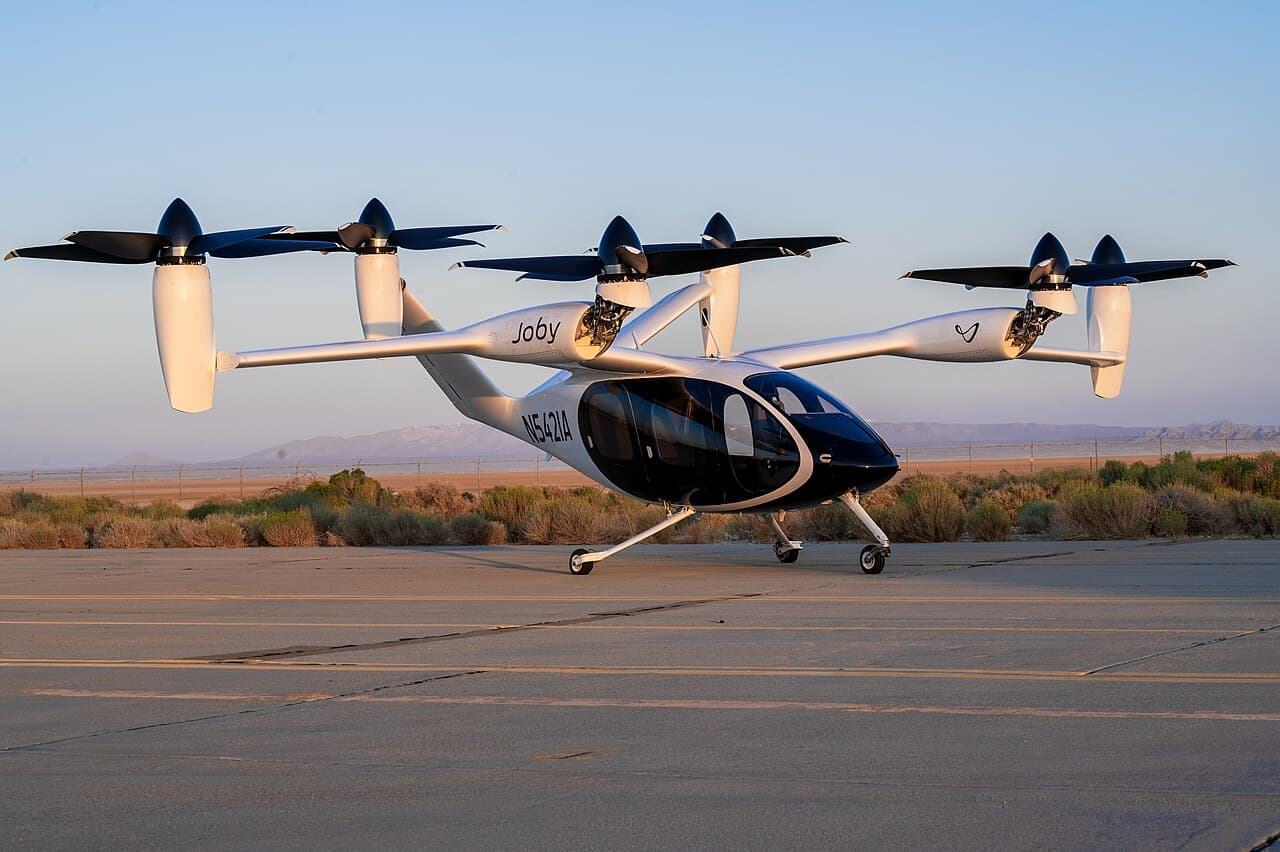
Completes first flight of a full-scale eVTOL prototype, validating the core tilt-prop design with six electric motors that rotate from vertical (for takeoff) to horizontal (for cruise flight).
2009
Founded by JoeBen Bevirt
JoeBen Bevirt founds Joby Aviation in Santa Cruz, California, to develop electric vertical take-off and landing aircraft. Early years focus on fundamental eVTOL technology research and prototyping.
08
Funding
$4.9Bdisclosed across 5 rounds with a stated amount
Cumulative disclosed raise · dated rounds
RoundAmountInvestors
Early Rounds (Series A–C)
2016–2020
$720M+
Toyota, Intel Capital, JetBlue Technology Ventures, Capricorn Investment Group
SPAC IPO (Reinvent Technology Partners)
August 2021
~$1.6B
Public offering (NYSE: JOBY), Toyota ($394M additional)
Follow-on Investments
2022–2024
$500M+
SK Telecom, Baillie Gifford, Delta Air Lines ($60M)
Equity, Convertible Debt, and Delta Warrants
Q1 2026 (January–March)
~$1.3B net proceeds
Public equity offering, convertible senior notes, and Delta Air Lines warrant exercises
At-The-Market (ATM) Equity Program
August 11, 2026
Up to $750M (undrawn shelf capacity; shares sold over time, not a lump-sum raise)
Equity Distribution Agreement with Morgan Stanley & Co., J.P. Morgan Securities, Allen & Company, and BofA Securities as sales agents
Blade passenger EBITDA earnout shares
2026-09-10
2,419,801 shares (no cash proceeds)
Selling stockholder under the Blade/Strata Critical Medical passenger-business acquisition earnout