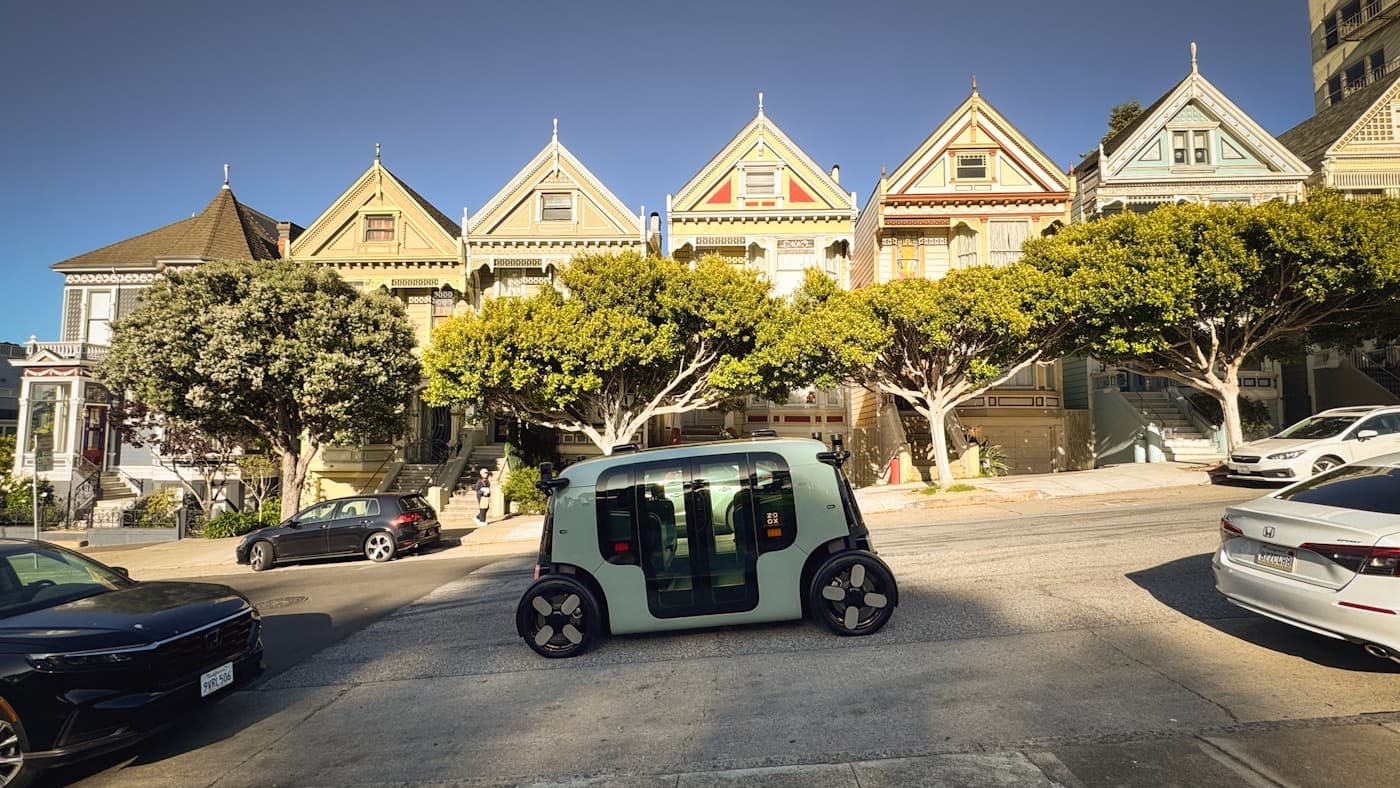
Zoox is Amazon's robotaxi company and the first operator in the United States cleared to charge fares in a purpose-built driverless vehicle with no steering wheel, pedals, or mirrors. NHTSA granted it a two-year exemption from portions of eight Federal Motor Vehicle Safety Standards on July 30, 2026, capped at 2,500 vehicles a year, and Zoox flipped its roughly 65-vehicle Las Vegas fleet to paid service on August 10, 2026 after nearly a year of free public rides. It designs and builds its bidirectional, four-seat, all-electric robotaxi itself at a Hayward, California plant sized for up to 10,000 vehicles a year, still runs free public rides in San Francisco while it waits on California permits, and has test fleets across twelve metros. Reporting around September 11, 2026 said Zoox has applied for a California DMV driverless deployment permit and called it a couple-month process; the CPUC still lists only Pilot permits, so San Francisco rides remain free. The company says it completes about 10,000 rides a week across a fleet of roughly 100 vehicles. By late August 2026 Zoox had carried nearly 1 million riders and driven more than 3 million autonomous miles across its four active markets (Las Vegas, San Francisco, Austin, Miami combined), with Las Vegas alone accounting for 350,000+ riders and nearly 2 million miles; independent app tracking put Zoox at 25% of US robotaxi monthly active users in June 2026, up from 15% in January, while Waymo's share fell from 79% to 69%. In March 2026 Zoox and Uber announced a strategic partnership to put Zoox robotaxis on the Uber app - first in Las Vegas, planned for summer 2026, then Los Angeles by mid-2027 - Zoox's first third-party ride-hailing distribution deal; as of mid-September 2026 the Uber integration had not yet gone live, with Zoox continuing to run its own app in parallel. On September 1, 2026 Zoox said it would begin supervised (safety-driver) mapping and testing in Houston and San Diego, bringing its US test-market footprint to twelve metros. The ramp has come with safety scrutiny: a string of software recalls, most recently 105 robotaxis in July 2026 after one drove into a smoke-obscured Las Vegas fire scene, and an August 2026 report of OSHA-logged injuries among Zoox and Waymo safety-test drivers from hard braking and swerving.
Nevada Highway Patrol said an autonomous Zoox vehicle and a silver Nissan Murano collided about 9:01 a.m. on Sept. 25 on southbound Las Vegas Boulevard at Four Seasons Drive. The Nissan driver was taken to a hospital with non-life-threatening, minor upper-body injuries, according to NHP and KTNV. Fault has not been assigned, and KTNV said it had asked Zoox for a statement.
Zoox has grounded its Atlanta autonomous test fleet after safety drivers reported possible carbon monoxide, carbon dioxide, or hydrogen sulfide exposure inside gasoline Highlander test vehicles in August. TechCrunch reported an OSHA inquiry after a worker complaint and Zoox's statement that it identified 28 employees who rode in six vehicles with an unexplained odor, detected CO2, and has ceased test-vehicle operations in that market while it investigates. Zoox said its purpose-built electric robotaxis are not affected, and OSHA has since closed its inquiry.
The Nevada Transportation Authority permit that limits Zoox to 100 robotaxis in the state expires on September 25, clearing the way for the Amazon-owned company to grow its paid Las Vegas fleet, an NTA official and a Zoox spokesperson confirmed to TechCrunch. Zoox operates roughly 100 of its purpose-built vehicles across four U.S. cities and Las Vegas remains the only market where it charges fares, with an independent tracker estimating more than 30 vehicles in the city today. A Zoox spokesperson declined to give a target fleet size but said the company plans to steadily increase it over the next several months, just as Tesla, Uber and Waymo ramp up under Clark County permits approved in August that together allow up to 7,000 robotaxis over a year.
Zoox extended its commercial robotaxi service in Las Vegas to Harry Reid International Airport on September 3, 2026, letting customers hail paid rides to and from the airport for the first time. The move unlocks one of the highest-demand ride-hailing destinations in Zoox's only paid market and builds on a string of recent regulatory and commercial wins for the Amazon-owned autonomous vehicle company.
Amazon's Zoox said it is starting supervised testing, with human safety operators on board, in Houston and San Diego beginning in September 2026, mapping streets ahead of eventual autonomous rides. The additions bring Zoox's US test-fleet footprint to 12 metro areas, though the company has not given a timeline for passenger service in either city; it still offers paid rides only in Las Vegas and free rides in San Francisco while the robotaxi race with Waymo intensifies.
A ground-up robotaxi rather than a retrofitted car: symmetric and bidirectional, with four-wheel steering, subway-style doors, four face-to-face seats, and no steering wheel, pedals, or mirrors in either direction. A 133 kWh battery supports up to 16 hours of operation per charge and a 75 mph top speed, though city operation runs far below that. The version shown on August 4, 2026 is the production model, with an aloe-green and stone-grey interior and reflectors that rotate position and color as the vehicle changes travel direction.
In series production at Hayward, California and carrying paying riders in Las Vegas since August 10, 2026.
Seating4 passengers, face to face
Battery and Endurance133 kWh, up to 16 hours of operation per charge
Top Speed75 mph design capability, limited well below that in city service
Regulatory StatusExempt from portions of eight FMVSS under a two-year NHTSA Part 555 grant, up to 2,500 vehicles a year
The app-booked robotaxi service itself. Paid in Las Vegas since August 10, 2026 across the Strip and downtown; free to the public in San Francisco, where Zoox still lacks the California permits needed to charge; and in early-rider phases in Austin and Miami. More than half a million riders have been carried since the September 2025 Las Vegas opening.
Commercial in Las Vegas (including Harry Reid airport since September 3, 2026), free public service in San Francisco pending DMV and CPUC deployment permits (DMV application reported mid-September 2026), early riders in Austin and Miami, supervised testing across twelve US metros.
Paid Markets1 (Las Vegas, including Harry Reid International Airport since September 3, 2026)
Riders ServedNearly 1M since September 2025, across all four active markets
US Robotaxi App Share25% of monthly active users, June 2026 (Apptopia)
The autonomy stack plus the human infrastructure behind it. Zoox Fusion Centers are the hubs where teleguidance, mission control, and rider support monitor the fleet and talk vehicles through situations they cannot resolve alone, as when a teleoperator reversed a robotaxi out of a smoke-obscured Las Vegas fire scene in June 2026. New markets are mapped first by retrofitted Toyota Highlander test vehicles with safety drivers before purpose-built robotaxis are introduced.
Fusion Centers operating alongside every market, including a Scottsdale, Arizona center opened with the Phoenix expansion in March 2026.
Autonomous Miles3M+ as of late August 2026, up from 1M+ in March 2026
Recalls Since 2025Several software recalls, most recently 105 vehicles in July 2026 over heavy-smoke handling at emergency scenes
What's Next
Launch on the Uber app in Las Vegas
Zoox and Uber announced a strategic partnership on March 11, 2026 to match eligible Uber trips with Zoox robotaxis, starting in Las Vegas with a 'summer 2026' target and extending to Los Angeles by mid-2027. That summer window has now passed without a public go-live: TechCrunch's September 3, 2026 airport-expansion report still described Uber as planning to operate robotaxis in Clark County through partnerships with Motional and Zoox, and mid-September reporting still had paid Las Vegas Zoox rides bookable only on Zoox's own app.
Late 2026 (Las Vegas); mid-2027 (Los Angeles)
Grow the Las Vegas fleet once the Nevada 100-vehicle cap lapses
The Nevada Transportation Authority permit capping Zoox at 100 robotaxis statewide expires September 25, 2026, and an NTA official and a Zoox spokesperson confirmed to TechCrunch that an updated permit lifts the ceiling. Zoox declined to name a target fleet size or say how many vehicles run in Las Vegas today, where an independent tracker counts more than 30, but said it will steadily increase the fleet over the next several months to meet demand. The test is whether Hayward output can actually fill the new headroom before Tesla, Uber and Waymo scale up under the Clark County permits the NTA approved in August, which together allow up to 7,000 robotaxis over a year.
Late 2026 to 2027
Win California permits and start charging in San Francisco
The NHTSA exemption cleared the federal barrier to charging fares, but California adds its own: Zoox needs driverless deployment permits from both the DMV and the CPUC before it can charge in San Francisco, where it has run free public rides since November 2025 and quadrupled its service area in March 2026. Mid-September 2026 reporting said Zoox has applied for the DMV deployment permit and that VP Carly Wyatt called it a couple-month process. The CPUC public list still shows only Pilot terms that forbid charging, so Waymo still holds California's paid commercial robotaxi rides. This is the single largest swing factor in Zoox's commercial ramp, since San Francisco is its home market and the one where it competes head to head with Waymo.
Late 2026 to 2027
Open Austin and Miami to public riders
Both cities were named as service markets on March 24, 2026 and started with rides limited to Zoox employees plus friends and family, with an Austin waitlist and Explorers early-rider access to follow. Converting them into open public service, and then into paid service, is the next test of whether Zoox's city-by-city playbook scales beyond Las Vegas.
2026-2027
Ramp Hayward output toward 100 robotaxis per week
The Hayward plant opened in 2025 building roughly one robotaxi a day against a design capacity of about three an hour, or 10,000 a year. Zoox says it is stepping output up toward as many as 100 vehicles a week, and in May 2026 leased an additional 10.2-acre, 34,000-square-foot site on Clawiter Road as a logistics and staging hub for finished vehicles. Fleet supply, not demand, is the constraint on multi-city commercial service.
2026-2027
Turn Phoenix, Dallas, Houston, and San Diego testing into rider service
Zoox began mapping Phoenix and Dallas with safety-driver Highlanders on March 9, 2026 and opened robotaxi depots in both plus a Fusion Center in Scottsdale. In September 2026 Zoox added Houston and San Diego to its supervised-testing footprint, mapping streets with human safety operators on board ahead of eventual autonomous rides; the addition brings Zoox's US test-fleet footprint to 12 metro areas. Axios said Houston mapping with retrofitted SUVs would start later in September 2026 in Rice Village, the Texas Medical Center, the Galleria, Memorial Park, Downtown, Midtown and Hyde Park; as of September 17 there was no public confirmation that those first mapping miles had begun, and Zoox has not given a passenger-service timeline for either new city. None of the four has a public service date. All are markets where Waymo already carries paying riders, so they remain the clearest read on how fast Zoox can close the footprint gap.
2027
Convert the temporary exemption into a durable federal framework
The Part 555 grant that lets Zoox charge fares expires July 31, 2028 and caps deployment at 2,500 vehicles a year, which is below the Hayward plant's design capacity. NHTSA framed the grant as part of a broader push to build an autonomous-vehicle framework rather than a one-off, and Zoox says it is coordinating with the agency on full approval of the platform. Watch whether a permanent rule arrives before the exemption lapses, and whether the recall record, including the July 2026 fire-scene recall, affects renewal.
By July 31, 2028
Confirm first Houston mapping miles
After the September 2026 announcement; still unconfirmed as of 2026-09-28
Track Record
2 of 3 announced dates hit · 1 slipped
Launch on the Uber app in Las Vegas
Target Summer 2026 · Resolved Sep 8, 2026
The summer 2026 Las Vegas Uber-app target passed without a public go-live. TechCrunch's September 3, 2026 report on Zoox's Harry Reid airport expansion still described Uber as planning to operate robotaxis in Clark County through partnerships with Motional and Zoox, and the Nevada Transportation Authority approved commercial permits for Tesla, Waymo and Uber-linked Aviari on August 20, 2026, but Zoox continued to take paid Las Vegas fares only through its own app.
Slipped
Begin charging fares in Las Vegas
Target Early 2026 · Resolved Aug 10, 2026
Paid rides began August 10, 2026 across the Las Vegas Strip and downtown, with the entire local fleet of roughly 65 robotaxis moving to commercial service. It landed several months later than the early-2026 guidance Zoox gave in December 2025, gated on the NHTSA exemption that did not arrive until July 30, 2026.
Hit
Win federal approval to charge for rides in a purpose-built robotaxi
Target 2026 · Resolved Jul 30, 2026
NHTSA granted Zoox a temporary Part 555 exemption on July 30, 2026 from portions of eight FMVSS written around a human driver, effective July 31, 2026 through July 31, 2028 and capped at 2,500 vehicles a year. It is the first federal clearance for a paid commercial service in a vehicle with no steering wheel, pedals, or mirrors.
Hit
Operations & Revenue
StatusOperational in Las Vegas; NTA 100-vehicle term ended; Houston mapping unconfirmed; Strip crash under NHP investigation
NTA still posts Zoox AVNC Permit 001 Sub 5 (dated about Aug. 28, 2026). The 100-vehicle restriction applies only to the first 12 months after the original Sept. 25, 2025 permit, so that term ended Sept. 25, 2026; NTA has not posted a later certificate that deletes the 100-vehicle language. Zoox has not confirmed first Houston mapping miles after the Sept. 1 supervised-testing announcement. FOX5, citing police, said no one was inside the Zoox in the Sept. 25 Strip crash with a Nissan Murano; NHP is investigating, fault is unassigned, and KTNV said it had asked Zoox for a statement. Paid service remains Las Vegas only. Atlanta Highlander tests remain ceased.
Revenue Streams
Robotaxi Fares (Las Vegas)
Zoox's only revenue-generating stream today. Fares combine a base charge with per-mile and per-minute components, quoted and locked in before booking, plus disclosed destination surcharges for the airport and venues such as the Sphere and T-Mobile Arena. Pricing is positioned in the comfort tier of conventional ride-hail apps.
Uber Platform Distribution (planned)
A March 2026 strategic partnership will let Uber riders be matched with Zoox robotaxis on eligible trips, first in Las Vegas and later Los Angeles (mid-2027), giving Zoox a second booking channel alongside its own app. The original summer 2026 Las Vegas target has slipped; as of September 17, 2026 the integration had not gone live and Zoox continued to take paid fares only through its own app.
Key Metrics
Employees
~2,200 was Zoox's last public figure (2023); Zoox and Amazon still do not disclose current headcount, but third-party employment trackers (Revelio Labs, Tracxn) estimate roughly 4,700-5,700 employees as of mid-2026, reflecting the Hayward production ramp and multi-city expansion
Est. Annual Revenue
Effectively pre-revenue at Amazon-disclosure scale. Every Zoox ride was free until August 10, 2026, when Las Vegas fares began; Amazon does not break out Zoox revenue in its filings and no run-rate has been disclosed as of Amazon's Q2 2026 results or mid-September 2026 reporting.
Paid Service Markets
1 (Las Vegas, since August 10, 2026, including Harry Reid International Airport since September 3, 2026). San Francisco rides remain free pending California DMV and CPUC driverless deployment permits; Austin and Miami are in early-rider phases
Test Markets
12 (San Francisco Bay Area, Las Vegas, Seattle, Austin, Miami, Los Angeles, Atlanta, Washington D.C., Phoenix, Dallas, plus Houston and San Diego added September 1, 2026 for supervised safety-driver mapping). Houston testing was due to start later in September 2026 with retrofitted SUVs covering Rice Village, the Texas Medical Center, the Galleria, Memorial Park, Downtown, Midtown and Hyde Park; no public confirmation of first mapping miles as of September 17.
Riders Served
Nearly 1M riders cumulatively across all four active markets (Las Vegas, San Francisco, Austin, Miami) as of late August 2026, still the latest cumulative rider figure as of September 17, 2026; Las Vegas alone accounts for 350,000+ riders. Company-reported weekly volume is about 10,000 US rides.
Autonomous Miles
3M+ cumulatively across all four active markets as of late August 2026, still the latest cumulative-mile figure as of September 17, 2026, up from 1M+ in March 2026; Las Vegas alone accounts for nearly 2M miles
US Weekly Rides and Fleet
About 10,000 rides a week across a fleet of roughly 100 autonomous vehicles as of mid-September 2026 reporting, versus Waymo's more than 500,000 rides a week and nearly 4,000 vehicles. The ~65-vehicle Las Vegas paid fleet sits inside that broader ~100-vehicle total.
Las Vegas Fleet
~65 robotaxis in paid Las Vegas service since August 10, 2026, under a July 16, 2026 Nevada Transportation Authority AVNC permit capped at 100 vehicles inside an approved Clark County geofence
Federal Deployment Cap
2,500 vehicles per year under the NHTSA Part 555 exemption, effective July 31, 2026 through July 31, 2028
US Robotaxi App Share
25% of US robotaxi app monthly active users in June 2026, up from 15% in January 2026 (Apptopia); Waymo fell from 79% to 69% over the same period and Tesla's user base was roughly flat. No newer independent app-share snapshot has been published as of September 8, 2026
Production Capacity
Hayward, California plant designed for up to 10,000 robotaxis a year (about three per hour); output was roughly one per day at opening in 2025 and is being ramped toward 100 vehicles a week. No newer disclosed weekly-output figure as of September 8, 2026
Atlanta Test Fleet
Grounded as of September 23, 2026. Zoox told TechCrunch it identified 28 employees who rode in six Highlander test vehicles with an unexplained odor, detected CO2, ceased test-vehicle operations in that market, and that purpose-built electric robotaxis are not affected. OSHA opened then closed an inquiry.
Nevada Fleet Cap
The NTA 100-vehicle cap expires September 25, 2026. An NTA official and Zoox confirmed to TechCrunch that an updated permit lifts the ceiling. Zoox declined to name a new Las Vegas fleet size; Robotaxi Tracker counted more than 30 vehicles in the city as of mid-September.
Nevada Fleet Cap
Posted AVNC Permit 001 Sub 5 still states a 100-vehicle limit for the first 12 months after the original Sept. 25, 2025 permit. That window ended Sept. 25, 2026. No later certificate deleting the 100-vehicle language was on the NTA site as of Sept. 28.
Houston mapping miles
Unconfirmed as of Sept. 28, 2026. Sept. 1 CNBC/company plan was later-September supervised Highlander mapping; Zoox has not posted first-miles confirmation.
Timeline
2026Testing expands to Phoenix and Dallas, ten markets in all
Zoox adds Phoenix and Dallas on March 9, 2026, bringing its test footprint to ten markets alongside the San Francisco Bay Area, Las Vegas, Seattle, Austin, Miami, Los Angeles, and Washington, D.C. It opens robotaxi depots in both cities plus a Fusion Center in Scottsdale, and discloses more than 1 million autonomous miles and over 300,000 riders served.
2026Zoox and Uber announce strategic partnership
On March 11, 2026 Zoox and Uber announce a strategic partnership to put Zoox robotaxis on the Uber app - Zoox's first third-party ride-hailing distribution deal. Eligible Uber trips will be matched with a Zoox vehicle starting in Las Vegas, planned for summer 2026, and later in Los Angeles by mid-2027. Zoox continues to operate its own app in both cities alongside the Uber integration.
2026Austin and Miami added, San Francisco footprint quadrupled
On March 24, 2026 Zoox names Austin and Miami as its next service cities and quadruples its San Francisco operating area to cover the Marina, North Beach, Chinatown, Pacific Heights, and the Embarcadero corridor, while more than doubling Las Vegas destinations to include the Sphere, T-Mobile Arena, and the convention center.
2026105 robotaxis recalled over an emergency fire scene
On June 20, 2026 an unoccupied Zoox robotaxi drove into heavy smoke obscuring an active, un-coned Las Vegas fire scene, braked hard, and had to be reversed out by a teleoperator. Zoox notified NHTSA on July 8 and issued an over-the-air software recall covering 105 vehicles, disclosed July 17, after regulators found its driving system lacked adequate logic for interpreting heavy smoke at emergency scenes. It landed days after NHTSA's administrator directed AV developers to keep clear of first responders.
2026First federal commercial exemption for a purpose-built robotaxi
NHTSA grants Zoox a temporary Part 555 exemption on July 30, 2026, effective July 31, 2026 through July 31, 2028, from portions of eight Federal Motor Vehicle Safety Standards written around a human driver (103, 104, 108, 111, 135, 201, 205, and 208). It allows up to 2,500 vehicles a year and is the first federal clearance for a paid commercial service in a vehicle with no steering wheel, pedals, or mirrors.
2026Production-spec robotaxi unveiled
On August 4, 2026 Zoox shows the version that becomes its official production model: an aloe-green and stone-grey interior chosen to reduce visual distraction and survive urban wear, and exterior reflectors that rotate position and color when the bidirectional vehicle changes travel direction. Hayward is being built out toward 100 vehicles a week.
2026Paid rides begin in Las Vegas
Zoox starts charging fares across the Las Vegas Strip and downtown on August 10, 2026, transitioning its entire local fleet of roughly 65 robotaxis to commercial service. Pricing is a base fare plus per-mile and per-minute components quoted and locked in before booking, positioned in the comfort tier of conventional ride-hail, with disclosed surcharges for the airport and high-traffic venues.
2026Safety Case Framework published
Two days after fares started, on August 12, 2026, Zoox published the methodology behind its safety conclusions rather than simply asserting that its vehicles are safe. The framework covers the driving software, the vehicle, and the people and processes running the fleet, and reduces the combined risk to a single predicted rate of collision, injury, and fatality events expressed as miles per event. It gives regulators and outside researchers something concrete to examine, though it reflects Zoox's own assumptions rather than any independent certification, and it landed weeks after the July fire-scene recall.
2026OSHA data shows test drivers injured by hard braking and swerving
Reporting published around August 27, 2026 based on OSHA filings found more than two dozen injuries - sprains, strains, whiplash and back pain, some sidelining workers for weeks or months - among Waymo and Zoox safety-test drivers in 2024 and 2025, caused by the vehicles' autonomous software braking hard or swerving suddenly. Incidents were concentrated in Los Angeles, Phoenix, and San Francisco. Zoox said it takes employee safety seriously and continues refining vehicle behavior based on the reports.
2026Starts supervised testing in Houston and San Diego
Zoox said it is beginning supervised testing (human safety operators on board) in Houston and San Diego starting in September 2026, mapping streets ahead of eventual autonomous rides and taking on Houston's heat and heavy rain alongside San Diego's coastal fog and freeway corridors. The additions bring Zoox's US test-fleet footprint to 12 metro areas, though the company has not given a timeline for passenger service in either city; it still offers paid rides only in Las Vegas and free rides in San Francisco.
2026Applies for a California DMV driverless deployment permit
Reporting on September 11, 2026 said Zoox has applied for a California DMV driverless deployment permit, the first of two state gates needed to charge fares in San Francisco. VP of communications Carly Wyatt called it a couple-month process. The CPUC public permit list still shows only Drivered Pilot and Driverless Pilot authorizations, which bar collecting money, so San Francisco rides remain free. TechSpot also reported Zoox saying it completes about 10,000 US rides a week on a fleet of roughly 100 vehicles, versus Waymo's more than 500,000 rides a week.
2026Grounds Atlanta test fleet after cabin-gas reports
TechCrunch reported that Zoox grounded its Atlanta Highlander test fleet after August cabin-gas exposure reports and a worker OSHA complaint. Zoox said it identified 28 employees who rode in six vehicles with an unexplained odor, detected CO2, ceased test-vehicle operations in that market, and that purpose-built electric robotaxis are not affected. OSHA opened then closed an inquiry.
2026Las Vegas Strip crash with a Nissan sends a driver to hospital
Nevada Highway Patrol said an autonomous Zoox vehicle and a silver Nissan Murano collided about 9:01 a.m. on Sept. 25 on southbound Las Vegas Boulevard at Four Seasons Drive. The Nissan driver was taken to a hospital with non-life-threatening, minor upper-body injuries. Lanes were closed then reopened. Fault has not been assigned; KTNV said it asked Zoox for a statement. The crash landed the same day the Nevada 100-vehicle cap was scheduled to expire.
2026NTA Sub 5 still posts a time-limited 100-vehicle cap
The certificate NTA still publishes as Zoox AVNC Permit 001 Sub 5, dated about August 28, 2026, cancels Sub 4 and authorizes compensated AVNC service in Nevada. Its restrictions clause still says Zoox may not use more than 100 fully autonomous vehicles, cumulatively, during the first 12 months after the original permit dated September 25, 2025. That 12-month term ended September 25, 2026. As of September 28, NTA had not posted a later certificate that removes the 100-vehicle language. TechCrunch reported September 17 that an NTA official and Zoox confirmed the cap would expire September 25.
2025Hayward production plant opens
Zoox opens a 219,000-square-foot robotaxi assembly plant in Hayward, California, initially building roughly one robotaxi a day with the line designed to reach about three per hour, or 10,000 vehicles a year, at full scale.
2025Public robotaxi service opens in Las Vegas, free of charge
On September 10, 2025 Zoox becomes the first company to open a purpose-built robotaxi service to the general public in Las Vegas. Rides are free, since federal rules did not yet allow fares to be charged in a vehicle without manual controls. A San Francisco Explorers programme follows on November 18, 2025.
2023First purpose-built robotaxi to carry passengers on open public roads
On February 11, 2023 Zoox runs its employee shuttle between two Foster City buildings on public roads, the first time a purpose-built robotaxi with no traditional driving controls carried passengers outside a closed course.
2020Amazon acquires Zoox
Amazon buys Zoox outright on June 26, 2020 for more than $1.2 billion, keeping it as a wholly owned subsidiary with its own brand, leadership, and product roadmap rather than folding it into Amazon logistics.
2020Purpose-built robotaxi unveiled
Zoox reveals its bidirectional, four-wheel-steering robotaxi in December 2020: a 133 kWh battery good for up to 16 hours of operation, a 75 mph top speed, four face-to-face seats, and no steering wheel, pedals, or driver position in either direction.
2019Aicha Evans becomes CEO
Intel's former chief strategy officer Aicha Evans joins as CEO in January 2019, shifting the company from research programme toward a manufactured, commercially deployable product.
2014Zoox founded to build a robotaxi from scratch
Australian designer Tim Kentley-Klay and Stanford autonomy researcher Jesse Levinson found Zoox on July 29, 2014, with the thesis that a driverless ride-hailing vehicle should be designed from the ground up rather than retrofitted from a consumer car. The name comes from zooxanthellae, the algae that power coral reefs.
Funding
Round
Date
Amount
Investors
Source
Venture rounds (private, pre-acquisition)
2014-2018
$800M
Private venture investors across seed through Series B; last private valuation reported at $3.2B in July 2018
Acquisition by Amazon
June 2020
$1.2B+
Amazon.com, Inc. (100% owner); funded from Amazon's balance sheet since