Active
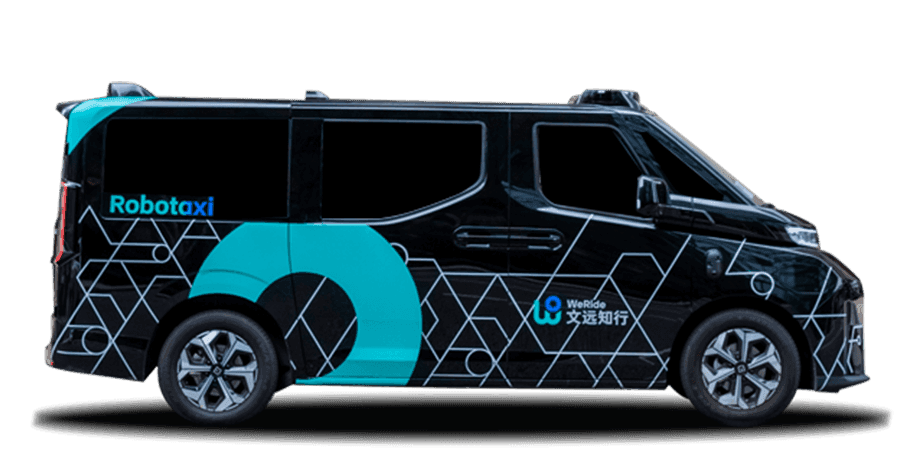
Robotaxi GXR
WeRide's latest purpose-built robotaxi platform, developed with Geely Farizon and deployed across China, the Middle East, Southeast Asia, and Europe.
WeRide is a commercial-stage autonomous-driving company building products from Level 2 ADAS to Level 4 robotaxis, robobuses, robovans, and robosweepers.
Latest update Sep 28, 2026
01
It operates or tests in 60+ cities across 13 countries, holds autonomous-driving permits in nine markets (China, the UAE, Singapore, France, Switzerland, Saudi Arabia, Belgium, the US, and Spain), and is scaling a global L4 fleet of about 3,400 vehicles, including more than 1,800 robotaxis - including fully driverless commercial service in Dubai and public service in Singapore - with Uber, Grab, Geely Farizon, Renault, GAC, Chery, and other partners. Europe has become a fast-moving front in 2026: WeRide, Uber and AVOMO received Spain's first national Level 4 passenger-vehicle permit from the DGT on September 10, 2026 (the first EU national approval for WeRide's GXR), after announcing a Madrid commercial robotaxi pilot in early June; fare-charging Zurich service with Uber and Rydera is still targeted around December 2026 with about 12 safety-driver vehicles, not yet a live commercial launch (Wikipedia still lists Zurich as announced for 2026). The Slovak government backed a plan for WeRide to roll out its full Level 4 portfolio nationwide, and as of September 20, 2026 Wikipedia still lists Bratislava as announced rather than commercial. Hong Kong remains the first right-hand-drive GXR market with Kwoon Chung. As of September 20, 2026 WeRide had not announced that the upgraded GXR had begun rolling off Geely Farizon's line (the March plan targeted Q3 2026) and had not disclosed an interim count against the 2,000-unit 2026 delivery target; the latest fleet print remains 1,800+ robotaxis / ~3,400 L4 vehicles as of July 31. In July 2026 WeRide accelerated the global rollout of its one-stage end-to-end L2++ intelligent-driving solution - co-developed with Bosch and integrated with Bosch's automotive-grade domain controller - beginning on-road testing and localization in Germany, France, and Japan, with production design wins now spanning 30+ vehicle programs at Chery and GAC, an L3 proof-of-concept with Mercedes-Benz disclosed on the Q2 2026 call, and cumulative WRD 3.0 deliveries topping 30,000 units, against a company target of 100,000 by year-end 2026 and 500,000 in 2027. On August 3, 2026 WeRide announced a strategic partnership with Danish shared-mobility operator GreenMobility to bring Level 4 autonomous ride-hailing to Denmark, its sixth European market and first in the Nordic region, targeting public service in the first half of 2027 pending Danish regulatory approval. Reporting record Q2 2026 revenue on August 12 (gross margin a record 37.5%, up from 28.1% a year earlier), CEO Tony Han said WeRide is now in talks with regulators in Australia and eyeing South Korea, Japan, and Southeast Asia as further expansion markets. WeRide's Hong Kong shares joined the HKEX Tech 100 Index effective September 14, 2026 after the exchange's September quarterly review. On September 15, 2026 GAC AION launched the 2027 AION i60 with WeRide's WRD 3.0 available from delivery, which WeRide called a move from the AION N60 validation car into multi-model mass production.
en.wikipedia.orgUpdated Sep 20, 2026
Analysis · 4 min read · Jun 15, 2026The long view on WeRide: strategy, technology and what to watch02
2026
Execute the Geely Farizon production plan (upgraded GXR was slated to start rolling off the line in Q3 2026) and move the global operating robotaxi fleet past 2,600 vehicles. As of the August 12, 2026 Q2 results the global robotaxi fleet stood at 1,800+ vehicles (3,400 total L4 vehicles including robobuses and robosweepers) as of July 31, 2026 - below the 2,600-robotaxi milestone. As of September 20, 2026 WeRide had still not disclosed an interim GXR delivery count against the 2,000-unit 2026 target, and had not announced that the upgraded model had begun rolling off the Farizon line even though Q3 2026 is in its final days.
2026-2031
Move the WeRide-Lenovo agreement from announcement to volume by bringing the HPC 3.0 compute platform (Lenovo AD1 + NVIDIA DRIVE AGX Thor) into production and jointly deploying 200,000 Level 4 vehicles - robotaxis, robobuses, and robosweepers - globally over five years, leveraging its ~50% suite-cost reduction to improve per-vehicle economics. As of September 16, 2026 WeRide had still not disclosed interim unit counts or ramp data specific to the Lenovo plan since the April 2026 announcement, though the GXR product page lists HPC 3.0 and 2,000 TOPS as current GXR hardware and the company's separate WRD 3.0 ADAS line (which also runs on Lenovo-partnered compute) passed 30,000 cumulative deliveries in Q2 2026.
2026-2027
Bring the GXR-based right-hand-drive robotaxi developed with Geely Farizon and Kwoon Chung into commercial service in Hong Kong - building on Kwoon Chung's existing Hong Kong pilot autonomous-driving licence and on-road trials - then extend the RHD model to Singapore, the United Kingdom, Japan, and Australia. As of September 16, 2026 the RHD program remained in the trial/development phase ahead of first commercial deployment, with no updates on a Hong Kong launch date since the June 22 announcement.
2026-2027
Bring the first WeRide vehicles into Slovakia in mid-2026 under the ELEVATE Slovakia framework with partner DiusAI, run multi-product testing in Bratislava before extending to Košice and the High Tatras, and move selected robotaxi and robobus models into public commercial operation as Slovak and EU safety approvals are met. The June 10, 2026 WeRide post said the first batch was set to arrive that month. As of September 20, 2026 Wikipedia still lists Bratislava as 'service announced' rather than commercial, and WeRide has not posted a later update confirming public commercial operations.
2026-2027
Turn WRD 3.0 design wins (30+ production programs at Chery and GAC, plus an L3 proof-of-concept with Mercedes-Benz disclosed on the August 12, 2026 Q2 call) into volume. On September 15, 2026 GAC AION launched the 2027 AION i60 with WRD 3.0 available from delivery, which WeRide called a step from the AION N60 validation car into multi-model mass production. The Bosch-partnered one-stage end-to-end L2++ solution began international on-road testing in Germany, France, and Japan in July 2026. Cumulative deliveries passed 30,000 units by Q2 2026; the company's stated targets remain 100,000 units by year-end 2026 and 500,000 in 2027. WeRide said it will keep working with GAC AION and other GAC Group brands to put WRD 3.0 on more models.
Q4 2026
End of 2026
CFO Jennifer Li told AGBI that WeRide's Riyadh robotaxi fleet, launched last year with Uber and Ai Driver from the airport, should reach about 100 vehicles by the end of 2026 before expanding into central Riyadh's Olaya district. A separate Qiddiya project is planned for 2027. The 100-vehicle year-end figure is the near-term gate on the longer 7,000 to 10,000 Saudi fleet target for 2030.
End of 2026
After receiving Spain's first national Level 4 passenger-vehicle permit on September 10, 2026, complete DGT ES-AV mapping, route validation and operational readiness testing in Greater Madrid with an initial 20 GXR vehicles carrying an onboard specialist, then open commercial service on the Uber app with AVOMO running the fleet by the end of 2026. WeRide called Madrid the fourth of 15 cities in its Uber partnership and the partners' first joint European deployment.
Dec 2026
Open fare-charging Uber-app robotaxi service in the Greater Zurich Region with local fleet operator Rydera. WeRide's director of capital markets told Zag Daily in June 2026 that Zurich would start around December with roughly 12 vehicles still carrying safety drivers, aiming to remove them about six months later, with Madrid targeted to go live first. WeRide already holds a FEDRO driverless permit for Zurich's Furttal region from November 2025. As of September 20, 2026 no commercial Uber launch had been announced; Wikipedia still lists Zurich as 'service announced' for 2026, and the company product page listing Zurich among public-operations cities appears to include testing rather than paid citywide service.
H1 2027
Work with GreenMobility and Danish regulators (the Danish Road Directorate and Danish Road Traffic Authority) to move from the August 2026 partnership announcement to public autonomous ride-hailing operations using the Level 4 GXR vehicle - WeRide's first Nordic market and sixth in Europe after France, Switzerland, Belgium, Spain, and Slovakia. As of September 16, 2026 neither company had announced a permit grant or a start-of-service date inside the H1 2027 window.
2027+
Following record Q2 2026 results, CEO Tony Han said WeRide is in active talks with Australian regulators about a possible deployment and is separately eyeing South Korea, Japan, and Southeast Asia (beyond its existing Grab partnership) as further overseas expansion markets, extending the asset-light, partner-fronted model used in Europe and the Middle East. No formal agreements or timelines have been announced for these markets as of September 16, 2026.
2030
CFO Jennifer Li told AGBI in early September 2026 that WeRide plans 7,000 to 10,000 robotaxis in Saudi Arabia by 2030, with about 100 vehicles in Riyadh by year-end 2026, Olaya expansion next, and a Qiddiya project in 2027, on top of the existing Uber/Ai Driver airport service and AlUla autonomous buses. That Saudi plan sits beside the earlier WeRide-Uber commitment to deploy at least 1,200 robotaxis across Abu Dhabi, Dubai, and Riyadh by 2027. Robosweeper units in the Gulf were recalled for dust and sand upgrades.
03
Dubai's Roads and Transport Authority and the Dubai Integrated Economic Zones Authority inaugurated Dubai Mobility Labs at Dubai Silicon Oasis on 27 September 2026. The facility has 248 test scenarios across controlled tracks and public roads toward Al Qudra, and RTA said it has already hosted trials of vehicles and autonomous-driving systems from WeRide, Pony.ai and Tesla. German testing firm DEKRA will operate the labs for the first three years under Dubai's plan to make 25 percent of journeys autonomous by 2030.
GAC AION launched the 2027 AION i60 on September 15 as a five-seat SUV in battery-electric and range-extended variants, powered from delivery by WeRide's WRD 3.0 one-stage end-to-end L2++ ADAS. WeRide said the stack, which it credits with eight China Urban Intelligent Driving Competition championships, now moves from the earlier AION N60 validation car into multi-model mass production, with features including NDA from a parked state, campus roaming without navigation, remote parking, three-point turns and parking-space-to-parking-space navigation. WeRide said it will keep working with GAC AION and other GAC Group brands to put WRD 3.0 on more models.
Spain's Directorate-General for Traffic issued the first national permit for Level 4 autonomous passenger vehicles on public roads to WeRide, Uber and AVOMO on September 10, 2026 under the DGT ES-AV framework. The partners said it is the first national approval for WeRide's GXR in the European Union and the start of mapping and route validation in Greater Madrid, with an initial 20 vehicles carrying an onboard specialist. Commercial service is targeted by the end of 2026, the first joint WeRide-Uber deployment in Europe and the fourth of 15 cities in their partnership.
WeRide CFO and international head Jennifer Li told AGBI the company plans 7,000 to 10,000 robotaxis in Saudi Arabia by 2030, versus about 100 vehicles in Riyadh by the end of 2026. Service, launched last year with Uber and local partner Ai Driver from the airport, is set to expand into central Riyadh's Olaya district and into Qiddiya next year, while WeRide also runs autonomous buses in AlUla. Li said Robosweeper units were recalled for upgrades to handle Gulf dust and sand.
WeRide reported Q2 2026 total revenue of RMB231.7 million (about $32 million) on August 12, up 82.2% year over year and 103.1% quarter over quarter, with overseas revenue up 164.4% year over year. The company's global Level 4 fleet reached about 3,400 vehicles, including more than 1,800 robotaxis, as of July 31, 2026.
WeRide announced a partnership with Danish electric car-sharing operator GreenMobility on August 3 to launch Denmark's first commercial autonomous ride-hailing service, becoming the first Chinese robotaxi company to enter the Nordic region. The companies plan to begin public operations in the first half of 2027 using WeRide's Level 4 GXR vehicle, pending approvals from the Danish Road Directorate and Danish Road Traffic Authority, making Denmark WeRide's sixth European market after Switzerland, Spain, Slovakia and others.
WeRide and Uber announced plans on June 17 to launch a commercial robotaxi service in the Greater Zurich region - their second European deployment after Madrid and their first in Switzerland. Pending approval from Swiss road authority FEDRO, rides will be booked through the Uber app with local operator Rydera managing day-to-day fleet operations on WeRide's autonomous-driving platform, starting later in 2026 and scaling progressively toward fully driverless service. Zurich is among the 15 cities WeRide and Uber are targeting under their global partnership.
WeRide outlined a plan on June 10 to commercialize its Level 4 autonomous-vehicle portfolio in Slovakia after a meeting between executives and Prime Minister Robert Fico in Bratislava, with first vehicles expected this month and testing to begin in Bratislava before expanding to Kosice and the High Tatras. The Slovakia push builds on a June 2 announcement that WeRide, Uber and AVOMO will launch Spain's first commercial robotaxi pilot in the Region of Madrid later in 2026 via the Uber app. The Chinese AV developer also took first place at the June 15 Tianjin round of China's Second Intelligent Driving Competition, a record sixth consecutive win.
WeRide, Uber and AVOMO on June 2 announced the launch of Spain's first commercial robotaxi pilot in the Region of Madrid, in collaboration with Madrid's regional government, with rides booked through the Uber app and AVOMO running fleet operations on WeRide's autonomous-driving platform. Service is slated to start later in 2026 with trained vehicle operators and scale toward fully driverless commercial coverage of central urban areas; Madrid is the fourth of 15 cities under WeRide and Uber's broader partnership, with 11 more planned by 2030.
04
WeRide's latest purpose-built robotaxi platform, developed with Geely Farizon and deployed across China, the Middle East, Southeast Asia, and Europe.
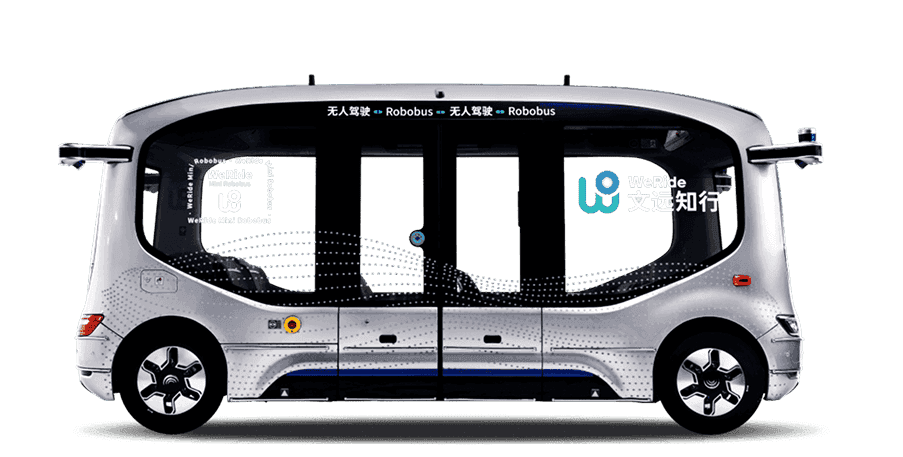
WeRide's mass-produced autonomous shuttle and minibus platform (LCR 2.0) for public transit, campus, airport, resort, and event routes. The company product page lists 10 seats, HPC 3.0 compute at 2,000 TOPS, and testing or operations in 40+ cities across China, Singapore, the UAE, Saudi Arabia, Qatar, France, Switzerland, Spain and other markets.
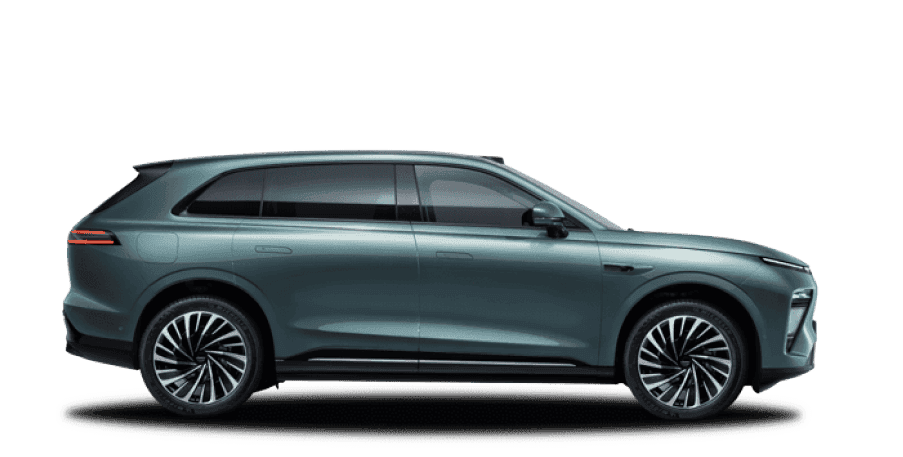
A one-stage end-to-end L2++ ADAS solution that transfers WeRide's Level 4 data, simulation, and autonomy stack into mass-production passenger vehicles.
WeRide's Level 4 autonomous logistics van for urban delivery, listed on the company product page as China's first remote-testing (driverless) and cargo-testing licensed robovan, with 5.5 m3 cargo space, 220 km range, and 1,000 kg load capacity.
WeRide's Level 4 autonomous sanitation vehicles for open-road sweeping. The company calls S1 the first L4 sanitation vehicle commercially deployed on public roads in China and Singapore, with S6 adding a 3.5 m3 water tank and at least 300 km NEDC range.
05
H1 2026 total revenue up 73.3% YoY; Q2 2026 revenue RMB231.7M / ~$32M (+82.2% YoY, +103.1% QoQ) at a record 37.5% gross margin. No newer quarterly print as of September 20, 2026.
permits in 9 markets after Spain's DGT Level 4 national permit on Sept 10, 2026
(+82.2% YoY, +103.1% QoQ), record quarter; overseas revenue +164.4% YoY
~$795.6M cash, time deposits, and other liquid financial resources (Jun 30, 2026), down from ~$902M at Mar 31, 2026
06
Operating status
Operational
WeRide remains operational. Dubai Mobility Labs opened 27 Sep 2026 at Silicon Oasis with 248 scenarios; RTA said WeRide, Pony.ai and Tesla vehicles have already been trialled there. That is a testing-lab milestone, not a new fare-charging launch; WeRide already runs fully driverless Dubai robotaxis on Uber. Spain's 10 Sep DGT L4 permit still covers Greater Madrid mapping and testing with about 20 specialist-supervised GXRs, with commercial service still targeted by year-end 2026. Wikipedia still lists Zurich and Bratislava as announced, not commercial. Q2 2026 remains the latest financial print: RMB231.7M revenue, 37.5% gross margin, about 3,400 L4 vehicles including 1,800-plus robotaxis as of 31 Jul. The upgraded GXR, slated to roll off Geely Farizon in Q3 2026, had still not been publicly confirmed in production as of 28 Sep. WRD closed at $5.53 on 25 Sep; StockAnalysis market cap $1.82B on 328.96M shares versus CNBC $1.518B on 274.49M shares. About and IR pages still say eight permit markets, omitting Spain. CEO Tony Han.
Robotaxi Services and Vehicle Sales
Robotaxi fare service, platform integrations, and GXR vehicle deployments; robotaxi revenue reached $21.2 million in FY 2025.
Sales and operations for robobuses (now branded LCR 2.0), robovans, robosweepers, and other Level 4 applications across mobility, logistics, and sanitation.
WRD 3.0 and related one-stage end-to-end L2++ ADAS programs for OEMs - now co-developed with Bosch on its automotive-grade domain controller, with 30+ production design wins at Chery and GAC, an L3 proof-of-concept with Mercedes-Benz disclosed on the Q2 2026 call, and international road testing under way in Germany, France, and Japan (July 2026) - plus intelligent data services. Cumulative WRD 3.0 deliveries passed 30,000 units by Q2 2026, with the company targeting 100,000 units by year-end 2026 and 500,000 in 2027; ADAS revenue grew roughly 2,600% year over year in Q2 2026.
07
2026
Named among first Dubai Mobility Labs trial operators
On 27 September 2026 Dubai's RTA and DIEZ inaugurated Dubai Mobility Labs at Dubai Silicon Oasis, with 248 test scenarios on closed tracks and public roads toward Al Qudra. RTA said WeRide, Pony.ai and Tesla vehicles and systems have already been trialled there. WeRide already operates fully driverless robotaxis in Dubai; this is a testing-lab milestone, not a new commercial launch.
WRD 3.0 enters mass production on the 2027 AION i60
On September 15, 2026 GAC AION launched the 2027 AION i60, a five-seat SUV in battery-electric and range-extended variants, powered from delivery by WeRide's WRD 3.0 one-stage end-to-end L2++ ADAS. WeRide said the stack, which it credits with eight China Urban Intelligent Driving Competition championships, now moves from the earlier AION N60 validation car into multi-model mass production, with NDA from a parked state, campus roaming without navigation, remote parking, three-point turns and parking-space-to-parking-space navigation. WeRide said it will keep working with GAC AION and other GAC Group brands to put WRD 3.0 on more models.
On August 31, 2026 WeRide announced it would become a constituent of the HKEX Tech 100 Index after Hong Kong Exchanges and Clearing's September 2026 quarterly review. The change was implemented after the close on September 11 and took effect on September 14, 2026, adding WeRide to a 100-stock benchmark of Southbound Stock Connect-eligible technology names spanning AI, biotech, EVs and intelligent driving, IT, internet services, and robotics.
Receives Spain's first national Level 4 passenger-vehicle permit
On September 10, 2026 WeRide, Uber and AVOMO received Spain's first national permit for Level 4 autonomous passenger vehicles on public roads from the Directorate-General for Traffic under the DGT ES-AV framework. WeRide called it its ninth autonomous-driving permit worldwide and the first national approval for the GXR in the European Union. The authorization covers mapping, route validation and operational readiness testing in Greater Madrid, with an initial 20 vehicles carrying an onboard vehicle specialist and commercial service targeted by the end of 2026 - the partners' first joint European deployment and the fourth of 15 cities in the WeRide-Uber partnership.
Sets 7,000-10,000 Saudi robotaxi target by 2030
CFO and international head Jennifer Li told AGBI WeRide plans 7,000 to 10,000 robotaxis in Saudi Arabia by 2030, with the Riyadh fleet expected to reach about 100 vehicles by the end of 2026. Service with Uber and Ai Driver, launched from the airport last year, is due to expand into central Riyadh's Olaya district and into Qiddiya in 2027; WeRide also operates autonomous buses in AlUla. Li said Robosweeper units were recalled for upgrades against Gulf dust and sand.
Q2 revenue up 82% as global fleet hits 3,400
WeRide reports Q2 2026 total revenue of RMB231.7 million (about $32 million) on August 12, up 82.2% year over year and 103.1% quarter over quarter, with overseas revenue up 164.4% year over year and a record gross margin of 37.5% (up from 28.1% a year earlier). The company's global Level 4 fleet reaches about 3,400 vehicles, including more than 1,800 robotaxis, as of July 31, 2026, operating across more than 60 cities in 13 countries. Cumulative WRD 3.0 ADAS deliveries pass 30,000 units, with the company targeting 100,000 by year-end 2026 and 500,000 in 2027; net loss narrowed slightly year over year to about RMB401 million. On the earnings call CEO Tony Han said WeRide is in talks with Australian regulators and is eyeing South Korea, Japan, and Southeast Asia as further expansion markets.
Enters Denmark, its sixth European market
On August 3, 2026 WeRide announced a partnership with Danish electric car-sharing operator GreenMobility to launch Denmark's first commercial autonomous ride-hailing service, becoming the first Chinese robotaxi company to enter the Nordic region. The companies plan public operations in the first half of 2027 using WeRide's Level 4 GXR vehicle, pending approval from the Danish Road Directorate and Danish Road Traffic Authority.
Named among China's Top 10 AI case studies for UAE deployment
On July 18, 2026 WeRide's autonomous-driving deployment in the United Arab Emirates was selected as one of the Top 10 examples of international cooperation in Chinese AI technologies - the only autonomous-driving company recognized. WeRide runs commercial robotaxi service in both Abu Dhabi and Dubai (bookable through the Uber platform) and holds autonomous-driving permits across eight markets, underscoring the Gulf's role as a flagship region for its global expansion.
2026
Added to Hong Kong Stock Connect
Effective June 4, 2026 WeRide's Hong Kong-listed shares (0800.HK) are added to the Hong Kong Stock Connect eligible-securities list, opening the stock to mainland Chinese investor access via Southbound trading.
Ichijo Futakawa joins board as non-executive director
On April 21, 2026 WeRide appoints Ichijo Futakawa - division general manager of corporate strategy and business development at Nissan Motor Co. and a former Toyota and Henkel executive - as a non-executive director under a three-year unpaid director service agreement.
End-to-end L2++ intelligent driving goes global with Bosch
On July 13, 2026 WeRide detailed the international expansion of its one-stage end-to-end intelligent-driving (L2++ ADAS) business. Built on WeRide's proprietary end-to-end driving algorithm and integrated with Bosch's automotive-grade domain controller platform, the solution began on-road testing and localization validation in Germany (unrestricted autobahns), France (dense roundabouts), and Japan (right-hand-drive), plus Southeast Asia and the Middle East. WeRide said the system has secured production design wins across more than 30 vehicle programs with Chery and GAC Group, and that Chery Exeed models running WRD 3.0 took six consecutive victories at the China Intelligent Driving Challenge over the prior six months.
Introduces WITT, a Physical AI cognitive foundation model
On July 17, 2026 WeRide unveils WeRide WITT (World Intelligence Toward Truth), a Physical AI cognitive foundation model built around 'Atomic Physical Facts' - the smallest verifiable units of information about the physical world - across four capabilities: fact extraction, fact reasoning, fact verification, and fact curation. WeRide says WITT turns real-world driving data into trusted training signals at up to 98% lower token cost and roughly 200x the data-processing efficiency of general-purpose AI models, underpinning both the GENESIS simulation platform and the WRD 3.0 ADAS stack.
WeRide GENESIS world model wins back-to-back industry awards
On June 25, 2026 WeRide GENESIS, the company's Physical AI world model for autonomous-driving simulation, training, and validation, is named 'Generative AI Platform of the Year' at the 2026 AI Breakthrough Awards, one day after also winning the 2026 Automotive Testing Technology International (ATTI) Simulation Innovation Award. WeRide says GENESIS cuts autonomous-driving data collection and annotation costs by more than 75%, underpinning the WITT (World Intelligence Toward Truth) fact-based data approach CEO Tony Han later cited on the Q2 2026 earnings call as central to scaling WRD 3.0 and claiming ADAS performance on par with Tesla FSD in urban Chinese scenarios.
Right-hand-drive robotaxi launched with Geely Farizon and Kwoon Chung
On June 22, 2026 WeRide, Geely Farizon and Hong Kong transport operator Kwoon Chung Bus Holdings signed a strategic cooperation agreement at the 2026 International Automotive & Supply Chain Expo in Hong Kong to jointly develop a mass-produced right-hand-drive robotaxi based on the factory-built GXR platform. Hong Kong will be the first market to deploy commercial right-hand-drive service - Kwoon Chung's smart-mobility arm had already secured a Hong Kong pilot autonomous-driving licence and begun on-road trials with left-hand-drive GXRs - and the partners plan to roll the RHD model out across Singapore, the United Kingdom, Japan and Australia.
WeRide and Uber to launch commercial robotaxis in Zurich
On June 17, 2026 WeRide and Uber announced plans to launch commercial robotaxi service in the Greater Zurich Region, in collaboration with Switzerland's Federal Roads Office (FEDRO) and with local mobility and logistics operator Rydera managing day-to-day fleet operations. Coming within weeks of the Madrid pilot, Zurich is the partners' second European deployment and deepens a global Uber tie-up that already spans the Middle East (Abu Dhabi, Dubai, and Riyadh). Service is expected to begin later in 2026, pending Swiss regulatory approval. As of September 20, 2026 Wikipedia still lists Zurich as 'service announced' for 2026 rather than live fare-charging Uber service, matching WeRide's own June target of a December start with safety drivers.
Slovak government backs nationwide Level 4 rollout
On June 10, 2026 Slovak Prime Minister Robert Fico meets WeRide and signals government support for deploying its full Level 4 autonomous portfolio - robotaxi, robobus, robovan, and robosweeper - across the country. Structured under the national ELEVATE Slovakia initiative with local partner DiusAI, the program will see first vehicles arrive in mid-2026 with testing starting in Bratislava before expanding to Košice and the High Tatras, and selected models entering public commercial operation in 2026. Slovakia becomes WeRide's fifth European market alongside France, Switzerland, Belgium, and Spain. As of September 20, 2026 Wikipedia still lists Bratislava as 'service announced' rather than commercial, and WeRide has not published a follow-up confirming public commercial operations.
Spain's first commercial robotaxi pilot with Uber and AVOMO
On June 2 WeRide, Uber and AVOMO announce the launch of Spain's first commercial Robotaxi pilot in the Region of Madrid, in collaboration with Madrid's regional government. Rides will be booked through the Uber app on WeRide's autonomous-driving platform with AVOMO running fleet operations, starting with trained vehicle operators and scaling toward fully driverless commercial coverage of core urban areas - Madrid is the fourth of 15 cities under the WeRide-Uber partnership. That pilot later received Spain's first national Level 4 passenger-vehicle permit on September 10, 2026.
Lenovo partnership targets 200,000 L4 vehicles by 2031
On April 27, 2026 at Auto China, WeRide and Lenovo expanded their strategic partnership with a plan to jointly deploy 200,000 Level 4 autonomous vehicles - robotaxis, robobuses, and robosweepers - globally over five years starting in 2026. The deployment is anchored by the newly unveiled HPC 3.0 compute platform, built on Lenovo's AD1 domain controller and NVIDIA DRIVE AGX Thor, which WeRide says cuts autonomous-driving suite cost by roughly 50% and lifecycle total cost of ownership by 84% versus HPC 2.0.
Q1 revenue and global fleet hit new highs
WeRide reports record Q1 2026 revenue of $16.5 million (up 57.6% YoY) at a 34.7% gross margin, a global robotaxi fleet of about 1,300 vehicles, and a total global AV fleet of about 2,800 vehicles. In the quarter it launches fully driverless commercial robotaxis in Dubai and public service in Singapore, and ends the period with more than $900 million in cash and investments.
GXR fleet enters scale-up phase
WeRide and Geely Farizon agree to deliver 2,000 upgraded purpose-built Robotaxi GXRs by 2026, with WeRide expecting the global operating robotaxi fleet to surpass 2,600 vehicles this year.
2025
Hong Kong dual-primary listing
WeRide lists on the Hong Kong Stock Exchange under 0800, becoming a dual-primary listed robotaxi and autonomous-driving company.
Global robotaxi expansion accelerates
WeRide launches fully driverless commercial operations in Abu Dhabi with Uber and receives major international permits, including a driverless robotaxi passenger-service permit in Switzerland.
2024
2019
2017
08
$459Mdisclosed across 1 round with a stated amount
Series A
October 2018
Renault-Nissan-Mitsubishi Alliance and others
Series D
January 2022
China-UAE joint sovereign fund, Asia Investment Capital, Bosch, GAC Group, Carlyle and others
Nasdaq IPO + Private Placement
October 2024
Public offering and concurrent private placements
Hong Kong IPO
November 2025
Public offering (HKEX: 0800)