Active
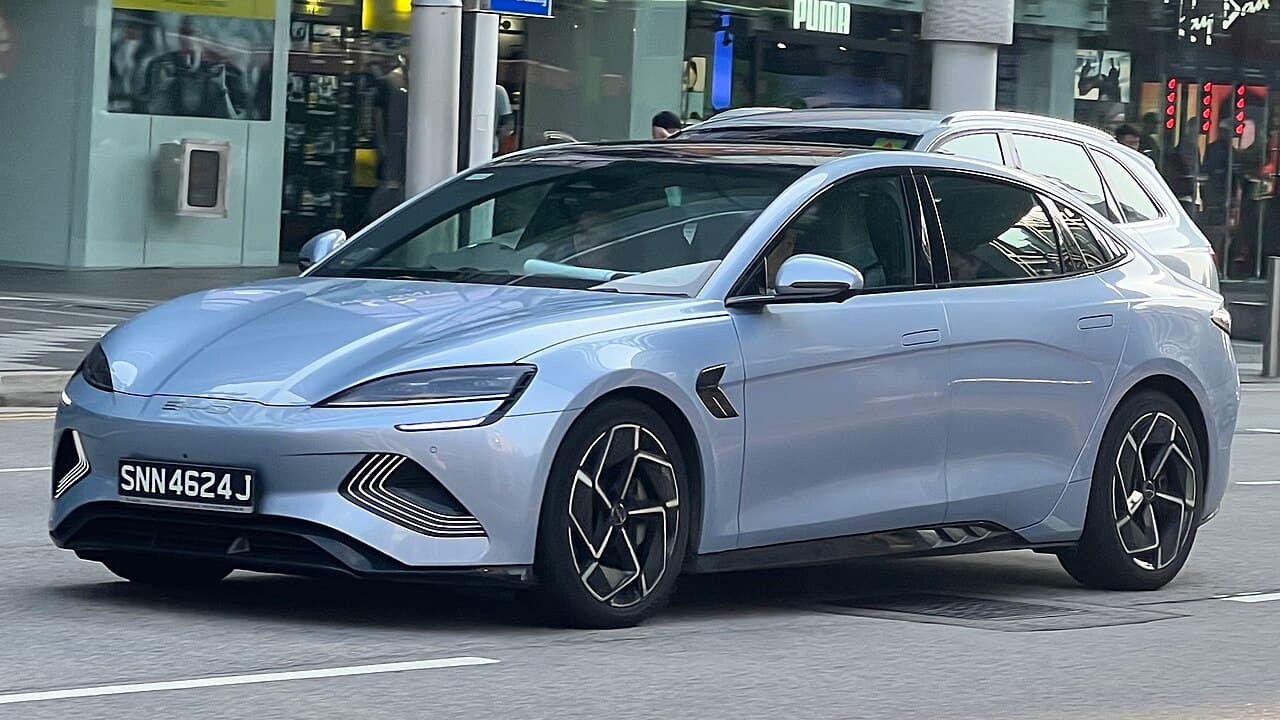
BYD Seal
All-electric performance sedan competing directly with the Tesla Model 3. Features Blade Battery, available dual-motor AWD, and BYD's cell-to-body (CTB) technology that integrates the battery into the vehicle structure.
BYD (Build Your Dreams) is a Chinese high-tech manufacturer spanning automobiles, batteries, electronics, renewable energy, and rail transit.
Latest update Oct 19, 2026
01
Its auto business is unusually vertically integrated, with in-house batteries, motors, power electronics, and automotive semiconductors underpinning a lineup that now ranges from low-cost EVs and plug-in hybrids to premium Denza and Yangwang vehicles. First-half 2026 revenue fell 7.13% YoY to ¥344.82B (~$50.9B) and net profit dropped 20.54% to ¥12.33B as China NEV weakness and foreign-exchange losses outweighed overseas growth; auto-related revenue was ¥275.34B (-8.98%) while gross margin rose to 18.85% from 18.01%. H1 NEV sales were 1,808,511 (-15.72%), with the Q2 decline narrowing to 3.24% after a 30% Q1 drop, and overseas shipments of about 792,000 (+67.8%) making up roughly 44% of H1 volume. August 2026 NEV wholesales reached 440,293 (+17.84% YoY), with 189,466 overseas units (43.03% of volume). The Oct. 1 HKEX voluntary announcement then reported September NEV sales of 463,561, a newer monthly high, production of 463,864, and year-to-date sales of 3,131,576, down 3.94%. On August 28, 2026 BYD opened its 10,000th FLASH Charging station in Shenzhen, doubling the network in under five months across 325 cities and reaching halfway to its 20,000 year-end target, with 1.83 million users (nearly one-third non-BYD). BYD's Szeged plant in Hungary began trial production in January 2026, but full-scale series production has slipped to November or December 2026; the planned €1B Turkey (Manisa) plant remains on hold, and on September 10 BYD cancelled its own Tanjong Malim, Malaysia factory, and on October 15 BYD Malaysia named Sime Motors unit Inokom as its CKD assembler, with no model or start date. At IAA Transportation in Hanover on September 14, EVP Stella Li said BYD will launch its first heavy-duty truck in Europe next year and ultimately manufacture trucks locally to avoid import tariffs, unveiling the ETT 44 4x2 tractor (651 kWh Blade Battery, up to 600 km, 1.5 MW charging). On September 16 in Turin, special adviser Alfredo Altavilla said Italy is now plan B for a second European plant because Stellantis will not sell factories, while Spain and France remain the most actionable options and he was flying on to inspect a site in England. On September 3, 2026 BYD opened its first Indonesian plant in Subang, and on September 11 its Pakistan Gharo CKD plant entered final commissioning for a second-half 2026 start. On September 2 it launched the Sealion 08 Ocean flagship SUV (229,900-279,900 yuan) and began mass-producing an in-house 4D radar chip. On September 16 Fang Cheng Bao launched its first sedan lineup, Formula S and Formula S GT, from 189,900 yuan, about 17% below the August pre-order band; Denza's all-electric N8L went on sale September 14 from 299,800 yuan with 960 km CLTC range, and the Denza Z9S sedan is due September 23 with a claimed 1,100 km CLTC range. The third-generation Tang SUV is still aimed at a Q4 2026 showroom launch. On September 17 BYD launched the 2027 Yuan Up Feichi Edition in China from 74,800 yuan with new 501 km CLTC variants. On September 18 China's SAMR said BYD is immediately recalling 183,211 older Tang and Qin vehicles (2014-2022) to replace defective brake-pedal stopper pads that can crack or detach and leave brake lights on. The same day Denza launched the Z9GT in Thailand at 2,999,900 baht, bringing flash charging to that market, and Reuters reported BYD is among Chinese companies under consideration for Xi Jinping's September 24 US visit; BYD declined to comment and the delegation had not been finalised.
www1.hkexnews.hkUpdated Oct 19, 2026
Analysis · 5 min read · Sep 7, 2026The long view on BYD: strategy, technology and what to watch02
2026
Following its August 21, 2026 presale launch at the Chengdu Auto Show, the Da Han reached dealer showrooms across China on August 24 and BYD opened firm orders the same day, still at presale pricing (249,900 yuan/~$36,850 for the rear-wheel-drive LiDAR Premium trim, 269,900 yuan for the rear-wheel-drive LiDAR Flagship, and 299,900 yuan - confirmed as the model's price cap - for the all-wheel-drive LiDAR Flagship). As of September 5, 2026 BYD has still not announced a distinct final on-sale price or a delivery start date; based on BYD's typical cadence, formal on-sale confirmation and first deliveries are expected within weeks of the order-opening.
2026
The FLASH Charging network reached 10,000 stations across 325 Chinese cities on August 28, 2026 (up from 7,000 by early July, 6,682 across 321 cities in mid-June and 5,715 on May 5), halfway to BYD's 20,000-station year-end target, with 1.83 million users (nearly one-third non-BYD) and 210 million kWh delivered. Partners include Sinopec, PetroChina, CNOOC, TELD and JD.com. That Sinopec framework became a working template on August 8, 2026, when BYD and Sinopec opened their first joint conversion at a working Sinopec petrol station in Shanghai - ripping out the underground fuel tanks and replacing them with six T-shaped 1,500 kW flash chargers (12 stalls) while keeping the site's 24-hour convenience store, a model BYD and Sinopec can repeat across Sinopec's 30,000+ existing fuel stations instead of building new charging hubs from scratch. Hitting 20,000 by year-end would require about 80 new stations a day. International expansion is scaling in parallel: BYD plans 6,000 overseas FLASH stations within a year - 3,000 across Europe by the end of March 2027, 2,000 in the Americas, and 1,000 in Asia-Pacific - to pair with the raised 1.9-2.0 million 2026 overseas target, and in mid-July 2026 it overhauled its overseas brand structure around channel integration and the charging network. Germany's first 1,500 kW FLASH station opened June 9, 2026.
2026-2027
BYD inaugurated its first Indonesian NEV plant in Subang, West Java, on September 3, 2026, its 13th production site worldwide. The 126-hectare factory is rated at 150,000 vehicles a year across stamping, welding, painting and final assembly, and is meant to serve Indonesia plus right-hand-drive export markets in ASEAN, the Middle East and Africa. The next watch item is how quickly output climbs from the inauguration toward that nameplate rate.
2026-2027
DENZA entered Europe in April 2026 (Paris launch event) with the Z9 GT shooting brake and D9 MPV, opening stores in France, Germany, Italy, Spain and the UK, and used the July 9, 2026 Goodwood Festival of Speed to launch its all-electric Z supercar globally alongside a roughly eight-model European lineup across the BYD, Denza, and Yangwang brands - still targeting 30+ European countries and 150+ retail stores by end-2026 (the UK network alone is expanding from 140-plus to roughly 165 locations). Deutsche Bank analysts citing BYD management on September 7, 2026 said the 2026 overseas target is now 1.9 million to 2.0 million units (up from 1.3 million in January and 1.5 million in March), with more than 2.5 million overseas targeted for 2027. January-August overseas sales reached 1,162,260 (+85.72% YoY), including a record 189,466 in August (43.03% of that month's volume). Meeting the new 2026 range requires averaging about 184,000-209,000 overseas units a month over the remaining four months, near the August pace. The export lift is still not enough to keep the company on track for its total 5.0-5.5 million-unit 2026 sales guidance - with 2,668,015 sold through August, BYD would need to average roughly 583,000-708,000 units a month for the rest of the year to reach the guided range, a pace it has not yet hit in 2026.
2026-2027
Following Xiao Di's early-August 2026 public debut at the Di Space center in Zhengzhou, BYD plans to roll the robot out to showrooms initially in Shenzhen and Shanghai, expanding to about 50 locations. EVP Stella Li said she hopes every BYD store eventually hosts two to three robots to greet customers and demo vehicles, with real-world robot sales advisors realistic within one to two years. Re-verified September 5, 2026: BYD has not yet disclosed how many showrooms are actually running Xiao Di beyond the initial Zhengzhou/Shenzhen/Shanghai deployments, nor a firm date for the ~50-location target - still an open rollout with no updated figures published.
2026
China's SAMR said on September 18, 2026 that BYD is immediately recalling 183,211 Qin and Tang series vehicles produced between 2014 and 2022 because a batch of brake-pedal stopper pads can crack or detach after prolonged use, and in extreme cases leave brake lights on when the pedal is not pressed. The Tang series accounts for 142,895 vehicles and the Qin series 40,316. BYD said authorised dealers will replace the parts free of charge. Watch completion of owner notifications and pad replacements, and whether SAMR posts a close-out.
2026
BYD Malaysia managing director Jacob Ma said on September 11, 2026 that the dedicated Tanjong Malim plant will not proceed, but local CKD assembly remains on with an unnamed established partner at a very advanced documentation stage. Naming that partner is the next sourced watch item for ASEAN localization after the September 3 Subang, Indonesia inauguration.
H2 2026
BYD-Mega Motor Company said on September 11, 2026 that the Gharo NEV assembly factory is in final commissioning, with volume production still targeted for the second half of 2026 after equipment validation and quality trials.
2026
TargetAfter the 2026-09-24 teaser; still undisclosed as of 2026-09-28
Reported Oct
TargetReported Oct. 20, 2026 launch; official channel date and prices still unpublished as of Oct. 19
Q4 2026
BYD debuted the third-generation Tang at the Chengdu Auto Show on August 21, 2026, a five-seat mid-to-large SUV positioned as an 8-series Dynasty flagship alongside the larger 9-series Da Tang launched in June. It carries BYD's second-generation Blade Battery with flash charging (10% to 70% in 5 minutes), up to 850 km of CLTC range, and comes with the God's Eye B driver-assist system as standard. As of September 13, 2026 sales are still set to begin in the fourth quarter of 2026, with official pricing not yet announced.
End of 2026
TargetEnd of 2026 (second site decision)
BYD special adviser for Europe Alfredo Altavilla said in Turin on September 16, 2026 that BYD expects to decide on its second European manufacturing site by the end of 2026, and that it prefers to acquire, fully own, and refurbish an existing facility rather than share a line or build from scratch. In a September 17 Reuters follow-up he said Spain and France remain the most actionable options, Italy is now plan B because Stellantis will not sell plants, and that he was flying on to inspect a factory in England. He framed it as the second of an eventual three assembly plants plus one battery factory needed to hit BYD's volume targets while complying with EU local-content rules. The near-term decision matters because the planned Manisa, Turkey plant has been on hold since June 2026 and Szeged is BYD's only European car plant, leaving local capacity well short of the roughly 27% total import tariff exposure on China-built cars. Watch for a named site and a confirmed capacity, and whether the battery plant is scoped alongside it or left to a later phase.
2026
Trial production at BYD's first European car plant in Szeged, Hungary began in January 2026 producing the Dolphin Surf and Atto 2. EVP Stella Li told Reuters in June 2026 that full-scale series production had slipped to Q4 2026 - about a year later than first planned - ramping toward a planned ~200,000-vehicle-per-year capacity. Deutsche Bank, citing BYD management after the early-September 2026 earnings call, now expects vehicle assembly to begin in November or December 2026. At IAA Transportation on September 14 Li told Reuters mass production is due to start next year, a looser window than that November-December assembly date. With BYD's planned Turkey plant on hold, Hungary is the company's top European manufacturing priority. Regulatory and reputational risk from 2026 construction-site accidents, labor allegations, and a July Hungarian subsidy investigation remains a live watch item on the most important European asset.
2027
EVP Stella Li told Carwow.es in Valencia that next year BYD will have one model using solid-state battery technology, a demonstration rather than a named retail launch or mass-production date. FinDreams is pursuing a sulfide (LPSC) electrolyte. CTO Sun Huajun has previously outlined a roughly 1,000-vehicle small batch around 2027 and large-scale commercial production around 2030, with early applications expected on Yangwang and flagship Denza vehicles.
2027
At IAA Transportation in Hanover on September 14, 2026, EVP Stella Li said BYD will launch its first heavy-duty truck in Europe next year and ultimately manufacture trucks locally to avoid EU import tariffs, offering fleets financing, solar-powered charging and a workshop network. The ETT 44 flagship is a 4x2 tractor for up to 44-tonne combinations with a 651 kWh Blade Battery, up to 600 km of range, more than 1.5 MW MCS charging, and a ten-year or 1.2 million km battery warranty. Reporting from the show puts a Hungary heavy-vehicle assembly plant at about 5,000 units a year. Watch for a Europe on-sale date, confirmation of that Hungary truck line, and whether Brussels follows passenger-car anti-subsidy duties with truck tariffs.
Sep 23, 2026
Local Chinese auto media reported on September 16, 2026 that Denza will officially launch the Z9S electric sedan on September 23, about seven weeks after August 3 pre-sales. Denza has not yet posted the date on its own social channels. Pre-sale prices are 319,800-389,800 yuan across three trims claiming 780, 920 and 1,100 km CLTC range from a 102.3 kWh second-generation Blade Battery, with flash charging (10% to 70% in 5 minutes) and a tri-motor variant of 890 kW / 2.68 s 0-100. Watch for final on-sale prices and whether Denza restates the 1,100 km claim as a mass-produced BEV range record.
03
BYD introduced the seven-seat Atto 8 at the Paris Motor Show on Oct. 12 and said European dealers will start sales in the first quarter of 2027. The company says the rear-drive model uses a 115 kWh second-generation Blade battery with up to 405 miles of WLTP combined range, and that Flash Charging takes that pack from 10% to 70% in five minutes and from 10% to 97% in nine minutes on BYD Flash chargers. BYD targets 3,000 Flash stations in Europe by the end of 2027. Prices were not announced. Electrek wrote the five-minute window as 10% to 80%; the company page says 10% to 70%.
BYD put the Da Han EV on sale on Oct. 13 in three variants at 235,900, 249,900 and 275,900 yuan, below the August pre-sale prices of 249,900, 269,900 and 299,900 yuan. CnEVPost and Sina Auto reported 1,008 km CLTC range on the rear-drive models, 880 km on the all-wheel-drive flagship, a 102.3 kWh second-generation Blade battery, and a company claim of a 10% to 97% charge in 9 minutes. A plug-in hybrid was not priced.
BYD Ocean sales chief Zhang Zhuo opened blind pre-orders for the second-generation Seagull on October 9, showing six exterior colors and no prices or a firm on-sale date. MIIT filings list the hatchback at 4,205 x 1,810 x 1,570 mm with a 2,650 mm wheelbase, 425 mm longer than the current car, a 95 kW rear motor and FinDreams LFP packs. Zhang said in August the model would launch this year.
BYD disclosed 463,561 new energy vehicle sales in September, up about 17% from a year earlier and its highest monthly total of 2026, according to a Hong Kong filing as reported by Reuters and specialist EV publications. Reuters, working from the disclosure, put overseas passenger-vehicle and pickup shipments at 179,877; the filing's NEV export line was 180,700, while China sales inferred from the total still fell about 13% year on year. Year-to-date NEV sales were 3,131,576, still down 3.94% from 2025, and passenger battery-electric volume was a monthly record of 273,143.
BYD Dynasty sales general manager Lu Tian said on 25 September 2026 that the Da Han (Great Han) flagship sedan will go on sale in China on 13 October. Pre-sales began at the Chengdu Auto Show on 21 August at 249,900 to 299,900 yuan for three EV variants; the two rear-drive trims claim 1,008 km CLTC range on a 370 kW motor and the all-wheel-drive trim claims 880 km CLTC with 570 kW combined. The D-segment sedan sits above the existing Han and follows the Da Tang SUV in BYD's premium Dynasty push; a plug-in hybrid version has not yet opened pre-sales.
BYD's Denza brand launched the Z9S electric sedan in China on September 23 at 255,800 to 325,800 yuan, well below August pre-sale prices. The Flash Charge Flagship lists a 122.496 kWh battery and 1,100 km CLTC range, which Denza called a record among mass-produced battery-electric cars; the tri-motor e3 performance trim is rated at 890 kW and 2.68 seconds to 100 km/h. All three trims use second-generation Blade batteries and flash charging that Denza said can take the pack from 10% to 70% in five minutes.
China's State Administration for Market Regulation said BYD is immediately recalling 183,211 Qin and Tang series vehicles built between 2014 and 2022 because a batch of brake-pedal stopper pads can crack or detach after long use. In extreme cases a detached pad can leave the brake lights on when the pedal is not pressed, sending a false signal to following traffic. Recalls S2026M0116V and S2026M0117V cover 58,026 Tang, 77,846 next-generation Tang DM, 7,023 Tang EV, and 40,316 Qin vehicles; authorized dealers will replace the pad free of charge, and cars that already received the improved part need no further work.
BYD special adviser for Europe Alfredo Altavilla said at a presentation in Turin on September 16 that the Chinese automaker will over the longer term need three vehicle assembly plants and one battery factory in Europe to hit its volume targets and comply with EU regulations. BYD is starting production at its first European plant in Szeged, Hungary and expects to decide on a second manufacturing site by the end of 2026, preferring to acquire and refurbish an existing facility rather than build one from scratch, with Spain and France among its favored locations. The localization push is BYD's answer to EU trade measures, which stack countervailing duties on top of a basic 10% tariff on cars built in China.
BYD executive vice president Stella Li said at IAA Transportation in Hanover on September 14 that the company will launch its first heavy-duty truck in Europe next year and ultimately build trucks locally to avoid import tariffs. The flagship ETT 44 is a 4x2 tractor for combinations up to 44 tonnes, with a 651 kWh Blade Battery, up to 600 km of range, and more than 1.5 MW charging that BYD says can take the pack from 20% to 80% in about 20 minutes. Li also said passenger-car mass production at the Szeged, Hungary plant is due to start next year, as BYD pitches fleets a package of financing, charging and workshops.
BYD executive vice president Stella Li told Carwow.es in Valencia that next year BYD will have one model using solid-state battery technology, framed as a demonstration rather than a named retail launch. FinDreams is pursuing a sulfide (LPSC) route. FinDreams CTO Sun Huajun has previously outlined a roughly 1,000-vehicle small batch around 2027 and large-scale production around 2030, with early use expected on Yangwang and flagship Denza vehicles.
BYD Malaysia managing director Jacob Ma said on September 10, 2026 that the planned Tanjong Malim assembly plant will not proceed, while local CKD assembly remains on the table with an unnamed established partner. Ma said talks are at a very advanced stage and that an official announcement will follow once documents are finished. Nikkei Asia reported the same shift on September 11, with BYD still committed to assembling vehicles in Malaysia rather than building its own factory.
Deutsche Bank analysts citing BYD management said the company now expects 1.9 million to 2.0 million overseas sales in 2026, up from 1.3 million guided in January and 1.5 million in March, and more than 2.5 million overseas in 2027. January-August overseas sales reached 1,162,260 vehicles, up 85.72% year over year, including a record 189,466 in August. Management said Hungary assembly is expected in November or December, the Indonesia plant has started, and Brazil is ramping toward 300,000 vehicles a year, while a roughly 250,000-unit flash-charge backlog is still gated by Blade 2 battery supply until early 2027.
BYD opened its first Indonesian new-energy vehicle plant on September 3, 2026 at Subang Smartpolitan in West Java, its 13th factory worldwide, on about 126 hectares with annual capacity of 150,000 vehicles. Industry Minister Agus Gumiwang Kartasasmita and National Economic Council chair Luhut Binsar Pandjaitan attended a ceremonial roll-off of a BYD M6 DM as the 100,000th locally produced unit. BYD said the site now employs more than 5,000 local workers (toward more than 20,000 at full output), works with more than 200 supply-chain partners, and is preparing for a 60% local-content (TKDN) target in January 2027.
BYD sold 440,293 new-energy vehicles in August 2026, up 17.84% year over year and 5.03% month over month, the company's highest monthly total of 2026 and a fourth straight month of year-over-year growth. Overseas deliveries set a record 189,466 units, up 134.45% year over year, and accounted for 43.03% of volume, while domestic sales of 250,827 were still down 14.34% year over year. Passenger BEVs hit a monthly record of 256,230 units.
BYD reported first-half 2026 revenue of 344.82 billion yuan ($50.9 billion), down 7.13% year-on-year, and net profit of 12.33 billion yuan, down 20.54%, as China NEV weakness and foreign-exchange losses outweighed overseas growth. Auto-related revenue fell 8.98% to 275.34 billion yuan while gross margin rose to 18.85% from 18.01%; H1 NEV sales were 1,808,511 (-15.72%), with overseas shipments of about 792,000 (+67.8%) making up roughly 44% of volume and Q2's sales decline narrowing to 3.24% after a 30% drop in Q1.
04
All-electric performance sedan competing directly with the Tesla Model 3. Features Blade Battery, available dual-motor AWD, and BYD's cell-to-body (CTB) technology that integrates the battery into the vehicle structure.
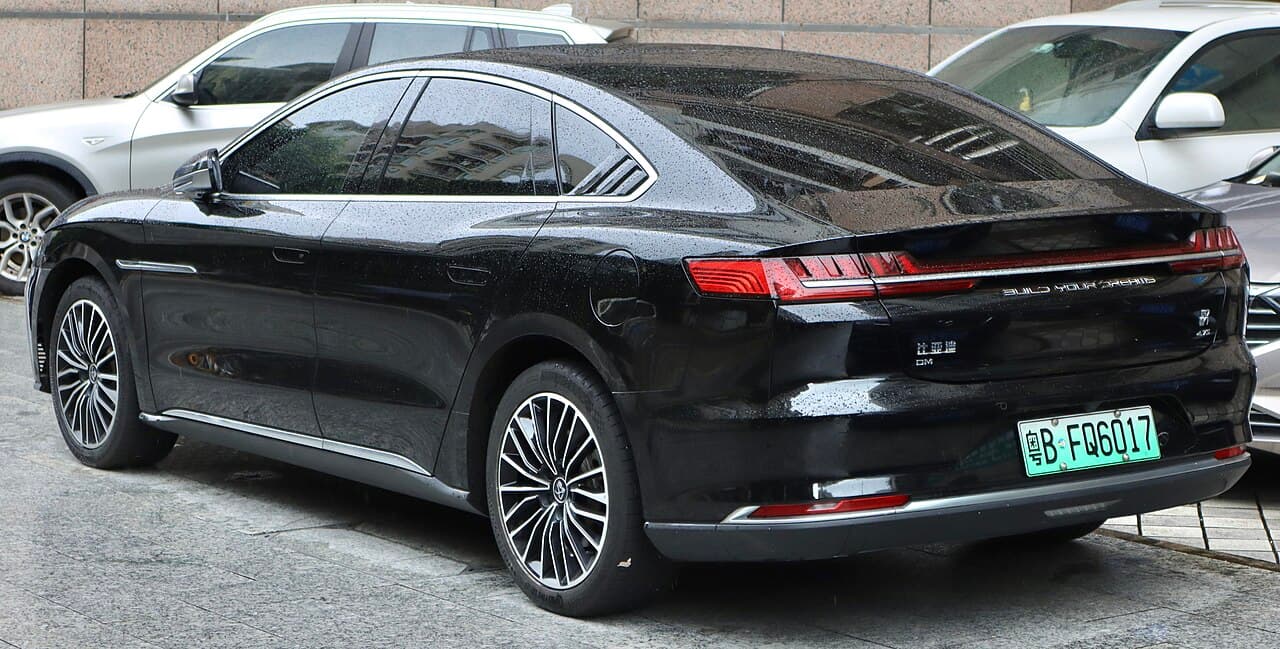
Flagship luxury sedan available in pure electric (EV) and plug-in hybrid (DM) variants. The first vehicle to feature BYD's Blade Battery technology. Positions BYD in the premium segment against Mercedes and BMW.
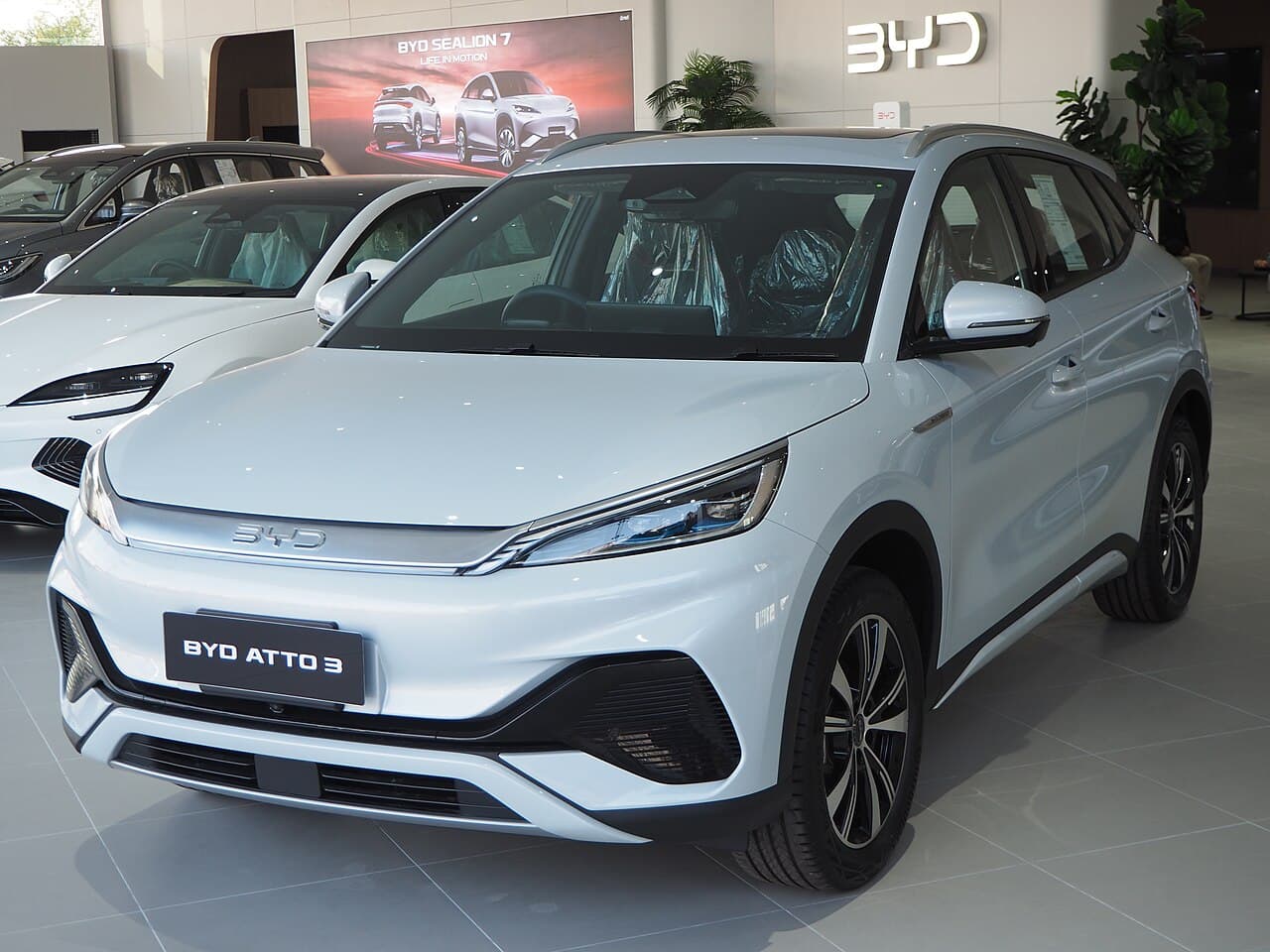
Compact electric crossover SUV, one of BYD's best-selling global models. Known as the Yuan Plus in China. Affordable pricing and Blade Battery technology make it a high-volume international model.
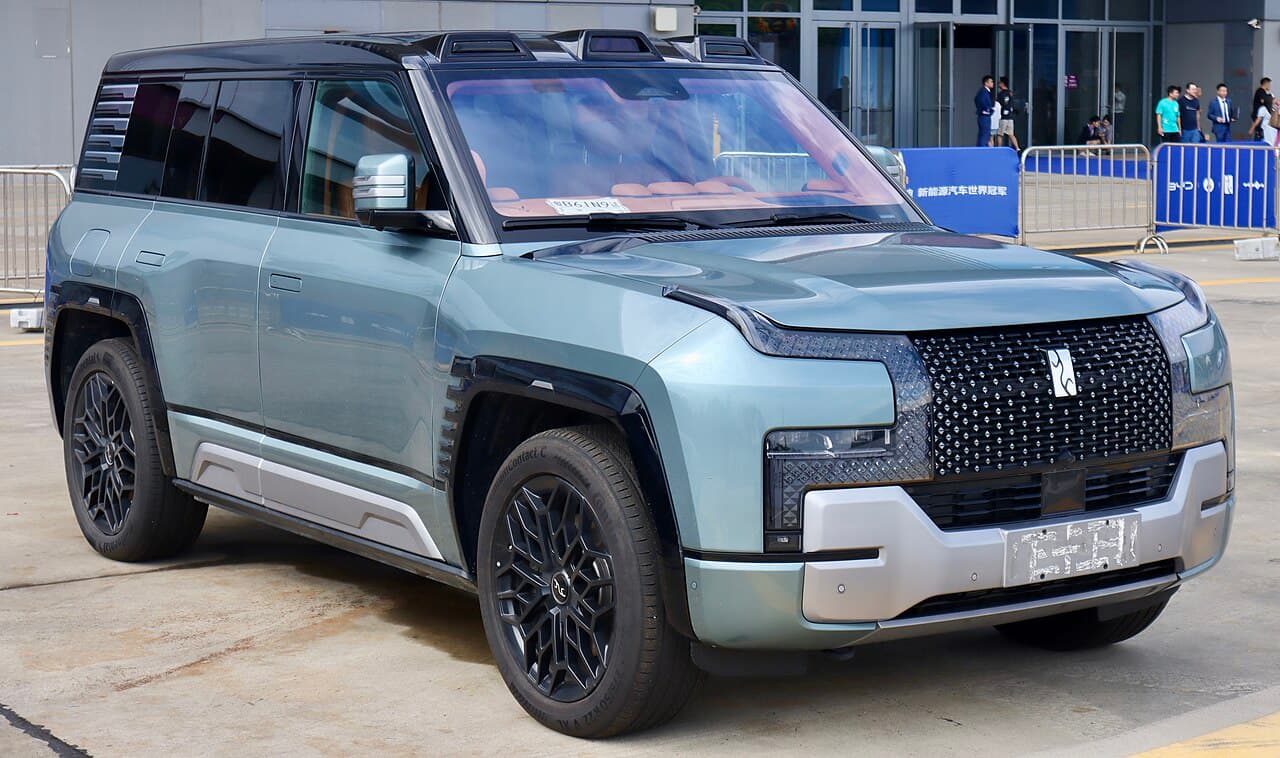
Ultra-luxury full-size off-road SUV under BYD's premium Yangwang brand. Features four independent electric motors, a plug-in hybrid powertrain with over 1,100 hp, and the ability to float and propel itself on water.
In-house automotive power-semiconductor business supplying the IGBT modules and silicon-carbide (SiC) MOSFETs used in BYD's electric-drive inverters and onboard chargers, giving BYD's EVs a vertically integrated power-electronics stack that most rivals still buy from third parties (Infineon, STMicro, etc.). Also supplies chips externally to other automakers.
BYD's first humanoid robot, a service-oriented machine designed to greet customers and demo vehicles in BYD's Di Space showrooms. Built around 360-degree vision, facial and lip-movement recognition, and gesture recognition, with real-time two-way translation across 6 Chinese dialects and 6 foreign languages, positioning BYD alongside Tesla, Unitree, XPeng, and Chery in the humanoid-robot race.
BYD's Denza Z9S is a mid-to-large battery-electric sedan launched in China on September 23, 2026. The Flash Charge Premium and Flagship are rear-drive 370 kW cars with CLTC ranges of 920 km and 1,100 km; the e3 Flash Charge Performance uses an 890 kW tri-motor setup, 780 km CLTC, and a claimed 2.68-second 0-100 km/h time. Denza said the Flagship's 1,100 km CLTC figure is a record among mass-produced battery-electric cars. CarNewsChina lists 102.326 kWh packs on the Premium and Performance and 122.496 kWh on the Flagship, with Denza claiming 10% to 70% flash charging in five minutes.
Dynasty flagship battery-electric sedan that went on sale in China on October 13, 2026 in three variants at 235,900, 249,900 and 275,900 yuan, below the August 21 pre-sale band of 249,900 to 299,900 yuan. Rear-drive models are rated 1,008 km CLTC and the all-wheel-drive flagship 880 km. CnEVPost reported a standard 102.3 kWh second-generation Blade battery and a company claim of a 10% to 97% charge in 9 minutes. A plug-in hybrid was not priced.
Second-generation Seagull hatchback. Ocean sales chief Zhang Zhuo opened China blind pre-orders on October 9, 2026 with six exterior colors and no published prices. MIIT filings list 4,205 x 1,810 x 1,570 mm, a 2,650 mm wheelbase, a 95 kW rear permanent-magnet motor and FinDreams LFP packs. Zhang said in August it would launch in 2026.
Seven-seat electric SUV shown at the Paris Motor Show on Oct. 12, 2026. BYD says European dealers start sales in Q1 2027. The rear-drive model is rated at up to 405 miles WLTP combined from a 115 kWh second-generation Blade battery. Flash Charging times are company claims on BYD's own chargers. Prices were not announced.
05
(~$116B) in FY2025; H1 2026 revenue ¥344.82B (~$50.9B, -7.13% YoY); H1 net profit ¥12.33B (-20.54% YoY); Q1 2026 revenue was ¥150.2B (~$21B, -11.82% YoY). Still the latest reported figures as of September 19, 2026.
cumulative NEV production reached 17M on July 8, 2026 (82 days after 16M) and remains the latest production milestone as re-verified September 19, 2026 - no 18M announcement yet. Monthly/YTD 2026 volume tracked separately under 'August 2026 NEV Sales'.
(¥803.97B); H1 2026: ¥344.82B (-7.13% YoY); H1 net profit ¥12.33B (-20.54% YoY); auto-related revenue ¥275.34B (-8.98%); gross margin 18.85% (from 18.01%). Re-verified September 19, 2026: Q3 2026 results have not been reported yet.
BYD sold 557,090 battery-electric vehicles in Q2 2026 vs Tesla's 480,126, retaking the global BEV sales lead; for H1 2026 overall BYD's 867,479 BEVs stayed narrowly ahead of Tesla's 838,149 despite Tesla's Q1 rebound. Re-verified September 5, 2026: neither company has reported company-level Q3 2026 BEV figures yet (quarter runs through September 30); BYD's passenger-BEV wholesales hit a monthly record of 256,230 units in August per its own sales report, while Tesla China's CPCA-reported wholesale volume (86,166 units, a China-only, all-models figure not directly comparable) grew just 3.57% YoY in August versus BYD's 17.84% YoY total NEV growth.
(+17.84% YoY, +5.03% MoM), highest month of 2026 and 4th straight YoY gain; overseas record 189,466 units (+134.45% YoY, 43.03% of volume); domestic 250,827 (-14.34% YoY). Passenger BEV record 256,230; passenger PHEV 177,154. YTD NEV sales 2,668,015 after adding August to the prior 2,227,722 through July. Re-verified Sept 18, 2026: September company wholesales have not been published (typical print around Oct 1).
(869,600 as of Dec 31, 2025; down ~99K in 2025 via automation); H1 2026 interim report did not disclose a newer official headcount, and no later company figure has been published as of September 18, 2026
(Aug 13, 2026), generating 220M+ km of driving data daily; intelligent-driving model sales reached 187,670 units in July 2026 alone. Re-verified September 5, 2026 - still the latest disclosed fleet count; no newer figure published.
11,586 stations across 341 cities as of September 24, 2026, including the 2,000th highway station at Jiangsu Yangzhou Baoying service area. That meets the 2026 highway target about three months early. The overall year-end China target remains 20,000 stations, with a separate plan for 6,000 overseas.
28, 2026. Latest official monthly print remains August 440,293 NEV wholesales (HKEX voluntary announcement dated Sept. 1). Fang Cheng Bao Shark China on-sale date and price still unnamed after the Sept. 24 teaser.
(+17% YoY, 2026 monthly high); 463,864 produced; 180,700 NEV exports in filing recaps / 179,877 overseas passenger+pickup per Reuters; YTD sales 3,131,576 (-3.94% YoY)
06
Operating status
Operational; Da Han priced, Inokom named
Da Han EV prices reported on Oct. 13 are 235,900, 249,900 and 275,900 yuan for three battery-electric trims, with a 102.3 kWh pack and a stated 10% to 97% flash charge in nine minutes. No delivery start and no priced plug-in hybrid were stated. On Oct. 15 BYD Malaysia named Sime Motors unit Inokom as its CKD partner, with no model or start date. The Atto 8 UK media page still gives no European price and no public CCS kilowatt rate. A reported Oct. 20 second-generation Seagull launch comes from Yiche via CnEVPost, not an official BYD channel, and still has no price.
Primary revenue driver - BYD sells millions of EVs and PHEVs annually across dozens of models spanning from budget to premium (Dynasty and Ocean series, Denza, Yangwang, Fang Cheng Bao).
World's largest electric bus manufacturer with deployments in 70+ countries. Also produces electric trucks and forklifts. At IAA Transportation 2026 BYD unveiled the ETT 44 Europe tractor and said it will launch its first heavy-duty truck in Europe next year, with local truck manufacturing as the long-term plan.
BYD is one of the world's largest battery manufacturers. It builds Blade Battery packs for its own vehicles, supplies cells externally, and has grown into the world's largest utility-scale storage integrator - its global battery-energy-storage-system shipments exceeded 60 GWh in 2025, overtaking Tesla (≈46.7 GWh) to rank #1 worldwide.
BYD Semiconductor designs and manufactures IGBT chips and SiC power modules used in its EVs. Also has a consumer electronics division (BYD Electronic) that manufactures components for Apple, Samsung, and others.
07
How past announced dates turned out.
4/4announced dates hit on time
Publish Da Han official on-sale prices
Target October 13, 2026 · Resolved Oct 13, 2026
CnEVPost on Oct. 13 and electrive on Oct. 16 report three battery-electric trims at 235,900, 249,900 and 275,900 yuan, a 102.3 kWh pack, and a 10 to 97 percent flash charge in nine minutes. Neither states a delivery start or a plug-in hybrid price. This pass did not open a BYD or HKEX price page.
Launch Fang Cheng Bao Formula S sedan lineup
Target September 16, 2026 · Resolved Sep 16, 2026
Fang Cheng Bao launched the Formula S liftback and Formula S GT shooting brake in Shanghai on September 16, 2026 at 189,900-239,900 yuan, about 17% below the August pre-order band. The series debuts DiSus-M magnetorheological suspension, uses second-generation Blade Battery with flash charging, and comes with God's Eye B as standard. Formula SL was not included in this launch.
Debut the Da Han (Great Han) flagship sedan at the Chengdu Auto Show
Target August 2026 · Resolved Aug 21, 2026
BYD debuted the Da Han and opened presales as planned on August 21, 2026 at the Chengdu Auto Show, in line with its August 17 announcement. The D-class Dynasty flagship offers up to 1,008 km of CLTC range and launched in three trims: a 370 kW (496 hp) rear-wheel-drive LiDAR Premium at 249,900 yuan (~$36,850), a rear-wheel-drive LiDAR Flagship at 269,900 yuan, and a 570 kW (764 hp) all-wheel-drive LiDAR Flagship at 299,900 yuan.
Unveil first humanoid robot at Di Space showrooms
Target August 2026 · Resolved Aug 5, 2026
BYD publicly unveiled its first humanoid robot, named Xiao Di, at the Di Space brand-experience center in Zhengzhou in early August 2026 - the company's first public appearance of a physical, operable humanoid prototype, joining Tesla, Unitree, and Chinese auto-industry rivals XPeng (IRON) and Chery (Aimoga) in the humanoid-robot race. The service-oriented robot stands about 1.61 meters tall, weighs roughly 58.5 kg, has 31 degrees of freedom (7 per hand), and supports real-time two-way translation across 6 Chinese dialects and 6 foreign languages via 360-degree vision and gesture/lip-recognition systems.
08
2026
Yiche reports an Oct. 20 second-generation Seagull launch
CnEVPost on Oct. 14, 2026 said Yiche, citing BYD, reported a China launch of the second-generation Seagull on Oct. 20. CnEVPost also said BYD had not announced that date on its own channels. Pre-orders opened Oct. 9 with no price. This is not an official on-sale price or a confirmed company launch notice.
Names Inokom as the Malaysian CKD partner
On Oct. 15, 2026 Just Auto reported that BYD Malaysia appointed Sime Motors subsidiary Inokom as its CKD contract assembler. Liu Xueliang and Sime group CEO Jeffri Salim Davidson signed an MoU in Shenzhen. The report says further details and timelines will be disclosed later, with no model and no production start date.
Shows the Atto 8 in Paris for a Q1 2027 sale
Seven-seat electric SUV with a 115 kWh second-generation Blade battery, rated up to 405 miles WLTP combined in rear-drive form. European dealer sales are planned for Q1 2027. Prices were not announced.
Prices the Da Han EV from 235,900 yuan
On Oct. 13, 2026 BYD put the Da Han EV on sale in three variants at 235,900, 249,900 and 275,900 yuan, below the August pre-sale prices of 249,900, 269,900 and 299,900 yuan. CnEVPost and Sina Auto reported 1,008 km CLTC for the rear-drive models and 880 km for the all-wheel-drive flagship. A plug-in hybrid was not priced.
Opens second-generation Seagull blind pre-orders
On October 9, 2026 Ocean sales general manager Zhang Zhuo opened blind pre-orders for the second-generation Seagull, showing six colors and no prices. MIIT filings list 4,205 x 1,810 x 1,570 mm with a 2,650 mm wheelbase, 425 mm longer and 150 mm longer in wheelbase than the current car, plus a 95 kW rear motor and FinDreams LFP packs. Zhang said in August the car would launch in 2026. Official on-sale prices and a launch day remain unpublished.
Ninth board re-elects Wang Chuanfu chairman and president
The first meeting of BYD's ninth board, held in person on Sept 29, 2026 with all nine directors present, elected Wang Chuanfu chairman. The announcement states he remains chairman, executive director and president. The Oct 1 HKEX sales filing still lists him as the executive director. This is continuity, not a CEO change.
Dynasty lineup reaches 10 millionth vehicle on a Da Han
On September 29, 2026 Dynasty sales general manager Lu Tian said the 10 millionth Dynasty vehicle had rolled off the line, marked by an upcoming Da Han. The sedan is still scheduled to launch on October 13 at pre-sale prices of 249,900-299,900 yuan; official on-sale prices have not been published.
HKEX posts official September NEV production and sales
BYD's October 1 voluntary announcement reported 463,561 NEV sales and 463,864 units produced in September 2026. Passenger sales were 456,713, with a passenger-BEV record of 273,143 and PHEV sales of 183,570. NEV exports were 180,700. Year-to-date NEV sales were 3,131,576, down 3.94%. Figures are unaudited.
2026
September NEV sales hit 463,561, a 2026 monthly high
On Oct. 1, 2026 BYD reported 463,561 NEV sales in September, up about 17% year on year and the highest monthly total of 2026. Reuters, using the disclosure, put overseas passenger-vehicle and pickup shipments at 179,877. Filing recaps listed 180,700 NEV exports, 456,713 passenger NEV sales, a 273,143 passenger BEV record, 463,864 vehicles produced, and 3,131,576 NEV sales in the first nine months, still down 3.94% year on year. China sales inferred from the total remained down about 13% year on year.
Da Han EV launch dated October 13
Dynasty sales general manager Lu Tian said on Weibo that BYD will launch the Da Han sedan on October 13, 2026. Pre-sale prices from the August 21 Chengdu Auto Show remain 249,900 to 299,900 yuan. Two rear-wheel-drive variants are rated 1,008 km CLTC at 249,900 and 269,900 yuan; the all-wheel-drive variant is 880 km at 299,900 yuan. A plug-in hybrid version has not opened pre-sales.
Fang Cheng Bao teases Shark pickup for China, no date or price
On September 24, 2026 BYD and Fang Cheng Bao posted official Shark images on Weibo with the slogan The overseas champion returns. Fang Cheng Bao general manager Xiong Tianbo shared the images. CnEVPost said the teaser did not disclose a domestic launch date or pricing. August overseas Shark sales were 4,300, bringing January-August 2026 to 29,997. The model appeared in a July MIIT filing as a plug-in hybrid multipurpose truck.
Sets October 13 on-sale date for Da Han flagship EV
On 25 September 2026 Dynasty sales general manager Lu Tian said the Da Han (Great Han) flagship sedan will launch in China on 13 October. Chengdu Auto Show pre-sales from 21 August priced three EV variants at 249,900 to 299,900 yuan, with two rear-drive trims claiming 1,008 km CLTC range and the all-wheel-drive trim claiming 880 km CLTC. The sedan sits above the existing Han; plug-in hybrid pre-sales had not opened.
Thailand Rayong plant produces its 100,000th vehicle
BYD said the Rayong, Thailand plant produced its 100,000th vehicle on September 21, an Atto 3, about 26 months after July 2024 start of operations. Designed capacity remains 150,000 a year. CnEVPost reported 95% Thai staff and about 50% local procurement; Thai Rath independently reported over 6,000 employees, about 95% Thai, about 50% domestic parts, and more than 24,000 exports from Rayong. Cumulative Thai deliveries already exceeded 130,000 including imports.
Completes 2,000th highway FLASH station, three months early
BYD said it completed its 2,000th highway FLASH charging station at the Jiangsu Yangzhou Baoying service area, meeting the March 5 plan's 2026 highway target about three months early. CnEVPost, citing BYD Weibo, put the China network at 11,586 stations across 341 cities as of September 24; Jiemian via Sina Finance reported the same 11,586 / 341 figures and the 20,000 year-end China target plus 6,000 overseas stations. The broader 20,000-station goal is still open.
Denza launches Z9S sedan at 255,800 yuan
Denza launched the Z9S battery-electric sedan in China in three trims at 255,800, 275,800, and 325,800 yuan. The Flagship lists 1,100 km CLTC range on a 122.496 kWh pack; the Premium is 920 km CLTC and the tri-motor e3 Performance is 780 km CLTC with 890 kW and a claimed 2.68-second 0-100 km/h time. Denza said the Flagship range is a record among mass-produced battery-electric cars. All trims use second-generation Blade batteries.
Denza launches Z9GT in Thailand with flash charging
Denza launched the Z9GT shooting brake in Bangkok on September 16, 2026, priced at 2,999,900 baht (~$89,870), bringing BYD's flash charging and second-generation Blade Battery to Thailand for the first time. Denza said it now operates in 13 Asia-Pacific markets. The model was already on sale in Europe and Malaysia. BYD's Rayong plant, which marked its second anniversary in July 2026, has a 150,000-vehicle annual capacity and has begun exporting to Europe; cumulative Thai deliveries reached 130,000.
Recalls 183,211 older Tang and Qin vehicles over brake-pedal stopper pads
China's State Administration for Market Regulation said on September 18, 2026 that BYD is immediately recalling 183,211 Qin and Tang series vehicles produced between 2014 and 2022 because a batch of brake-pedal stopper pads can crack or detach after prolonged use. In extreme cases the pads can leave brake lights illuminated when the pedal is not pressed. The Tang series accounts for 142,895 vehicles and the Qin series 40,316. BYD said authorised dealers will replace the parts free of charge.
Launches 2027 Yuan Up Feichi Edition with 501 km CLTC variants
On September 17, 2026 BYD launched the 2027 Yuan Up Feichi Edition in China in five variants priced 74,800-104,800 yuan (~$11,070-$15,510), adding 501 km CLTC versions on a 51.13 kWh pack while keeping 301 km (32 kWh) and 401 km (45.12 kWh) options. The 401 km starting price fell 18,000 yuan to 81,800 yuan. All new variants use a 70 kW motor; God's Eye C is not offered on every trim. The Yuan family sold a record 84,550 units in August. The compact SUV is sold overseas as the Atto 2.
Italy becomes plan B for BYD's second European plant
Speaking in Turin on September 16-17, 2026, BYD special adviser for Europe Alfredo Altavilla told Reuters that Spain and France remain the most actionable options for a second European assembly site, that BYD wants to buy and fully own an existing factory rather than share a line, and that Italy is now plan B because Stellantis will not sell plants. He said he was flying on to inspect a factory in England, and repeated that BYD expects to pick the second site by year-end as the next of an eventual three assembly plants plus one battery factory.
Fang Cheng Bao launches Formula S sedan lineup
BYD's Fang Cheng Bao brand launched its first sedan lineup on September 16, 2026 in Shanghai: the Formula S liftback (189,900-229,900 yuan) and Formula S GT shooting brake (219,900-239,900 yuan), about 17% below the August 20 pre-order band of 230,000-280,000 yuan. The series debuts DiSus-M magnetorheological suspension, uses second-generation Blade Battery with flash charging (10% to 70% in 5 minutes), and comes with LiDAR-equipped God's Eye B as standard. Entry RWD Formula S claims 730 km CLTC from a 76.744 kWh pack; the long-range RWD trim claims 900 km from 92.093 kWh. Formula SL was not part of this launch.
Denza launches all-electric N8L with 960 km CLTC range
BYD's premium Denza brand launched the all-electric N8L SUV in China on September 14, 2026 in two trims at 299,800 and 329,800 yuan, cheaper than the PHEV N8L's 319,800 yuan starting price. It uses a 130.15 kWh second-generation Blade Battery with 960 km of CLTC range, a 370 kW rear motor, 800-volt architecture, and flash charging of 10% to 97% in about nine minutes.
Sets out a three-plant European manufacturing footprint
At a presentation in Turin on September 16, 2026, BYD special adviser for Europe Alfredo Altavilla said the company will over the longer term need three vehicle assembly plants and one battery factory in Europe to meet its volume targets while complying with European regulations, adding that this 'is not something that will happen overnight.' He said BYD is starting production at its first European plant in Szeged, Hungary and expects to decide on a second manufacturing site by the end of 2026, and that it is looking to acquire and refurbish an existing facility rather than build a new plant from scratch, with Spain and France among its preferred locations.
Unveils ETT 44 and plans Europe heavy-truck production
At IAA Transportation in Hanover on September 14, 2026, EVP Stella Li said BYD will launch its first heavy-duty truck in Europe next year and ultimately manufacture trucks locally to avoid import tariffs, pitching fleets a package of financing, solar-powered charging and workshops. The flagship ETT 44 is a Europe-focused 4x2 tractor for combinations up to 44 tonnes, with a 651 kWh Blade Battery on an 851V architecture, up to 600 km of range, a 10-year or 1.2 million km battery warranty, and more than 1.5 MW charging that BYD says can take 20% to 80% in about 20 minutes. The IAA lineup spans 3.5 to 44 tonnes.
Stella Li confirms a 2027 solid-state vehicle demonstration
BYD executive vice president Stella Li told Carwow.es in Valencia that next year BYD will have one model using solid-state battery technology, framed as a demonstration rather than a named retail launch. FinDreams is pursuing a sulfide (LPSC) route. FinDreams CTO Sun Huajun has previously outlined a roughly 1,000-vehicle small batch around 2027 and large-scale production around 2030, with early use expected on Yangwang and flagship Denza vehicles.
Pakistan Gharo plant enters final commissioning for H2 2026 start
BYD-Mega Motor Company said on September 11, 2026 that its purpose-built NEV assembly factory in Gharo, Pakistan is in final equipment installation and commissioning, with volume production still targeted for the second half of 2026. The plant was built in under 18 months and still needs validation, production trials and quality testing before series output.
Launches Sealion 08 flagship Ocean SUV in China
BYD officially launched the Sealion 08 in China on September 2, 2026, the Ocean lineup's flagship SUV after August 13 pre-orders. Eight variants run 229,900-279,900 yuan (~$33,890-$41,250) in BEV and DM-i plug-in hybrid form with 5- and 6-seat layouts. All use second-generation Blade Battery and flash charging (10% to 70% in 5 minutes); the BEV rear-drive trim claims 900 km CLTC range and the DM-i claims up to 1,650 km combined. God's Eye B is standard.
Cancels Tanjong Malim plant, seeks Malaysian CKD partner
BYD Malaysia managing director Jacob Ma said on September 10, 2026 that the planned Tanjong Malim assembly plant will not proceed. Local CKD assembly remains on the table with an unnamed established partner; Ma said talks are at a very advanced stage and that an official announcement will follow once documents are finished. Nikkei Asia reported the same shift on September 11, with BYD still committed to assembling vehicles in Malaysia rather than building its own factory.
Raises 2026 overseas outlook toward 2 million units
Deutsche Bank analysts citing BYD management after the earnings call said the company now expects 1.9 million to 2.0 million overseas sales in 2026, up from 1.3 million guided in January and 1.5 million in March, and more than 2.5 million overseas in 2027. January-August overseas sales reached 1,162,260 (+85.72% YoY). Management pointed to a larger dedicated carrier fleet and local plants (Indonesia started, Brazil ramping toward 300,000 a year, Hungary assembly expected November or December) and said first-half overseas profit was about 20,000 yuan per vehicle.
BYD Semiconductor starts mass production of a 4D radar chip
BYD Semiconductor began mass production of a new 4D millimeter-wave radar chip on September 2, 2026, built around the Xuanji A3 smart-driving chip as its compute hub and fabricated on a 28nm automotive-grade process for Level 2 through Level 4 driving systems. The single-chip design integrates 8 transmit and 8 receive channels, detects stably beyond 400 meters, and offers 0.8-degree horizontal angular resolution and 0.05-meter parking-grade range resolution, deepening BYD's in-house control of the sensing hardware behind its God's Eye assisted-driving stack.
Opens first Indonesia plant in Subang
BYD officially inaugurated its first Indonesian assembly plant in Subang, West Java on September 3, 2026, its 13th production facility worldwide. The roughly $632M (~Rp11.7 trillion), 126-hectare site has annual capacity for 150,000 vehicles across stamping, welding, painting and final assembly, and builds the Atto 1, M6 and M6 DM, plus the Denza D9. BYD said the plant employs about 5,000 local workers currently, rising toward 20,000 at full capacity, and is intended as a right-hand-drive export hub for ASEAN, the Middle East and Africa alongside serving the domestic Indonesian market.
August NEV sales hit 2026 high on record overseas shipments
BYD sold 440,293 new-energy vehicles in August 2026, up 17.84% year over year and 5.03% from July, the highest monthly total of 2026 and a fourth straight month of year-over-year growth. Overseas deliveries set a record 189,466 units (+134.45% YoY, 43.03% of volume) while domestic sales of 250,827 were still down 14.34% year over year. Passenger BEVs hit a monthly record of 256,230 units; passenger PHEVs were 177,154.
Opens 10,000th FLASH Charging station in Shenzhen
BYD inaugurated its 10,000th FLASH Charging station on August 28, 2026 at its Shenzhen Longhua flagship site, doubling the 1,500 kW network in under five months since the 5,000th station on April 1 and covering 325 cities, halfway to a 20,000-station year-end target. The network has delivered 210 million kWh and signed up 1.83 million users, nearly one-third in non-BYD vehicles, with partners including Sinopec, PetroChina, CNOOC, TELD and JD.com; hitting 20,000 by year-end would require about 80 new stations a day.
H1 2026 profit falls 20.5% as China NEV sales weaken
BYD reported first-half 2026 revenue of ¥344.82B (~$50.9B), down 7.13% year-on-year, and net profit attributable to shareholders of ¥12.33B, down 20.54%, citing China NEV weakness and foreign-exchange losses. Auto-related revenue fell 8.98% to ¥275.34B while gross margin rose to 18.85% from 18.01%; H1 NEV sales were 1,808,511 (-15.72%), with overseas shipments of about 792,000 (+67.8%, ~44% of volume) and Q2's sales decline narrowing to 3.24% after a 30% drop in Q1. Operating cash flow rose 17.3% to ¥37.34B and R&D spend was about ¥28.9B.
Da Han flagship sedan debuts and opens presales
BYD debuts the Da Han (Great Han), a new D-class Dynasty flagship sedan positioned above the existing Han, at the Chengdu Auto Show on August 21, 2026, and opens presales in three trims: a rear-wheel-drive LiDAR Premium (370 kW/496 hp, 1,008 km CLTC range) at 249,900 yuan (~$36,850), a rear-wheel-drive LiDAR Flagship at 269,900 yuan, and an all-wheel-drive LiDAR Flagship (570 kW/764 hp combined, 880 km CLTC range, 0-100 km/h in 3.8s) at 299,900 yuan. The sedan targets rivals like the Tesla Model S and Lucid Air.
Opens pre-orders for Sealion 08, flagship of the Ocean lineup
BYD opened pre-orders for the Sealion 08 SUV on August 13, 2026, the flagship of its Ocean series offered in DM-i plug-in hybrid and all-electric versions with five- and six-seat layouts. Pre-order pricing runs 230,000-260,000 yuan (~$32,000-$36,000) for the Sealion 08 DM-i and 250,000-280,000 yuan (~$35,000-$39,000) for the EV, with the DM-i variant BYD's first plug-in hybrid SUV to get flash charging.
Brings LiDAR-equipped God's Eye B down to the Seal 06
BYD launches the revamped 2027 Seal 06 in Shenzhen on August 11, 2026, the first time the LiDAR-equipped God's Eye B driver-assistance tier has come to a family sedan in this price range, previously reserved for pricier models running the camera-only God's Eye C. The redesigned Seal 06 grows to 4.87 meters in length and is offered in EV and DM-i plug-in hybrid versions, with the pure-electric variant's single motor peaking at 240 kW, up from 160 kW in the outgoing model.
Xiao Di humanoid robot publicly unveiled
BYD publicly unveils its first humanoid robot, named Xiao Di, at the Di Space brand-experience center in Zhengzhou in early August 2026, becoming the latest Chinese automaker after XPeng and Chery to field a physical, operable humanoid prototype alongside Tesla and Unitree. Xiao Di stands about 1.61 meters tall, weighs roughly 58.5 kg, has 31 degrees of freedom including 7 per hand, and offers real-time two-way translation across 6 Chinese dialects and 6 foreign languages via 360-degree vision, facial and lip-movement recognition, and gesture recognition. It is designed to greet customers and demo vehicles in showrooms, starting in Shenzhen and Shanghai with plans to expand to about 50 locations.
Denza opens Z9S pre-orders with record 1,100 km EV range claim
BYD's premium Denza brand opened pre-orders for the Z9S sedan on August 3, 2026, in three trims priced 319,800-389,800 yuan (~$47,000-$57,000), all built on the same 102.3 kWh Blade Battery 2.0 with Flash Charging (10-70% in as little as 5 minutes). The top tri-motor trim claims a CLTC range of 1,100 km, which Denza bills as the longest range of any mass-produced all-electric vehicle, ahead of the 780 km and 920 km lower trims.
Guides 2026 sales to 5.0-5.5M units; July pace falls short
On an investor call following the April 2026 Beijing Auto Show, BYD management guided to full-year 2026 new-energy-vehicle sales of 5.0 million to 5.5 million units (domestic volume of 3.5-4.0 million plus the reiterated 1.5 million overseas target), implying 10-20% year-on-year growth. July 2026 wholesales of about 420,000 units (+21.76% YoY) kept the streak of year-on-year growth alive for a third straight month, but after 1.81 million units sold in H1, BYD would need to average roughly 530,000 units a month for the rest of the year to reach even the low end of its guidance - a pace it has not yet hit in 2026, making the second half a real test of whether the export-led recovery can outrun the softer domestic market.
Hungary opens investigation into BYD's Szeged subsidies
Hungary's new Magyar government opens a formal investigation on July 22, 2026 into the subsidies, tax breaks, permits, and environmental exemptions the previous Orban government granted BYD for the Szeged plant, alleging more than HUF 70 billion (~€175M) in undisclosed state infrastructure support plus an additional direct subsidy, and citing 29 separate police probes tied to the project (workplace accidents and suspected criminal offenses). The inquiry follows, and raises revolving-door questions about, former foreign minister Szijjarto's move to a BYD executive role a week earlier. Hungarian inspectors visited the factory site on July 23 to check workers' residency permits, contracts, and other documentation, a follow-up to forced-labor allegations and two fatal construction-site accidents already dogging the project; no delay to the Q4 2026 Szeged production target has been reported as of early August 2026.
Former Hungarian foreign minister Szijjarto joins BYD as an executive
Peter Szijjarto - who as Viktor Orban's foreign and trade minister personally negotiated BYD's Szeged, Hungary plant deal - resigns his parliamentary seat on July 15, 2026 to take an executive 'international relations and new business lines' role at BYD. The move comes two months after Orban's Fidesz party lost power to Peter Magyar's Tisza party in Hungary's April 2026 election, ending Orban's 16-year rule.
Brazil adds BYD to forced-labor 'dirty list' over Camacari plant construction
Brazil's Labour Ministry formally added BYD to its Lista Suja ('dirty list') of employers found to have used labor analogous to slavery on April 7, 2026, following inspections between December 2024 and May 2025 at the Camacari, Bahia site where BYD's first Latin American passenger-vehicle plant was built. Inspectors reported rescuing 163 Chinese construction workers from slave-like conditions (471 identified as illegally brought into the country), citing overcrowded housing, confiscated passports, and wages redirected to contractors in China. The listing bars BYD from accessing certain categories of Brazilian bank financing for up to two years, a reputational setback even as the Camacari plant itself has continued ramping (its 100,000th vehicle rolled out in mid-2026).
Fatal accidents and forced-labor allegations mount at the Szeged, Hungary construction site
A worker died in a crane-related accident at BYD's Szeged factory construction site on February 14, 2026, prompting a Hungarian police negligence probe; a second worker died at the same site on June 25, 2026, deepening scrutiny. In between, the US nonprofit China Labor Watch published a report in late March 2026 alleging indicators of forced labor among the roughly 50 Chinese migrant workers it interviewed at the site, including shifts of up to 14 hours, seven-day weeks, wage delays of up to three months, debt-bondage-style recruitment fees, and workers held on business visas rather than proper work permits. BYD has disputed the characterization of the allegations. The controversy compounds the reputational and regulatory risk already facing BYD's most important European manufacturing asset, alongside the July 2026 Hungarian government investigation into the plant's subsidies.
Leads EU in H1 2026 as new EU countervailing duties take effect
BYD outsold Tesla across the European Union in the first half of 2026, registering 130,743 vehicles (+168.2% YoY) - about 6,501 more than Tesla - according to ACEA data, though Tesla retook the monthly EU lead in June (35,348 vs BYD's 30,791, itself up 199.3% YoY). The surge came despite the EU's definitive countervailing duties on China-built EVs, in force since July 1, 2026, which push BYD's total import tariff to roughly 27% and sharpen the rationale for local production in Hungary and a planned second European plant.
Unveils 8-Series Tang, an 850 km flagship electric SUV
On July 17, 2026 BYD unveiled the production 8-Series Tang, a mid-to-large full-size electric SUV slotting between the Tang L and the flagship 9-Series Da Tang. Built on BYD's second-generation Blade Battery with Flash Charging, it claims a CLTC all-electric range of 850 km from a single 300 kW motor (250 km/h top speed) and adds roughly 9-minute near-full charging plus DiSus-A air suspension. The God's Eye B intelligent-driving system is standard, and BYD priced it at roughly 280,000-320,000 yuan (~$39,000-$45,000) for a second-half 2026 showroom launch.
Signs Poland's largest battery-storage supply deal (600 MW / 2.4 GWh)
On July 1, 2026 BYD Energy Storage signed an agreement with Greenvolt Power to supply battery systems for the 600 MW / 2.4 GWh Siedlce project in Poland - set to be the country's largest battery-energy-storage facility and among Europe's largest. The deal uses BYD's Haohan system built around its 2,710 Ah storage-dedicated Blade Battery, with construction planned to start in Q3 2026 and commercial operation by the end of 2027, deepening BYD's push into grid-scale storage in Europe on the heels of its 11.275 GWh Masdar award in Abu Dhabi.
Brazil plant builds its 100,000th vehicle in about a year
BYD's factory in Camaçari, Brazil rolled out its 100,000th vehicle roughly a year after production began, with a Dolphin Mini marking the milestone. The plant - BYD's first passenger-vehicle assembly site in the Americas - builds the all-electric Dolphin Mini alongside the plug-in hybrid King and Song Pro, underscoring how BYD is leaning on overseas manufacturing and exports to offset a cooling and price-pressured Chinese home market.
Denza Z supercar launches globally at Goodwood in European push
BYD's premium Denza brand held the global launch of its all-electric Z performance sports car at the UK's Goodwood Festival of Speed on July 9, 2026 - billed as the first Chinese intelligent electric supercar to debut there - with a Europe-first market rollout and outputs reported up to roughly 1,580 hp. The event anchored a broader BYD European offensive: around eight new models shown across the BYD, Denza, and Yangwang brands, including the Denza Z Coupe and Z Racing and the European debut of the BAO 5 plug-in-hybrid SUV, as BYD scales its premium lineup abroad to offset domestic price pressure.
Wins 11.275 GWh Masdar storage deal in Abu Dhabi
BYD Energy Storage said on July 9, 2026 it signed a contract to supply 11.275 GWh of battery storage - a single station rated at 1,644 MW / 11,275 MWh - for Masdar's Round-the-Clock renewable-energy project in Abu Dhabi, the world's first gigascale plant designed to deliver solar power around the clock. The RTC project pairs a 5.2 GW solar array with a 19 GWh battery system; BYD's award, one of the largest storage procurements ever signed, uses its Haohan system built around a new 2,710 Ah storage-dedicated Blade Battery. The deal deepens BYD's push beyond passenger EVs into grid-scale energy storage in the Middle East.
Reaches 17 million cumulative NEVs
BYD's 17 millionth new-energy vehicle rolled off the line on July 8, 2026 - just 82 days after the 16 million milestone - with the milestone car a newly launched Seal 08 flagship sedan. BYD said the Seal 08, on sale since July 2 from ¥196,900 (~$28,950), had already logged more than 100,000 firm orders, underscoring the accelerating pace of BYD's output as it expands overseas.
Launches Seal 08 flagship sedan; 65,000 orders in 30 hours
BYD launches the Seal 08, a 5.15-meter mid-to-large flagship sedan, in China on July 2, 2026 in both battery-electric and plug-in hybrid variants from ¥196,900 (~$28,980). It is BYD's first model with flash charging standard across the lineup, built on an 800-volt architecture with DiSus-A air suspension and up to 905 km of all-electric range. Cumulative locked orders reached roughly 65,000 units in just over 30 hours, with pure-electric configurations making up more than 65% of selections, positioning the car well below a comparable Tesla Model 3 in China.
Retakes global BEV crown in Q2; June exports hit record
BYD sold about 557,090 fully electric vehicles in Q2 2026, reclaiming the global battery-electric sales lead from Tesla. In June, new-energy vehicle wholesales rose 5.46% year over year to 403,472 units - a second straight month of annual growth - while overseas sales reached a record 175,349 units (+94.73% YoY), more than 43% of the month's total, keeping BYD on track toward its 1.5-million-unit 2026 export goal.
Launches Da Tang, its longest-range full-size electric SUV
BYD officially launches the Da Tang EV on June 17, 2026 - the first D-segment flagship SUV in its Dynasty lineup - in four versions priced from ¥239,900 to ¥309,900 (~$35,500 to $45,900). Built on BYD's second-generation Blade Battery, it offers up to 950 km of range, which BYD calls the longest among full-size SUVs globally, with a dual-motor all-wheel-drive variant doing 0-100 km/h in 3.9 seconds. The model had drawn more than 150,000 pre-orders since reservations opened April 24 at the Beijing Auto Show.
Refreshed Seagull (Dolphin Surf) adds LiDAR-grade autonomy at entry prices
BYD launches the updated 2026 Seagull - sold overseas as the Dolphin Mini / Dolphin Surf and built at the new Szeged, Hungary plant for Europe - on May 11, 2026. The four-variant city EV starts at ¥69,900 (~$10,300) and offers up to 405 km CLTC range, with an optional God's Eye B (DiPilot 300) LiDAR-equipped driver-assistance package on the top trims (~¥97,900). Pushing LiDAR-grade assisted driving into a sub-$15,000 car underscores BYD's strategy of democratizing its smart-driving stack across the lineup.
Pauses €1B Turkey plant, makes Hungary its top European priority
In June 2026 BYD put its planned €1 billion Manisa, Turkey car plant - announced in 2024 with a 150,000-vehicle annual capacity and up to 5,000 jobs, and originally due to start production by end-2026 - on hold after the Turkish government withdrew tax exemptions and pressed BYD to either build or repay incentives already granted. EVP Stella Li confirmed the suspension (construction had barely broken ground), saying 'right now our first priority is Hungary,' with a second priority of finding an additional European factory site. The move concentrates BYD's near-term European manufacturing on the Szeged plant, whose full-scale series production has itself slipped to Q4 2026.
Pentagon designates BYD a Chinese military company under Section 1260H
The U.S. Department of Defense's updated Section 1260H list published June 8, 2026 names BYD - alongside NIO, Alibaba, Baidu, CALB, and 183 other companies - as a firm supporting China's military-civil fusion strategy. The FY2024 NDAA prohibits direct DoD contracting with any listed entity starting June 30, 2026, with indirect procurement bans following a year later; BYD called the designation baseless and said it would pursue all available legal channels to challenge it.
Assumes full crash liability when God's Eye is active - an industry first
Also at the May 28 event, BYD announced it will assume full financial liability for at-fault accidents that occur while God's Eye urban autonomous driving is active, covering vehicle repairs, third-party property damage, and personal injury. The policy applies to God's Eye A and the LiDAR-equipped God's Eye B across BYD's lineup - new deliveries and existing owners who update to God's Eye 5.0 via OTA - and is the first such liability guarantee from a major global automaker.
Launches Xuanji A3, China's first 4nm smart-driving chip
At its May 28 intelligence strategy event BYD unveils the Xuanji A3, an automotive-grade 4nm SoC for L3/L4 driving that delivers over 2,100 TOPS in a three-chip cluster, already in mass production. Paired with BYD's next-generation God's Eye ADAS, the chip gives the company full-stack control of its assisted-driving hardware and software.
Unveils Blade Battery 2.0 and FLASH Charging
Introduces Blade Battery 2.0 alongside a 1,500 kW FLASH Charging system capable of taking compatible vehicles from 10% to 97% in nine minutes (10% to 70% in 5 minutes), unveiled March 5, 2026 and presented by Chairman Wang Chuanfu the following day. BYD says it had already installed 4,239 FLASH charging stations in China by March 2026 and planned 20,000 by year-end, with overseas rollout to follow.
Q1 2026: revenue falls 12%, profit halves under domestic price war
BYD's Q1 2026 revenue fell 11.82% year-on-year to ¥150.23B ($21B), and net profit attributable to shareholders dropped 55.38% to ¥4.09B ($594M) - its lowest quarterly profit in more than three years - as an intense domestic EV price war compressed margins. A bright spot: Q1 overseas sales surged 55% YoY to ~320,000 units (46% of Q1 volume, spanning 120 countries), and BYD raised its full-year 2026 overseas target to 1.5 million units.
Hungary Szeged plant begins trial production
BYD starts trial production at its Szeged, Hungary passenger-car plant in January 2026 - the first BYD car factory in Europe. The ~200,000-vehicle-per-year facility (representing up to €4B in total investment) is producing the Dolphin Surf compact EV (sold as the Seagull in China) and the Atto 2 SUV. In June 2026 EVP Stella Li told Reuters that full-scale series production has slipped to Q4 2026 - about a year later than first planned - as equipment is still being installed, with BYD also considering a third European plant (Spain) for longer-term capacity.
2025
Reaches 15 million cumulative NEVs
BYD's 15 millionth new energy vehicle - a Denza N8L built at its Jinan factory - rolls off the line on December 18, 2025, with the most recent 5 million units completed in just 13 months. By early 2026 the company says it sold 4.6 million vehicles in 2025, more than 1 million of them outside China, and its footprint spans more than 110 countries and regions.
2024
2022
2020
2008
2003
1995
09
$230Mdisclosed across 1 round with a stated amount