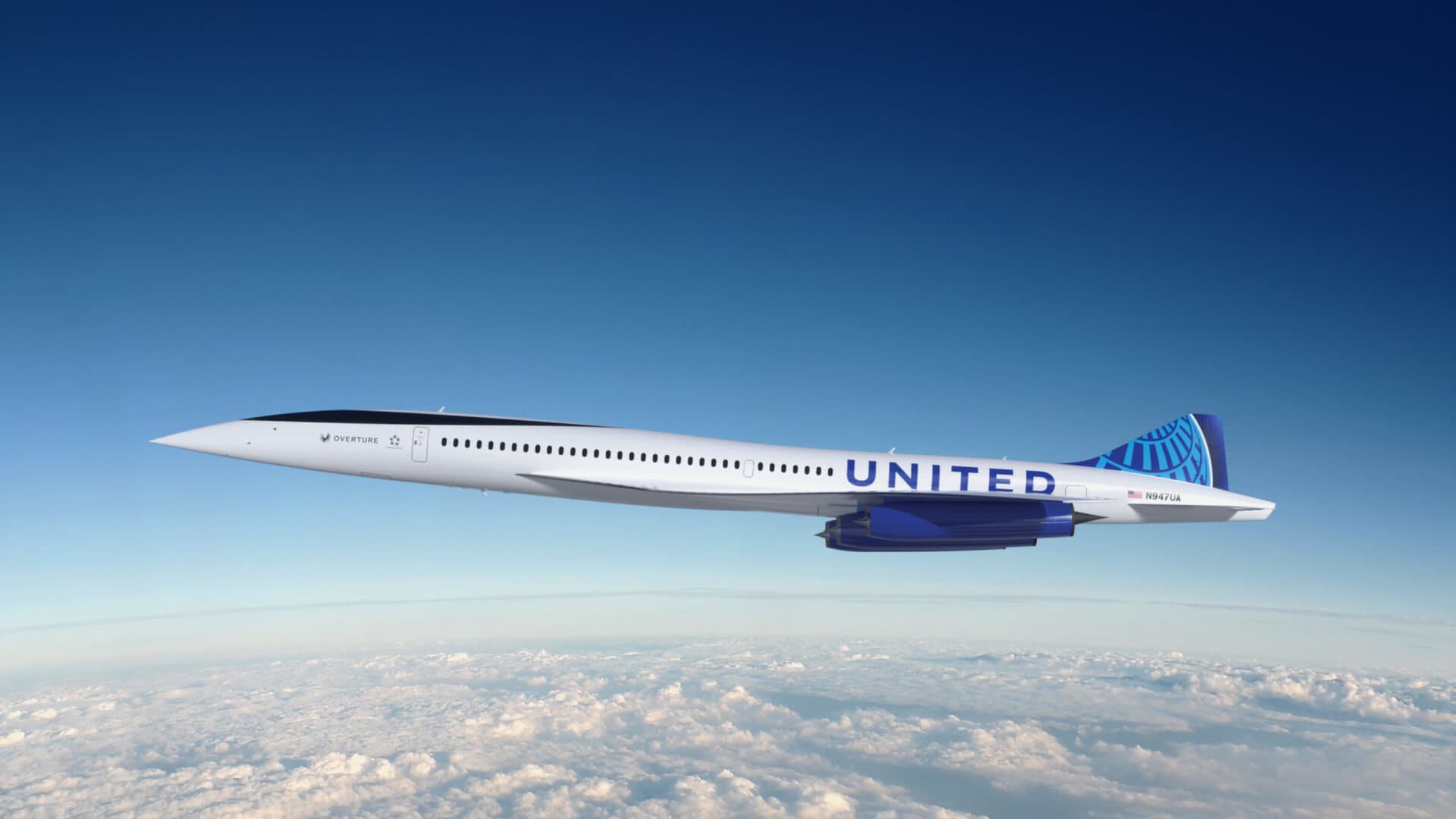
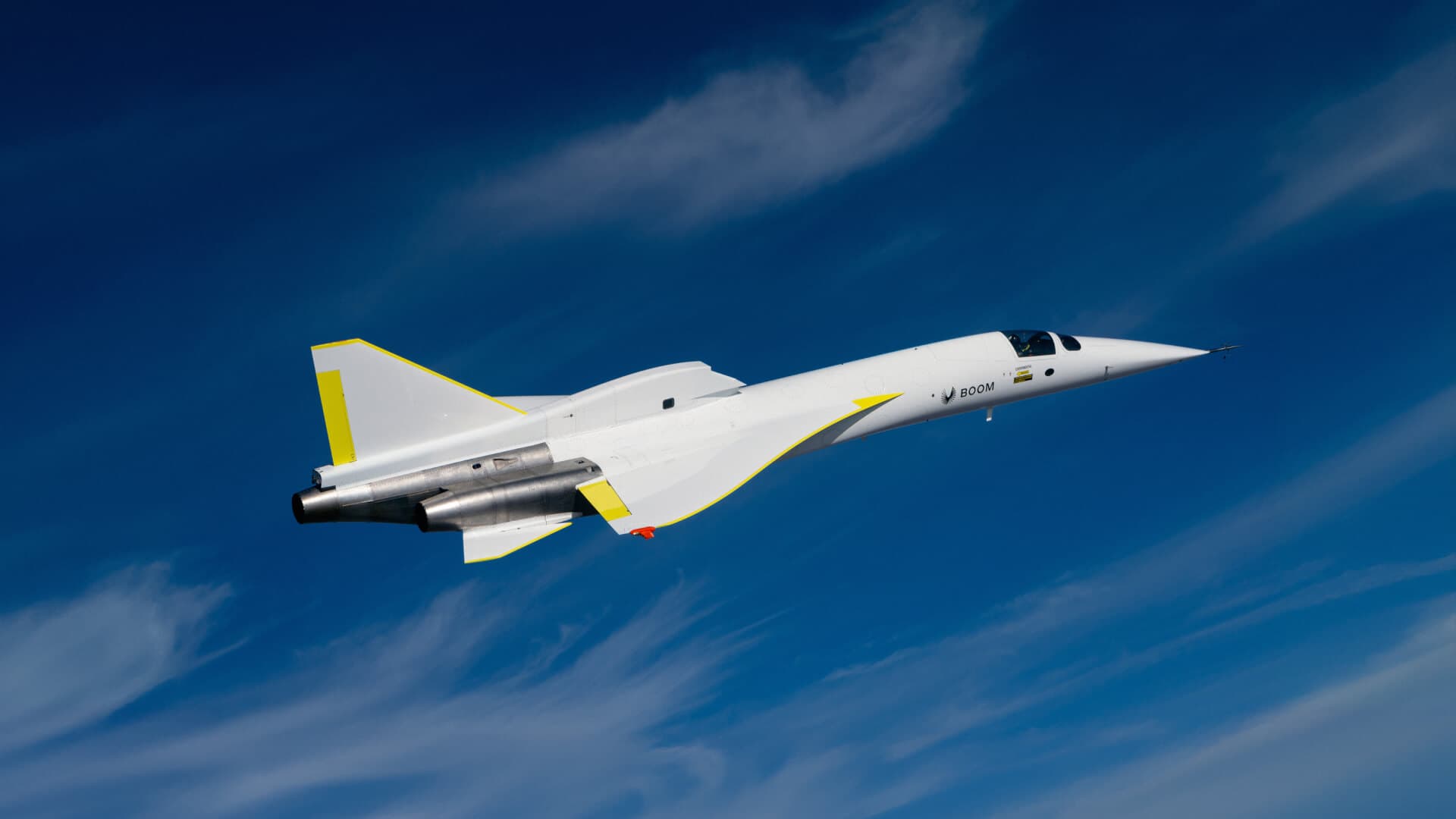
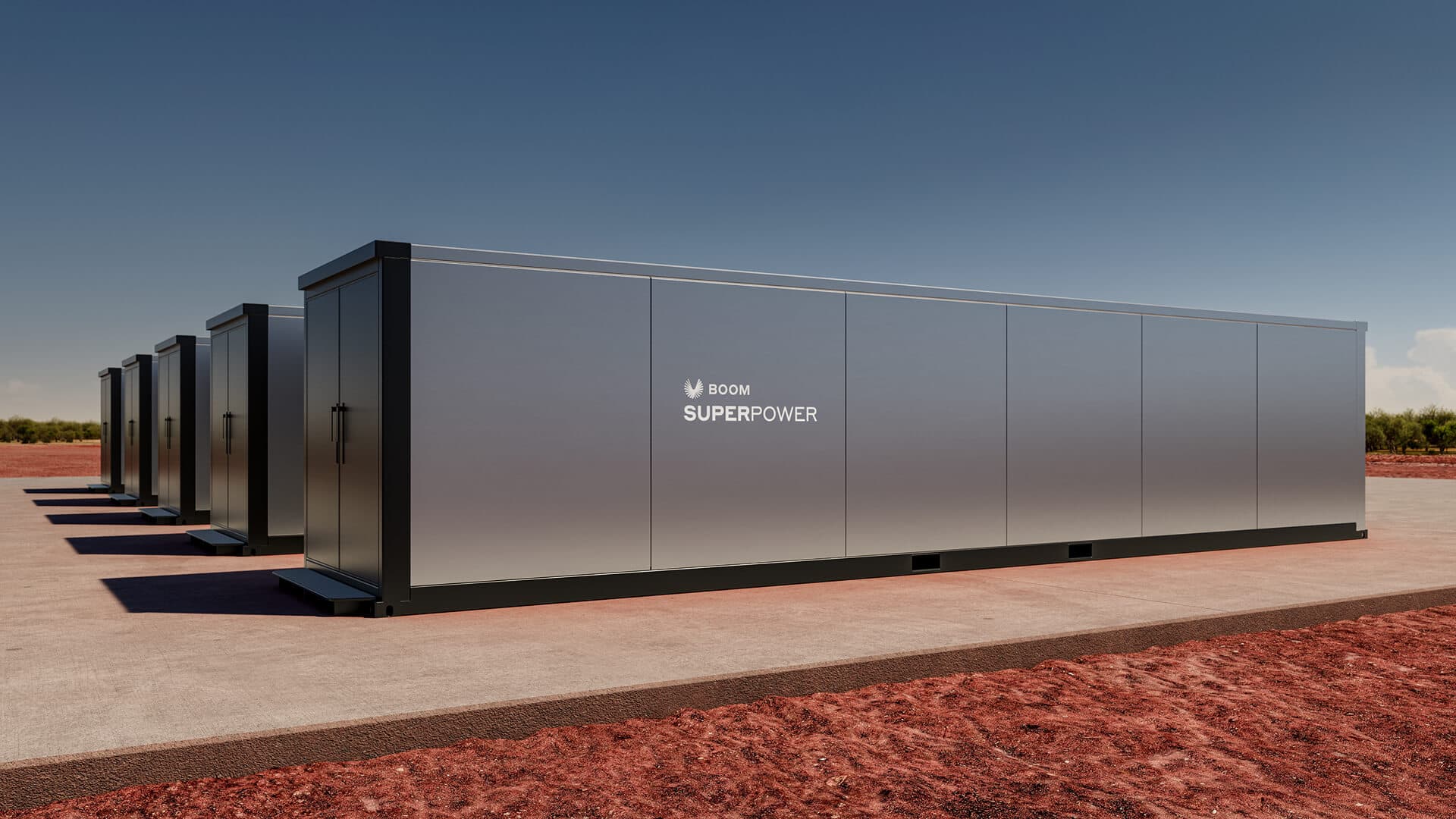
Boom Supersonic is building Overture, a 60-80 seat Mach 1.7 supersonic airliner, while using the Symphony engine core for Superpower, a 42 MW industrial gas turbine.
After XB-1 became the first independently developed jet to fly supersonic in 2025, Boom shifted most near-term effort onto propulsion. Aviation Week reported on September 8, 2026 that the prototype high-pressure core was nearing completion and expected to begin Watkins, Colorado ground tests within two months, a slip toward November, with a fully integrated 42 MW pre-production turbine still targeted for assembly by end-2026. On September 25 Crusoe ended the Superpower launch partnership; Crusoe confirmed to TechCrunch it is no longer doing business with Boom. Scholl said Boom plans about 250 MW of Superpower deliveries next year to unnamed sites and is targeting 1 GW in 2028. Boom still cites nearly $1B in funding and a 130-aircraft Overture book from American, United and Japan Airlines. The Greensboro Superfactory remains largely idle ahead of a December 31, 2026 500-employee lease threshold. Two regulatory tracks remain open: the FAA overland-supersonic proposal (comment period closed August 17, 2026, final rule targeted mid-2027) and the Supersonic Aviation Modernization Act, which still awaits a Senate floor vote.
Finish Symphony sprint core and run the first ground-test cycle
CEO Blake Scholl said in late August 2026 that Boom was a few weeks from running the Symphony sprint core for the first time at the Colorado Air and Space Port. Aviation Week reported on September 8 that the prototype high-pressure core is nearing completion and is expected to begin ground tests at Watkins, Colorado, within two months, a slip out of the original Q3 2026 window into roughly November. The 14,000-pound stand-alone test article covers the high compressor, combustor, and high turbine, the key technical gate for de-risking both Symphony and the Superpower turbine.
Assemble first integrated 42 MW Superpower pre-production turbine
TargetEnd of 2026 (assembly); H1 2027 (operational)
Use the sprint core results to assemble a fully integrated 42 MW pre-production Superpower turbine by the end of 2026 and reach operational readiness in the first half of 2027 ahead of the first Crusoe deliveries.
Hit the Greensboro Superfactory 500-employee benchmark
Boom's Piedmont Triad Airport lease allows termination if fewer than 500 people are employed at the Overture Superfactory by December 31, 2026 - against an original commitment to hire 1,761 workers at the site. With the 179,000-sq-ft hangar still yet to produce a single aircraft and largely idle, The News & Observer reported in 2026 that Boom declined to share its Greensboro headcount and that the 500-employee mark looked unlikely to be met. Hitting (or renegotiating) that benchmark remains a near-term execution gate before Overture aircraft production can credibly start.
Keep Overture aircraft engineering, flight-deck, and supplier work advancing in parallel with the propulsion sprint so an Overture prototype rollout and certification path remain viable as Symphony hardware matures - even as the Greensboro Superfactory stays largely idle and United Airlines CEO Scott Kirby has publicly put Overture's odds at roughly 50-50. Two parallel regulatory tracks now favor Overture's boomless-cruise design: the FAA's proposed rule to repeal the U.S. overland supersonic ban (published in the Federal Register July 2, 2026, comment period closed August 17, 2026, final rule still targeted mid-2027; a separate takeoff-and-landing noise rule has not yet been proposed), and the bicameral Supersonic Aviation Modernization Act, which passed the House on March 24, 2026, cleared the Senate Commerce Committee on July 22, 2026, and still awaits a full Senate floor vote as of September 20, 2026.
Begin handing over the first units from the 29-turbine, $1.25B+ Crusoe order in late 2027 (per CEO Blake Scholl in June 2026), then ramp Superpower production toward 1 GW in 2028, 2 GW in 2029, and 4 GW in 2030 to fund Overture development.
Boom CEO Blake Scholl said on Sept. 25 that Crusoe is no longer the launch partner for Superpower, Boom's 42 MW data-center turbine, because turbines are no longer part of Crusoe's near-term power mix at Abilene and other sites. Crusoe had been described as ordering 29 turbines worth $1.25 billion with first deliveries in 2027; Crusoe confirmed to TechCrunch it is no longer doing business with Boom. Scholl said Boom still expects to deliver about 250 MW of Superpowers next year to other unnamed sites and is targeting 1 GW in 2028.
The FAA released a proposed rule, 'Enabling Supersonic Overland Flight,' on June 30 that would repeal the longstanding U.S. prohibition on civil flight above Mach 1 over land and replace it with a noise-based standard, allowing supersonic operation as long as sonic-boom overpressure at the surface stays at or below 0.11 pound per square foot. The move follows a 2025 executive order and is a regulatory tailwind for developers such as Boom Supersonic, whose Overture jet is designed around a 'Boomless Cruise' Mach-cutoff technique. The FAA said it plans a second rule later this year setting takeoff and landing noise standards for supersonic aircraft.
Boom Supersonic is targeting the end of 2027 to ship the first five units of its Superpower ground turbines, founder and CEO Blake Scholl said at the AIAA AVIATION Forum on June 11. Each Superpower generates 42 megawatts - which Boom argues is enough to power the AI data centers being built across the U.S. - and the units are derived from the same core the company developed for the Symphony engines that will power its Overture supersonic airliner. Boom says it already holds about $1.2 billion in orders for the natural-gas turbines, an adjacent business line that monetizes its propulsion R&D ahead of Overture's entry into service.
NASA's Lockheed Martin-built X-59 Quesst quiet supersonic research aircraft completed its first supersonic flight at Edwards Air Force Base on June 5, with test pilot Jim 'Clue' Less hitting Mach 1.1 (~713 mph) at 43,400 feet during an 81-minute sortie. The milestone produces the first real flight data NASA needs to seed an FAA and ICAO 'quiet thump' noise standard - the same regulatory pathway Boom Supersonic's Overture needs to fly cross-country routes - and lands as the House-passed Supersonic Aviation Modernization Act presses the FAA to revisit the 1973 overland supersonic ban.
The $1.25B Crusoe Superpower launch backlog is cancelled as of Sept 25, 2026. Scholl said about 250 MW of Superpower deliveries next year to unnamed sites and a 1 GW company target in 2028.
Total Funding Raised
Nearly $1B (~$948M across all rounds)
Overture Order Book
130 aircraft
American 20+40, United 15+35, JAL 20 options
Planned Factory Output
33 aircraft/year initially
66/year planned
XB-1 Flight Test Campaign
13 flights, 6 supersonic runs
retired 2025
Superpower Launch Backlog
$1.25B+ / 29 turbines / 1.21 GW (Crusoe)
Superpower Generator Pairing
31 Baker Hughes BRUSH DAX 7 generators totaling 1.3 GW (25 new + 6 from 2025), deliveries mid-2026 through 2028, paired with the 29-turbine Crusoe Superpower order
counterparties and sites still unnamed as of Sept 30, 2026
Baker Hughes generator pairing
Still published against Crusoe
survival after cancellation unconfirmed
06
Operations & revenue
Operating status
Development Stage; Superpower launch customer Crusoe cancelled
XB-1 remains retired after the 2025 campaign. Near-term focus is still propulsion: Aviation Week reported Sept. 8 that the Symphony sprint core was nearing completion and expected to begin Watkins ground tests within two months, a slip toward November. A fully integrated 42 MW pre-production turbine is still targeted for assembly by end-2026. On Sept. 25 Boom CEO Blake Scholl said Crusoe is no longer the Superpower launch partner; Crusoe confirmed to TechCrunch it is no longer doing business with Boom. Scholl said Boom expects about 250 MW of Superpower deliveries next year to other sites and is targeting 1 GW in 2028; counterparties and sites remain unnamed. Official Superpower and newsroom pages still have not posted a cancellation release. Wikipedia now records the September 2026 Crusoe abandonment, citing TechCrunch. Boom's February 24 flyby still describes Baker Hughes 31 BRUSH DAX 7 generators totaling 1.3 GW as paired with the 1.21 GW Crusoe commitment, with deliveries mid-2026 through 2028; no later Baker Hughes or Boom statement confirms that generator pairing survives the Crusoe exit. The Greensboro Overture Superfactory remains largely idle ahead of a Dec. 31, 2026 500-employee lease threshold.
Revenue streams
Overture Aircraft (future)
Boom's main long-term business remains aircraft sales to airline customers. The current order book stands at 130 aircraft from United Airlines, American Airlines, and Japan Airlines, representing Boom's first five years of planned Overture production.
Superpower Gas Turbines
Superpower is Boom's near-term power-generation line for AI data centers. The launch order book is worth more than $1.25B, with Crusoe ordering 29 turbines that will provide 1.21 GW of capacity. Baker Hughes is supplying 31 BRUSH DAX 7 generators totaling 1.3 GW to pair with those turbines, with deliveries scheduled from mid-2026 through 2028.
Government & Special Mission Programs
Boom is also pursuing non-airline applications of Overture through government and defense relationships, including special-mission work with Northrop Grumman and continued engagement with the U.S. Air Force.
07
Timeline19
2026
Crusoe ends Superpower launch partnership
On Sept. 25, 2026 Boom CEO Blake Scholl said Crusoe would not proceed as Superpower launch partner because turbines are no longer part of Crusoe's near-term primary power mix at Abilene and other sites. Crusoe confirmed to TechCrunch it is no longer doing business with Boom. Scholl said Boom plans about 250 MW of Superpower deliveries next year to other sites and is targeting 1 GW in 2028.
Symphony sprint-core ground tests slip toward November
Aviation Week reported on September 8, 2026 that Boom's prototype high-pressure Symphony core is nearing completion and expected to begin ground tests at the Watkins, Colorado, facility within two months, a slip out of the original Q3 2026 first-fire window into roughly November.
Having passed the U.S. House by voice vote on March 24, 2026, the bicameral Supersonic Aviation Modernization Act (S.1759/H.R.3410) - which would direct the FAA to issue rules within a year legalizing civil supersonic flight over U.S. land as long as no sonic boom reaches the ground - was approved by the Senate Commerce, Science, and Transportation Committee on July 22, 2026 and sent to the full Senate floor. The bill runs alongside, and would codify into law, the FAA's own proposed overland supersonic rule, giving Overture's boomless-cruise design a second, legislative route to the same regulatory outcome.
Launches the $800K Boom Prize for amateur supersonic flight
On July 17, 2026 Boom announced the Boom Prize, an $800,000 award ($750,000 cash plus $50,000 in Boom stock) for the first amateur-built, remotely piloted, air-breathing aircraft (up to 55 lb takeoff weight) to break Mach 1 twice in a single day. Free to enter and open through 2030, the contest - which grew from a $100,000 challenge CEO Blake Scholl floated on July 2 - is judged by figures including NASA Administrator Jared Isaacman, and is aimed at widening the pool of supersonic engineering talent and re-energizing public interest in the technology.
FAA proposes lifting supersonic overland ban
On June 30, 2026 the FAA released a proposed rule, 'Enabling Supersonic Overland Flight,' that would repeal the decades-old U.S. prohibition on civil flight above Mach 1 over land and replace it with a noise-based standard, permitting supersonic operation as long as sonic-boom overpressure at the surface stays at or below 0.11 pound per square foot. The notice of proposed rulemaking was published in the Federal Register on July 2, 2026 (Docket FAA-2026-6935) with a public comment period that closed August 17, 2026; a final rule remains targeted for mid-2027. The change - following a 2025 executive order - is a key regulatory tailwind for Boom, whose Overture is designed around a 'Boomless Cruise' Mach-cutoff technique that keeps the boom from reaching the ground. The FAA said a second rule setting supersonic takeoff and landing noise standards will follow later in 2026.
Targets end of 2027 for first Superpower turbine deliveries
At the AIAA AVIATION Forum on June 11, 2026, CEO Blake Scholl said Boom is targeting the end of 2027 to ship the first five units of its 42 MW Superpower ground turbines, which are derived from the same core developed for the Symphony engine. Scholl reiterated Boom holds about $1.2 billion in orders for the natural-gas turbines, positioning Superpower as a near-term revenue line aimed at powering AI data centers ahead of Overture's entry into service.
Greensboro Superfactory sits idle ahead of 2026 lease deadline
Reports in March 2026 describe Boom's 179,000-sq-ft Overture Superfactory at Piedmont Triad International Airport as 'mostly quiet', with North Carolina having committed more than $50M to the project. The lease with the Piedmont Triad Airport Authority allows termination if Boom employs fewer than 500 people at the site by December 31, 2026. The News & Observer later reported that Boom declined to share its Greensboro headcount and that the 500-employee mark looked unlikely to be met, with no aircraft built or tested at the site.
Symphony engine assembly begins; 90% of effort shifts to propulsion
Blake Scholl announces in April 2026 that Boom is about two weeks from starting assembly of the first Symphony engine sprint core at its Colorado R&D supercenter, with the high-pressure spool (high compressor, combustor, high turbine) coming together first. Scholl says roughly 90% of company efforts are now on propulsion, with Symphony sharing about 80% of its hardware with the Superpower turbine.
2026
Baker Hughes to supply 1.3 GW of generators for Superpower
On February 24, 2026 Baker Hughes announced an award to supply 25 BRUSH Power Generation DAX 7 generators, plus AVRs and cubicles, to pair with Boom's 42 MW Superpower turbines for the 1.21 GW Crusoe commitment. Including six generators already on order from 2025, Boom has firm orders for 31 generators totaling 1.3 GW, with deliveries scheduled from mid-2026 through 2028.
2025
Launches Superpower and raises $300M
Boom unveils Superpower, a 42 MW natural-gas turbine for AI data centers, names Crusoe as launch customer with a 29-turbine order worth more than $1.25B, and closes a new $300M Series E round at a roughly $1.5B valuation.
Symphony engine test site selected in Colorado
Boom selects a former hypersonic test facility at the Colorado Air and Space Port for Symphony engine testing and starts investing to prepare the site for company-owned propulsion testing.
XB-1 completes supersonic campaign and demonstrates boomless cruise
XB-1 becomes the first independently developed jet to fly supersonic, then completes a second and final supersonic flight in February. The 13-flight test campaign ends with six supersonic runs and a demonstrated boomless-cruise profile before the aircraft is retired to Boom's Denver HQ.
2024
XB-1 maiden flight and Superfactory completed
XB-1 completes its maiden flight in March 2024, and Boom completes the Overture Superfactory in Greensboro in June, giving the company its U.S. production base for the future airliner.
2022
Major Overture redesign and American Airlines order
Boom unveils the refined four-engine Overture design, expands key supplier relationships, teams with Northrop Grumman on special-mission variants, and secures American Airlines for 20 aircraft with 40 options.
2021
United Airlines orders 15 Overture
United Airlines places a firm order for 15 Overture aircraft with options for 35 more, the first major U.S. airline commitment to supersonic travel.
2020
XB-1 demonstrator rollout
Boom rolls out the XB-1, a one-third scale supersonic demonstrator aircraft designed to validate key Overture technologies.
2017
Japan Airlines invests and pre-orders
Japan Airlines invests $10 million in Boom and pre-orders up to 20 Overture aircraft, becoming the first airline customer.
2016
Accepted into Y Combinator
Boom is accepted into the Y Combinator W16 batch, gaining early backing from Sam Altman and Paul Graham.
2014
Founded
Blake Scholl, Joe Wilding, and Joshua Krall found Boom Technology in Denver, Colorado, with the vision of bringing back supersonic commercial flight.
08
Funding
$478Mdisclosed across 4 rounds with a stated amount