
Active
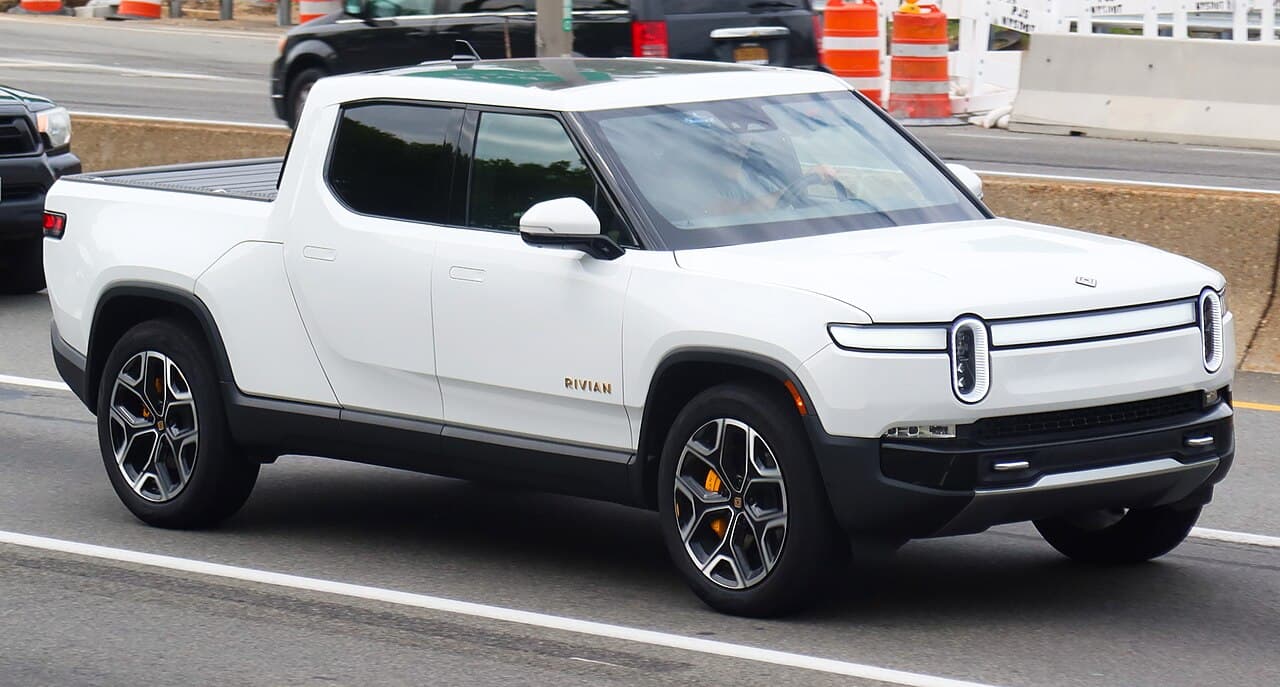
R1T
All-electric midsize pickup truck with quad-motor AWD, up to 400+ miles of range, and adventure-focused features like a gear tunnel and camp kitchen option. First electric pickup truck to market.
Rivian sells the R1T, R1S, Commercial Van and midsize R2. Last reported quarterly financials remain Q2 2026: $1.658 billion revenue and $179 million consolidated gross profit.
Latest update Oct 19, 2026
01
Q3 2026 production and deliveries were 19,751 and 19,248, and full-year 2026 delivery guidance remains 65,000-70,000. Rivian has not published an R2, R1 or Commercial Van split of those 19,248 deliveries. Kelley Blue Book estimates as of 13 October 2026 put U.S. Q3 sales at 3,456 R2, 5,582 R1S, 1,732 R1T and 8,469 EDV 500/700, summing to 19,239, which is not the company delivery total. On 7 October 2026 Rivian funded the committed $1.0 billion Volkswagen Group joint-venture term loan in full. EV reported on 12 October that an unnamed spokesperson said the second R2 shift at Normal began in the third quarter and gave no date. The 2 October production release did not say the shift was live, so that milestone stays pending. As of 30 June 2026 Rivian held 32.1 percent of Mind Robotics. Doug Field became Mind's president on 13 October and is not described as a Rivian officer. Sources opened do not show a Mind robot deployed in a Rivian factory. The 14 October Redwood expansion states no storage figure beyond the April 10 MWh at Normal and does not say scrap recycling has started. Autonomy Early Access invitations began 15 October on a rolling basis for a limited, uncounted group of U.S. Gen 2 R1 and R2 owners with paid Autonomy+, starting in California and Florida. Point to Point remains supervised hands-free driving, targeted for those participants in late 2026 and more broadly in 2027. The August roadmap attaches the traffic-light limitation to Universal Hands-Free. Point-to-Point's own note includes intersection maneuvers under continuous supervision. Claire McDonough remains scheduled to depart 30 October 2026. Q3 financial results are due 29 October.
sec.govUpdated Oct 19, 2026
Analysis · 4 min read · Oct 5, 2026The long view on Rivian: strategy, technology and what to watch02
2026-2028
Keep the roughly 2,000-acre Stanton Springs North facility on track for production in late 2028 under the restructured plan: an initial-phase capacity of 300,000 vehicles per year supported by a renegotiated DOE loan of up to $4.5B that Rivian expects to begin drawing in early 2027. On August 5, 2026 Rivian released detailed site plans and renderings, unveiled at a press briefing at its new East Coast HQ in Atlanta, showing primary factory structures fully enclosed by 2027 to allow tool installation ahead of production, surrounded by a public-facing 63,550-sq-ft visitor build-out (museum, walking trails, cabins, campsites, and an off-road test track) rolled out in three phases. The plant is set to build R2, the upcoming R3/R3X, robotaxis and delivery vans, and could reach full capacity by the end of the decade. By late August 2026 Rivian said site construction was 'progressing well,' with crews grading roads and installing water and sewer infrastructure across the property.
2026-2028
CEO RJ Scaringe said in June 2026 that Rivian will bring supervised, Tesla-FSD-like point-to-point driving to its Gen 2 vehicles within 2026, followed by eyes-off autonomy in 2027. Rivian's own Autonomy+ roadmap page, still current as of September 16, 2026, no longer names Universal Hands-Free 2.0 as a Q3 milestone. It lists Universal Hands-Free on 3.5 million miles of US and Canadian roads plus Lane Change on Command on any marked-line road, then jumps to Point-to-Point assisted driving (limited rollout later in 2026, widespread customer rollout targeted for 2027). A footnote still says Universal Hands-Free will not stop or slow for traffic lights or stop signs. The 2026.31 RivianOS 2 update that shipped September 4 was a UI and AI overhaul, not a surface-street driving upgrade. A late-2026 hardware upgrade begins shipping Rivian's ACM3 (Autonomy Compute Module 3) plus a roof-mounted lidar sensor on R2. The stack underpins the performance milestones tied to Uber's up-to-$1.25B investment and the planned 2028 robotaxi rollout in San Francisco and Miami, expanding to 25 cities by 2031. On its Q2 2026 earnings call Rivian said it also still expects an additional $250M Uber equity tranche - one of several milestone-based investments inside the up-to-$1.25B commitment - later in 2026, subject to completion of certain conditions; it had not yet been received as of mid-September.
Late 2026-2027
Rivian has staged the R2 lineup: the $57,990 Performance Launch Edition ships first, followed by the R2 Premium at $53,990 - a dual-motor AWD trim rated at 450 hp / 537 lb-ft with up to 330 miles of range - and the RWD long-range R2 Standard at $48,490 MSRP / $49,985 with destination fee (345 mi est. range, 350 hp, 0-60 in 5.9s). At the June 2026 launch Rivian pulled its entry-level rear-wheel-drive R2 Standard forward from late 2027 to summer 2027, firming the price at $44,990 (350 hp, 275+ mi est. range) after customer pushback over the original timeline. On the August 3, 2026 Q2 earnings call, CEO RJ Scaringe referenced 'early 2027' three times when discussing the Premium and Standard rollout, prompting a Rivian clarification that the comments described the overall pace of rolling out additional R2 variants at scale rather than a delay, and that Premium 'will become available' in late 2026 as previously guided. As of September 16, 2026 Rivian still had not announced a firm order-open date for the Premium trim, leaving the late-2026 target unconfirmed in practice.
Oct 2026
Under loan agreements disclosed in Rivian's Q1 2026 10-Q, Rivian, Rivian JV SPV LLC, and Volkswagen Group have arranged a committed $1.0B term loan facility - backed by Rivian's stake in the Rivian and Volkswagen Group Technologies joint venture - available to the joint venture in a single draw on any business day from October 1 through October 30, 2026, subject to customary funding conditions. If drawn, proceeds would be loaned on to Rivian for general corporate purposes, with Rivian's loan maturing on the tenth anniversary of funding (no principal due until 2029) at an interest rate equal to Volkswagen's seven-year cost of debt plus 25 basis points. This is separate from the JV equity tranches already received. On its August 3, 2026 Q2 earnings call, Rivian reaffirmed it still expects to receive the $1.0B non-recourse VW term loan 'later in 2026,' subject to completion of certain conditions. As of September 16, 2026 the October draw window had not yet opened and the facility had not been drawn.
Oct 2026
CFO Claire McDonough, who has led Rivian's finance function since January 2021 and helped steer its 2021 IPO and subsequent capital raises, is departing October 30, 2026 to become CFO of GE Vernova. VP of Finance Derek Mulvey - a Rivian veteran since 2021 and former J.P. Morgan vice president - becomes interim CFO on her exit, while Rivian has retained executive search firm Heidrick & Struggles to run a global search for a permanent successor - a transition set against the backdrop of the R2 ramp, the Georgia plant buildout, and the Volkswagen joint-venture term loan facility that opens for a single draw in October 2026. Rivian's investor-relations page had not yet posted a confirmed Q3 2026 earnings date as of September 16, 2026; financial platforms project early November after McDonough's departure, likely with Mulvey already in the interim-CFO seat.
Late 2026
Oct 29, 2026
Nov 9, 2026
Q4 2026
End of 2026
With first customer deliveries (June 9, 2026) and a Q2 R2 ramp behind it - roughly 1,100+ R2 deliveries inside a total 12,194-vehicle Q2 - Rivian kept widening its daily order-invite cadence through July and August. CEO RJ Scaringe said on September 8, 2026 that Rivian was still planning to add a second production shift at Normal before the end of Q3 (September 30), though management does not expect a material volume contribution from that shift until Q4. As of September 16 the shift had not been confirmed as live. The R2 color rollout is broadening in step: Coastal Cloud and Forest Green became orderable in August 2026 and Borealis follows in September, all with the Launch Package. A July 21 pause on Half Moon Grey R2 deliveries (~800 vehicles, paint-mismatched trim parts) still had no announced restart date as of September 16. Rivian maintained its 65,000-70,000 full-year 2026 delivery guidance (implying roughly 20,000-25,000 R2 units) and had not posted Q3 production or delivery figures.
Oct 7, 2028
Oct 7, 2029
03
Rivian said invitations to its Autonomy Early Access Program began rolling out on Oct. 15 to U.S. R1 Gen 2 and R2 owners with paid Autonomy+, starting in California and Florida. Gen 1 vehicles and Canada are excluded. Rivian targets Point to Point, a supervised door-to-door assist, for those participants in December and for a broader Autonomy+ rollout in 2027.
On Oct. 14, 2026, Rivian and Redwood Materials said Redwood will recycle Rivian production scrap and end-of-life battery packs and supply stationary storage at the Normal, Illinois plant. Redwood will collect packs through Rivian's service centers and either repurpose them or recycle them, recovering lithium, nickel, cobalt, and copper at rates above 95 percent. The companies said the new scope builds on an April 2026 plan to deploy 10 MWh of storage from repurposed Rivian packs at Normal.
Mind Robotics, founded by Rivian CEO RJ Scaringe, named Doug Field president on Oct. 13, 2026. Field, formerly Ford's chief EV, digital and design officer, will oversee product, engineering and operations. Mind said Rivian is a key customer and launch partner and will provide a high-volume factory for training and deployment.
Rivian produced 19,751 vehicles at Normal, Illinois and delivered 19,248 in the quarter ended Sept. 30, 2026, and said both figures were in line with outlook. CNBC said deliveries rose 46% from 13,201 a year earlier; Rivian reaffirmed 2026 guidance of 65,000 to 70,000 vehicles. Q3 financial results are due after the close on Oct. 29. Rivian did not disclose the R2 share of the quarter.
Rivian listed NHTSA recall 26V-625, issued Sept. 29, 2026, covering 14 model-year 2027 R2 vehicles that may have an improperly torqued high-voltage battery fastener that can cause loss of motive power. NHTSA's vehicle-recall API reports the same campaign (FSAM-1888) and says owner letters are expected Nov. 28, 2026. Rivian said all affected vehicles are already at service centers and it is not aware of related customer reports, accidents, injuries or fatalities.
Rivian is recalling US R1T, R1S and R2 vehicles because an on-screen notification can obstruct the rearview camera in reverse, a condition NHTSA filings describe as failing FMVSS 111. AutoGuide, citing the NHTSA filing, put the US campaign at 98,828 vehicles; a Rivian spokesperson told USA TODAY about 100,700 vehicles are potentially affected under recall FSAM-1866, that more than 95% already received a free over-the-air fix, and that owner letters are due November 9, 2026. Direct NHTSA document retrieval was blocked in this run, so the two reported counts are both retained.
Rivian began rolling out software update 2026.31 on September 4, 2026, bringing RivianOS 2 to the R1 lineup and putting first-generation R1, second-generation R1, and R2 on a single software foundation. The release rebuilds the interface, adds Google Maps and Waze-sourced police and speed-camera alerts, and extends Rivian Unified Intelligence, with R2 and Gen 2 R1 using Unreal Engine 5 and hybrid edge compute while Gen 1 R1 stays on Unreal Engine 4. Connect+ subscribers also get a weather app and mobile live-trip controls.
Rivian said on August 27, 2026 that CFO Claire McDonough, who joined in 2021 and led the company through its IPO and its Volkswagen Group partnership, will step down October 30, 2026 to become CFO of GE Vernova. VP of Finance Derek Mulvey will serve as interim CFO while Rivian searches for a permanent replacement during the critical ramp of its midsize R2 platform. Rivian shares fell about 7% the day after the announcement.
Rivian said on August 27 that Chief Financial Officer Claire McDonough will step down effective October 30 to become CFO of GE Vernova, relocating to the East Coast. VP of Finance Derek Mulvey, who has worked with McDonough on financial planning and capital allocation since joining in 2021, will serve as interim CFO while Rivian runs an internal and external search for a permanent replacement; shares fell roughly 6% after the announcement.
Also, the micromobility company Rivian CEO RJ Scaringe spun out in 2025, closed a $150 million Series D on August 19 led by Prysm Capital with Eclipse, Greenoaks and MVP Ventures participating, bringing its total funding to about $455 million. The capital funds autonomous-driving development across small-vehicle formats beyond its e-bikes and cargo quads, extending into autonomous delivery vehicles.
Rivian told NHTSA the front turn-signal defect covered by its 2025 recall was not fully contained by its supplier, expanding the campaign by 3,829 additional 2025-2026 R1S and R1T vehicles built with unquarantined parts. The affected lamps may fail to illuminate or flash, and Rivian says it is not aware of any related crashes or injuries; a remedy was available as of August 11.
Rivian unveiled the 2027 model-year R1S and R1T on August 13, adding second-row captain's chairs, its most-requested feature, for a new six-seat layout with a center pass-through to the third row, plus a new Esker Silver paint option that replaces LA Silver. The R1 trim names now mirror R2's naming scheme: Dual becomes Premium and Tri becomes Performance, while starting prices hold at the $79,990 (R1T) and $83,990 (R1S) levels Rivian set in July.
Rivian released detailed site plans on August 5 for its $5 billion, roughly 2,000-acre manufacturing campus in Stanton Springs North, Georgia, which will surround the factory with a museum, public walking trails, overnight cabins, campsites and an off-road test track. Primary factory structures are set to be fully enclosed by 2027, with the plant targeting 300,000 vehicles a year and R2, R3 and R3X production starting in late 2028.
Rivian reported second-quarter 2026 results on July 30, with revenue up 27% year over year to $1.658 billion and a record $179 million consolidated gross profit, though the automotive segment itself still lost $36 million. The company delivered 12,194 vehicles as the R2 ramp got underway, held its raised full-year delivery guidance of 65,000 to 70,000 units, narrowed its 2026 adjusted-EBITDA-loss guidance to $1.8-2.0 billion, and ended the quarter with $5.31 billion in cash and short-term investments.
Federal prosecutors in Manhattan unsealed an indictment on July 24 charging two former Volkswagen engineers, Michael Stamp and Marcus Plank, with securities fraud for allegedly trading on inside knowledge of Volkswagen's planned multibillion-dollar electric-vehicle joint venture with Rivian. Prosecutors say the pair bought Rivian shares and options before the partnership, internally codenamed 'Project Climb,' was announced in June 2024, then sold for more than $300,000 in combined profits once the news went public. Each faces one count of securities fraud carrying a maximum 25-year sentence; neither Rivian nor Volkswagen was accused of wrongdoing.
04
All-electric midsize pickup truck with quad-motor AWD, up to 400+ miles of range, and adventure-focused features like a gear tunnel and camp kitchen option. First electric pickup truck to market.
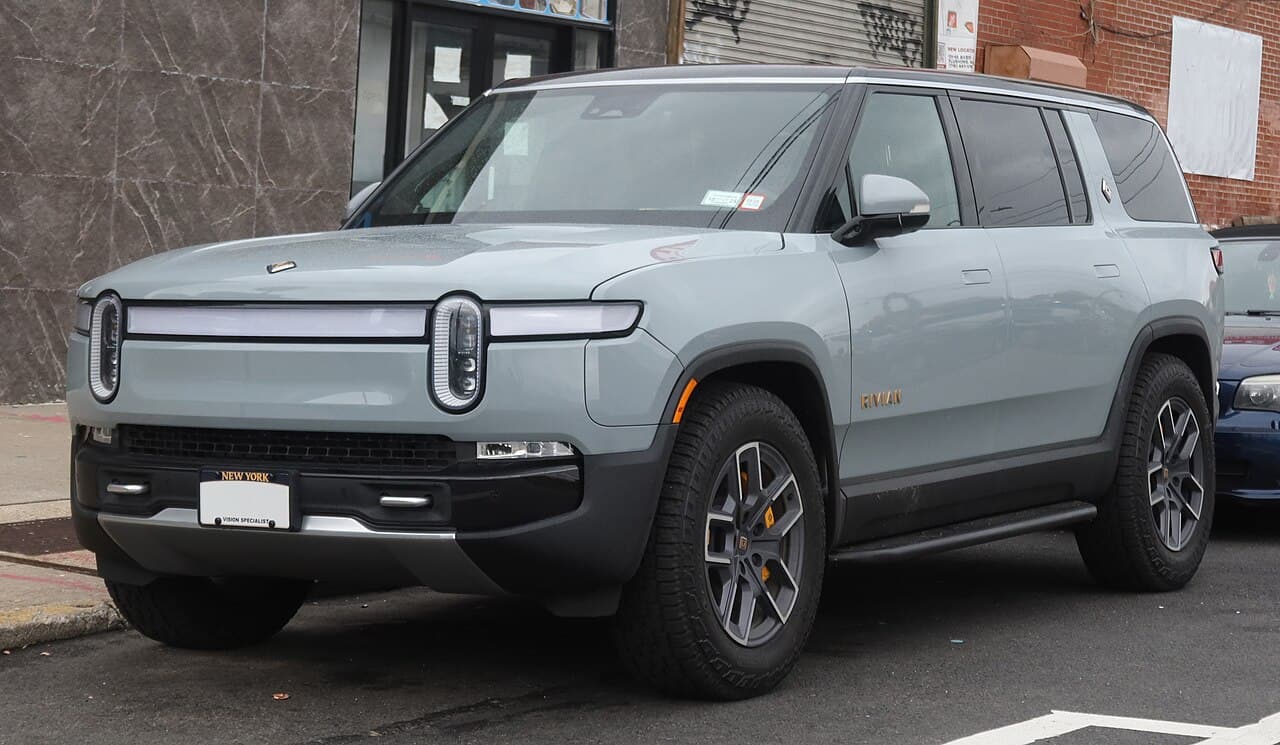
All-electric midsize SUV sharing the R1T's skateboard platform, offering three rows of seating, up to 400+ miles of range, and robust off-road capability.

Midsize SUV on Rivian's new platform, positioned below the R1 line and designed to drive much higher unit volumes. The R2 lineup is staged: Performance Launch Edition first, followed by Premium and long-range Standard trims.
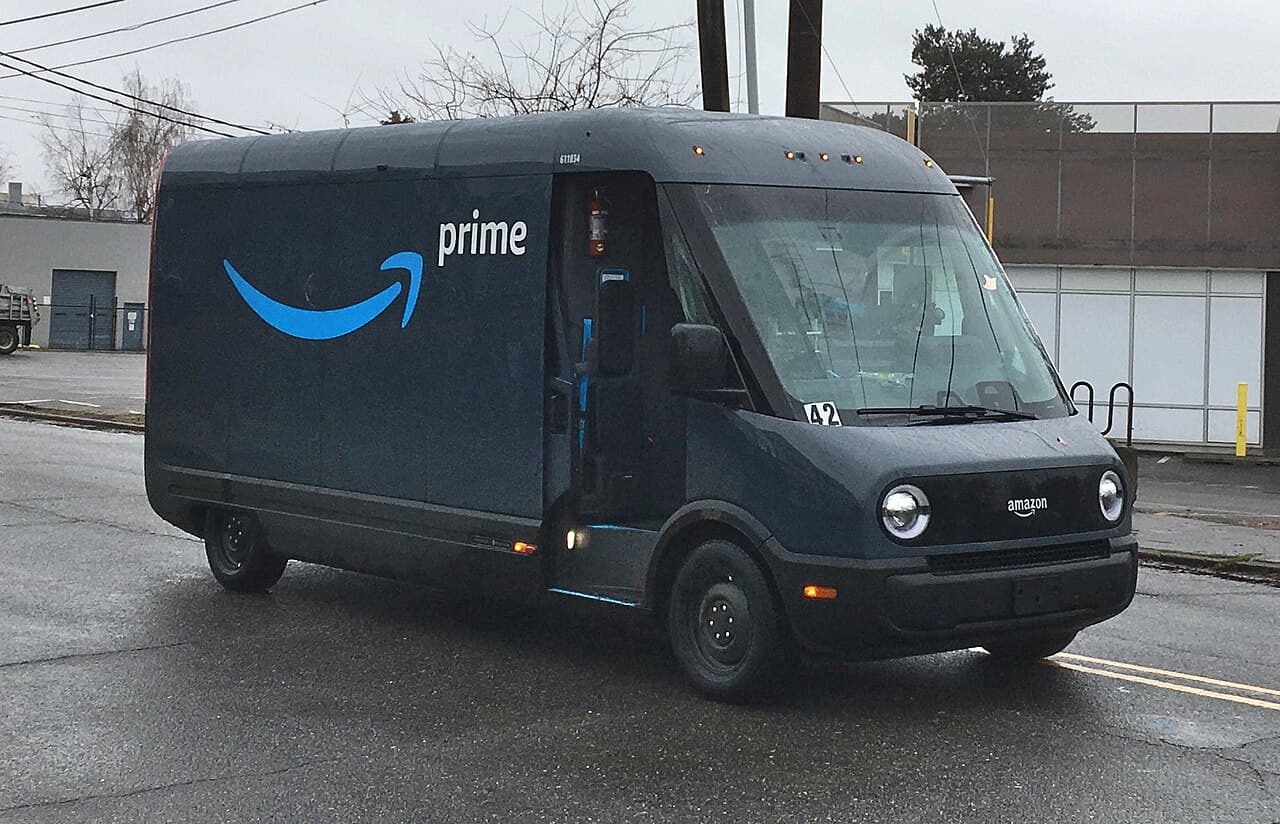
Purpose-built electric delivery van platform derived from the Amazon EDV program and now marketed to a wider range of fleet operators for last-mile logistics and specialty upfits.
05
as of May 2026; figure disclosed by CEO RJ Scaringe includes Rivian and Volkswagen Group Technologies JV personnel consolidated for accounting
(up 27% YoY, record $179M gross profit); $1.381B in Q1 2026; $5.4B in FY2025. Q3 2026 results not yet reported as of September 16, 2026.
company record; R2 Launch Edition reservation-to-order conversion ran ahead of expectations
raised from 62,000-67,000 after the Q2 beat; reaffirmed Oct. 2, 2026 alongside Q3 production of 19,751 and deliveries of 19,248
1,111 DC fast-charging stalls across 159 sites as of mid-September 2026 (Rivian Roamer fleet telemetry; up from 1,087 stalls / 157 sites in late August and 1,073 stalls / 155 sites at Q2-end)
(11% margin); automotive gross loss narrowed to $(36)M from $(335)M YoY; software & services gross profit $215M (42% margin)
($5.85B total liquidity incl. revolver capacity), up from $4.83B at March 31, 2026
06
Operating status
Operational; Q3 results due 29 October 2026
The $1.0 billion Volkswagen JV term loan funded in full on 7 October 2026. Rivian has not split the 19,248 Q3 deliveries by R2, R1 and Commercial Van. Kelley Blue Book's 13 October U.S. estimates are a separate 19,239-unit table. The second R2 shift is not confirmed in an IR release; EV's 12 October spokesperson account gives no date and the live-shift milestone stays pending. Mind Robotics was 32.1 percent owned at 30 June, Doug Field is its president rather than a Rivian officer, and no Mind robot deployment was shown. Redwood's 14 October expansion adds scrap and end-of-life recycling scope without a storage figure above the April 10 MWh, and it does not say scrap recycling has started. Early Access invitations started 15 October with no owner count.
R1T pickup and R1S SUV sales remain Rivian's core automotive business, with the R2 - now delivering since June 2026 - broadening the addressable market as planned.
Commercial Vehicle Sales & Fleet Solutions
Rivian's Commercial Van platform began as the Amazon EDV program but is now sold more broadly to fleet customers, pairing vehicle revenue with charging, service and fleet software relationships.
Software and services now include Volkswagen joint-venture development work, vehicle electrical architecture licensing, repair and maintenance services, remarketing and connected software capabilities.
07
How past announced dates turned out.
1/1announced date hit on time
Post Q3 2026 production and delivery figures
Target October 2026 · Resolved Oct 2, 2026
Official Exhibit 99.1 dated October 2, 2026: 19,751 produced at Normal, Illinois and 19,248 delivered in the quarter ended September 30, 2026, in line with outlook. 2026 delivery guidance reaffirmed at 65,000-70,000. Mix of R2 versus R1 versus Commercial Van was not disclosed. The 14-unit R2 high-voltage fastener recall is a separate quality event already on the timeline.
08
2026
Starts Autonomy Early Access invitations
On Oct. 15, 2026 Rivian began rolling invitations to an Autonomy Early Access Program for U.S. R1 Gen 2 and R2 owners with paid Autonomy+, starting in California and Florida. Gen 1 vehicles and Canada are excluded. Rivian says Point to Point, a supervised door-to-door assist, is targeted for participants in December and for a broader Autonomy+ rollout in 2027.
Expands Redwood recycling and Normal storage
On Oct. 14, 2026 Rivian and Redwood Materials said Redwood will recycle production scrap and end-of-life Rivian packs and supply stationary storage at Normal, Illinois. Packs collected through service centers may be repurposed or recycled. The companies said this builds on an April 2026 deployment of 10 MWh from repurposed packs. No new storage capacity beyond that 10 MWh was stated.
Mind Robotics names Doug Field president
On Oct. 13, 2026 Mind Robotics appointed Doug Field president to oversee product, engineering and operations alongside founder RJ Scaringe. The company said Rivian is a key customer and launch partner and will provide a live, high-volume factory for model training and deployment. The release does not disclose an ownership stake or a production start.
Volkswagen $1.0B JV term loan funded
On October 7, 2026 Rivian funded the committed $1.0 billion, 10-year term loan facility from Volkswagen Group tied to Rivian and Volkswagen Group Technologies, LLC. The back-to-back loans were funded in full: Loan A from Volkswagen Specter LLC to the joint venture at 5.93% and Loan B from the joint venture to Rivian JV SPC, LLC at 6.03%. Loan B is non-recourse to Rivian Automotive, Inc., secured by Rivian's 50% JV equity, and matures October 7, 2036. Amortization of $100 million per year begins on the third anniversary. Rivian intends to use proceeds for general corporate purposes. This is distinct from previously received Volkswagen equity tranches.
Recalls 14 R2s over high-voltage battery fasteners
Rivian listed NHTSA recall 26V-625 (FSAM-1888) on its support page, issued Sept. 29, 2026, covering 14 model-year 2027 R2 vehicles that may have an improperly torqued high-voltage battery fastener that can cause loss of motive power. NHTSA's vehicle-recall API reports the same campaign and says owner letters are expected Nov. 28, 2026. Rivian said all affected vehicles are already at service centers, with remedy available Oct. 2, and it is not aware of related customer reports, accidents, injuries or fatalities.
Reports Q3 2026 production and deliveries
On Oct. 2, 2026 Rivian said it produced 19,751 vehicles at Normal, Illinois and delivered 19,248 in the quarter ended Sept. 30, in line with outlook, and reaffirmed 2026 delivery guidance of 65,000-70,000. CNBC said deliveries rose 46% from 13,201 a year earlier. Q3 financial results are due Oct. 29 after the close.
Newcom describes second-shift hiring as Rivian heads into Q4
At Evercore ISI's 9th Annual ADAS, AV and AI Forum on 29 September 2026, Rivian IR VP Chip Newcom said the company had first-shift operations up and was now hiring and ready to have the second shift get up and running as it headed into the fourth quarter. That is one day before the Q3 end-of-September target from the 30 July earnings call. It is not a confirmation that the second shift was live. After 30 September the IR page still shows an empty Q3 row and the newsroom has no shift or delivery print.
Official recall-information page lists FSAM-1866
Rivian's official recall-information page, last updated 26 September 2026, now lists FSAM-1866 / NHTSA 26V-597 / Transport Canada 2026-443 for 2022-2026 R1T, 2022-2027 R1S and 2027 R2, with remedy available 23 September and more than 95 percent of impacted vehicles already on the OTA. Owner letters remain expected 9 November 2026. This is the company page that was still dated 15 September without FSAM-1866 on the prior pass.
2026
Rear-camera software recall FSAM-1866
Rivian is recalling US R1T, R1S and R2 vehicles because a center-display notification can obstruct the rearview camera in reverse, described as an FMVSS 111 noncompliance. AutoGuide cited a NHTSA filing covering 98,828 US vehicles; a Rivian spokesperson told USA TODAY about 100,700 vehicles are potentially affected under FSAM-1866, with a free OTA fix already on more than 95% of them. Owner letters are expected November 9, 2026. Direct NHTSA PDFs were not retrieved in this run.
RivianOS 2 unifies R1 and R2 onto one software stack
On September 4, 2026 Rivian began rolling out software update 2026.31, bringing RivianOS 2 - its biggest in-car software overhaul since the original R1 launch - to R1 vehicles for the first time, unifying first-generation R1, second-generation R1, and R2 on a single software foundation. The update brings a rebuilt interface, real-time police and speed-camera alerts via Google Maps and Waze, and a deeper AI layer called Rivian Unified Intelligence (the same foundation behind the 'Hey Rivian' voice assistant). R2 and Gen 2 R1 render 3D vehicle and surroundings visuals in Unreal Engine 5 and use hybrid edge compute for low-latency AI processing; Gen 1 R1s stay on Unreal Engine 4 to keep older hardware responsive but get expanded cloud-assisted voice. The release focused on the UI and AI overhaul rather than the surface-street Universal Hands-Free 2.0 driving upgrade, which remains targeted for later in Q3 2026.
CFO Claire McDonough to depart; Derek Mulvey named interim CFO
On August 27, 2026 Rivian disclosed in an SEC filing that CFO Claire McDonough - who joined in January 2021 and helped lead the company through its 2021 IPO and subsequent financings - will step down effective October 30, 2026 to become CFO of GE Vernova and relocate to the East Coast; Rivian said the departure is not the result of any disagreement. VP of Finance Derek Mulvey, a Rivian finance veteran since 2021 and former J.P. Morgan vice president who has worked closely with CEO RJ Scaringe and McDonough on financial planning, strategic partnerships and capital allocation, will serve as interim CFO while Rivian searches for a permanent successor.
Select R2 owners told to pause DC fast charging over connector-to-header fault reports
Starting around August 19, 2026, Rivian began flagging select R2 owners in-app for a service inspection of the DC fast-charging connector-to-header joint after reports that a marginal joint can run trouble-free for months on 240-volt home charging, then overheat the first time it sees the 200-plus amps of a DC fast charger. A service technician told at least one owner Rivian had escalated the issue to an engineering investigation; if a joint tests not-OK, Rivian replaces both the DCFC header assembly and the DCFC connector assembly. As of late August the issue had not been filed with NHTSA and Rivian was handling it through targeted, VIN-based inspections rather than a formal recall campaign, with owners tracking roughly 15 confirmed cases out of more than 6,000 R2s built or delivered since June 2026.
Rivian Adventure Network ranks third in J.D. Power's 2026 public charging study
J.D. Power's 2026 U.S. EV Experience Public Charging Study, released August 13, 2026, scored the Rivian Adventure Network 755 out of 1,000 for owner satisfaction, placing it third among branded charging networks behind first-time entrant IONNA (807) and the Mercedes-Benz Charging Network (797). The study found DC fast charging satisfaction industry-wide up 12 points year-over-year, with reported charging failures falling to 12% of sessions from 14% a year earlier.
Expands turn-signal recall after supplier containment failure
Rivian tells NHTSA the front turn-signal defect covered by its 2025 recall (25V-387) was not fully contained by its supplier, which failed to properly quarantine suspect parts. The expansion (NHTSA campaign 26V-508) adds 3,829 more 2025-2026 R1S and R1T vehicles - 3,204 R1S built June 2024-May 2026 and 625 R1T built October 2024-March 2026 - bringing the combined campaign past 31,700 vehicles. Affected front turn-signal lamps may fail to illuminate or flash, violating FMVSS 108; Rivian says it is not aware of any related crashes or injuries, and a remedy (inspection and/or replacement) was available as of August 11, 2026.
2027 model-year R1S and R1T add captain's chairs, rename trims
On August 13, 2026 Rivian unveiled the 2027 model-year R1S and R1T, adding second-row captain's chairs, its most-requested feature, for a new six-seat layout with a center pass-through to the third row. The refresh also adds an Esker Silver paint option replacing LA Silver and renames the R1 trims to match R2's naming: Dual becomes Premium and Tri becomes Performance, with Quad unchanged at the top. Starting prices hold at the $79,990 (R1T) and $83,990 (R1S) levels set with July's trim consolidation.
Q2 2026 results: record gross profit driven by software, guidance narrowed
On July 30, 2026 Rivian reported Q2 2026 revenue of $1.658B (up 27% year-over-year: $1.14B automotive, $515M software and services) and a record $179M consolidated gross profit, though software and services drove nearly all of it ($215M gross profit, 42% margin) while automotive gross loss narrowed to $36M from $335M a year earlier, aided by higher volumes, regulatory-credit revenue and a partial IEEPA tariff-refund receivable. Net loss was $837M ($0.63/share, a $278M improvement year-over-year) and adjusted EBITDA loss narrowed to $379M from $667M. Rivian ended the quarter with $5.31B in cash and short-term investments ($5.85B total liquidity including revolver capacity), maintained its 65,000-70,000 full-year delivery guidance, narrowed 2026 adjusted-EBITDA-loss guidance to $1.8B-$2.0B (from $1.8B-$2.1B), and lowered planned capex to $1.7B-$1.8B (from $1.95B-$2.05B). Management said R2 will add a second production shift by the end of Q3 2026, with material volume contribution expected in Q4.
Two former VW engineers charged with insider trading on the Rivian JV
On July 24, 2026 U.S. prosecutors charged two former Volkswagen engineers, Michael Stamp and Marcus Plank, with securities fraud for allegedly buying Rivian stock and options ahead of the June 25, 2024 public announcement of the Rivian-Volkswagen joint venture (internally codenamed 'Project Climb'), netting more than $300,000 in combined profits. Each count of federal securities fraud carries a maximum 25-year sentence, and prosecutors noted one defendant had searched 'statute of limitations insider trading' days before the deal went public. The charges target the individuals, not Rivian or Volkswagen; VW is now Rivian's largest shareholder through the up-to-$5.8B joint venture.
Sues U.S. government for full refund of 'Liberation Day' tariffs
On July 23, 2026 Rivian filed suit in the U.S. Court of International Trade against the U.S. government, Customs and Border Protection, and CBP Commissioner Rodney Scott, seeking a full refund - with interest - of IEEPA ('Liberation Day') tariffs after the Supreme Court ruled on February 20, 2026 that IEEPA does not authorize the president to impose tariffs. Rivian's lawyers argue the ruling alone doesn't guarantee automatic repayment, so a separate suit is needed. CFO Claire McDonough had previously estimated the refund at 'tens of millions of dollars'; CEO RJ Scaringe has said the tariffs added as much as a couple of thousand dollars per vehicle at their peak, falling to the low hundreds by late 2025. Costco, FedEx, Toyota, and several other importers have filed similar suits.
Halts Half Moon Grey R2 deliveries over paint-mismatch parts
On July 21, 2026 Rivian paused deliveries of Half Moon Grey R2s after discovering pre-painted plastic exterior parts - bumpers and fascias - had been mismatched to body color at the paint shop, with roughly 800 vehicles affected. The root cause is that plastic exterior parts are painted off-line and inventoried separately from painted bodies, allowing mix-ups to reach the assembly line. Rivian has not announced a restart date; it is at least the fifth distinct R2 quality issue reported since deliveries began in June 2026.
Rivian discontinues entry Dual Standard R1 trims, lifting base prices ~$7,000
Ahead of the R2 launch Rivian phased out the entry-level Dual Standard versions of the R1T and R1S - which paired the dual-motor drivetrain with the smallest battery pack and a roughly 270-mile range - making the Dual Motor Large Pack the new base trim. The change lifted starting prices by about $7,000: the R1T now starts at $79,990 (from $72,990) and the R1S at $83,990 (from $76,990). CEO RJ Scaringe said the move reflected buying patterns, noting Rivian sells 'very, very few of the base spec' of its vehicles.
Scaringe flags memory-chip crunch as the top R2 ramp risk
In a July 1, 2026 interview, CEO RJ Scaringe framed the R2 as an existential test - 'if R2 doesn't go well, the whole company is not designed properly' - and said his biggest worry is supply, not demand: by far his biggest concern about ramping R2 is whether Rivian 'can get enough parts to build cars.' He warned the whole semiconductor space, and memory chips in particular (tightening on surging AI demand), will be 'quite constrained.' Rivian nonetheless raised full-year 2026 guidance to 65,000–70,000 vehicles days later on the back of its Q2 delivery beat.
Q2 deliveries beat guidance; full-year outlook raised
Rivian produced 12,613 vehicles and delivered 12,194 in Q2 2026, topping its own 9,000-11,000 guidance as customer deliveries of the new R2 SUV got underway in June. On the strength of the quarter - driven by growth in EDV and R1 alongside the R2 ramp - Rivian raised its full-year 2026 delivery outlook to 65,000-70,000 vehicles from a prior 62,000-67,000. Shares rose about 8% on the news; Q2 financial results are scheduled for July 30.
Layoffs hit service and sales teams a week after R2 launch
On June 16, 2026 - about a week after opening R2 orders and starting deliveries - Rivian confirms it is laying off hundreds of workers, under 2% of its workforce (up to roughly 300 roles), concentrated in service, sales and marketing rather than R2 production. The company frames the move as restructuring 'a handful of teams' to profitably scale; it is at least Rivian's fourth round of cuts since the start of 2024.
NHTSA opens preliminary probe into 115,000 R1 vehicles for toe link separation
NHTSA opened investigation PE26004 on May 26, 2026 covering 114,922 Rivian R1S and R1T vehicles (MY2022–2025) after two owners reported rear toe link bolts fracturing while driving, causing lane departures - one incident resulting in a collision. Rivian stated internal data shows the joints operating as intended and is cooperating with the evaluation; the probe follows a January 2026 recall (26V-003) that extended an improved toe-link service procedure to earlier-serviced vehicles.
R2 launches June 9 - orders and demos open; first deliveries begin 'soon after'
Rivian opens R2 Performance order invitations and demo drives at its retail spaces on June 9, 2026 as planned, but tells customers first physical deliveries will begin 'soon after' rather than on the day itself - with a 2-to-6-week window from order confirmation to delivery of the $59,485 R2 Performance with Launch Package. The Rivian Adventure Network crossed 1,007 DC fast-charging stalls across 148 U.S. sites during launch week, with 97% open to all EVs - 40% more stalls than a year prior. The R2 Premium ($53,990) follows in late 2026 and the long-range R2 Standard ($48,490) in 2027.
Volkswagen $1B investment milestone
Volkswagen Group completes a $1.0B equity investment into Rivian in Q1 2026 under the joint-venture investment agreement, taking 62.9M Class A shares at $15.90 per share after Rivian hit prescribed testing milestones.
DOE Georgia loan restructured to $4.5B
On April 30, 2026 Rivian announces a renegotiated DOE loan reduced from $6.57B to up to $4.5B, alongside a revised Georgia plant plan. The Stanton Springs site's initial phase capacity rises from 200,000 to 300,000 vehicles per year while peak capacity is cut from 400,000 to 300,000; Rivian now expects to start drawing the loan in early 2027 with production beginning in late 2028.
R2 saleable production begins despite tornado
On April 22, 2026 RJ Scaringe drives the first customer-bound R2 off the line at Normal, Illinois - just five days after an EF-1 tornado damaged Building 2 of the R2 expansion. Rivian confirms no injuries and no schedule slip, with first units going to employees ahead of external deliveries.
Redwood Materials second-life battery energy storage deal
On April 14, 2026 Rivian and Redwood Materials (founded by Tesla co-founder JB Straubel) announce a partnership to deploy second-life Rivian EV battery packs as on-site battery energy storage at Rivian's Normal, Illinois manufacturing plant - billed as the first repurposed-battery storage system deployed at a U.S. automaker's own factory. The system uses more than 100 second-life Rivian packs integrated via Redwood's Pack Manager technology to initially provide 10 MWh of dispatchable energy, cutting cost and grid load during peak demand periods.
Uber robotaxi partnership and $1.25B investment
In March 2026 Rivian and Uber announce a partnership to deploy up to 50,000 fully autonomous R2-based robotaxis starting in 2028 in San Francisco and Miami, backed by an initial $300M Uber investment and milestone-based commitments totaling up to $1.25B. Rivian agrees not to sell autonomous vehicles to direct Uber competitors during an exclusivity period.
2025
Full-year gross profit and R2 validation milestone
Rivian posts $144M of consolidated gross profit for full-year 2025 and completes its first R2 manufacturing validation builds in Normal, keeping customer deliveries on track for Q2 2026.
Commercial Van opens to broader fleets
Rivian opens sales of its Commercial Van beyond Amazon, turning the former EDV program into a broader fleet product for U.S. business customers.
2024
2022
2021
2019
2018
2009
09
$35.6Bdisclosed across 8 rounds with a stated amount
Cumulative disclosed raise · dated rounds
Series A–C
2017–2019
Amazon, Ford, T. Rowe Price, Cox Automotive
Series D–F
2020–2021
T. Rowe Price, Amazon, Coatue, D1 Capital, Ford
IPO
November 2021
Public offering (NASDAQ: RIVN)
VW Joint Venture
November 2024
Volkswagen Group
DOE Loan Facility
January 2025 (restructured Apr. 2026)
Up to $4.5B (renegotiated down from $6.57B)
U.S. Department of Energy Loan Programs Office
Volkswagen JV equity tranche
Q1 2026
$1.0B (62.9M shares at $15.90)
Volkswagen Group
Public equity offering
July 2026
~$1.34B gross / ~$1.32B net (86.25M shares at $15.50 - 75M base plus fully exercised 11.25M over-allotment)
Public offering (NASDAQ: RIVN); proceeds toward general corporate purposes incl. DOE loan equity contributions
Volkswagen JV term loan
October 7, 2026
Volkswagen Group (Volkswagen Specter LLC via Rivian and Volkswagen Group Technologies, LLC)