Zhipu AI (Z.ai) logo

Zhipu AI (Z.ai)

Public (HKEX: 2513, renamed Z.AI Co., Ltd. from Knowledge Atlas Technology on July 17, 2026; Shanghai STAR Market A-share listing in the tutoring-acceptance stage)Founded 2019🇨🇳Beijing, China
CEO

Zhang Peng

Data verified as of Sep 1, 2026

Summary

Zhipu AI - branded Z.ai internationally, and renamed Z.AI Co., Ltd. on the Hong Kong exchange in July 2026 - is a Beijing-based frontier AI lab spun out of Tsinghua University's Knowledge Engineering Group in 2019, best known for its open-weight GLM foundation-model family and for becoming the world's first publicly listed LLM company with its January 2026 Hong Kong IPO (HKEX: 2513). Led by CEO Zhang Peng, it ships MIT-licensed frontier models on a rapid cadence - the current flagship GLM-5.3 (August 2026) is an extended post-training pass on the same ~743B-parameter mixture-of-experts base as June's GLM-5.2, leading open-source models on several agentic and coding benchmarks and, on Zhipu's own reporting, edging Anthropic's Claude Mythos 5 and OpenAI's GPT-5.6 Sol on a cybersecurity vulnerability-detection test - alongside the Z.ai/ChatGLM assistant, API platforms, the AutoGLM agent line and the ZCode coding harness aimed at Anthropic's Claude Code. Its API business has scaled fast on coding-tool demand: registered MaaS API users neared 7M by mid-August 2026 and annualized recurring revenue reportedly crossed $1B in July 2026, though Zhipu has not officially confirmed that figure. Added to the US Entity List in January 2025, Zhipu leans into a sovereign-AI strategy, selling government-grade LLM infrastructure across Southeast Asia, the Middle East and Africa, and is pushing for domestic-chip compute self-sufficiency, having powered up a roughly 1-gigawatt Nvidia-free data center and acquired AI heterogeneous-computing software developer XCore Sigma in July 2026. Its stock rose roughly 1,700% in the six months after listing before a sharp, volatile pullback tied to a thin free float, and in July 2026 it raised a further ~$4B placement to fund compute, with an up-to-RMB-15B Shanghai STAR Market listing also in progress.

/ Recent News

View all →
  • View all news

    Browse the daily archive

Main Products

GLM open-weight model family (GLM-5 / 5.1 / 5.2 / 5.3)

Zhipu's frontier line, designed for 'Agentic, Reasoning, Coding' workloads. GLM-5.3 (August 14, 2026) is an extended post-training pass on the same ~743B-parameter mixture-of-experts base as GLM-5.2, claiming a 50% jump in coding capability and the top spot among open-weight models on benchmarks including Terminal-Bench 3.0.

GLM-5.3 is live on the GLM Coding Plan and ZCode, and its full open weights (753B total parameters) were published on Hugging Face on August 28, 2026 after Zhipu's internal safety review - on the promised two-week schedule, but under a new bespoke 'GLM-5.3 License' rather than GLM-5.2's plain MIT terms, requiring companies above $10B in trailing-12-month revenue to pass a Z.ai security review before commercial hosting.

GLM-5.3 Base~743B-parameter MoE base (shared with GLM-5.2), extended post-training
Coding Improvement+50% vs GLM-5.2 on Zhipu's internal coding benchmarks
Context Window1M tokens
Cybersecurity Benchmarks84.5% on CyberGym (vulnerability identification from source code), narrowly ahead of Anthropic's Claude Mythos 5 (83.8%) and OpenAI's GPT-5.6 Sol (83.6%); 54.4% on ExploitBench (exploitation depth), trailing those rivals' high-70s scores. Company-reported, not independently verified; in security-team testing against real codebases GLM-5.3 flagged 2,436 vulnerabilities across 269 open-source projects.

Z.ai / ChatGLM assistant

Generally Available

Zhipu's consumer chatbot, served as ChatGLM in China and chat.z.ai internationally, running the GLM-5 family with vision, image/video generation (Ying) and agent features.

Roughly 3M free overseas users after the GLM-4.6 release (a tenfold jump in 2025), alongside a large domestic ChatGLM base.

Overseas Users~3M free users (2025, 10x YoY)

Zhipu's agentic product line: AutoGLM operates phones and the web on a user's behalf (AutoGLM-Thinking reasons and acts concurrently), while ZCode - launched July 2, 2026 - is a coding-agent harness for GLM-5.2 aimed squarely at Anthropic's Claude Code, seeded with free-token promotions.

ZCode launched July 2, 2026 with 5M free tokens for new users; GLM Coding Plan demand after GLM-4.7 was rationed to 20% of volume in January 2026.

GLM Coding Plan$18 (Lite) / $72 (Pro) / $160 (Max) per month list price (Aug 2026); a 30%-off intro promo through Sept 2026 brings effective prices to $12.60/$50.40/$112

What's Next

Complete the Shanghai STAR Market A-share listing

Execute the board-approved plan (June 1, 2026) to raise up to RMB 15B (~$2.1B) in an A-share listing, with RMB 12B earmarked for foundation-model R&D, becoming dual-listed under China's 'H-to-A' policy tailwind. As of June 17, 2026 the listing moved into the 'tutoring acceptance' stage with Guotai Haitong Securities as sponsor - an early procedural step still requiring a shareholder special resolution, CSRC registration, and Shanghai Stock Exchange approval. Re-checked mid-August 2026: no further procedural update (shareholder vote, CSRC filing, or SSE review) has been publicly reported since the June tutoring-acceptance milestone.

2026–2027

Deploy the $4B placement into compute

Convert the July 2026 placement proceeds into training and inference infrastructure - largely on domestic hardware given Entity List constraints - to keep scaling the GLM family. In July 2026 Zhipu acquired AI heterogeneous-computing software developer XCore Sigma to squeeze more utilization out of its domestic chip fleet, and is separately in early-stage talks with domestic chip-design houses about a custom ASIC for the GLM family, driven by GLM-5.2 daily token usage surging as much as 27x in its first week; no ASIC partner has been selected and that project could take 2+ years.

2026–2027

Expand sovereign-AI deals internationally

Grow the government-infrastructure business across Southeast Asia, the Middle East and Africa via the Indonesia and Vietnam innovation centers and Huawei-based private AI offerings - a push third-party analysts say continues to show notable progress in securing government and state-owned-enterprise contracts across the three regions.

Ongoing 2026

Track Record

2 of 2 announced dates hit

Open-source the GLM-5.3 model weights

Target Late Aug 2026 · Resolved Aug 28, 2026

Zhipu published the full GLM-5.3 weights (753B total parameters) on Hugging Face on August 28, 2026, right on the promised two-weeks-after-launch schedule and after completing its internal safety review. The weights shipped under a new bespoke 'GLM-5.3 License' rather than GLM-5.2's plain MIT terms - a departure that requires any company with more than $10B in trailing-12-month revenue to pass a Z.ai security review before hosting the model commercially, while individual users and smaller companies see no change. The model's most sensitive cybersecurity-testing functions remain gated behind a separate 'trusted access' program, as originally announced.

Hit

Ship the next frontier GLM model

Target H2 2026 · Resolved Aug 14, 2026

Zhipu shipped GLM-5.3 on August 14, 2026 rather than the rumored GLM-5.5, an extended post-training pass on the same ~743B-parameter GLM-5.2 base rather than a new pretraining run. The company claims a 50% jump in coding capability over GLM-5.2 and the top spot among open-weight models on benchmarks including Terminal-Bench 3.0, with the model also credited with finding 2,436 vulnerabilities across 269 open-source projects during security testing.

Hit

Operations & Revenue

StatusPublic; scaling aggressively

Zhipu is the world's first publicly listed LLM company and one of the most volatile 2026 listings anywhere - its stock rose roughly 1,700% post-IPO to a market cap above US$125B by early July before a sharp pullback tied to its thin post-placement free float, and swung as much as 9% intraday around the August 14, 2026 GLM-5.3 launch. It ships MIT-licensed frontier models at a rapid cadence (GLM-5, 5.1, 5.2 and 5.3 within seven months), sells sovereign-AI infrastructure to governments across Southeast Asia, the Middle East and Africa, is deploying its ~$4B July 2026 placement into compute (having acquired chip-utilization software developer XCore Sigma, while also exploring a custom AI chip with domestic chip-design houses), and renamed itself Z.AI Co., Ltd. on the Hong Kong exchange in July 2026 while advancing an up-to-RMB-15B Shanghai STAR Market listing - still at the tutoring-acceptance stage reached June 17, 2026, with no further procedural update publicly reported as of mid-August 2026.

Revenue Streams

API platform & GLM Coding Plan

Per-token access to the GLM family via open.bigmodel.cn (China) and the Z.ai open platform (international), plus subscription coding plans - list price rose to $18/$72/$160 per month (Lite/Pro/Max) by August 2026 as demand outstripped capacity, up from $10/$30/$80 after GLM-4.7, when sales were briefly rationed.

Sovereign & enterprise AI deployments

Government-grade LLM infrastructure - often paired with Huawei hardware - sold to state bodies in Malaysia, Singapore, the UAE, Saudi Arabia and Kenya, with joint innovation centers in Indonesia and Vietnam.

Consumer assistant subscriptions

The Z.ai / ChatGLM assistant across web and mobile, with roughly 3M free overseas users converting into a nascent paid base.

Key Metrics

Employees

1,094 (end of 2025)

Est. Annual Revenue

RMB 953.9M (~$142M) in H1 2026 (six months ended June 30), up 399.7% year-over-year but about 30% below the average analyst estimate, against a RMB 2.07B net loss (adjusted net loss RMB 1.96B) - the company spends heavily on R&D and prices aggressively to win developer share amid China's AI price war.

Market Cap

Highly volatile post-lockup: peaked ~HK$1.3T (~US$167B) late June 2026, crossed HK$1T (~US$128B) July 8-9, then fell sharply as the H-share lockup unwound against a thin free float (~13.5% tradable) - down as low as ~US$93.3B on July 10, with double-digit single-day swings continuing through late July. Shares fell a further 7.7% to HK$911.50 around August 3, 2026 as Alibaba's Qwen3.8-Max and MiniMax's H3 model launches intensified competitive pressure on Chinese open-weight AI leaders. Shares fell as much as 9% intraday on August 14, 2026 following the GLM-5.3 launch - analysts attributed it to profit-taking ahead of quarterly results after a volatile run - leaving market value around $75-80B, down from a ~$137B peak reached right after GLM-5.2's June release.

H1 2026 Revenue

RMB 953.9M (~$142M) for the six months ended June 30, 2026, up 399.7% YoY but about 30% below the average analyst estimate; API/open-platform revenue (86.5% of total) grew 27x to RMB 825.2M

Annualized Recurring Revenue (ARR)

Reportedly crossed $1B by July 2026, up roughly 15x from about $100M five months earlier, driven by coding-tool adoption (GLM-4.6 was integrated into third-party tools including Claude Code) - reported by 36Kr and Dealroom citing people familiar with the matter. Zhipu has not officially confirmed the figure, and a later market rumor of $2B ARR was denied by the company.

H1 2026 Net Loss

RMB 2.07B, narrowed 12.1% YoY; adjusted net loss widened 12.1% to RMB 1.96B as R&D spend rose 33.6% to RMB 2.13B

GLM-5.2 / 5.3 Scale

744B total / 40B active params (MoE), 1M-token context, MIT license; GLM-5.3 (Aug 14, 2026) reuses this exact base with no new pretraining, adding only extended post-training

Users

~7M registered API users on the MaaS open platform (Aug 12, 2026, up ~2M since early July 2026); ~3M free overseas chatbot users after the GLM-4.6 release (10x YoY growth in 2025)

China Market Position

Estimated ~18% share of domestic enterprise LLM adoption (early 2026); ranked among China's 'four startup forces' in foundation models alongside DeepSeek, Moonshot AI and MiniMax, distinct from the four Big Tech labs (Baidu, Alibaba, ByteDance, Tencent)

Employees

1,094 (end of 2025), ~CNY 1.36B (~$198.3M) total employee benefit costs - still the latest disclosed headcount; no interim 2026 figure has been published

Timeline

2026World's first LLM-company IPO

On January 8, 2026 Zhipu lists on the Hong Kong Stock Exchange as Knowledge Atlas Technology (2513.HK), raising ~$558M at a HK$51.8B (~$6.7B) valuation - the first of China's AI tigers, and the first pure LLM company anywhere, to go public. MiniMax follows shortly after.

2026GLM-5 generation lands; GLM-5.2 leads open source

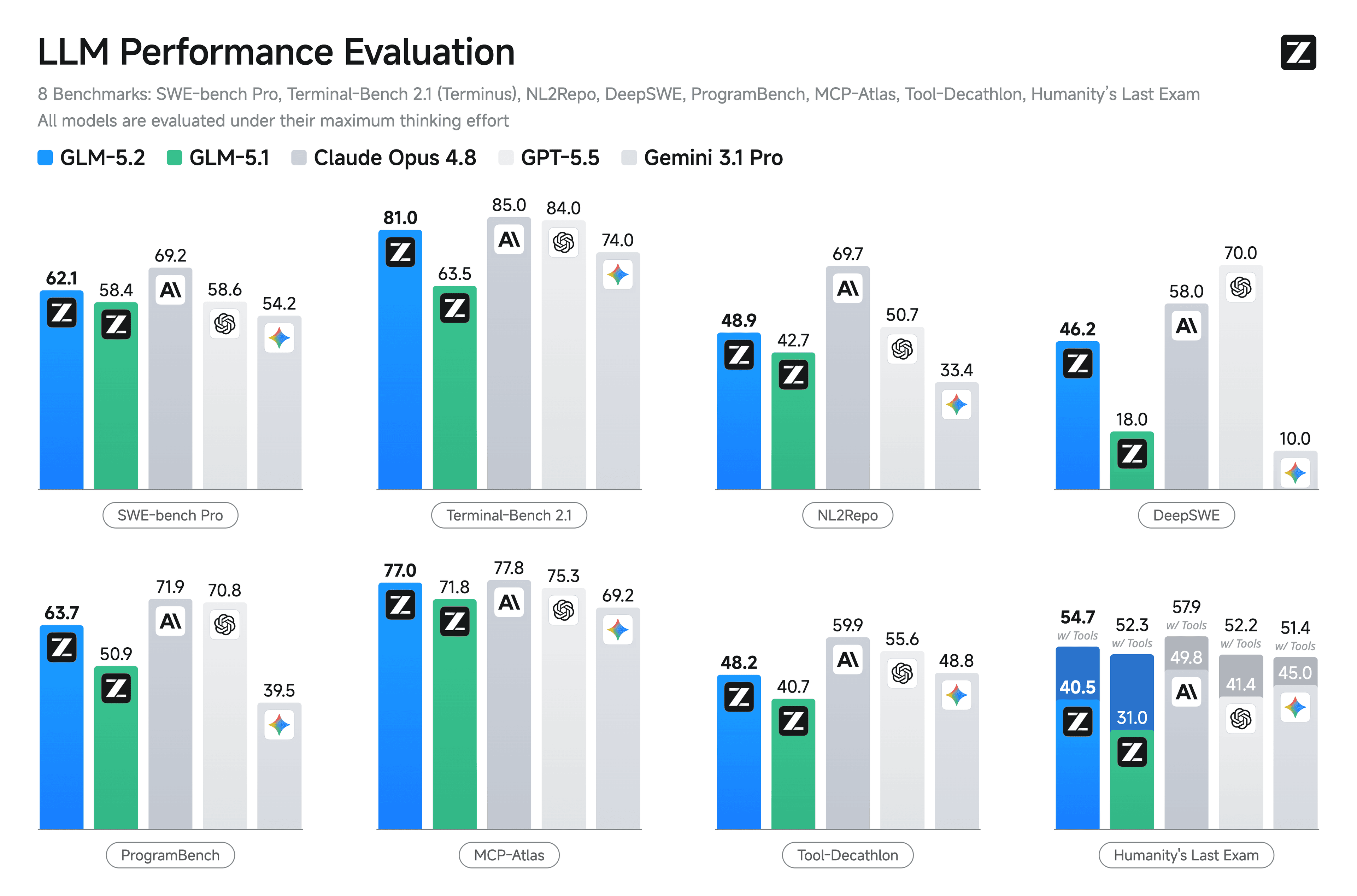
Zhipu releases GLM-5 (February 11), GLM-5.1 (April) and GLM-5.2 (June 13, 2026) - the latter a 744B-total / 40B-active MoE with 1M-token context under an MIT license, scoring 62.1 on SWE-bench Pro and topping open-source rankings on agentic benchmarks, in what observers call a second 'DeepSeek moment' for coding.

2026Market cap tops HK$1T; $4B placement

On July 8, 2026 - after a ~1,700% post-IPO rally driven by GLM-5.2 - Zhipu prices a ~US$4B follow-on H-share placement at HK$1,588 per share; the stock rises 22% on pricing and its market capitalization crosses HK$1 trillion (~US$128B). Proceeds fund compute infrastructure and model development.

2026Powers up ~1GW data center built entirely on Chinese chips

In July 2026 Z.ai began partial operation of a roughly 1-gigawatt AI data center built exclusively on Chinese-made chips - reportedly running multiple clusters of more than 10,000 domestic accelerators each with no Nvidia silicon - to train and deploy its GLM models. It is one of the first gigawatt-scale frontier-training hubs assembled entirely on domestic Chinese hardware, underscoring Zhipu's compute self-sufficiency push under the US Entity List.

2026Acquires XCore Sigma; shares rebound 37% in a day

Days after completing its Nvidia-free data center, Zhipu discloses it has acquired XCore Sigma, an AI heterogeneous-computing software developer spun out of the Chinese Academy of Sciences' Institute of Computing Technology that builds compilers, runtime systems and inference engines to improve utilization across different domestic AI chips. News of the acquisition and data-center completion sends Zhipu shares up 37% in a single session to HK$1,219, rebounding from a prior week's 40%-plus slide.

2026Rebrands as Z.AI Co., Ltd. on the Hong Kong exchange

Effective July 17, 2026, the company changes its registered English name to Z.AI Co., Ltd. and its H-share stock short name from 'KNOWLEDGE ATLAS' to 'Z.AI' (Chinese name and stock code 2513 unchanged), aligning its listed identity with its international Z.ai branding shortly after the ~$4B H-share placement completed July 13.

2026Added to the MSCI China Index

MSCI's August 2026 index review, announced August 13, 2026, adds Zhipu AI (listed as Z.AI Co H) to the MSCI China Index alongside 32 other Chinese companies - one of the three largest additions to the MSCI Emerging Markets Index by full company market capitalization. The change takes effect after the close on August 31, 2026, and signals growing institutional and index-fund interest in Zhipu among global investors.

2026GLM-5.3 ships, claims top open-weight coding model

Zhipu releases GLM-5.3 on August 14, 2026 through its GLM Coding Plan and ZCode harness, built via extended post-training on the same ~743B-parameter base as GLM-5.2 rather than a new pretraining run. The company claims a 50% jump in coding capability over GLM-5.2 and the top rank among open-weight models on benchmarks including Terminal-Bench 3.0, with open model weights due roughly two weeks after release.

2026Unmasks stealth 'Ox Alpha' as GLM-5.3-Flash; shares jump 8%

Zhipu confirmed on August 26, 2026 that its mystery stealth model 'Ox Alpha,' which had topped OpenRouter and OpenCode usage charts, is GLM-5.3-Flash: a 320B-parameter (18B active) natively multimodal mixture-of-experts model with a 1,048,576-token context window, released under an MIT license. The company said it used 100,000 China-made chips to serve all online requests to the model, and its Hong Kong-listed shares rose more than 8% on August 27 on the news; GLM-5.3-Flash ranked 10th on the Artificial Analysis Intelligence Index, ahead of DeepSeek's V4 Pro Max.

2026GLM-5.3 open weights published under a new, non-MIT license

On August 28, 2026 - roughly two weeks after the August 14 API launch, matching the promised schedule - Zhipu published the full GLM-5.3 weights (753B total parameters) on Hugging Face after completing its internal safety review. Unlike GLM-5.2's plain MIT release, GLM-5.3 ships under a bespoke 'GLM-5.3 License' that requires any company with more than $10B in aggregate revenue over a trailing 12 months to pass a Z.ai security review before hosting the model commercially; individual users and smaller companies see no change. The model's most sensitive cybersecurity-testing functions remain gated behind a separate 'trusted access' program for verified users.

2026H1 2026 revenue up ~400% but misses analyst estimates

Zhipu (Z.ai) reported first-half 2026 revenue of RMB 953.9M (~$142M) for the six months ended June 30, up 399.7% year-over-year, but the figure fell about 30% short of the average analyst estimate as competition in China's AI market intensifies. Open-platform and API revenue surged 27-fold to RMB 825.2M (86.5% of total, up from 15.2% a year earlier), enterprise-agent revenue rose 304.4% to RMB 55.6M, R&D spending rose 33.6% to RMB 2.13B, and net loss narrowed 12.1% to RMB 2.07B even as adjusted net loss widened 12.1% to RMB 1.96B.

2025Added to the US Entity List

On January 16, 2025 the US Commerce Department adds Zhipu and nine affiliates to the Entity List for allegedly aiding China's military AI modernization - the first major Chinese LLM developer blacklisted. Zhipu says it does not rely on US technology.

2025GLM-4.5 ships open-source; Z.ai rebrand

On July 28, 2025 Zhipu releases GLM-4.5 - a 355B-parameter MIT-licensed mixture-of-experts model built for 'Agentic, Reasoning, Coding' workloads that ranks #1 among open models at launch - and rebrands internationally as Z.ai. GLM-4.6 and 4.7 follow, with overseas users growing tenfold.

2024Saudi-linked round at ~$3B valuation

In May 2024 Zhipu raises $400M led by Prosperity7 Ventures, Saudi Aramco's venture arm, at a roughly $3B valuation - rare Middle Eastern capital in a Chinese frontier lab - with state-backed rounds following.

2023ChatGLM launches; big-tech backing arrives

Zhipu launches its ChatGLM chatbot and open-sources ChatGLM-6B in March 2023, and raises RMB 2.5B (~$350M) from Alibaba, Tencent, Meituan, Ant Group, Xiaomi and HongShan - becoming one of China's 'AI tiger' startups.

2019Spun out of Tsinghua University

Professors Tang Jie and Li Juanzi spin Zhipu AI out of Tsinghua University's Knowledge Engineering Group, making it one of the earliest of China's dedicated LLM startups.

Funding

Cumulative disclosed raise · dated rounds

$500M$1B$1.5B2024$1.2B raised
RoundDateAmountInvestorsSource
Strategic round2023RMB 2.5B (~$350M)Alibaba, Tencent, Meituan, Ant Group, Xiaomi, HongShan
Growth roundMay 2024$400M at ~$3B valuationProsperity7 Ventures (Saudi Aramco VC, lead)
State-backed rounds2024–2025$412M (Dec 2024) + ~$257M (Mar 2025) + $140M (Jul 2025)Beijing Zhongguancun Science City fund, Chengdu, Zhuhai Huafa, Hangzhou City Investment, Shanghai state funds
IPO (HKEX: 2513)Jan 2026~$558M at HK$51.8B (~$6.7B) valuationPublic listing at HK$116.20/share - world's first LLM-company IPO
Follow-on H-share placementJul 2026~$4B at HK$1,588/shareInstitutional placement (proceeds for compute infrastructure and model R&D)

/ Related Companies

All AI Labs
Anthropic logo

Anthropic

AI Labs

Anthropic is a San Francisco AI-safety and research company, founded in 2021 by former OpenAI researchers led by siblings Dario and Daniela Amodei, that develops the Claude family of large language models. As of mid-August 2026 its lineup spans Claude Haiku 4.5, Claude Sonnet 5, the everyday-default Claude Opus 5 (which replaced Opus 4.8 on July 24), and its most capable widely released model, Claude Fable 5 (plus the invitation-only Claude Mythos 5). Claude reaches customers through the claude.ai apps, the Claude API, enterprise and government plans, and Claude Code - its agentic coding tool, which runs at a $2.5B+ run-rate with 2M+ weekly active users - alongside the Claude Cowork 'AI coworker' and the June 2026 Claude Science research workbench, built on the ~$400M acqui-hire of ex-Genentech drug-discovery startup Coefficient Bio, that positions Anthropic in AI-driven pharma R&D. Anthropic differentiates on safety and interpretability research and runs one of the industry's largest multi-vendor compute footprints spanning Amazon (Project Rainier; Amazon's committed capital reached $33B in April 2026), Google (TPUs, up to $40B plus a 3.5 GW Broadcom-built expansion), AMD, CoreWeave, and newer data-center leases with TeraWulf, Riot Platforms and Volta Infra - and was reported on August 13, 2026 to be in talks to acquire AI-infrastructure startup Decart for roughly $6B. Annualized run-rate revenue topped $65B as of late July 2026 (up from ~$47B in May and ~$9B at the end of 2025; some IPO investors are modeling $100-120B by year-end), more than 1,000 customers now spend over $1M/year, and preliminary Q2 2026 revenue exceeded $11.5B with its first profitable quarter since founding. In May 2026 it raised a $65B Series H at a $965B valuation (secondary markets have since priced it above $1T-$1.2T) and confidentially filed for an IPO in June 2026; CFO Krishna Rao is now holding early investor meetings for a possible fall listing that some backers are modeling near a $2T valuation, though Anthropic itself has not set a target. On August 27, 2026 a San Francisco federal judge (Rita Lin) ruled the Pentagon's supply-chain-risk designation of Anthropic unlawful as First Amendment retaliation and arbitrary and capricious, writing that the measures were illegal and baseless; a separate D.C. Circuit case over a second designation remains pending, and the government is expected to appeal. The same day Anthropic opened a research preview of the Model Hardware Standard (MHS), a model-agnostic specification started with HHMI Janelia that lets AI agents operate lab and manufacturing hardware such as microscopes, liquid handlers and robotic arms, with a plan to open-source the standard after the preview.

Apptronik logo

Apptronik

AI Labs

Apptronik builds Apollo, a 5 foot 8 inch, 160 pound humanoid that lifts boxes up to 55 pounds, and it is the humanoid company Google DeepMind chose as its hardware partner. Spun out of the University of Texas at Austin's Human Centered Robotics Lab in 2016 on the back of roughly 15 earlier robots including NASA's Valkyrie, it unveiled Apollo in 2023 and now has units working in designated areas inside factories and warehouses run by Mercedes-Benz, GXO Logistics, and contract manufacturer Jabil. Funding came in two waves: a $350 million Series A in February 2025 co-led by B Capital and Capital Factory with Google participating, later extended, and then a $520 million Series A-X extension on February 11, 2026 that took the Series A past $935 million and total capital to nearly $1 billion at a valuation around $5 billion. In June 2026 it unveiled Apollo 2, available in both bipedal and wheeled-base configurations, and opened Robot Park, a roughly 90,000 square foot data-collection and training facility in Austin. When Google DeepMind launched Gemini Robotics 2 on July 30, 2026, the whole-body-control demonstration ran on Apollo 2 rather than on Boston Dynamics' Atlas. The honest state of the business is that Apollo is still in pilots: Apptronik has never published a price, and CEO Jeff Cardenas has pointed at 2027, with the commercial Apollo 3, as the year volume orders are supposed to arrive.

Aurora Innovation logo

Aurora Innovation

AI Labs

Aurora Innovation is a self-driving vehicle company now focused on commercial autonomous trucking, with the Aurora Driver deployed first as Aurora Driver for Freight. After beginning regular driverless customer deliveries between Dallas and Houston in late April 2025, Aurora has tripled its driverless network to 10 routes across the Sun Belt - including a roughly 1,000-mile Fort Worth–Phoenix lane - and in May 2026 ran its first lane outside Texas, a ~200-mile Dallas–Oklahoma City route with Volvo's VNL Autonomous. By June 2026 it had surpassed 440,000 driverless miles with zero Aurora Driver-attributed collisions and 100% on-time performance. Customers now include Werner, Hirschbach, McLane (Berkshire Hathaway), Detmar, Uber Freight, Value Truck, Charger Logistics, and others, and Aurora runs both an asset-light Driver-as-a-Service subscription model (carrier owns the trucks) and a Transportation-as-a-Service model (Aurora owns and operates the trucks), with vehicle partners PACCAR, Volvo, and AUMOVIO. Q2 2026 revenue was $2M against a $270M net loss, and management reaffirmed guidance of $14-16M for 2026 with a goal of exiting the year with 200+ driverless trucks (~20-25 by end of Q3) and ~$80M run-rate.

Baidu Apollo logo

Baidu Apollo

AI Labs

Baidu Apollo is Baidu's autonomous-driving platform and the operator of Apollo Go, one of the world's largest fully driverless robotaxi networks. On its August 18, 2026 Q2 earnings call Baidu disclosed Apollo Go has delivered more than 23 million cumulative public rides and over 350 million autonomous kilometers across a 28-city global footprint (including a first Asian expansion beyond China and Hong Kong, into South Korea, in February 2026), with roughly 1 million fully driverless rides in the quarter alone and a safety record of one airbag deployment per 14.4 million km, with management saying Apollo Go has reached unit-economics breakeven in its largest China operating city. That international growth came alongside a rockier domestic quarter: a March 31, 2026 mass system failure stranded over 100 Apollo Go vehicles on elevated highways in Wuhan (no injuries), prompting Chinese regulators to pause new robotaxi permits nationwide for several months; Baidu said the resulting operational adjustments weighed on ride volume in certain domestic cities before operations began resuming on a stronger footing in August. The same Q2 quarter, China's Ministry of Industry and Information Technology issued GB 44721-2026, the country's first mandatory national safety standard for L3/L4 automated driving, taking effect July 1, 2027. Apollo Go runs fully driverless commercial service in China, Dubai, and on Abu Dhabi's Yas Island, began Level 4 open-road trials in eastern Switzerland (AmiGo, with PostBus) on June 1, 2026, and has kept widening its Hong Kong testing scope - an August 14 approval added the Southern District to its North Lantau driverless zone, its third expansion there in about six months, pushing cumulative safe driverless testing distance in the city past 20,000 km. It also runs safety-operator road testing in London with Freenow/Lyft and Uber, begun July 28, and in July 2026 signed an MoU with Kazakhstan's Turlov Private Holding to explore autonomous mobility services, the first move by a Chinese robotaxi operator into Central Asia.

DeepSeek logo

DeepSeek

AI Labs

DeepSeek is a Hangzhou-based AI lab, founded in July 2023 by hedge-fund billionaire Liang Wenfeng as a spin-off of his quant fund High-Flyer, that builds frontier open-weight language models at radically low cost. Its January 2025 R1 reasoning model - released under an MIT license and trained for a small fraction of US-lab budgets - briefly made its free chatbot the top US iOS app and triggered a historic market rout in which Nvidia shed roughly $600B in a day. As of mid-2026 its flagship is the DeepSeek-V4 family (V4-Pro at 1.6T total parameters and V4-Flash), open-weight models with 1M-token context reportedly trained on Huawei Ascend chips without Nvidia GPUs. DeepSeek serves ~130M monthly active users in China, though QuestMobile data now ranks it third among domestic AI apps behind ByteDance's Doubao and Alibaba's Qwen, and monetizes through an API priced orders of magnitude below US frontier labs, with annualized revenue reportedly nearing $500M by mid-2026. After operating for three years on High-Flyer's money alone, it closed a record ~$7B maiden round at a ~$52B valuation in June 2026 - with most investors taking non-voting stakes that preserve Liang's control - and is preparing a mainland IPO targeted for 2027, though a planned follow-on raise was paused in late July 2026.

Google DeepMind logo

Google DeepMind

AI Labs

Google DeepMind is Alphabet's consolidated artificial-intelligence research lab, formed in April 2023 by merging the original DeepMind (founded in London in 2010, acquired by Google in 2014) with Google Brain. Co-founder and Nobel laureate Demis Hassabis stepped down as CEO on August 5, 2026, moving to Chair of Google DeepMind and Chief Scientist of Alphabet to focus on long-term AGI research and Isomorphic Labs; Koray Kavukcuoglu, an SVP reporting directly to Sundar Pichai, now runs day-to-day operations and the Gemini roadmap. The lab builds the Gemini family of frontier multimodal models - which powers the Gemini app (900M+ monthly active users as of mid-2026), Google Search's AI Mode and AI Overviews, Google Cloud's Vertex AI, and, via a 2026 partnership, Apple's next-generation Siri. Beyond consumer AI, DeepMind pioneered game-playing systems (AlphaGo, AlphaZero) and scientific breakthroughs including AlphaFold - whose protein-structure database has been used by 3M+ researchers and earned Hassabis and John Jumper the 2024 Nobel Prize in Chemistry - plus AlphaGenome, AlphaEvolve, Veo and Genie world models, and Gemini Robotics. Its drug-discovery spinout Isomorphic Labs is preparing first-in-human oncology trials. The August leadership change follows a stretch of talent departures (Jumper among them) and delays shipping Gemini 3.5 Pro, and coincided with Google chief scientist Jeff Dean also leaving the company after 27 years.