
Apptronik
Jeff Cardenas
Data verified as of Sep 21, 2026
Summary
Apptronik builds Apollo, a 5 foot 8 inch, 160 pound humanoid that lifts boxes up to 55 pounds, and it is the humanoid company Google DeepMind chose as its hardware partner. Spun out of the University of Texas at Austin's Human Centered Robotics Lab in 2016 on the back of roughly 15 earlier robots including NASA's Valkyrie, it unveiled Apollo in 2023 and now has units working in designated areas inside factories and warehouses run by Mercedes-Benz, GXO Logistics, and contract manufacturer Jabil. Funding came in two waves: a $350 million Series A in February 2025 co-led by B Capital and Capital Factory with Google participating, later extended, and then a $520 million Series A-X extension on February 11, 2026 that took the Series A past $935 million and total capital to nearly $1 billion at a valuation around $5 billion. In April 2026 it hired former Waymo chief product officer Daniel Chu as CPO, plus Boston Dynamics, Amazon, Paramount+ and iRobot veterans, as it prepared to commercialize. In June 2026 it unveiled Apollo 2, available in both bipedal and wheeled-base configurations, and opened Robot Park, a nearly 90,000 square foot data-collection and training facility in Austin, where the company said it then had more than 350 employees. When Google DeepMind launched Gemini Robotics 2 on July 30, 2026, the whole-body-control demonstration ran on Apollo 2 rather than on Boston Dynamics' Atlas. No later funding round or commercial-price announcement has followed, and Apptronik's own press list still ends at the June 30 Robot Park release. A June 2025 wholly owned subsidiary, Elevate Robotics, is meant to automate heavy industrial tasks outside the humanoid form; Apptronik has not published a later product or revenue figure for it. The honest state of the business is that Apollo is still in pilots: Apptronik has never published a price, and CEO Jeff Cardenas has pointed at 2027, with the commercial Apollo 3, as the year volume orders are supposed to arrive.
Main Products
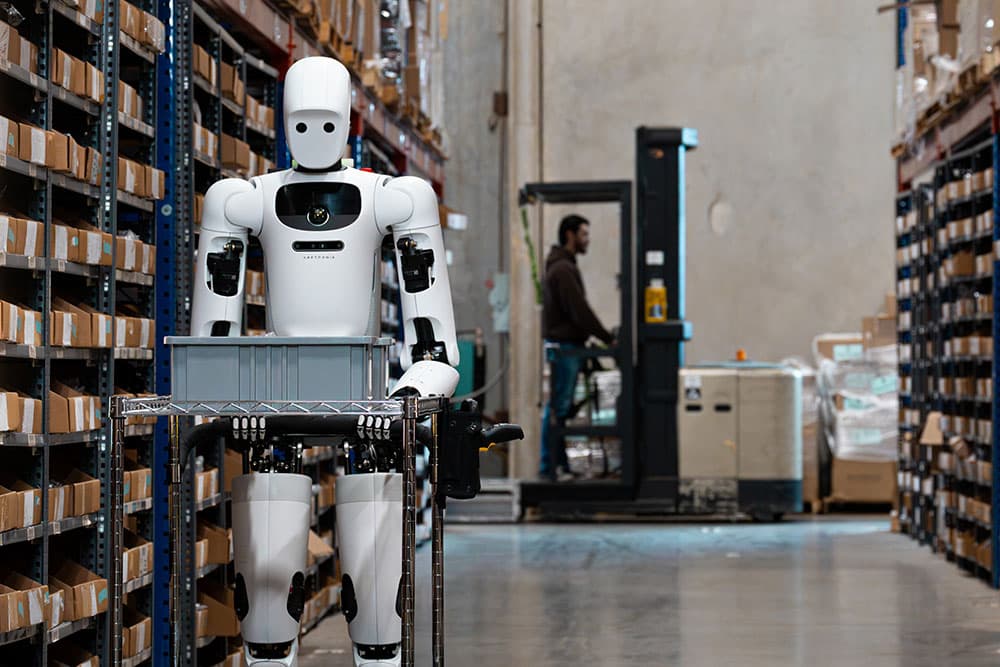
The humanoid that put Apptronik on the map: 5 feet 8 inches, 160 pounds, able to lift boxes up to 55 pounds, and sized and shaped to work in spaces built for people rather than requiring a rebuilt facility. It is pitched as multi-purpose rather than general purpose, aimed first at trailer unloading, palletizing, case picking, kitting, and parts transport. Units are working in designated areas inside Mercedes-Benz, GXO Logistics, and Jabil sites.
Still in pilot deployment with strategic partners as of September 2026. Not sold commercially, and no price has been published. Apptronik's press list still ends at the June 30 Robot Park release.
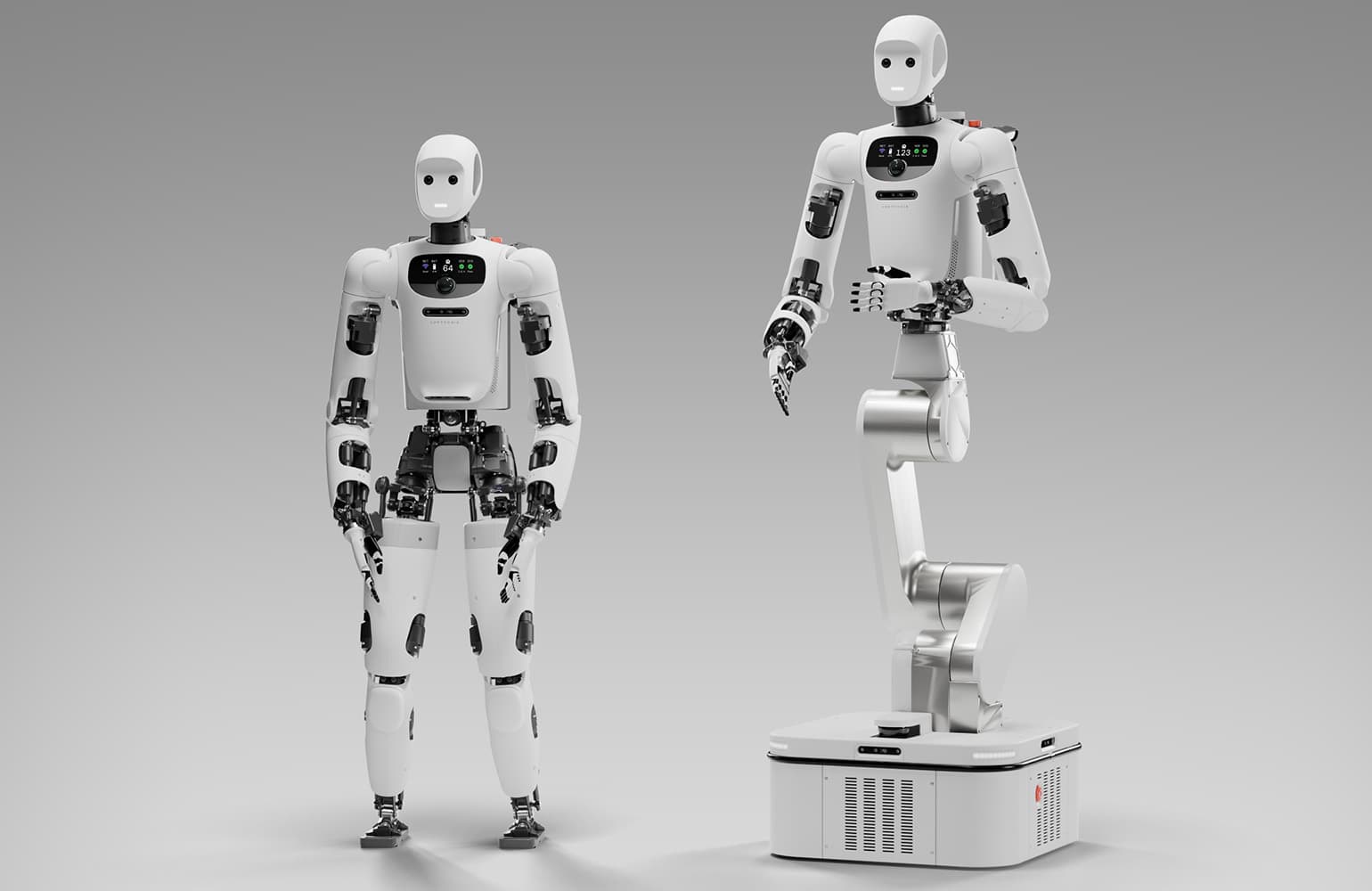
The second-generation platform, unveiled at the end of June 2026 through a site update rather than a launch event after more than a year of internal use. It ships in two configurations, bipedal and wheeled-base, uses patented actuators Apptronik rates above 90% efficient, takes swappable batteries for continuous operation, and communicates through an expressive LED mouth, coordinated lighting, speech, and listening. Its 22 degree-of-freedom, five-fingered SharpaWave hand is dexterous enough for Gemini Robotics 2 to tie knots and seal a ziplock bag with it. Apollo 2 is explicitly a data-collection and learning platform whose job is to produce the commercial Apollo 3.
Still running at Robot Park in Austin and at customer and partner sites as of September 2026, collecting training data for Gemini Robotics and for Apollo 3. Not a commercial product. No later ship date for Apollo 3 has been published since the June 30 Robot Park announcement.
What's Next
Ship Apollo 3, the first true commercial product
Everything Apptronik is learning on Apollo 2 at Robot Park is aimed at Apollo 3, which the company still describes as its next-generation commercial product expected in 2027. No later ship date has been published since the June 30 Robot Park announcement. It is the transition the whole company is built around: from pilot units inside partner facilities to a robot that gets sold, and it is what the $520 million extension was raised to fund.
Convert pilots into roughly $1B of orders
CEO Jeff Cardenas told CNBC in February 2026 that he expects orders worth around $1 billion starting in 2027, with investor Howard Morgan projecting high-volume delivery at roughly $80,000 a year per robot, about the price of a luxury car. Apptronik has never published a price and nobody can buy an Apollo today, so this is still the number that turns the pilot deployments at Mercedes-Benz, GXO, and Jabil into a business.
Scale Apollo production through Jabil
Apptronik's manufacturing route runs through Jabil rather than through factories of its own, under the April 2025 collaboration that also puts Apollo to work inside Jabil's own operations. Neither company has published 2026 production volumes. Proving that a contract manufacturer can build humanoids at rate is the supply-side half of the 2027 plan, and it is the part Apptronik controls least directly.
Expand the Robot Park network to customer and partner sites
The Austin Robot Park is the flagship of what Apptronik describes as a growing network of Robot Parks at customer and partner locations, including data-collection workflows at Google DeepMind, Mercedes-Benz and GXO. The June 30, 2026 release said the company plans to open new Robot Park locations in more cities soon. More sites mean more task diversity, which is the input both Apollo 3 and Google DeepMind's Gemini Robotics models depend on.
Operations & Revenue
Apollo units are working in designated areas inside factories and warehouses run by strategic partners Mercedes-Benz, GXO Logistics, and Jabil, which is pilot deployment rather than commercial fleet operation. Apollo 2 has been running for over a year at Robot Park, the nearly 90,000 square foot Austin data-collection and training facility opened June 30, 2026, and the data it gathers feeds both Google DeepMind's Gemini Robotics foundation models and Apptronik's own next-generation product. Production scaling runs through Jabil rather than in-house factories. Headcount passed 350 as of the June 30 company statement; the April 28 commercialization hires, including CPO Daniel Chu from Waymo, are still the latest named leadership additions. A June 2025 subsidiary, Elevate Robotics, remains the non-humanoid industrial line, with no later public product. Jeff Cardenas remains CEO. No later press release has followed Robot Park.
Revenue Streams
Apollo running real tasks inside partner facilities: intra-factory logistics, kitting and parts transport at Mercedes-Benz, warehouse work at GXO Logistics, and sorting and assembly support at Jabil. The June 30 Robot Park release said similar data-collection workflows now run at DeepMind and at Mercedes-Benz and GXO sites. These are the commercial agreements that exist today, ahead of any volume product.
Apptronik markets Apollo across manufacturing (material handling, line-side tasks, inspection), warehouse and third-party logistics (picking, packing, goods movement), and retail (inventory, replenishment, back-of-house), broken into six named solutions: goods-to-person, person-to-goods, packout, kitting, inspection and sorting, and machine and tool tending.
The Google DeepMind partnership runs both ways: Apollo is the reference humanoid for Gemini Robotics, and the data Apollo 2 collects at Robot Park advances DeepMind's foundation models. It is a research relationship rather than a disclosed revenue line, but it is why Apptronik gets frontier robot models before its competitors do.
Elevate Robotics (non-humanoid industrial)
A wholly owned subsidiary announced June 24, 2025, led by CEO Paul Hvass, to commercialize automation outside the humanoid form for heavy-duty industrial work. Apptronik has not published a later named product or revenue figure for Elevate; it remains a separate line from Apollo pilots.
Key Metrics
- Employees
- More than 350 (company, June 30, 2026)
- Est. Annual Revenue
- Not disclosed and small. Apollo is in pilot deployments with Mercedes-Benz, GXO Logistics, and Jabil rather than in volume sale, and Apptronik has never published a price for the robot. CNBC reported in February 2026 that CEO Jeff Cardenas expects orders worth around $1 billion starting in 2027, when investor Howard Morgan projects high-volume delivery at roughly $80,000 a year per robot, about the price of a luxury car. Both remain forward projections, not bookings: Apptronik's press list as of September 21, 2026 still ends at the June 30 Robot Park release, with no later revenue figure.
- Valuation
- ~$5B at the February 2026 Series A-X per CNBC, reported above $5.5B by Bloomberg, roughly 3x the initial Series A mark. No later round has been announced.
- Commercial Partners
- Mercedes-Benz, GXO Logistics, and Jabil running Apollo in designated areas of factories and warehouses; Google DeepMind as AI partner. The June 30 Robot Park release said similar data-collection workflows run at DeepMind and at Mercedes-Benz and GXO sites.
Timeline
On February 11, 2026 Apptronik closes a $520 million Series A-X extension at a valuation reported around $5 billion by CNBC and above $5.5 billion by Bloomberg, roughly three times the initial Series A mark. Returning investors Google, Mercedes-Benz, B Capital, and PEAK6 are joined by AT&T Ventures, John Deere, and the Qatar Investment Authority. Total Series A passes $935 million and cumulative funding approaches $1 billion.
On April 28, 2026 Apptronik names former Waymo chief product officer Daniel Chu as CPO, plus Kevin Garell (SVP of services and support, from Boston Dynamics), Chirag Shah (VP of software, from Amazon), Dave Perry (VP of marketing, from Paramount+ and Amazon) and Justin Birtz (VP of people operations, from Cellino and iRobot). CEO Jeff Cardenas frames the hires as the shift from R&D toward a production-ready commercial product. Headcount in the release is 350, the same floor the company restated when Robot Park opened in June.
At the end of June 2026 Apptronik quietly unveils Apollo 2 through a site update and confirms it alongside the opening of Robot Park, a roughly 90,000 square foot flagship data-collection and training facility in Austin where Apollo 2 has already been running for over a year. Apollo 2 comes in bipedal and wheeled-base configurations, uses patented actuators the company rates above 90% efficiency, takes swappable batteries, and carries an expressive LED mouth and chest display. Everything learned on it feeds the next-generation commercial product, Apollo 3.
Google DeepMind launches Gemini Robotics 2 on July 30, 2026 and uses Apptronik's Apollo 2, not Boston Dynamics' Atlas, for the whole-body-control demonstration: told to put a watering can in a bin on a bottom shelf, Apollo walks to the table, picks it up, walks to the shelves, and places it. It is the first time the model family controls whole-body motion rather than upper-body tabletop tasks, and it also drives Apollo 2's five-fingered, 22 degree-of-freedom SharpaWave hand through tasks like tying knots and sealing a ziplock bag.
Announced February 13, 2025, Apptronik closes a $350 million Series A co-led by B Capital and Capital Factory with Google participating, the largest round in the sector outside Figure at the time. The round is oversubscribed and later extended, reaching about $415 million.
Apptronik and Jabil announce a collaboration in April 2025 with two halves: Jabil deploys Apollo robots in its own manufacturing operations to help with tasks like sorting and assembly, and Jabil's manufacturing capacity is used to scale Apollo production. It gives Apptronik both a demanding reference customer and a route to volume that does not require building its own factories.
On June 24, 2025 Apptronik creates Elevate Robotics Inc., a wholly owned subsidiary led by CEO Paul Hvass, formerly of Plus One Robotics, to commercialize multipurpose automation outside the humanoid form for heavy-duty industrial work. Apptronik keeps Apollo as the humanoid line. Elevate has its own site at elevaterobotics.ai; Apptronik has not published a later named product or revenue figure for the subsidiary.
On December 19, 2024 Apptronik announces a strategic partnership with Google DeepMind's robotics team to build humanoids around Gemini 2.0. DeepMind brings machine learning, physics simulation, and embodied reasoning; Apptronik brings the body. Gemini Robotics is explicitly designed to run across multiple embodiments, from dual-arm industrial arms to a full humanoid like Apollo, without retraining for each one.
Apptronik reveals Apollo, a 5 foot 8 inch, 160 pound humanoid that can lift boxes up to 55 pounds, pitched at trailer unloading, palletizing, and case picking rather than at general-purpose autonomy. Cardenas calls it the iPhone of robots, meaning a platform partners build applications on, and sets out a plan of pilots followed by commercial availability.
Apptronik is founded in Austin as a spinout of the University of Texas at Austin's Human Centered Robotics Lab, with Jeff Cardenas as CEO and Nicholas Paine as CTO and lab founder Luis Sentis involved. The team goes on to build roughly 15 robots over the next several years, including work on NASA's Valkyrie humanoid, before attempting a commercial product.