Inversion Space
Justin Fiaschetti
Data verified as of Aug 29, 2026
Summary
Inversion Space, founded in 2021 by Boston University students Justin Fiaschetti and Austin Briggs and backed by Y Combinator, builds reentry vehicles that park cargo in orbit and bring it down on demand, inverting the usual direction of space logistics: instead of launching goods when they are needed, the goods wait overhead and come back within an hour of the request. Its flagship vehicle, Arc, was unveiled on October 1, 2025 as a fully reusable lifting body about four feet across and eight feet tall that stores roughly 500 lb of payload on orbit for up to five years, survives reentry above Mach 20, steers more than 1,000 km of cross-range, and touches down under an autonomously guided parachute within about 50 feet of a target, needing no runway and using non-toxic propellants so crews can approach it immediately. The company has raised roughly $54 million, most of it a $44 million Series A in November 2024 co-led by Spark Capital and Adjacent with Lockheed Martin Ventures and Kindred Ventures, on top of a $71 million STRATFI award from AFRL and SpaceWERX in September 2024. Its pathfinder, the 20-inch Ray capsule, launched on SpaceX's Transporter-12 in January 2025 and validated avionics, power, propulsion, and separation, but a short circuit kept the deorbit engine from igniting, so it never flew the reentry it was built to demonstrate. Defense demand has arrived ahead of the flight record: Inversion was selected into Kratos' $1.45 billion MACH-TB 2.0 hypersonic test program in September 2025 and joined Anduril's team for the Space Force's Golden Dome space-based interceptor work in May 2026. It operates a 55,000-square-foot Los Angeles factory and a five-acre Mojave test site with about 60 employees, and the whole thesis now rests on flying Arc for the first time.
Main Products
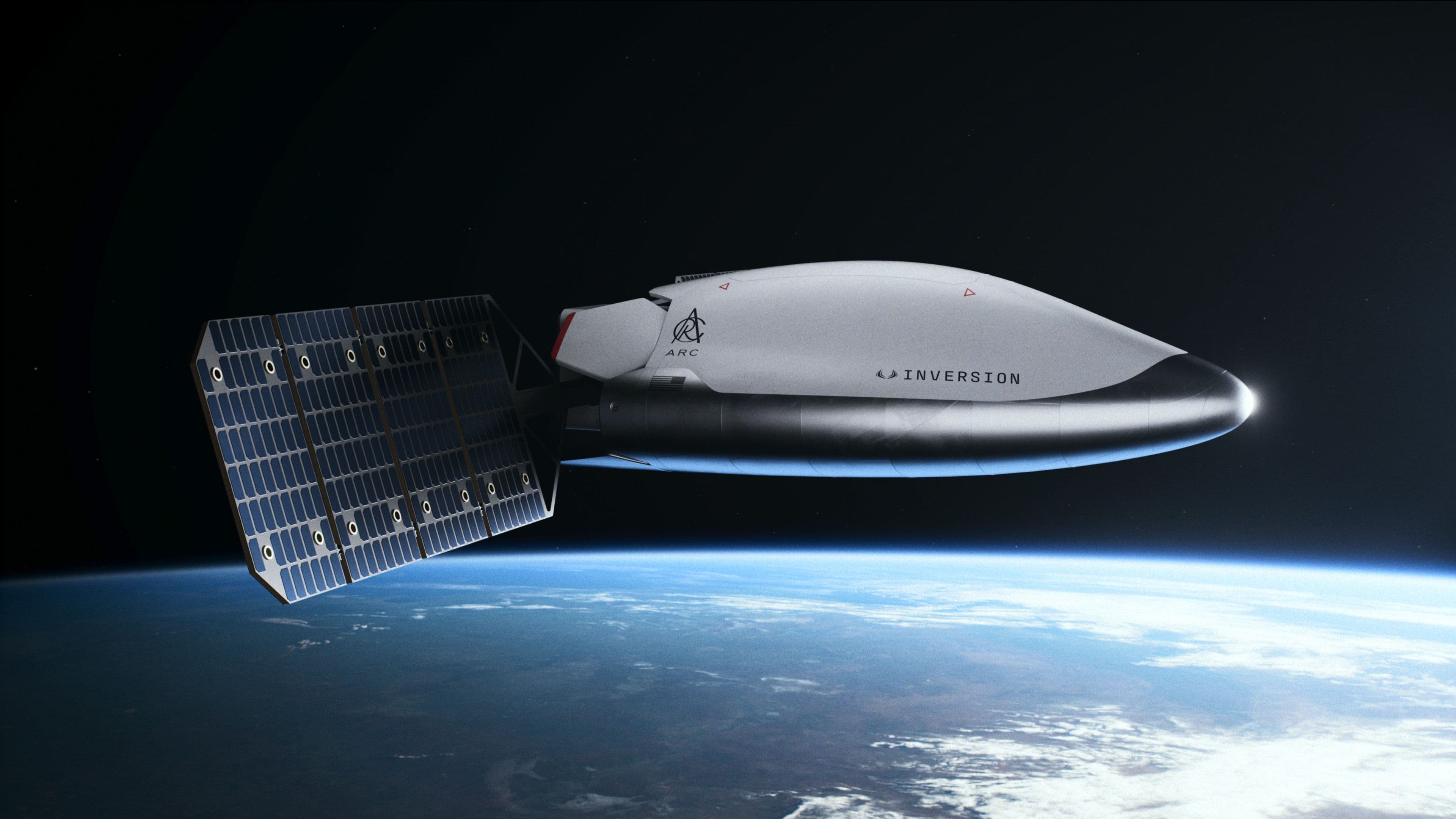
A fully reusable lifting-body reentry vehicle, roughly four feet wide and eight feet tall, that stays on orbit as a functioning satellite for up to five years holding about 500 lb of cargo, then deorbits on command. Control flaps, attitude-control thrusters, and a deorbit engine steer it through a Mach 20-plus reentry with more than 1,000 km of cross-range, and an autonomously guided parachute puts it down within about 50 feet of a target on unprepared ground. Non-toxic propellants let crews approach it as soon as it lands, and it can also capture and deploy assets and rendezvous with other spacecraft while on orbit.
Full-scale structural development unit built, mission profile complete, dozens of drop tests flown, NASA working the thermal protection system; first orbital mission targeted 2026
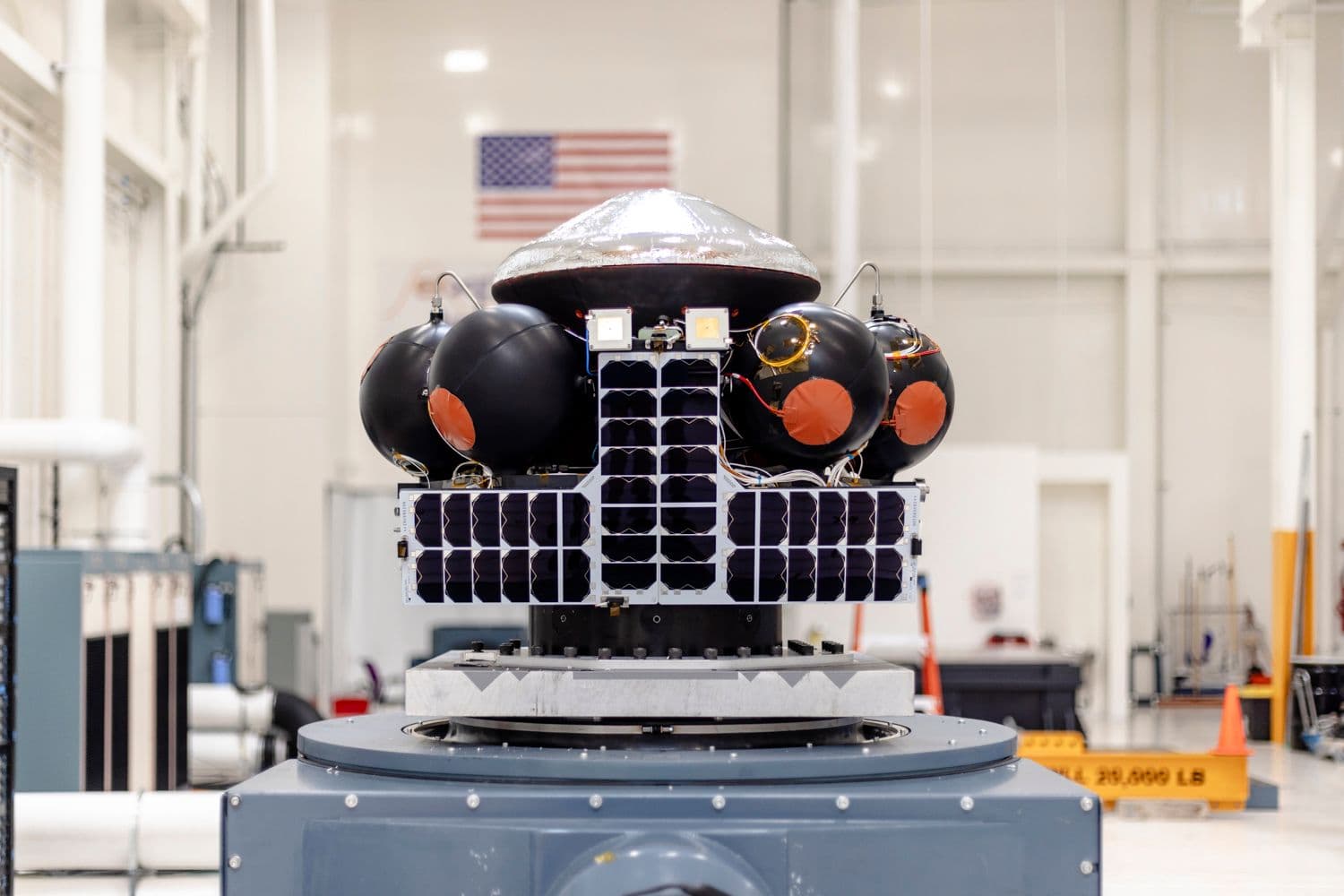
The 20-inch pathfinder capsule that flew Inversion's first orbital mission on SpaceX's Transporter-12 in January 2025. It validated avionics, solar power, the propulsion system, and an in-house separation mechanism on orbit, but a short circuit prevented the deorbit engine from igniting, so the planned reentry and recovery never happened. Its flight data underpins the Arc design.
Flew January 2025; subsystems validated on orbit, reentry objective not achieved
What's Next
The mission that decides whether the company has a product. Inversion has said since the October 2025 unveiling that Arc flies its first mission in 2026, which means launching the vehicle, holding it on orbit, deorbiting under control, surviving a Mach 20-plus reentry, and landing under parachute close to a target. Ray never got past the deorbit burn, so this is the first real test of the reentry stack end to end. Watch for a launch assignment and an FAA reentry license for the Arc configuration.
Fly hypersonic test payloads under MACH-TB 2.0
Inversion's selection into Kratos' MACH-TB 2.0 program gives it a paying use for reentry itself. Kratos completed its $50 million, 68,000-square-foot Indiana Payload Integration Facility in Crane, Indiana on July 28, 2026, ahead of schedule, the dedicated site built to prep hypersonic test payloads like Arc for flight. Watch for the first task order and the first customer payload flown through hypersonic conditions on an Inversion vehicle, the point at which the reentry capability starts generating revenue independently of the cargo-delivery thesis.
Stand up an operational constellation of Arcs
CEO Justin Fiaschetti has put constellation deployment around 2028, which implies producing hundreds of vehicles a year. That is a manufacturing problem as much as an aerospace one, and the gap between one flight article and a production line is where most reentry programs stall. Watch for factory expansion beyond the current 55,000 square feet and for a multi-vehicle order from the Air Force or Space Force.
Deliver reentry hardware for Golden Dome interceptors
Under the Anduril-led space-based interceptor team named in May 2026, Inversion's maneuvering and reentry work feeds the Space Force's Golden Dome architecture. All 12 SBI prototype teams, including Anduril's, cleared Gate 1 (design lock and component-level testing) by the August 11, 2026 Space and Missile Defense Symposium and are moving into Gate 2, building hardware meant to operate in space; two further gates prove on-orbit performance and integration into the wider architecture, which the service wants to demonstrate initial capability for by 2028. That schedule now carries real funding risk: Golden Dome's fiscal 2027 budget is roughly 97 percent dependent on a second reconciliation bill with thin bipartisan support, and program director Gen. Michael Guetlein warned in August 2026 that a funding lapse in October 2026 would halt the program outright. Watch for Gate 2 completion, a defined subcontract scope for Inversion specifically, and any prototype flight demonstration tied to it.
Track Record
0 of 1 announced date hit · 1 missed
Ray demonstrator returns from orbit
Target January 2025 · Resolved Jan 30, 2025
Ray launched on Transporter-12 on January 14, 2025 with an FAA reentry license in hand and successfully checked out avionics, solar power, propulsion, and separation on orbit. A short circuit in a component prevented the deorbit engine from igniting, so reentry became impossible and the capsule was never recovered. Inversion folded the flight data into Arc rather than reflying Ray.
Operations & Revenue
Inversion has one orbital flight behind it and it was a partial failure: Ray reached orbit in January 2025 and checked out its subsystems, but a short circuit stopped the deorbit burn, so the company has not yet demonstrated the one capability its entire business rests on, controlled reentry and precision landing. Arc is the vehicle that has to prove it. Hardware progress is real, with a full-scale structural development unit built, a mission profile closed, dozens of parachute drop tests run, and NASA collaborating on thermal protection, and the first Arc mission is targeted for 2026 with an operational posture that would require producing hundreds of vehicles a year by 2028. Money and demand are not the constraint: a $44 million Series A, a $71 million STRATFI award, a seat in the $1.45 billion MACH-TB 2.0 hypersonic testbed program, and a place on Anduril's Golden Dome interceptor team give it customers before it has a product. Schedule and reentry physics are the constraint, and the hypersonic testbed work is the near-term hedge that pays whether or not the on-demand cargo market appears.
Revenue Streams
Defense cargo delivery from orbit
The core proposition: constellations of Arc vehicles pre-positioned in low Earth orbit, holding cargo for allied militaries and deorbiting on request to put it anywhere on the planet in under an hour, including in denied environments where aircraft and ships cannot go. Funded so far through the $71 million AFRL and SpaceWERX STRATFI award rather than delivery revenue.
Selling reentry as a test service: an Arc coming home above Mach 20 is a reusable hypersonic testbed, and Inversion's selection into Kratos' MACH-TB 2.0 program gives it a way to bill for flights while the cargo market is still theoretical. This is the nearest-term revenue line.
Key Metrics
Timeline
Anduril names Inversion on May 5, 2026 among the partners for the Space Force's space-based interceptor prototype work under Golden Dome, alongside Impulse Space, K2 Space, Voyager Technologies, and Sandia National Laboratories, with Inversion's reentry expertise applied to the interceptor problem.
At the Space and Missile Defense Symposium in Huntsville on August 11, 2026, Golden Dome director Gen. Michael Guetlein says all 12 space-based interceptor prototype teams, including Anduril's team with Inversion, Impulse Space, K2 Space, and Voyager Technologies, have cleared Gate 1 (design lock and component-level testing) and are moving into Gate 2, building hardware meant to operate in space. Two further gates, proving on-orbit performance and integration into the wider Golden Dome architecture, remain ahead of the program's 2028 initial-capability target.
Ray launches January 14, 2025 on SpaceX's Transporter-12 rideshare and validates avionics, solar power, propulsion, and an in-house separation system on orbit. A short circuit in a component prevents the deorbit engine from igniting, so the capsule never performs the reentry it was built to demonstrate.
Kratos selects Inversion in September 2025 for MACH-TB 2.0, the Pentagon's hypersonic testbed program worth up to $1.45 billion, opening a near-term revenue line: flying test payloads through real hypersonic reentry conditions rather than waiting for the cargo-delivery market to mature.
On October 1, 2025 Inversion reveals Arc, a reusable lifting-body delivery vehicle sized to hold about 500 lb on orbit for up to five years and return it anywhere on Earth in under an hour. The company says it has already built a full-scale structural development unit, completed the first mission profile, and run dozens of drop tests, and is working with NASA on the thermal protection system.
Justin Fiaschetti and Austin Briggs leave Boston University to start Inversion around the premise that returning things from space, not launching them, is the missing half of space logistics. The company goes through Y Combinator and closes a seed round announced in November 2021.