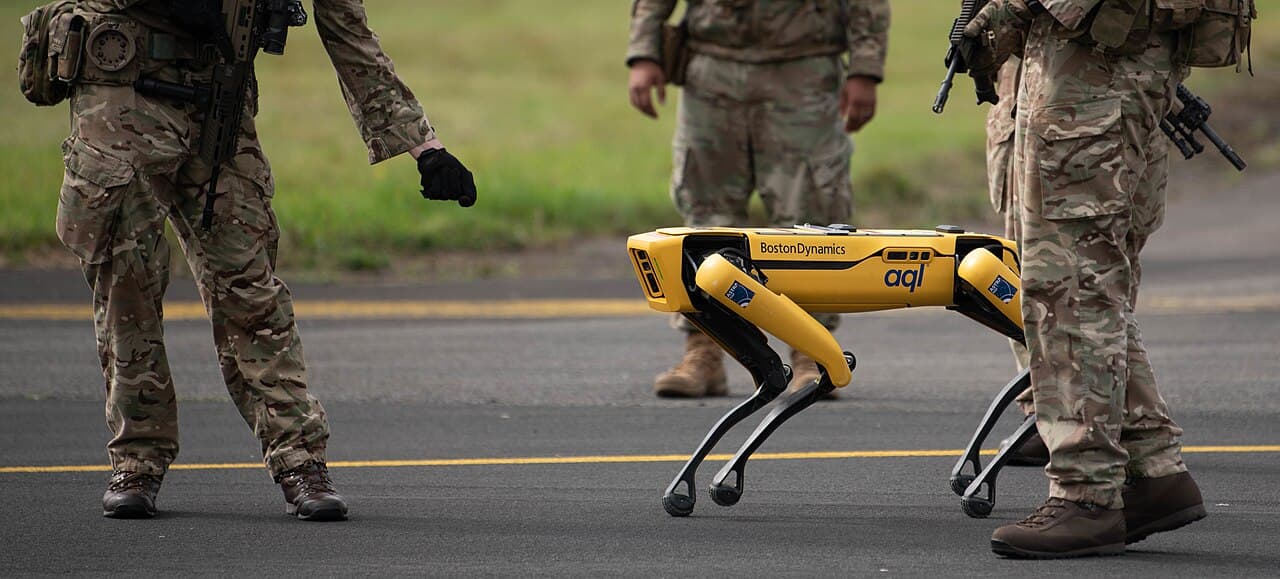
Agile quadruped robot for autonomous industrial inspection, data collection, and remote operation in hazardous environments. Features 3D vision, SLAM navigation, obstacle avoidance, and stair climbing. Used across oil & gas, utilities, construction, mining, and manufacturing.
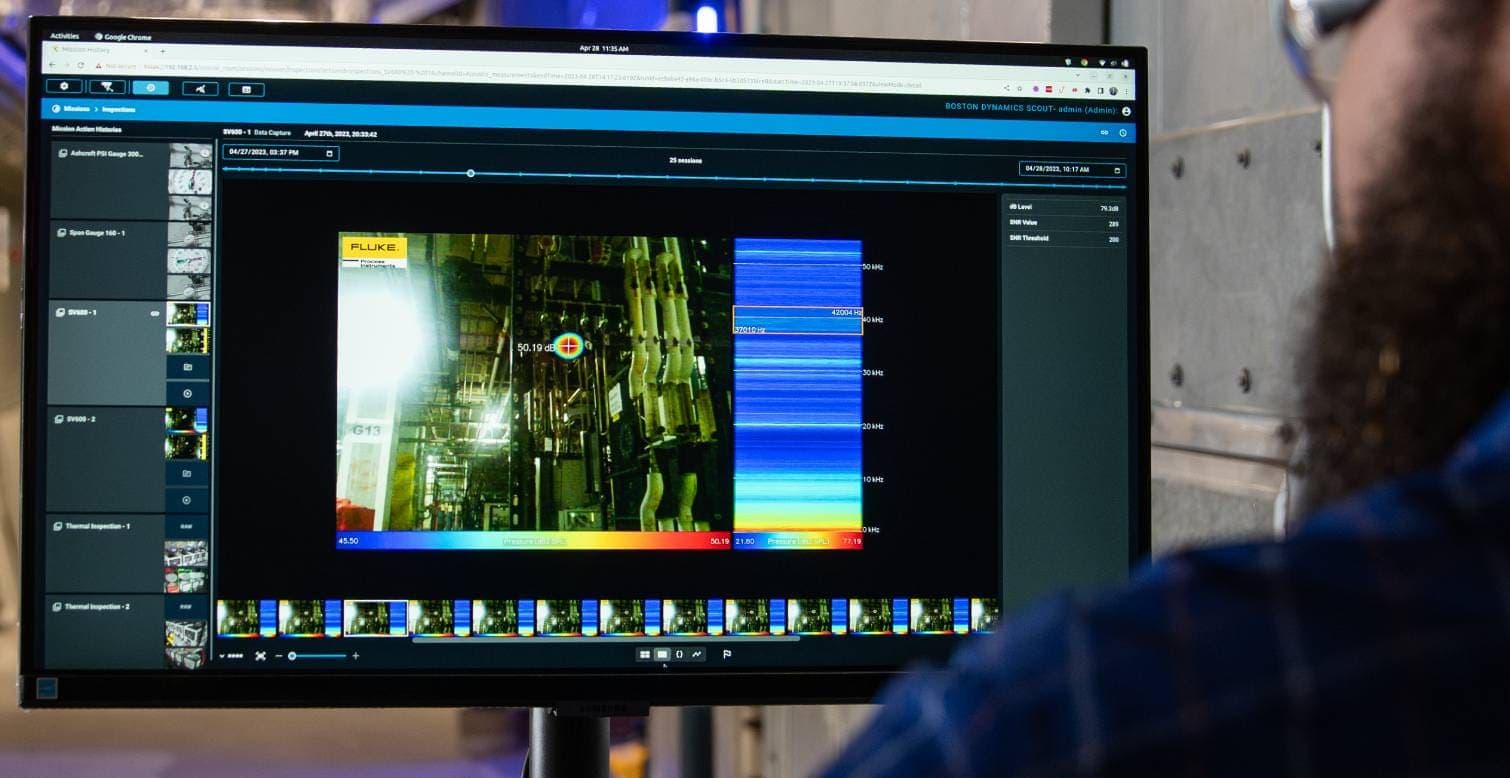
Commercially available since 2020. Boston Dynamics' Spot product page now says over 1,500 robots are in customer hands. Boston Dynamics shipped Spot/Orbit 5.1 in January 2026 with the new Spot Cam 2 payload (4K PTZ + thermal + 360° spherical) and door-opening workflow (2,500+ doors across 18 beta customers). Spot's AIVI-Learning inspection model became Google Gemini Robotics ER 1.6-powered on April 8, 2026. Spot 5.2, released in September 2026, re-architected Orbit around assets rather than inspections, opened the API to third-party sensors and cameras as the foundation for an MCP layer that lets AI agents dispatch Spot autonomously, and added Gemini-powered video inspection, detection of more than 20 gases, visual vibration analysis and partial-discharge checks.
Announced next steps from Boston Dynamics that mention Spot.
2026–2027
Push Gemini Robotics foundation models into Atlas
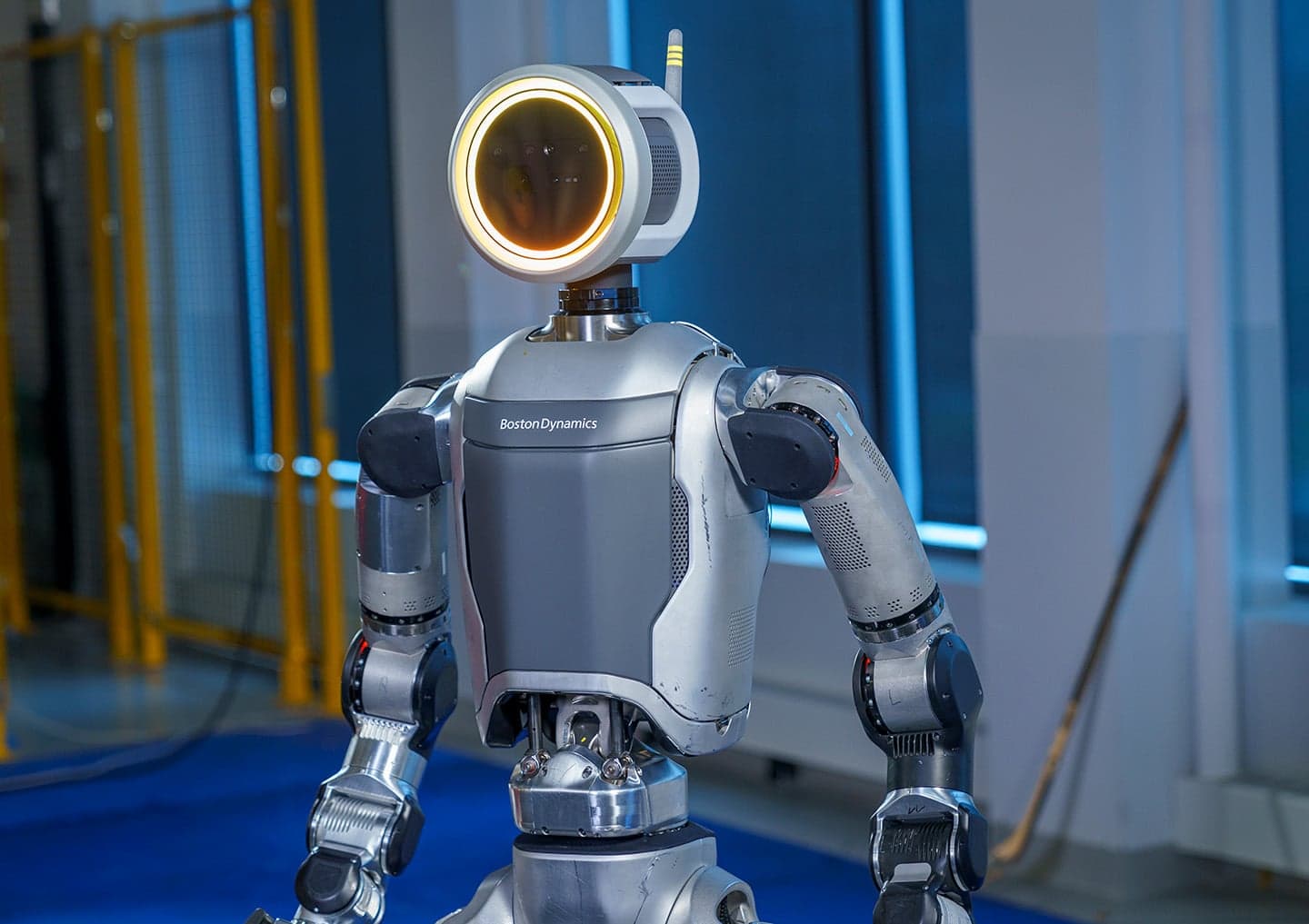
Extend the Boston Dynamics-Google DeepMind partnership from Spot (where Gemini Robotics ER 1.6 now powers AIVI-Learning) into Atlas, integrating Gemini Robotics foundation models for broader humanoid task learning beyond reinforcement learning policies. Google DeepMind shipped Gemini Robotics 2 on July 30, 2026 with true whole-body control (legs, torso, arms, and five-fingered hands under one learned policy) - but the public demonstration platform was Apptronik's Apollo 2, not Atlas. As of September 12, 2026 an Atlas-specific integration milestone still has not shipped. Claims of an already-shipped 'Gemini 3-powered Atlas' continue to circulate in low-quality financial-content aggregators but remain uncorroborated by Boston Dynamics, TechCrunch, The Robot Report, or Google DeepMind's own blog, and are not reflected here.
Conclude the board's CEO search to replace interim CEO Amanda McMaster, who took over from retired founder/CEO Robert Playter on February 27, 2026. In a September 2026 Machina Summit interview she was still titled interim CEO and CFO, said Spot remains the currently adopted revenue product, and said the company would not rush Atlas commercialization. No successor has been named.
Build on the March 2026 FieldAI partnership: expand Spot deployments across construction and other changing environments using Field Foundation Models for autonomous inspections, mapping, and monitoring in less structured sites, with Stretch and the electric Atlas named as the next platforms to integrate FieldAI. A February 2026 Boston Dynamics case study reported that construction customers using FieldAI-equipped Spot deployments across Asia, Europe, and North America cut inspection and documentation time by more than 90%. As of September 12, 2026 no new deployment figures or Stretch/Atlas FieldAI integration have been announced.
Broaden Hyundai deployment programs and build the Atlas factory
Turn Hyundai's $26B U.S. investment plan - which funds a robotics factory targeting 30,000 Atlas units/year by 2028 and Atlas deployment at Hyundai's Georgia Metaplant (sequencing first from 2028, assembly by 2030) - into broader Spot, Stretch, and Atlas deployment across manufacturing and logistics programs. At Hyundai Motor's August 26, 2026 CEO Investor Day, the company reaffirmed 2028 U.S. robot production at 30,000 units a year, said an initial committed volume of 25,000 units is already confirmed, and said the factory site will be announced by year-end, with Atlas first deployed at Hyundai Motor Group Metaplant America from 2028. The 25,000+ unit Hyundai/Kia deployment plan drew escalating labor pushback in Korea through most of August 2026: after strikes in July and a fourth round of partial stoppages running August 12-16 pushed cumulative Hyundai Motor production losses to an estimated 42,510+ vehicles and roughly $1.3B in lost revenue, Hyundai's union staged a full-day walkout on August 21 (its first in a decade) before a 17th round of negotiations produced a tentative wage agreement on August 24-25: a 100,000-won (~$72) monthly base increase, a performance bonus of more than 400% of monthly salary, a separate 12.5-million-won lump-sum payment, an extended retirement age, and a commitment to hire 500 new technical workers in 2027-2028. Union members ratified the deal on August 31, 2026 with 61.55% approval (78.63% turnout), ending the 117-day dispute; Hyundai has maintained throughout that the 2028 Atlas plan is not formally part of the wage talks.
Land a first named logistics partner for Spot last-mile delivery
Convert the July 14, 2026 'Bridging the Porch Gap' concept reveal - Spot riding in a delivery van, then walking parcels the final ~50 feet from curb to doorstep using a conveyor payload that carries two packages at a time (Boston Dynamics estimates that covers at least 60% of an average delivery van's load) - into a named pilot. Boston Dynamics said it was in talks with major logistics companies toward a full pilot in which Spot would work alongside a driver to deliver roughly 200 packages a day, five days a week. As of September 12, 2026 the company still has not named a partner, city, or start date.
Resolve the ICE Spot procurement into a signed contract
Follow ICE's Office of Firearms and Tactical Programs' August 27, 2026 sole-source procurement notice for an estimated $1-2M of Spot robots and accessories (place of performance: Fort Benning, Georgia) through to a formal solicitation and, if pursued, a signed contract. The DHS forecast listed an expected solicitation date of September 4, 2026, but as of a September 9 Boston.com report the government had still not issued an RFP. ICE did post a related Sources Sought notice for a quadruped unmanned ground vehicle (Notice ID 192126NFU00000158) around September 2, with responses due that day and the listing marked inactive on September 4; that was a capability survey, not the Spot RFP. Volume, delivery timeline, and whether a noncompetitive award survives scrutiny remain unconfirmed; Boston Dynamics has restated that any attempted weaponization is prohibited under its terms.
Convert Dynamic Creatures into a named guest-facing launch
Dynamic Creatures emerged from stealth on September 8, 2026 as Boston Dynamics' official hospitality and entertainment partner, already working with an unnamed large theme park and a retailer on mobile character robots. Interim CEO Amanda McMaster called it a new frontier for the company's platforms. The next milestone is a named venue, a public guest-facing start date, and whether the characters run on Spot, a custom body, or both.
Land a first named customer using Spot 5.2 agentic dispatch
Spot 5.2, released in September 2026, re-architected Orbit around assets rather than inspections, opened the API to third-party PLC sensors and cameras, and described that connectivity as the foundation for an MCP layer that lets AI agents dispatch Spot when business logic fires, for example sending the robot to a pump after a fixed sensor alerts. Gemini-powered AIVI now covers gauges, sight glasses, pallets, 5S boards and video inspections, plus gas sensing, visual vibration analysis and partial-discharge checks. Boston Dynamics has not named a customer running that agentic loop in production. Watch for a first disclosed site that actually lets an enterprise system send Spot rather than a scheduled mission.
Develop and launch a new robot platform beyond the current Atlas, Spot, and Stretch lineup. Interim CEO Amanda McMaster tied the mid-July 2026 $100M Waltham robotics and AI center expansion - with phased move-in from mid-2027 - to giving the team the space and resources to launch its 'third robot platform this decade,' the company's clearest public signal yet of a new commercial product line in development. No platform name, category, or date had been disclosed as of late August 2026.
Boston Dynamics released Spot 5.2, rebuilding its Orbit fleet software around assets rather than inspections and opening its API to outside inputs such as PLC sensors and security cameras. The release lays the foundation for an MCP layer that lets AI agents dispatch Spot on their own, for example sending the robot to gather data when a fixed sensor alerts or to a zone where a camera detects movement. Orbit's AI visual inspection is now powered by Google Gemini and trained on industrial data for gauges, sight glasses, pallets and 5S boards, alongside detection of more than 20 gases, video-based vibration analysis and partial-discharge checks.
Dynamic Creatures emerged from stealth on September 8, 2026 as Boston Dynamics' official partner for mobile interactive character robots in hospitality and entertainment. The Boston company said it is already working with an unnamed theme park and a retailer, and interim Boston Dynamics CEO Amanda McMaster called the effort a new frontier for advanced robotics. It is a guest-facing character line, not a new industrial Atlas, Spot, or Stretch product.
Immigration and Customs Enforcement disclosed procurement plans in late August to spend as much as $2 million on Boston Dynamics' Spot robots for immigration enforcement operations, according to reporting by NBC News and the Boston Globe. The agency's notice describes the doglike robots, which start around $75,000 per unit and can be fitted with cameras and chemical sensors, as providing remote inspection, situational awareness, and hazard assessment in environments that could be unsafe for officers; the purchase remains at the procurement stage rather than a completed deployment.
At Hyundai Motor's August 26 CEO Investor Day, the company said U.S. robot production will begin in 2028 with 30,000 units of annual capacity for Spot, Stretch and Atlas, and that it aims to deploy Atlas at Hyundai Motor Group Metaplant America from 2028. CEO Jose Munoz called it the world's first large-scale commercial robot manufacturing facility and said an initial committed volume of 25,000 units is already confirmed, with the production site to be announced by year-end. The Robot Metaplant Application Center opened in the United States in June and is slated to expand ten-fold by the end of 2026.