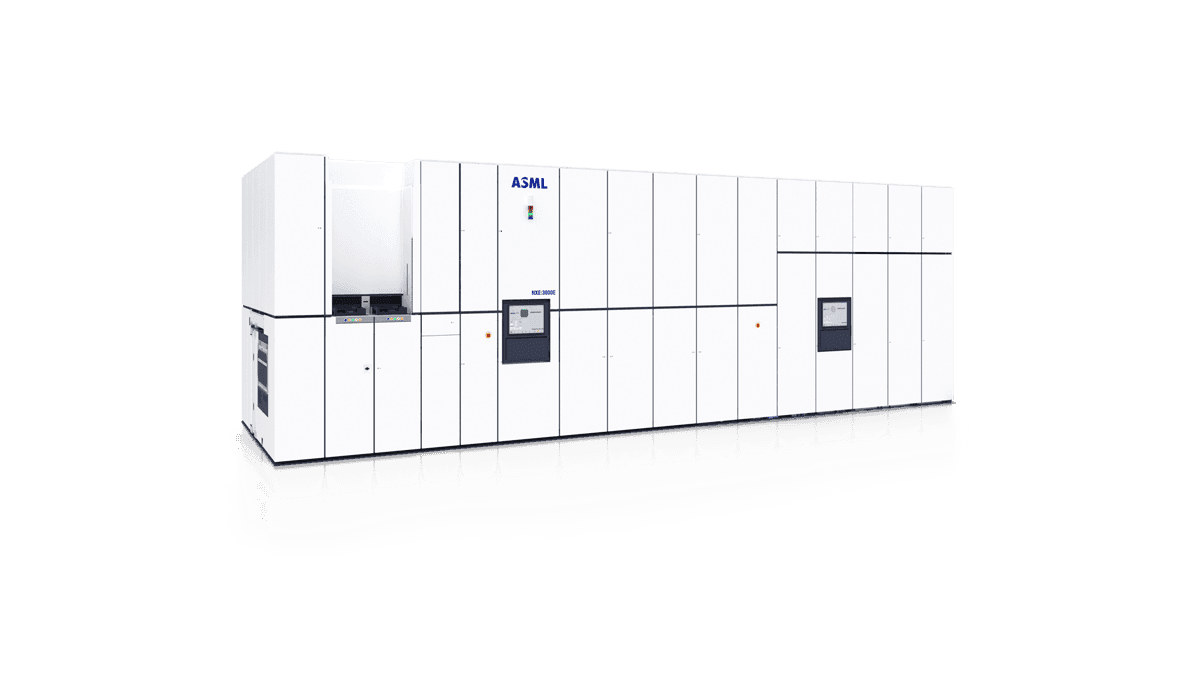
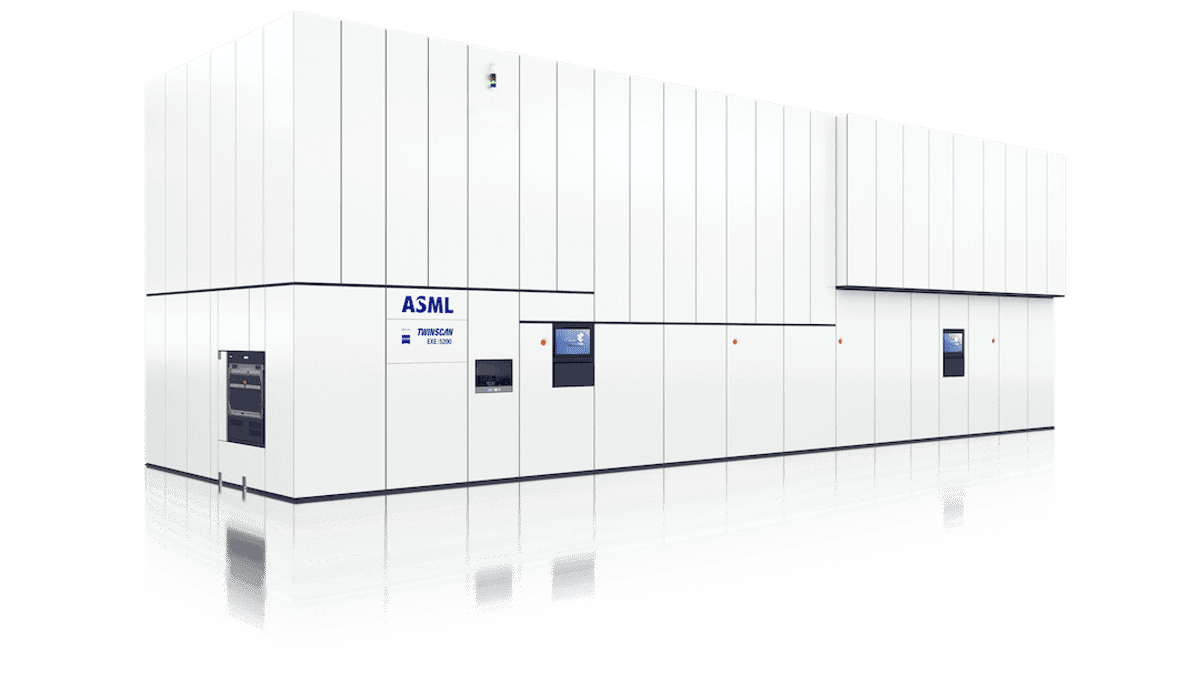
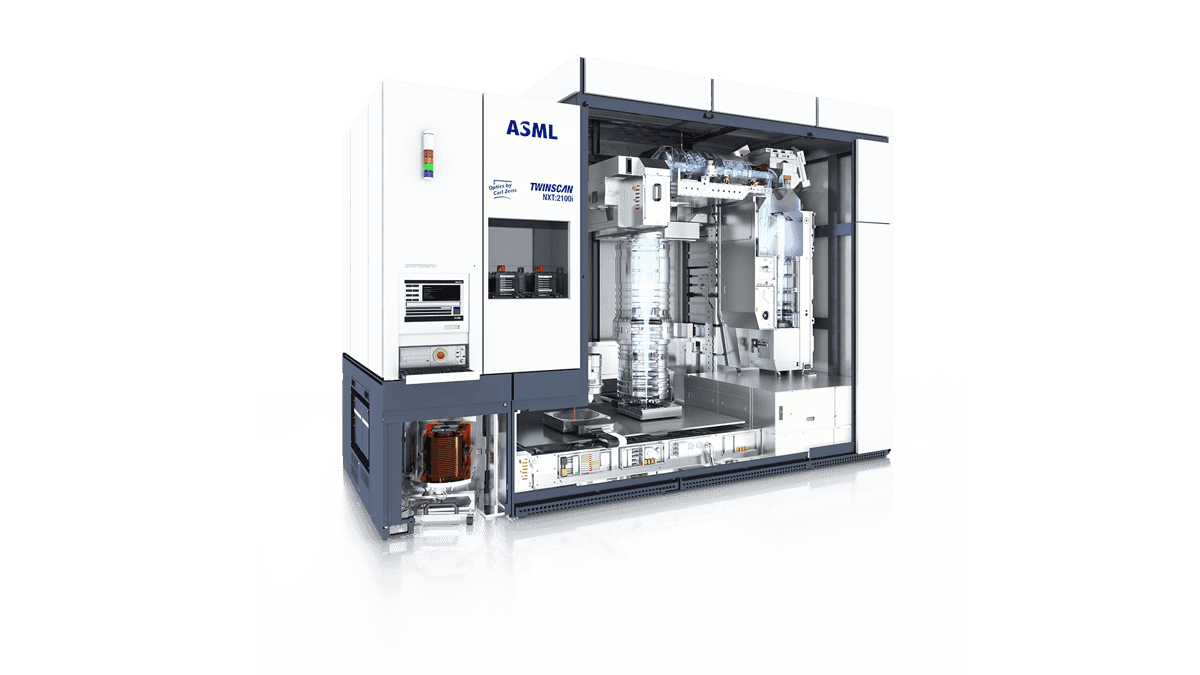
ASML, founded in 1984 as a Philips/ASM International joint venture that built its first machine in a shed in Eindhoven, is the world's dominant supplier of photolithography systems (~83% of the market) and the only company on Earth that makes EUV machines - the $180M-$400M tools without which no leading-edge chip can be manufactured.
That monopoly has made the Veldhoven company one of Europe's most valuable tech firms (about $637B as of September 18, 2026, after a mid-year China-competition scare took it down from a ~$693B July peak). 2025 revenue reached €32.7B with a record €13.2B in Q4 bookings and a €38.8B year-end backlog (ASML has since stopped disclosing quarterly bookings), and after twice raising 2026 guidance during the year - most recently at Q2 2026 to €43-45B - CEO Christophe Fouquet says chip demand is outpacing supply, with 65 low-NA EUV systems planned for 2026, rising toward 80-85 in 2027. The next act is High-NA EUV: the first EXE:5000 shipped to Intel in December 2023, the production-grade EXE:5200B arrived at Intel in Q4 2025 for its 14A node (risk production still targeted 2027), and on July 15, 2026 Intel became the first company to ship a high-volume commercial product patterned with High-NA EUV - select layers of its Panther Lake (Core Ultra Series 3, 18A) chips are now dual-qualified for either 0.33 NA or 0.55 NA scanners. On September 8, 2026 Intel Foundry and ASML said more than one million wafers had been processed on High-NA tools across certification, R&D and those Panther Lake layers. Samsung, SK hynix and imec also hold early High-NA systems - 10 EXE tools were running at four customers as of Semicon Taiwan 2026, with three more shipping, at roughly $380M each. The same day TSMC said it intends to use High-NA in high-volume manufacturing for advanced nodes from 2030 and joined ASML in an industry push to 12-inch High-NA photomasks (pilot line 2031, production-ready 2033); Samsung separately said it will put High-NA into DRAM high-volume manufacturing by 2028, which the companies called an industry first, and Reuters reported September 14 that SK Hynix set the same 2028 DRAM date. On September 17 at SEMICON India 2026, ASML said it will expand India customer-support and supplier work around Tata Electronics' Dholera 300 mm fab, expected operational in 2028, with no India manufacturing plans. ASML also made an uncharacteristic strategic bet in September 2025, investing €1.3B to become the largest shareholder (~11%) of French AI lab Mistral AI. The main headwind is geopolitics: China was 33% of 2025 sales and held at roughly 20% of net sales through Q2 2026 under expanding US and Dutch export controls; a July 27, 2026 report that a state-linked Chinese entity has begun mass-producing a domestic immersion DUV tool (assessed as roughly equivalent to ASML's ~2008-era NXT:1950i, 15-18 years behind ASML's current platform) briefly knocked ASML shares down as much as 8%. Separately, US Commerce Secretary Howard Lutnick told senior ASML executives in a series of meetings beginning in April 2026 that Washington believes an EUV system or EUV-specific components may have reached China in breach of export controls - a claim ASML has categorically denied, backing its denial with an accounting of all 314 operational and 26 decommissioned EUV units worldwide by location; no formal enforcement action had been announced as of ASML's July 15, 2026 earnings call, and Dutch DUV-servicing license rules took effect in September 2026.
imec's EXE:5200 - installed since March 2026 in its Leuven cleanroom, one of fewer than a dozen High-NA tools worldwide - continues toward sub-2nm process qualification, still targeted for Q4 2026, de-risking High-NA recipes for the whole industry. Re-verified September 14, 2026: imec has not announced a new qualification date.
Bring EXE fleet availability from 84% in July 2026 to the 90% Q4 2026 target that ASML High-NA product chief Greet Storms said customers need for high-volume manufacturing (longer-term goal 93%). Ten systems were running at four customers as of Semicon Taiwan, with three more shipping or installing, and the qualified EXE:5200B had reached 135 wafers per hour in acceptance testing.
After €9.3B of Q2 net sales beat guidance on July 15, 2026, ASML lifted full-year 2026 sales guidance to €43-45B and gross margin to 54-56%, up from the April range of €36-40B, citing robust logic and memory demand and order momentum extending into 2027-2028. It guided Q3 net sales of €11-12B, with results due October 14, 2026 - the cleanest yearly test of whether AI-driven equipment demand holds. Re-verified September 14, 2026: no guidance change since the Q2 call; Q3 results have not been released.
First High-NA production insertion: Intel 14A risk production
Intel's 14A node is the first process natively built around High-NA EUV, with risk production slated for 2027 and high-volume manufacturing in 2027-2028. Intel already dual-qualified select Panther Lake (18A) layers on High-NA in July 2026 as an interim validation step; ASML plans 80-85 low-NA EUV systems for 2027 alongside the High-NA ramp. Re-verified September 2026: no change to the 14A timing, and Semicon Taiwan comments focused on EXE availability rather than a new Intel insertion date.
Convert TSMC, Samsung and SK hynix High-NA commitments into high-volume layers
TSMC said on September 8, 2026 that it intends to use High-NA EUV in high-volume manufacturing for advanced nodes from 2030, starting on 6-inch masks, and joined ASML in an industry initiative for 12-inch High-NA photomasks (pilot line 2031, production-ready 2033). The same day Samsung said it will put High-NA into DRAM high-volume manufacturing by 2028, an industry first, and joined the 12-inch mask initiative; Reuters reported on September 14 that SK hynix set the same 2028 DRAM date, while Micron has ordered tools without a production date. Intel Foundry and ASML said more than one million wafers have been processed on High-NA tools across certification, R&D and selected Panther Lake (18A) layers. The near-term demand test is whether those dated commitments turn into high-volume layers outside Intel's already-shipping Panther Lake High-NA use and the still-pending Intel 14A insertion. Semicon Taiwan 2026 said 10 EXE systems were already running at four customers, with three more shipping.
Support Tata Electronics' first 300 mm fab in Dholera
At SEMICON India 2026 on September 17, ASML said it will expand India customer-support, supplier, and ecosystem work around Tata Electronics' planned 300 mm fab in Dholera, Gujarat, which a senior executive said is expected to be operational in 2028. ASML currently has no manufacturing plans in India; building a local supply chain comes first. The May 16, 2026 memorandum of understanding remains the commercial frame, covering lithography tools and support from 28 nm to 110 nm via Tata's PSMC technology partnership.
Finish the first phase of the BIC North campus near Eindhoven Airport by 2029, adding offices, logistics and a Flow Factory cleanroom so ASML can assemble lithography tools faster. The full site on about 35 hectares is designed to house up to 20,000 workers; ASML said electrical supply has been secured.
ASML Japan President Shojiro Fujiwara said at a September 3, 2026 Tokyo briefing that domestic headcount will rise from 500 to about 700 by fiscal 2030, a roughly 40 percent increase, to support Rapidus 2-nanometer production around fiscal 2027 and TSMC's Kumamoto fabs. ASML has already doubled its Chitose office near Rapidus from about 25 people in 2024 to around 50.
ASML's next optical leap, an 0.75 NA platform (the 'HXE' series) aimed at the A7 and A5 nodes, targets the early 2030s; ASML and imec have confirmed the platform's feasibility, alongside a demonstrated next-generation EUV light source that could lift chip output 50% by decade's end. Semicon Taiwan 2026 commentary stayed on High-NA EXE availability and the EXE:5200C/D/5400E/5600 productivity roadmap rather than pulling Hyper-NA forward.
Ship production-ready 12-inch High NA lithography systems
With TSMC, drive the industry transition from 6-inch to 12-inch High NA photomasks: a 12-inch mask pilot line targeted for 2031, then 12-inch High NA lithography systems ready for advanced-node production by 2033, aimed at higher scanner productivity, lower chipmaking costs and the removal of stitching constraints.
Resolve the US Commerce Department's EUV-to-China shipment inquiry - as the Dutch government's own new DUV servicing curbs take effect
TargetOngoing (Dutch DUV servicing license rule now in effect; MATCH Act/NDAA floor vote still pending)
Commerce Secretary Howard Lutnick told senior ASML executives in a series of meetings beginning in April 2026 that the US government believes an EUV system, or EUV-specific components, may have reached China in breach of export controls. ASML has categorically denied ever shipping an EUV machine or EUV-specific component to China and circulated a document in Washington accounting for all 314 operational and 26 decommissioned EUV units worldwide by location; as of this update no formal Bureau of Industry and Security enforcement action had been announced. That original inquiry has since been overtaken by two separate escalations. First, the Dutch government's own rules, published in June 2026, took effect in September 2026: they require ASML to obtain a government license before shipping certain immersion DUV lithography systems to China, and - new relative to prior controls - before servicing, repairing, or providing spare parts and software updates for immersion DUV tools it already sold to Chinese customers, extending Dutch export control from new-equipment sales to the installed base for the first time. Second, an August 20, 2026 report said Washington is separately preparing to pressure the Dutch government to go further and force a near-total ban on ASML's DUV (not just EUV) sales and servicing to China, running alongside the stalled congressional MATCH Act (S.4281, introduced April 2026), which would itself ban DUV sales and servicing in China and give the Netherlands and Japan a 150-day deadline to match US export controls or face unilateral US Foreign Direct Product Rule enforcement against ASML. That bill's expected vehicle - a manager's amendment to the Senate FY2027 NDAA, advanced 18-9 by the Senate Armed Services Committee on June 10, 2026 - stalled on an unrelated July 14, 2026 procedural vote and had not reached a full floor vote as of this update; Dutch Trade Minister Sjoerd Sjoerdsma formally protested the extraterritorial provisions and lobbied Lutnick and Congress in Washington in late June 2026. The February 2026 $252.5M BIS settlement with Applied Materials over a comparable violation remains the closest recent precedent for what a finding against ASML could cost.
Nikon and Canon test ASML's edges: an ArF price war and a nanoimprint memory push
TargetFY2028 (Nikon's next ArF platform)
ASML's EUV monopoly is unthreatened, but its mature-node dominance is seeing its first real competitive pressure in years. Under new CEO Yasuhiro Ohmura (announced late May 2026), Nikon is undercutting ASML's roughly $82.5M average price on argon-fluoride (ArF) immersion DUV scanners to win back share it lost over the past decade, leaning on in-house component manufacturing to do it, and has a next-generation ASML-compatible ArF immersion platform planned for fiscal 2028. Separately, Canon is pushing nanoimprint lithography (NIL) tools, already installed at the Texas Institute for Electronics, at NAND memory and specialty-logic wafers that ASML does not prioritize rather than competing head-on in EUV. Neither approach threatens ASML's leading-edge business, but a marquee memory customer qualifying Canon's NIL for production, or Nikon's 2028 platform actually winning fabs back, would be the first crack in ASML's mature-node share in years - worth watching alongside the China export-control fight, since both rivals stand to gain most from any Chinese fabs pushed toward alternative suppliers. Re-verified September 14, 2026: no new Nikon or Canon production-win announcement since the May-June 2026 reporting.
ASML reported third-quarter 2026 total net sales of EUR 11.7 billion and net income of EUR 5.0 billion for the quarter ended September 27, with a 57.5 percent gross margin. CEO Christophe Fouquet said planned 2027 and 2028 supply will not fully meet customer demand and that ASML is looking at 2028 capacity beyond a previously described 30 percent increase. The company guided fourth-quarter sales to EUR 14.2-15.2 billion and narrowed full-year 2026 sales to EUR 44-45 billion, with a gross margin around 56 percent.
The Elec, citing industry sources, reported that ASML will raise prices 10% on all EUV and DUV lithography replacement parts supplied to South Korea, with deliveries from January 2027. Samsung Electronics and SK hynix accepted the increase after ASML's Korean unit notified them in early September. ASML has not confirmed the change; The Elec said new-tool price talks continue and that TSMC has opposed equipment increases.
Reuters reported September 14 that Samsung and SK Hynix have both set 2028 dates to begin High-NA EUV DRAM production, while Micron has ordered tools without a production date. TSMC remains committed to High-NA high-volume manufacturing from 2030, and Intel has processed more than one million High-NA wafers across certification, R&D and select Panther Lake layers. ASML CEO Christophe Fouquet said the AI boom is not over and that memory makers are more aggressive on High-NA as low-NA EUV tools are all but sold out through 2027.
TSMC and ASML said on September 8, 2026 that TSMC intends to use High NA EUV in high-volume manufacturing for advanced nodes starting in 2030, with the number of High NA layers expected to rise as AI transistor architectures get more complex. The companies also launched an industry initiative to move High NA photomasks from today's 6-inch format to 12-inch, targeting a pilot line by 2031 and production-ready systems by 2033. CNBC reported that Samsung separately plans to use High NA for DRAM from 2028, joining Intel, which is already patterning some high-volume layers with the tools.
ASML began construction on September 8, 2026 of BIC North, a second large production campus on about 35 hectares of undeveloped land near Eindhoven Airport, roughly 7 km from its Veldhoven headquarters. The site is designed to eventually house up to 20,000 workers, with a first phase targeted for 2029 that adds offices, logistics and a Flow Factory cleanroom for faster lithography-tool assembly. ASML said electrical supply for the site has been secured; Prime Minister Rob Jetten and Eindhoven Mayor Jeroen Dijsselbloem were expected at the groundbreaking.
ASML Japan President Shojiro Fujiwara said at a September 3, 2026 Tokyo briefing marking the unit's 25th anniversary that headcount will rise from 500 to about 700 by fiscal 2030 to support advanced chip production, including Rapidus 2-nanometer work around 2027 and TSMC's Kumamoto plants. Most of the extra roughly 200 roles are customer-support and field-service jobs. TECH+ reported Japan now accounts for about 5% of ASML sales across eight sites.
At Semicon Taiwan 2026, ASML High-NA product chief Greet Storms said the company expects 0.55-NA EXE systems to reach the availability customers need for high-volume manufacturing by the end of 2026, targeting 90% fleet availability in the fourth quarter after 84% in July. Ten High-NA systems are running at four customers, with three more shipping or installing, and EXE tools had accumulated more than 1.35 million wafer exposures by mid-July. The qualified EXE:5200B reached 135 wafers per hour in acceptance testing, with a longer-term availability goal of 93%.
ASML shares slid 6.6% on July 27 after The Information reported that state-backed Shanghai Yuliangsheng Technology has begun mass-producing domestically developed immersion deep ultraviolet (DUV) lithography machines, ending China's total reliance on ASML for that class of chipmaking tool. About five units are expected to ship this year to SMIC, Hua Hong and CXMT, with roughly 20 more planned for 2027, though the Chinese tools reportedly still trail ASML's on performance, reliability and uptime. ASML, which expects to ship about 130 immersion systems in 2026, still holds a total monopoly on the more advanced EUV machines needed for leading-edge chips.
ASML reported second-quarter 2026 net sales of €9.3 billion, net income of €2.9 billion and a 54.0% gross margin, and lifted its full-year revenue guidance to between €43 billion and €45 billion from prior forecasts. The Dutch lithography monopolist guided to €11-12 billion of third-quarter sales and said order intake stayed strong through the first half, helped by a record €6.86 billion booking from memory maker SK Hynix earlier in July. Citing that momentum, ASML said it plans to add about 30% to both its low-NA EUV and DUV immersion tool capacity for 2027, with a possible further 30% in 2028.
(net income €2.9B; gross margin 54.0%); Q3 guided to €11-12B at 55-57% gross margin, results due October 14, 2026
Order backlog
€38.8B
(end of 2025; record €13.2B Q4 bookings) - ASML stopped disclosing quarterly bookings from Q1 2026 onward, describing order intake only qualitatively as 'very strong'; plans a 30% increase in both 2027 low-NA EUV and DUV immersion capacity to meet it
Market cap
About $684B
NASDAQ close $1,780.34 on Oct. 9, 2026; 384.10M shares outstanding used in the prior metric, vs about $637B at $1,679.92 on Sept. 18
2025 systems delivered
48 EUV + 279 DUV revenue-recognized
High-NA fleet worldwide
10 EXE systems running at 4 customers, plus 3 more shipping or installing (as of Semicon Taiwan 2026); more than 1.35 million wafer exposures by mid-July; July fleet availability 84%, with a 90% Q4 2026 high-volume-manufacturing target
China revenue share
33%
(2025); full-year 2026 guided ~20%, though Q2 2026 system sales to China specifically fell to 14% (down from 19% in Q1 2026 and 36% in Q4 2025)
06
Operations & revenue
Operating status
Public. Q3 2026 net sales EUR 11.7 billion
On 14 Oct 2026 ASML reported Q3 total net sales of EUR 11.7 billion (EUR 11,662 million), net income of EUR 4,960 million, and a 57.5 percent gross margin for the quarter ended 27 Sep 2026. Full-year 2026 guidance is now EUR 44-45 billion with a gross margin around 56 percent, narrowed from EUR 43-45 billion. Q4 guidance is EUR 14.2-15.2 billion. Fouquet said planned 2027 and 2028 supply will not fully meet demand, and ASML bought about EUR 4.1 billion of shares in the quarter. An interim dividend of EUR 1.88 is payable on 4 Nov 2026. The Oct. 11 Korea spare-parts price report remains unconfirmed by ASML.
Revenue streams
EUV systems (NXE + EXE)
0.33 NA and High-NA extreme-ultraviolet scanners - €11.6B in 2025 (+39%, 48 systems), roughly 35% of revenue and growing fastest as every leading-edge logic and DRAM fab expands.
DUV systems (TWINSCAN NXT/XT)
Deep-ultraviolet immersion and dry scanners that pattern the majority of layers on every chip - €12.0B in 2025 (279 systems), with China exposure making this the stream most affected by export controls.
Installed Base Management (service & upgrades)
Service contracts, spares, software, and performance upgrades across the global fleet - €8.2B in 2025 (~25% of revenue), the recurring stabilizer that keeps growing even in downturns (€2.5B in Q1 2026 alone).
Metrology & inspection
YieldStar optical metrology and HMI e-beam inspection systems that close the litho control loop - the remaining ~€1B of 2025 sales.
07
Track record
How past announced dates turned out.
3/4announced dates hit on time
3 Hit
0 Slipped
1 Missed
Missed
TSMC adopts High-NA EUV at its A14 node
Target ~2028 · Resolved Apr 23, 2026
TSMC's April 2026 process roadmap update ruled out High-NA EUV for every node through A16, A14, A13, and A12 (production planned through 2029), with SVP Kevin Zhang citing the tool's cost - the anticipated A14 adoption is no longer expected.
Ship the first second-generation High-NA (EXE:5200) in 2025
Target 2025 · Resolved Dec 31, 2025
The first EXE:5200 shipment was confirmed in July 2025, and the production-grade EXE:5200B shipped and installed at Intel in Q4 2025, with two High-NA systems recognized in Q4 revenue.
The first TWINSCAN EXE:5000 shipped to Intel on December 21, 2023, meeting the long-promised 2023 delivery window for the industry's first High-NA system - it arrived in Oregon in 250 crates the following month.
On 14 Oct 2026 ASML reported third-quarter total net sales of EUR 11.7 billion, or EUR 11,662 million in the results table, a 57.5 percent gross margin, and net income of EUR 4,960 million. Installed Base Management sales were EUR 3,289 million. CEO Christophe Fouquet said planned 2027 and 2028 supply will not fully meet customer demand and that ASML is investigating 2028 capacity beyond the 30 percent increase it had already described. Fourth-quarter sales are guided to EUR 14.2-15.2 billion, and full-year 2026 sales to EUR 44-45 billion. The release does not mention a Korea parts-price increase. Figures are from the GlobeNewswire text republished by Taiwan News; the ASML investor page was access-blocked in this run.
Reported 10% Korea EUV/DUV parts increase
Industry sources told The Elec on Oct. 11, 2026 that ASML will raise prices 10% on all EUV and DUV lithography replacement parts supplied to South Korea from January 2027 deliveries, and that Samsung Electronics and SK hynix accepted after an early-September notice through ASML's Korean unit. ASML's newsroom still ends at Sept. 8, 2026 and has not confirmed the change. The same report said new-tool price talks continue and that TSMC has opposed equipment increases. Installed-base services, parts and upgrades were EUR 8.193 billion in 2025.
Korea spare-parts prices rise 10% from 2027
On Oct. 11, 2026 The Elec reported, citing industry sources, that ASML will raise prices 10% on all EUV and DUV lithography replacement parts supplied to South Korea from January 2027 deliveries. Samsung Electronics and SK hynix accepted after an early-September notice through ASML's Korean unit. ASML has not confirmed the change, and new equipment price talks remain open.
Expands India support around Tata's first 300 mm fab
On September 17, 2026 at SEMICON India, ASML Chief Strategic Sourcing and Procurement Officer Allan Wayne said the company will expand its India customer-support, supplier, and ecosystem footprint around Tata Electronics' planned 300 mm fab in Dholera, Gujarat, expected operational in 2028. He said ASML currently has no manufacturing plans in India and that a local supply chain has to come first. The May 16, 2026 Tata Electronics memorandum of understanding remains the commercial frame.
Samsung commits to High-NA DRAM high-volume manufacturing by 2028
On September 8, 2026 Samsung Electronics and ASML expanded their partnership: Samsung joined the industry initiative for 12-inch High-NA photomasks and said it plans to introduce High-NA EUV into DRAM high-volume manufacturing by 2028, which the companies called an industry first. Christophe Fouquet called Samsung one of ASML's most important innovation partners. Reuters on September 14 reported that SK Hynix set the same 2028 DRAM date, while Micron ordered tools without a production date.
Samsung and SK Hynix set 2028 High-NA DRAM production
Reuters reported on September 14, 2026 that Samsung and SK Hynix have both set 2028 dates to begin High-NA EUV DRAM production, while Micron has ordered tools without naming a production date. TSMC remains committed to High-NA high-volume manufacturing from 2030. CEO Christophe Fouquet told Reuters the AI boom is not over and that memory makers are more aggressive on High-NA; CFO Roger Dassen said low-NA EUV tools are all but sold out through 2027.
Intel Foundry and ASML pass one million High-NA wafers
On September 8, 2026, at SPIE Photomask Technology, Intel Foundry and ASML said more than one million wafers had been processed on High-NA EUV tools across early certification, R&D, and volume production on select Panther Lake (Intel 18A / Core Ultra Series 3) layers. Overlay, throughput and availability were meeting Intel Foundry's expectations. The total is cumulative, not one million fully commercial Panther Lake wafers.
Breaks ground on BIC North production campus
On September 8, 2026 ASML began construction of BIC North, a second large production campus on about 35 hectares near Eindhoven Airport, roughly 7 km from Veldhoven. The site is designed to eventually house up to 20,000 workers, with a first phase targeted for 2029 adding offices, logistics and a Flow Factory cleanroom for faster lithography-tool assembly. ASML said electrical supply has been secured.
2026
TSMC commits to High NA HVM from 2030; 12-inch mask initiative
On September 8, 2026 ASML and TSMC said TSMC intends to use High NA EUV in high-volume manufacturing for advanced nodes starting in 2030, and launched an industry initiative to move High NA photomasks from 6-inch to 12-inch, targeting a pilot line by 2031 and production-ready systems by 2033. CEO Christophe Fouquet said High NA adoption should increase first on current 6-inch masks, then on 12-inch masks that raise scanner productivity. CNBC reported Samsung plans High NA for DRAM from 2028.
ASML Japan to grow from 500 to about 700 staff by 2030
At a September 3, 2026 Tokyo briefing marking ASML Japan's 25th anniversary, President Shojiro Fujiwara said the unit will raise headcount from 500 to about 700 by fiscal 2030 to support Rapidus 2-nanometer production around 2027 and TSMC's Kumamoto fabs. Most of the extra roughly 200 roles are customer-support and field-service jobs; TECH+ reported Japan now accounts for about 5% of ASML sales across eight sites.
Tata Electronics partnership for India's first 300 mm fab
On May 16, 2026 ASML and Tata Electronics sign a memorandum of understanding under which ASML will supply lithography tools and support the ramp of Tata's planned $11B 300 mm fab in Dholera, Gujarat - India's first commercial 300 mm semiconductor plant - covering nodes from 28 nm to 110 nm via Tata's PSMC technology partnership, plus local talent, supply-chain and R&D work.
High-NA EUV targeted for production-grade availability by year-end
At Semicon Taiwan 2026, ASML High-NA product chief Greet Storms said EXE systems should reach the availability customers need for high-volume manufacturing by the end of 2026, targeting 90% fleet availability in the fourth quarter after 84% in July (longer-term goal 93%). Ten High-NA systems are running at four customers, with three more shipping or installing, and EXE tools had accumulated more than 1.35 million wafer exposures by mid-July. The qualified EXE:5200B reached 135 wafers per hour in acceptance testing.
Intel ships first High-NA-patterned high-volume logic product
On July 15, 2026 ASML and Intel announce that select layers of Intel's Panther Lake (Core Ultra Series 3, 18A) chips are now dual-qualified for either 0.33 NA (NXE) or 0.55 NA (EXE) scanners and shipping to customers at yields matched to the existing EUV platform - the first time a High-NA-patterned product has reached high-volume manufacturing, a full node ahead of the previously flagged Intel 14A risk-production milestone.
2026 guidance raised to €36–40B on AI demand
Q1 2026 delivers €8.8B in sales at a 53% gross margin, and ASML raises full-year guidance from €34–39B to €36–40B - Fouquet: 'demand for chips is outpacing supply. Our customers are accelerating capacity expansion plans for 2026 and beyond.'
2025
First production High-NA ships; record Q4 bookings
The production-grade EXE:5200B ships and installs at Intel in Q4 2025 for the 14A node, with two High-NA systems recognized in revenue; Q4 net bookings hit a record €13.2B (€7.4B EUV) and FY2025 closes at €32.7B with a €38.8B backlog.
€1.3B investment makes ASML Mistral AI's largest shareholder
On September 9, 2025, ASML leads Mistral's €1.7B Series C at a ~€11.7B valuation, taking ~11% and a board seat - an uncharacteristic strategic bet pairing Europe's chip champion with its leading AI lab.
2024
Christophe Fouquet becomes President & CEO
Fouquet, who joined ASML in 2008 and previously ran the EUV business, succeeds Peter Wennink in April 2024.
2023
First High-NA EUV system ships to Intel
On December 21, 2023, ASML ships the industry's first High-NA system (TWINSCAN EXE:5000, 0.55 NA) to Intel in Oregon - it arrives in 250 crates - opening the sub-2nm era.
2017
First production-ready EUV system ordered in volume
The NXE:3400 becomes the first EUV machine ordered in volume for production use, after two decades and billions of euros of development - the 100th EUV system ships in early 2020.
2013
Acquires EUV light-source maker Cymer for $2.55B
ASML buys San Diego-based Cymer, vertically integrating the laser-produced-plasma light source that is EUV's hardest subsystem; e-beam metrology firm Hermes Microvision follows in 2016 for $3.1B.
2012
Intel, TSMC, and Samsung co-fund EUV development
With EUV's cost threatening to sink it, ASML's three biggest customers buy in - Intel alone invests $4.1B for 15% - funding the decade-long push to make extreme-ultraviolet lithography work.
2001
TWINSCAN dual-stage architecture launches
TWINSCAN exposes one wafer while measuring the next - a throughput breakthrough that remains the basis of every ASML system; the company also acquires Silicon Valley Group the same year.
1995
IPO on Amsterdam and New York exchanges
ASML goes public, becoming fully independent as Philips divests over the following years - today it is dual-listed on Euronext Amsterdam and Nasdaq.
1991
PAS 5500 breakthrough makes ASML profitable
The PAS 5500 platform wins key customers and turns the struggling venture profitable - the foundation of ASML's rise against then-dominant Japanese rivals Nikon and Canon.
1984
Founded as a Philips/ASM joint venture - in a shed
ASM Lithography launches as a 50/50 joint venture of Philips and ASM International, building its first stepper (PAS 2000) in a shed next to a Philips office in Eindhoven.
09
Funding
$4.1Bdisclosed across 1 round with a stated amount
RoundAmountInvestors
Founding joint venture
1984
50/50 JV
Philips and ASM International
IPO (Amsterdam + Nasdaq)
Mar 1995
IPO
Public markets; Philips divested over the following years