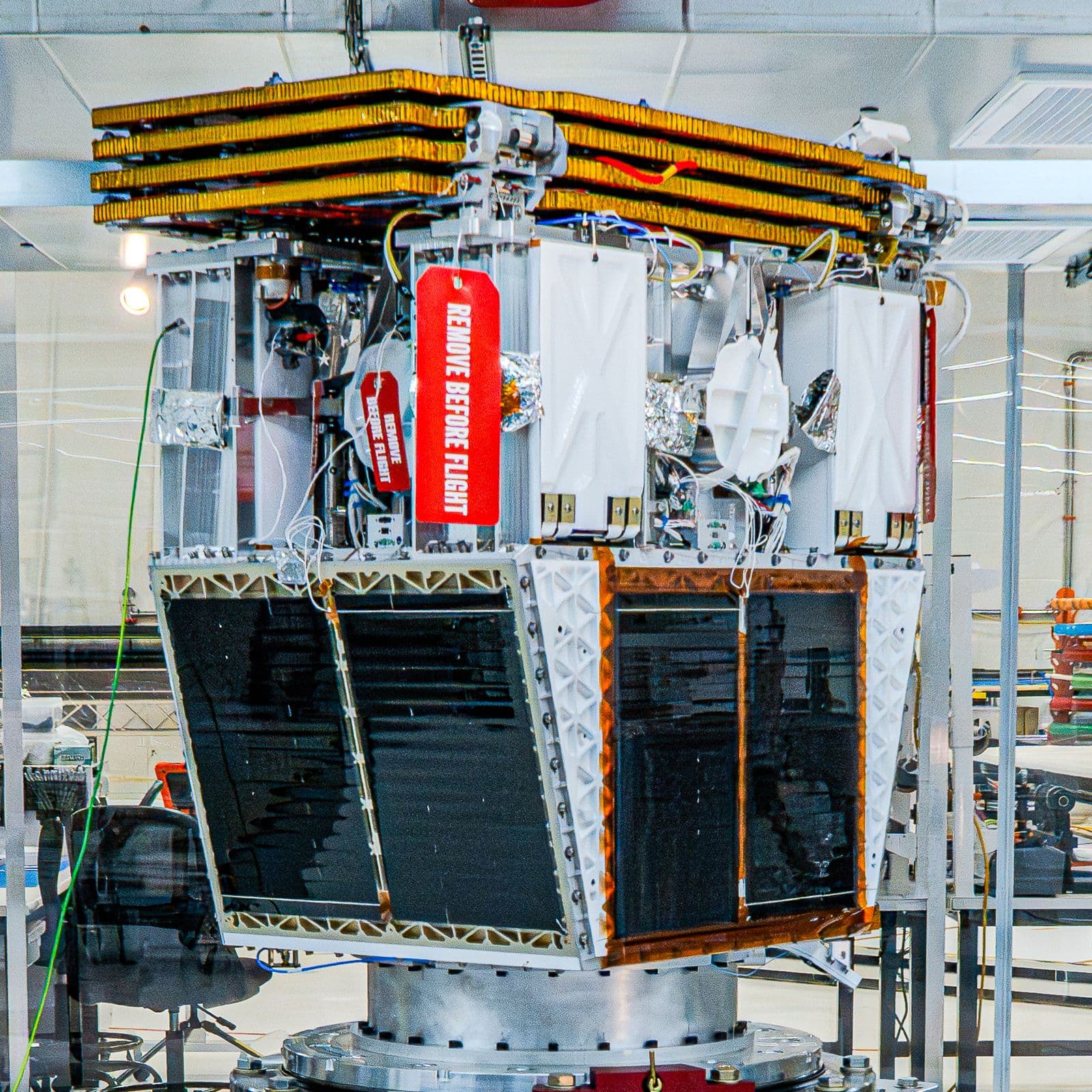
Reflect Orbital, founded in October 2021 by former SpaceX engineer Ben Nowack and former Zipline mechanical engineer Tristan Semmelhack, is building satellites that unfurl thin-film mirrors in low Earth orbit and steer reflected sunlight onto specific spots on the ground after dark.
The pitch is sunlight on demand: a customer picks a location and a time window, and a passing reflector lights it up, initially at roughly the brightness of a full moon over a spot a few kilometers wide, with the long-term business aimed at extending the generating day of utility-scale solar farms. The company has raised about $35 million, including a $6.5 million seed led by Sequoia Capital in September 2024 and a $20 million Series A led by Lux Capital in May 2025, and won a $1.25 million AFWERX SBIR Phase II contract in June 2025. Its first demonstration satellite, Earendil-1, carries a roughly 18-meter-square aluminized reflector on a 142 kg spacecraft. The FCC licensed it on July 9, 2026. On October 9, 2026 the Space Bureau reissued that license in DA 26-1101, extended the surety-bond deadline to January 5, 2027, and said the August 6 Application for Review and a separate August 7 petition for reconsideration both remain pending. The order says Earendil-1 is scheduled to launch within several months of the July grant and names no rideshare. On October 14, 2026 Reflect said it bought two dedicated Skyroot launches, one Vikram-1 and one Vikram-1U, for future spacecraft, and that those flights complement other planned launches from sites in the United States. That release does not move Earendil-1 off a Falcon 9 rideshare or name the spacecraft. The homepage still shows two satellites in 2026, 36 in 2027 in one section and 38 in another, then more than 1,000 by 2028 and 50,000 by 2035.
Reflect's published plan calls for two demonstration satellites in 2026, the pair that establishes whether reflected passes can be scheduled and handed off between spacecraft rather than delivered one at a time. The second satellite is now built and was unveiled publicly on August 14, 2026, but as of September 16, 2026 it has not yet received its own FCC license or a launch date.
The FCC granted the license on July 9, 2026 and Reflect expects to fly Earendil-1 on a SpaceX rideshare later in the year; as of September 16, 2026 no launch date has been set, the satellite has not flown, and the August 6 Application for Review is still pending with no Commission timeline. Watch for the launch manifest assignment, then for the two hardest events in sequence: deployment of the 18-meter membrane and the first steered reflection onto a ground target. Everything downstream, including the 2027 tranche and any energy business, depends on this vehicle working.
The roadmap steps from two demonstrators to 36 satellites in 2027, the first fleet large enough to offer repeatable service windows rather than occasional passes. The company homepage still shows that 2026-to-2027 step as of September 16, 2026, though one later section of the same page lists 38 satellites for 2027. It will also require a far larger FCC authorization than the single-satellite grant, in a docket astronomers are already contesting and where the current grant is explicitly test-only and sets no precedent. CEO Ben Nowack has since described a more cautious near-term goal (roughly 4,000 satellites by decade's end, with a possible dedicated Falcon 9 rideshare as soon as 2028 that is not yet booked or funded), so the pace of this step is less certain than the published roadmap number implies.
The energy business, not novelty lighting, is what justifies a constellation of thousands. Reflect's homepage still projects roughly a 1% capacity-factor gain for solar farms around 2030 rising toward 20% by 2035. Watch for a named utility or independent power producer signing up for a measured trial, which would be the first outside validation that the physics closes economically; none had been named as of September 16, 2026.
On Oct. 14, 2026, Reflect Orbital said it purchased two dedicated Skyroot Aerospace launches for future spacecraft. The first uses Vikram-1 and the second uses Vikram-1U, which Skyroot describes as an in-development rocket with additional first-stage boosters. Payload reported that a Reflect spokesperson said the company is the only payload for now, and that price and launch dates were not disclosed.
DarkSky International, Environment America, the American Bird Conservancy and Public Employees for Environmental Responsibility filed a petition on August 6 asking the FCC to reverse its approval of Reflect Orbital's Earendil-1 demonstration satellite, which would carry a 59-foot-wide mirror to reflect sunlight onto specific spots on Earth during darkness. The groups argue the FCC limited its review to radiofrequency spectrum and ignored potential harm to nocturnal wildlife, astronomy and eye safety, and warned the single approved test mission could pave the way for a much larger constellation.
The FCC granted Reflect Orbital a license on July 9 to build and operate Earendil-1, a 142 kg demonstration satellite carrying an 18-meter-square thin-film reflector designed to beam sunlight to chosen spots on the ground after dark. The license followed a docket that drew roughly 1,900 mostly critical comments, with the FCC saying optical-astronomy concerns fell outside its regulatory authority while noting Reflect's commitments to coordinate with NASA and the NSF; the company is targeting a launch on a SpaceX rideshare later in 2026.
no satellite in orbit; neither demo satellite has flown as of Sept 16, 2026
Total funding raised
~$35.2M
(as of 2026); no later round disclosed as of Sept 12, 2026
Satellites licensed to date
1 licensed for flight
(Earendil-1, FCC grant July 9, 2026, valid for up to 2 years of test-only operations); that grant remains under a pending Application for Review filed Aug 6, 2026, with no Commission ruling as of Sept 16, 2026. A second demonstration satellite has been built and unveiled but has not yet received its own FCC license
Demo reflector size
18 m x 18 m thin film
(about 324 m2) on a 142 kg satellite; company homepage still lists 2026 lighting as 0.1 lux for about 5 minutes
Illuminated spot
About 5 km wide
(2.5 km radius), up to 5 minutes per pass. Reflect's homepage still describes the 2026 demo as 0.1 lux (comparable to a full moon). A peer-reviewed August 31, 2026 Astrophysical Journal Letters paper by Kocifaj, Bakos and Kundracik calculates about 1.05 lux (~4x full-moon illuminance, magnitude -14.3) for the 18-meter prototype and about 9.5 lux (~38x full moon, magnitude -16.7, street-light level) for the planned 54-meter operational mirrors; Reflect told Space.com the paper's assumptions are inaccurate.
Sunlight requests received
260,000+ from 157 countries
most recent public figure; company site still invites new requests
Constellation target
Published homepage roadmap still reads 2 satellites in 2026, 36 in 2027, 1,000+ by 2028, 5,000+ by 2030, and 50,000 by 2035; CEO Ben Nowack said in an August 14, 2026 interview the company now hopes for roughly 4,000 satellites in orbit by the end of the decade, including a possible dedicated Falcon 9 rideshare of Reflect satellites as soon as 2028, though those launches are not yet booked or funded
Government contract
$1.25M AFWERX SBIR Phase II
(Jun 2025); no Phase III or additional government award reported as of Sept 12, 2026
Employees
~76
(LinkedIn company page, 2026); Tracxn listed 74 as of May 31, 2026
Demo satellite build cost
About $2M for the Earendil-1 prototype
similar production units estimated around $300,000 each (July 2026)
Earendil-1 surety bond
Due January 5, 2027
06
Operations & revenue
Operating status
Pre-launch; bond due Jan. 5, 2027
On October 9, 2026 the FCC Space Bureau released DA 26-1101. It reissued the July 9 Earendil-1 license, moved the surety-bond deadline from August 10, 2026 to January 5, 2027, and corrected one uplink center frequency to 2047.645 MHz. The order says the August 6 Earthjustice Application for Review, filed for DarkSky International, Public Employees for Environmental Responsibility, Environment America, and the American Bird Conservancy, and Jean Sebastien Larro's August 7 petition for reconsideration both remain pending. It describes Earendil-1 as scheduled to launch within several months of the July 9 grant and gives no vehicle or date. On October 14, 2026 Reflect said it purchased two dedicated Skyroot launches for future spacecraft, one on Vikram-1 and one on Vikram-1U, and that those launches complement other planned launches from sites in the United States. The release does not name Earendil-1, disclose price or dates, or change a Falcon 9 rideshare. Payload quotes a spokesperson saying Reflect is the primary and only payload at this time. Checked October 17, 2026. This is not a full 15-page audit.
Revenue streams
Sunlight on demand (lighting)
Sells time-boxed illumination of a chosen location ordered through an app or website. The company site now lists response (disaster and search-and-rescue), industrial night work, agriculture (season extension), street lighting, defense illumination, and events as target uses. Coverage is described as 5 km and up per pass, with the 2026 demo capability at roughly moonlight levels and brightness scaling with constellation size.
Solar farm illumination (energy)
The long-run business: beaming sunlight to utility-scale solar farms in the hours just after sunset and before sunrise to extend generating time and lift capacity factors. Reflect's published roadmap puts a roughly 1% capacity-factor gain around 2030 and up to 20% by 2035, both of which require thousands of satellites in orbit.
07
Track record
How past announced dates turned out.
0/1announced date hit on time
0 Hit
1 Slipped
0 Missed
Slipped
Launch first reflector satellite
Target Spring 2026 · Resolved Jul 9, 2026
The Series A announcement in May 2025 pointed at a first mission in early 2026, and the target moved through spring and then mid-2026 while the FCC application sat in a docket that drew about 1,900 comments. The license was granted July 9, 2026 and the launch is now expected later in 2026 on a SpaceX rideshare.
FCC reissues the Earendil-1 license and defers the bond
On October 9, 2026 the Space Bureau released DA 26-1101. It grants Reflect's petition, extends the Earendil-1 surety-bond deadline to January 5, 2027, and corrects a center frequency to 2047.645 MHz. The order states that the August 6 Application for Review and an August 7 individual petition for reconsideration remain pending. It says Earendil-1 is scheduled to launch within several months of the July 9 grant and does not name a launch vehicle or date.
Buys two dedicated Skyroot launches
On Oct. 14, 2026 Reflect Orbital said it purchased two dedicated Skyroot launches for future spacecraft, one on Vikram-1 and one on Vikram-1U. A spokesperson told Payload the company is the only payload for now. Price and launch dates were not disclosed, and the announcement does not put a spacecraft in orbit.
Second demonstration satellite completed; CEO answers critics
Reflect unveils a second, completed demonstration satellite and CEO Ben Nowack responds directly to dark-sky and safety critics in an August 14, 2026 interview. Nowack says the company hopes to have roughly 4,000 satellites in orbit by the end of the decade, well short of the 50,000-by-2035 figure on its public roadmap, and that it wants to fly a dedicated Falcon 9 rideshare of Reflect satellites as soon as 2028, potentially more than one, though he acknowledges those launches are not yet booked or funded. Neither Earendil-1 nor the new satellite had flown as of this date.
Peer-reviewed study models 54-meter operational mirrors, not the 18-meter demo
On August 31, 2026, Astrophysical Journal Letters published a study by Miroslav Kocifaj (Slovak Academy of Sciences), Gaspar Bakos (Princeton), and Frantisek Kundracik modeling Reflect Orbital's planned 54-meter operational mirrors, not Earendil-1. For a 54-meter satellite they calculate about 9.5 lux at the ground (roughly 38 times full-moon illuminance) and an apparent magnitude of -16.7, with sky glow exceeding a moonlit sky tens of kilometers from the beam; they separately put the 18-meter prototype at about 1.05 lux (roughly 4 times full-moon illuminance) and magnitude -14.3. Reflect Orbital told Space.com the findings rest on inaccurate assumptions and that most service locations would be remote construction and solar sites.
Environmental groups petition FCC to reverse Earendil-1 approval
DarkSky International, the American Bird Conservancy, Environment America and Public Employees for Environmental Responsibility, represented by Earthjustice, filed a formal Application for Review on August 6, 2026 asking the full FCC to reverse the Space Bureau's July 9 license grant, arguing the agency limited its review to radiofrequency spectrum and ignored potential harm to nocturnal wildlife, astronomy and eye safety. The groups also warned the single approved test mission could pave the way for Reflect's much larger planned constellation. As of August 13, 2026 the full Commission has not ruled and no timeline for a decision has been set.
Astronomers publish a sky-brightness warning
A peer-reviewed study led by European Southern Observatory astronomer Olivier Hainaut concludes that a full 50,000-satellite reflector constellation would brighten the background night sky by a factor of three to four, degrading faint-object observations at facilities including the Vera C. Rubin Observatory.
FCC licenses Earendil-1, the first orbital mirror
On July 9, 2026 the FCC grants Reflect a license to build and operate Earendil-1, a 142 kg satellite carrying an 18-meter-square thin-film reflector at 600 to 650 km, after a docket that drew roughly 1,900 mostly critical comments. The commission said optical-astronomy concerns fell outside its review while noting Reflect's commitments to work with NASA and the NSF.
2025
Dark-skies commitments published as opposition builds
With astronomers organizing against the constellation, Reflect publishes a set of commitments: reflections confined to defined areas for defined times, satellite positions shared in advance through standard channels, and observatory coordinates loaded into its service software so reflections are steered away from protected sites.
2025
AFWERX SBIR Phase II contract
Reflect is selected for a $1.25 million SBIR Phase II contract by AFWERX on June 3, 2025 to advance satellite-based sunlight redirection, its first government customer and an early signal of defense interest in on-demand illumination.
$20M Series A led by Lux Capital
On May 14, 2025 the company raises a $20 million Series A led by Lux Capital, with Sequoia Capital and Starship Ventures participating, earmarked for team growth and the first satellite mission.
2024
$6.5M seed round led by Sequoia
Reflect announces a $6.5 million seed round on September 24, 2024, led by Sequoia Capital with Shaun Maguire, funding the first flight hardware for its reflector satellites after a ground demonstration campaign that used a mirror flown under a hot-air balloon.
2021
Company founded to sell sunlight after dark
Ben Nowack, a former SpaceX engineer, and Tristan Semmelhack, a former Zipline mechanical engineer, found Reflect Orbital in October 2021 around the idea of orbiting steerable mirrors that redirect sunlight to chosen points on the night side of Earth.
09
Funding
$27Mdisclosed across 2 rounds with a stated amount
RoundAmountInvestors
Seed
Sep 2024
$6.5M
Sequoia Capital (lead), Shaun Maguire
Series A
May 2025
$20M
Lux Capital (lead), Sequoia Capital, Starship Ventures