Starcloud is building data centers in orbit, and it is the only company that has actually run a data-center-class GPU in space rather than rendering one. Starcloud-1, a 60 kg satellite carrying an Nvidia H100, launched November 2, 2025 on SpaceX's Bandwagon-4 rideshare and by December had run Google's Gemma model and trained a small language model in orbit, both firsts. Founded in January 2024 as Lumen Orbit by Philip Johnston, Ezra Feilden, and Adi Oltean, renamed in March 2025 and now based in Redmond, Washington, it closed a $170 million Series A on March 30, 2026 at $1.1 billion and a $250 million Series A extension on August 21, 2026 at $2.3 billion, taking total raised to about $450 million. The pitch is that solar power above the atmosphere and radiative cooling in vacuum beat grid power and water cooling on the ground once launch is cheap enough, and the company has filed with the FCC for a constellation of up to 88,000 orbital data-center satellites. Starcloud-2, once targeted for October 2026, is now two 8 kW rideshare satellites in 2027 for customers including US government agencies, while Starcloud-3 remains gated on commercial Starship around 2028 to 2029. On September 30, 2026 Firefly said Starcloud's SC-1L compute payload will fly on Elytra on Firefly's third lunar mission, targeted no earlier than 2028; Starcloud.com has not posted its own release.
Firefly Aerospace said on September 30, 2026 it signed a commercial payload agreement to fly Starcloud's SC-1L AI compute payload on an Elytra orbital vehicle. Starcloud is being added to Firefly's third lunar mission, targeted no earlier than 2028, where Elytra will first relay for a Blue Ghost CLPS landing at the Gruithuisen Domes and then remain in lunar orbit for five years. Firefly did not disclose the contract value.
France's space ministry said SpaceX, Blue Origin, Stoke Space and Starcloud canceled attendance at President Emmanuel Macron's International Space Summit in Paris on September 9-10 after the White House Office of Science and Technology Policy hosted a call with US firms planning to go. Reuters, citing people familiar with the matter, said officials warned that showing up could be read as support for European space-policy positions Washington opposes, including the EU Space Act and mobile-satellite spectrum rules, but did not explicitly order a boycott. Some planned US-European announcements were also dropped; an OSTP official said the administration still looks forward to talks at the summit on science, exploration and space security.
Starcloud closed a $250 million Series A extension on August 21 led by Manhattan West, at a $2.3 billion post-money valuation, taking its total raised to around $450 million. Nvidia and Cisco Investments joined as new backers alongside existing investors Benchmark and EQT Ventures, with the capital funding a new 100,000-square-foot manufacturing facility in Woodinville, Washington to build the next-generation Starcloud-3 orbital data-center satellite.
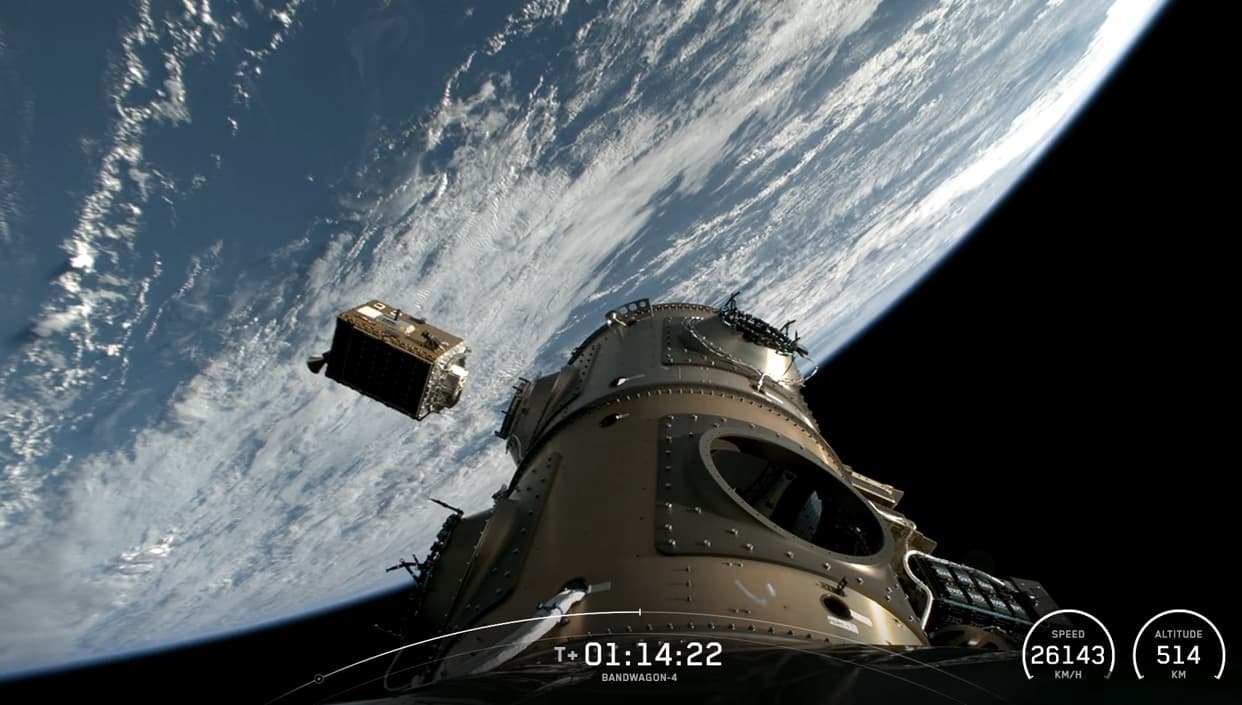
The demonstration satellite that made the case. A 60 kg spacecraft on Astro Digital's Corvus-Micro bus carrying the first data-center-class Nvidia H100 GPU to operate in space, launched November 2, 2025 on SpaceX's Bandwagon-4 rideshare. Within weeks it had run Google's Gemma model and trained nanoGPT in orbit, and it now runs inference on Capella Space radar data. One Nvidia A6000 GPU aboard failed during launch.
In orbit and operating since November 2025, running AI workloads and customer Earth-observation data. Official pages still present it as the flown H100 mission as of September 2026.
Mass60 kg
ComputeOne Nvidia H100 GPU
LaunchNovember 2, 2025, Falcon 9 Bandwagon-4 from Cape Canaveral
The first commercial mission: a GPU cluster with persistent storage and 24/7 access, plus an AWS server blade, bitcoin mining ASICs, and a pair of Starlink Mini Laser terminals. Waste heat, not power, is the binding constraint on dense orbital compute. Johnston told TechCrunch in August 2026 the near-term plan is two 8 kW Starcloud-2 satellites on 2027 rideshares for customers including US government agencies, rather than a single October 2026 launch. The official product page still targets full operation in sun-synchronous orbit by 2027.
October 2026 launch target slipped. Two 8 kW Starcloud-2 class satellites are now planned for 2027 rideshares, with full commercial operation in sun-synchronous orbit still targeted for 2027.
Power8 kW per satellite (company figure, August 2026), described earlier as roughly 100x Starcloud-1's power generation
ComputeNvidia Blackwell B200 GPUs, an AWS server blade, and bitcoin mining ASICs
Target LaunchTwo satellites on 2027 rideshares (was October 2026)
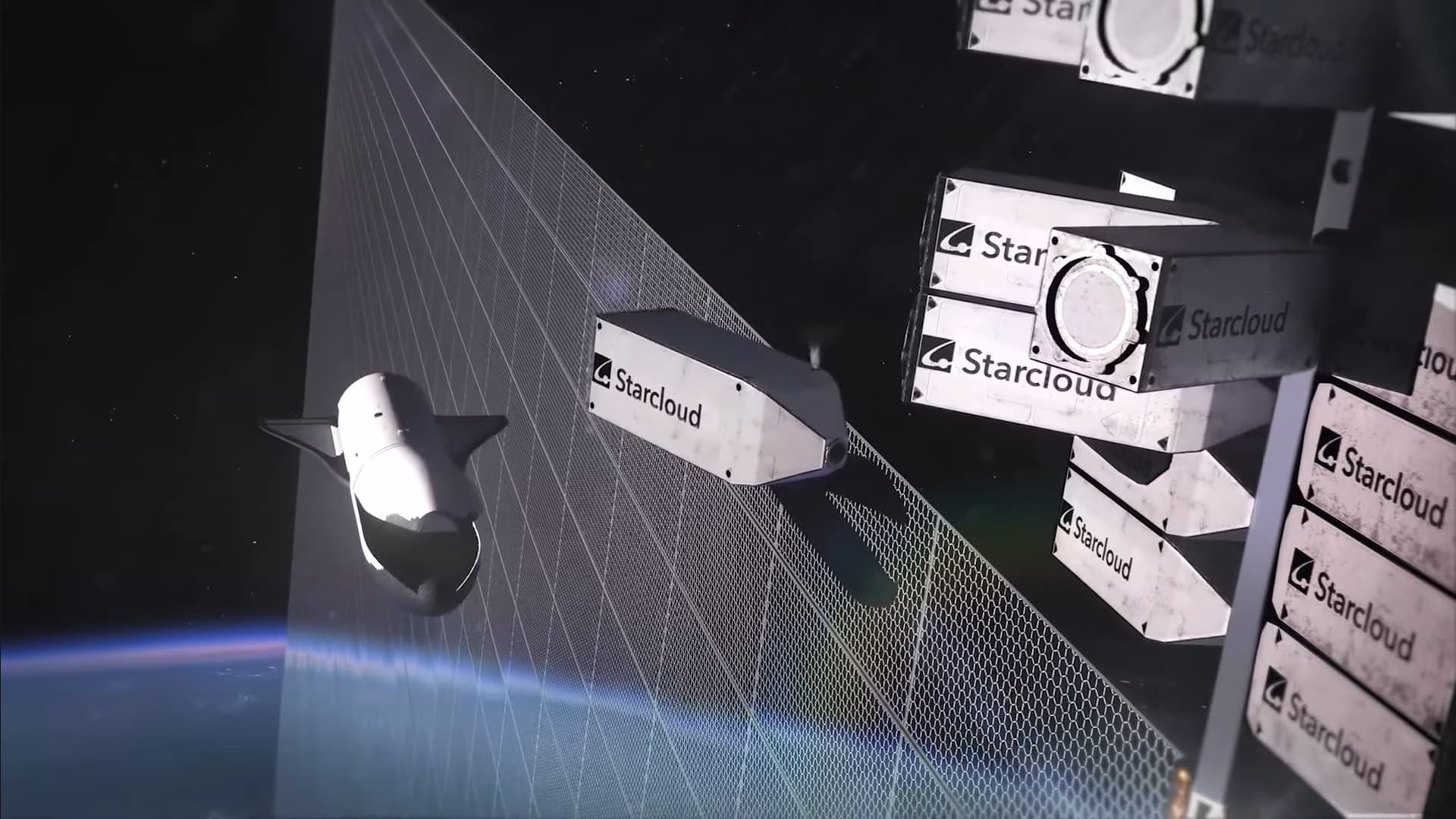
The design that is supposed to make orbital data centers cheaper than terrestrial ones: a 200 kW, roughly three-tonne spacecraft sized to fit the dispenser SpaceX built for launching Starlink satellites from Starship. Starcloud projects electricity costs near $0.05 per kilowatt-hour from it, but only if commercial Starship launch reaches roughly $500 per kilogram, which the company expects around 2028 to 2029.
In design. The August 2026 raise is explicitly for Starcloud-3 production lines at Woodinville and for booking launch. Still gated on commercial Starship around 2028 to 2029. Starcloud also hopes to fly Nvidia's still-unbuilt Vera Rubin Space-1 GPU on a late-2028 mission.
Power200 kW
Mass~3 tonnes
Target Energy Cost~$0.05 per kWh, contingent on $500/kg launch
A hosted lunar-orbit compute payload, not a free-flying Starcloud satellite. Firefly said SC-1L will fly on Elytra on Firefly's third lunar mission, targeted no earlier than 2028, ingest data from Firefly's Solux vision system, and remain in lunar orbit for five years after the Blue Ghost CLPS landing at the Gruithuisen Domes. Contract value was not disclosed. Starcloud has not posted its own product page.
Booked on Firefly Elytra NET 2028 per Firefly's September 30, 2026 release. Distinct from the two 8 kW Starcloud-2 LEO commercial satellites planned for 2027 rideshares.
What's Next
Launch Starcloud-2, the first commercial orbital data center
Starcloud-2 is now two 8 kW satellites on 2027 rideshares, each meant to carry a GPU cluster, an AWS server blade, bitcoin mining ASICs, and a pair of Starlink Mini Laser terminals. It is the first test of whether Starcloud can dissipate the waste heat that dense compute generates in vacuum, which is the engineering problem that decides whether any of the larger designs are possible. Johnston also said the company is considering a dedicated Falcon 9 to fly more spacecraft.
2027
Sell GPU capacity from orbit through Crusoe Cloud
Crusoe agreed in October 2025 to deploy Crusoe Cloud on a Starcloud satellite and offer limited GPU capacity from early 2027, which would make it the first cloud operator selling compute from space. That window now sits against a 2027 Starcloud-2 launch rather than a late-2026 deploy, and Crusoe has not restated the date since the slip.
2027
Bring Starcloud-2 to full commercial operation in sun-synchronous orbit
The official product page still targets full operation in 2027, in a sun-synchronous orbit that keeps the arrays in sunlight more than 95% of the time so the GPU cluster can run continuously rather than duty-cycled the way Starcloud-1 does. Persistent storage and 24/7 access are what would let it serve terrestrial customers rather than only other spacecraft.
2027
Build Starcloud-3, the 200 kW Starship-class node
The 200 kW, three-tonne Starcloud-3 is designed around Starship's Starlink dispenser and is the first design Starcloud claims could beat terrestrial data centers on energy cost, at roughly $0.05 per kWh. The August 2026 raise is meant to fund Woodinville production lines and launch bookings. It is still gated on commercial Starship at about $500 per kilogram, which Johnston expects in 2028 to 2029.
2028-2029
Fly Nvidia's Vera Rubin Space-1 GPU
Starcloud is sharing on-orbit H100 data with Nvidia as the chipmaker designs its first purpose-built space GPU, the Vera Rubin Space-1 module. The chip has not been built yet. Johnston told TechCrunch Starcloud hopes to fly it in late 2028.
Late 2028
Fly SC-1L compute payload on Firefly Elytra in lunar orbit
NET 2028
Track Record
0 of 1 announced date hit · 1 slipped
Launch Starcloud-2, the first commercial orbital data center
Target October 2026 · Resolved Aug 21, 2026
CEO Philip Johnston told TechCrunch on August 21, 2026 that the near-term plan is two 8 kW Starcloud-2 satellites on 2027 rideshares for customers including US government agencies, rather than a single October 2026 launch. The official Starcloud-2 page no longer states an October 2026 date and now only commits to full operation in sun-synchronous orbit by 2027.
Slipped
Operations & Revenue
StatusOperating; lunar Elytra payload booked NET 2028
Firefly on September 30, 2026 said Starcloud SC-1L will fly on Elytra on Firefly's third lunar mission, targeted no earlier than 2028, remaining in lunar orbit for five years after a Blue Ghost CLPS landing at the Gruithuisen Domes. Contract value was not disclosed. Starcloud.com has no own newsroom item; Wikipedia retrieved October 1 still omits SC-1L. Starcloud-1 remains the operating LEO satellite. The official Starcloud-2 page still targets full sun-synchronous operation by 2027. Y Combinator still says the second satellite launches in October 2026, which conflicts with Johnston's August 21 TechCrunch statement of two 8 kW 2027 rideshares.
Revenue Streams
Hosted Compute for Spacecraft Operators
The near-term business: processing data in orbit for other satellites instead of downlinking it. Starcloud-1 runs inference on Capella Space synthetic-aperture radar imagery, and the company says it holds committed contracts with Earth-observation operators. This is the revenue that exists before launch costs fall.
Cloud Capacity Through Platform Partners
Crusoe agreed in October 2025 to deploy Crusoe Cloud on a Starcloud satellite and offer limited GPU capacity from orbit starting in early 2027, making Starcloud a capacity supplier rather than the customer-facing cloud. That deploy window now sits against two Starcloud-2 rideshares in 2027 rather than a late-2026 launch. Nvidia, AWS, and Google Cloud are named strategic partners, with an AWS server blade planned for Starcloud-2.
Bitcoin Mining as a Revenue Bridge
Starcloud-2 carries bitcoin mining ASICs alongside its GPUs, intended to monetize power during periods of low AI utilization. It is an unusual hedge for a space company and an explicit acknowledgment that orbital AI demand will not be smooth in the first years.
Key Metrics
Employees
25 (company figure to TechCrunch, August 21, 2026); about-us page names 16 people as of October 1, 2026; Y Combinator still lists Team Size 12
Est. Annual Revenue
Pre-commercial. Starcloud had no publicly disclosed revenue as of September 2026. Starcloud-2 is still described as its first commercial mission, now two 8 kW satellites on 2027 rideshares, with Crusoe previously saying it would sell limited GPU capacity from early 2027. The company has told investors it expects Starcloud-2 to generate more cash than it costs to build and launch, which is a projection rather than a booked result.
Valuation
$2.3B post-money (Series A extension, August 21, 2026), up from $1.1B at the March 2026 Series A
Total Raised
~$450M across seed, Series A and an August 21, 2026 Series A extension
GPUs Flown
One Nvidia H100 on Starcloud-1, the first data-center-class GPU operated in space and roughly 100x the GPU compute previously flown
Orbital Firsts
First to run a Gemma model in space and first to train a language model in orbit, both December 2025
Constellation Filed
Up to 88,000 orbital data-center satellites, accepted for filing by the FCC on March 13, 2026; still an application, not a grant
Cost Threshold
Orbital compute becomes cost-competitive at roughly $500 per kg to orbit, which the company expects around 2028 to 2029 with frequent Starship flights
Starlink Optical Mesh
Contract for 50-plus Starlink Mini Laser terminals across 25-plus satellites (May 26, 2026), two per spacecraft, up to 25 Gbps out to 4,000 km
Lunar compute booking
SC-1L payload on Firefly Elytra, third lunar mission NET 2028; five years in lunar orbit; contract value undisclosed (Firefly, Sept 30, 2026)
Timeline
2026FCC accepts a filing for up to 88,000 satellites
On March 13, 2026 the FCC accepts for filing Starcloud's application to operate as many as 88,000 satellites across a range of low Earth orbits as orbital data centers. Like SpaceX's rival filing for up to one million compute satellites, the design leans on optical intersatellite links to broadband constellations such as Starlink, Amazon Leo, and Blue Origin's Tera Wave rather than its own ground network.
2026$170M Series A makes it the fastest unicorn in YC history
Starcloud closes a $170 million Series A on March 30, 2026 led by Benchmark and co-led by EQT Ventures at a $1.1 billion valuation, taking total funding to roughly $200 million. It is the fastest a Y Combinator company has reached a billion-dollar valuation, 17 months after demo day. Backers across the cap table include In-Q-Tel, Nvidia, Macquarie Capital, NFX, and Y Combinator, plus angels including former Boeing CEO Dennis Muilenburg and retired US Air Force General Stephen Wilson.
2026Orders 50-plus Starlink Mini Lasers for the orbital mesh
In late May 2026 Starcloud contracts for more than 50 Starlink Mini Laser terminals across 25-plus satellites, two terminals per spacecraft, for optical links of up to 25 Gbps out to about 4,000 km. The first pair is slated for Starcloud-2, giving the orbital compute nodes a path onto Starlink's mesh rather than building their own ground network.
2026$250M Series A extension at $2.3B; Starcloud-2 slips to 2027
On August 21, 2026 Starcloud adds a $250 million Series A extension led by Manhattan West, with Nvidia and Cisco Investments among new backers, at a $2.3 billion post-money valuation and about $450 million raised in total. CEO Philip Johnston tells TechCrunch the company is standing up production lines at a 100,000-square-foot site in Woodinville, Washington, and that the next generation is now two 8 kW Starcloud-2 satellites on 2027 rideshares for customers including US government agencies, rather than a single October 2026 launch.
2026Books SC-1L on Firefly Elytra for lunar-orbit demo
On September 30, 2026 Firefly said Starcloud's SC-1L compute payload will fly on Elytra to demonstrate high-power AI computing in lunar orbit, ingesting data from Firefly's Solux vision system. The payload is being added to Firefly's third lunar mission, targeted no earlier than 2028, with Elytra remaining in lunar orbit for five years after the Blue Ghost CLPS landing. Firefly did not disclose the contract value.
2025Renamed Starcloud after a trademark challenge
In March 2025 the company drops the Lumen Orbit name following a legal challenge from Lumen Technologies and rebrands as Starcloud, raising additional seed capital that takes the total to roughly $34 million.
2025Crusoe signs on as the first cloud operator in space
Announced October 22, 2025, Crusoe agrees to deploy its Crusoe Cloud platform on a Starcloud satellite, making it the first cloud provider to offer capacity from orbit. The deployment is planned for late 2026 with limited GPU capacity sold to customers from early 2027.
2025Starcloud-1 puts the first H100 in orbit
A Falcon 9 lifts off from Cape Canaveral at 1:09 a.m. ET on November 2, 2025 on the Bandwagon-4 rideshare, deploying Starcloud-1 among 18 payloads. The 60 kg satellite, roughly the size of a mini fridge and built on Astro Digital's Corvus-Micro bus, carries the first data-center-class Nvidia H100 GPU ever operated in space, about 100 times the GPU compute previously flown. Contact is established after separation and the spacecraft enters nominal operations.
2025First language model trained in orbit
In December 2025 Starcloud becomes the first to run a version of Google's Gemma model on a GPU in space and the first to train a language model in orbit, using Andrej Karpathy's nanoGPT. The satellite also begins running inference on Capella Space synthetic-aperture radar data, the use case that turns orbital compute into a service other spacecraft can buy.
2024Founded as Lumen Orbit and admitted to Y Combinator
Philip Johnston (ex-McKinsey, where he worked with national space agencies), Ezra Feilden (ex-Airbus Defence and Space), and Adi Oltean (ex-SpaceX and Microsoft) found the company in January 2024 in El Segundo, California, then move to Redmond, Washington in February to be near the region's space and cloud infrastructure talent. It goes through Y Combinator's Summer 2024 batch and raises roughly $10 million in seed funding.
Funding
Cumulative disclosed raise · dated rounds
Round
Date
Amount
Investors
Source
Seed
2024
~$10M
Y Combinator (Summer 2024 batch) and others
Seed extension
March 2025
~$24M
In-Q-Tel, NFX, Plug and Play, Soma Capital, Andreessen Horowitz and Sequoia scout funds; takes seed funding to roughly $34M in total
Manhattan West (lead), with new investors Nvidia, Cisco Investments, Cedar Capital, Goanna Capital and Standard Capital joining existing backers Benchmark, EQT Ventures, Soma Capital, NFX and 776; $2.3B post-money valuation, bringing total raised to ~$450M