
ICEYE
Rafal Modrzewski
Data verified as of Sep 18, 2026
Summary
ICEYE is a Finnish synthetic aperture radar (SAR) satellite manufacturer and operator, founded in 2014 as an Aalto University spin-off, that flies the world's largest SAR constellation and sells both commercial imagery and turnkey sovereign ISR systems. The company has launched 76 SAR satellites since 2018, images at up to 16 cm on Generation 4 spacecraft, and in 2025 posted unaudited revenue above EUR 250 million, EBITDA above EUR 100 million, and a contracted backlog above EUR 1.5 billion. Its commercial model has shifted from data-as-a-service into selling complete national constellations: Poland's four-satellite POLSARIS system went from contract to operational handover in under 12 months in May 2026, seven European governments have procured sovereign ICEYE systems, and a Rheinmetall joint venture holds a roughly EUR 1.7 billion Bundeswehr reconnaissance contract that ICEYE's CEO has described as a 40-satellite, in-country build. A June 2026 Series F led by General Atlantic valued the company above EUR 10 billion on EUR 450 million of primary capital (more than EUR 1 billion including secondary), and ICEYE is doubling production from 50 satellites a year toward 100 by the end of 2027. In September 2026 ESA selected the ICEYE-led ARISE consortium to design Europe's Earth Observation Governmental Service architecture, ICEYE US won a NOAA environmental-monitoring IDIQ seat after an August NRO Radar Commercial Augmentation award, and the company signed an Ariane 6 launch MoU with Arianespace as it opened national entities from Germany and Portugal to India and Korea.
Company OverviewRead the long-form profile of ICEYEMain Products
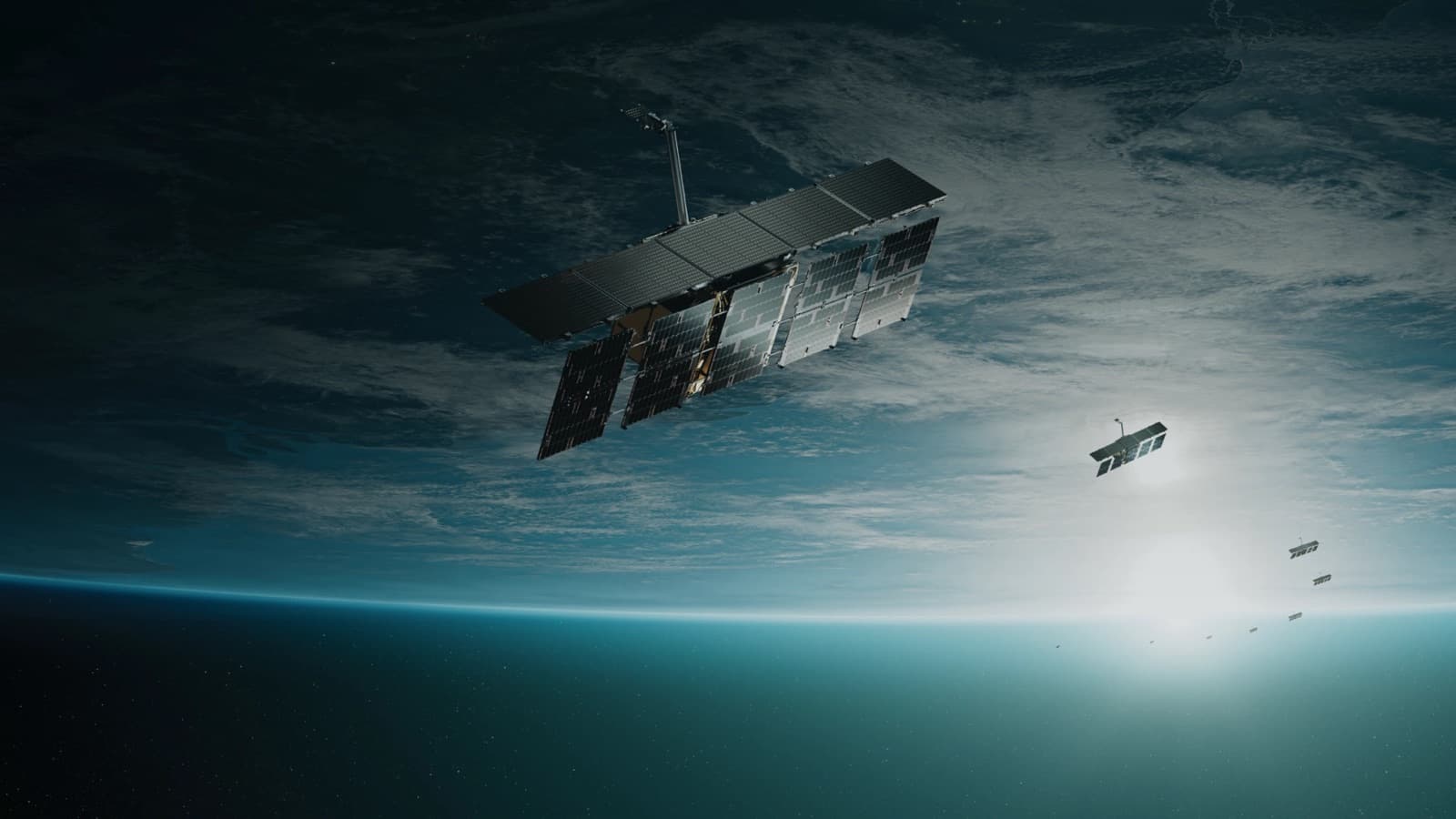
The world's largest commercial synthetic aperture radar constellation, imaging through clouds, smoke, and darkness from roughly 500-600 km sun-synchronous orbits. ICEYE sells tasking, archive, and derived products from its own fleet and uses the same buses for customer-owned national missions. Imaging modes run from wide Scan (scenes up to about 120,000 km2) down to Dwell Precise at 25 cm or 16 cm on Gen4, with claimed global revisit under six hours and sub-15-minute revisit on a dense constellation.
76 satellites launched as of July 7, 2026. ICEYE continues to add Gen4 spacecraft on SpaceX rideshares and is targeting 100 satellites produced per year by the end of 2027. No launch after Transporter-17 had been announced as of September 18, 2026.
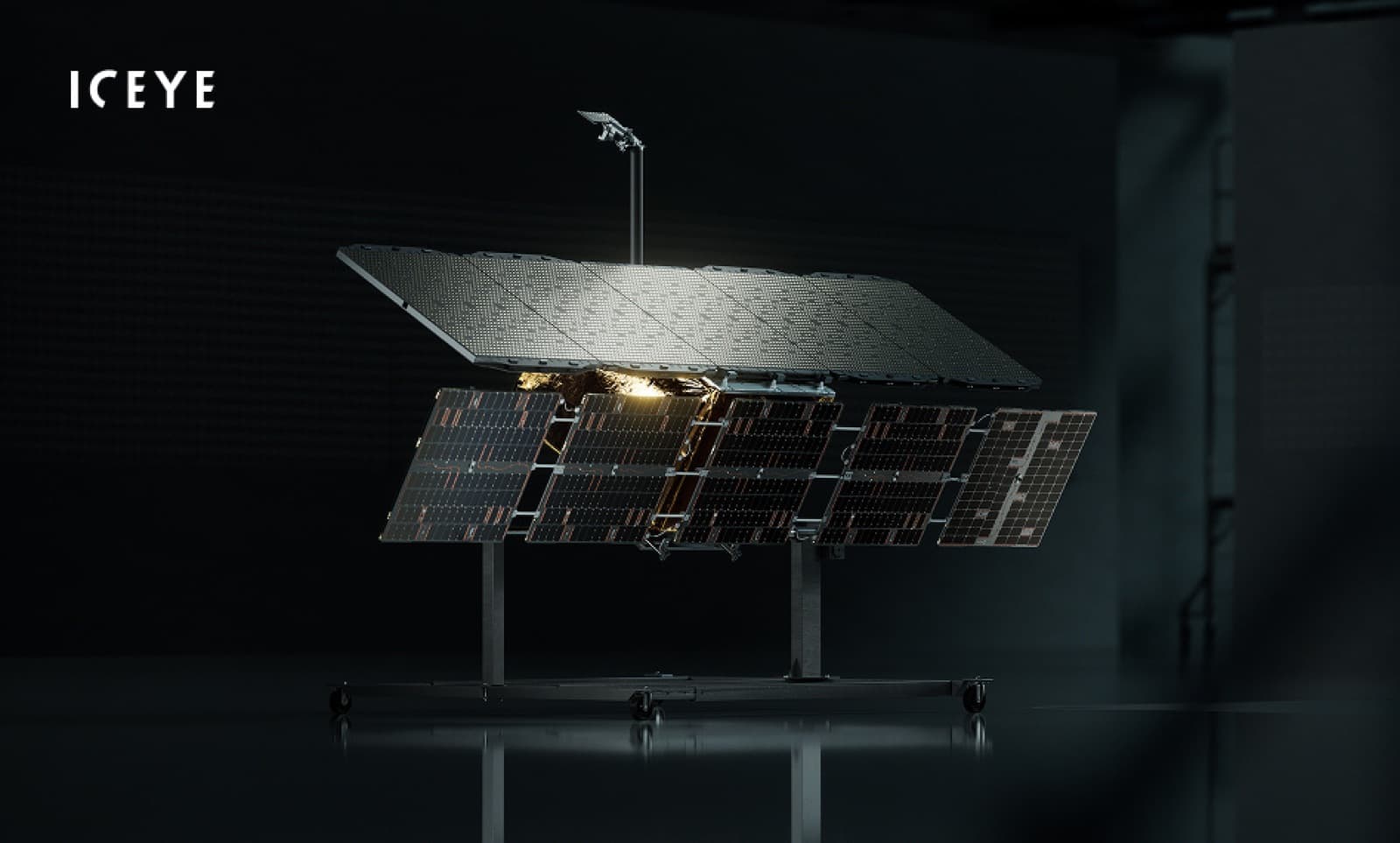
ICEYE's current production SAR bus, designed for mass manufacture and sovereign missions. Gen4 doubles antenna size and signal strength versus prior generations, images at up to 16 cm, covers a 400 km high-resolution field of regard, and downlinks at up to 700 Mbps on a steerable antenna. The satellites are software-defined (IceOS) and ITAR-free, which is central to ICEYE's European and allied government pitch.
In commercial and sovereign operation. A Gen4 spacecraft flew on Transporter-17 in July 2026. ICEYE says a full Gen4 mission system can be operational 12 months after contract.
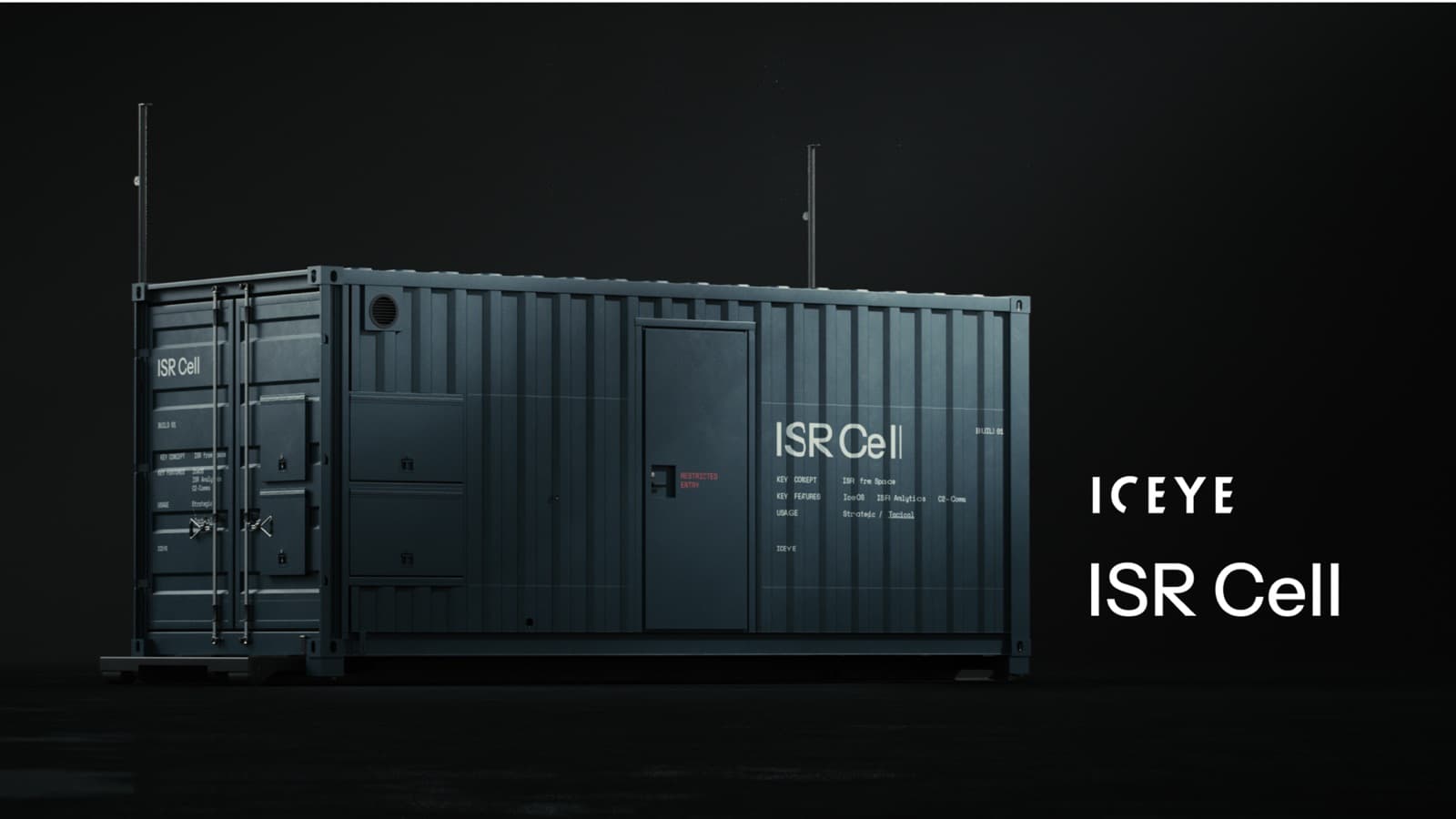
An end-to-end intelligence, surveillance, and reconnaissance stack: customer-owned Gen4 satellites, on-prem processing, IceOS mission software, automated target recognition, and a deployable ISR Cell that runs the full tasking-to-dissemination loop from a single container. ICEYE says processing a Dwell Fine image takes under 15 seconds and that the ISR Cell can operate if the main ground segment is knocked out. The system is sold as NATO-interoperable and is described as battle-tested with Ukrainian forces since 2022.
Fielded with European sovereign customers and exercised with NATO units since 2024. Poland's POLSARIS handover in May 2026 is the reference 12-month sovereign deployment. Federation across allied national fleets is the upsell: ICEYE says a four-satellite national fleet can tap 50+ satellites of allied capacity without giving up ownership.
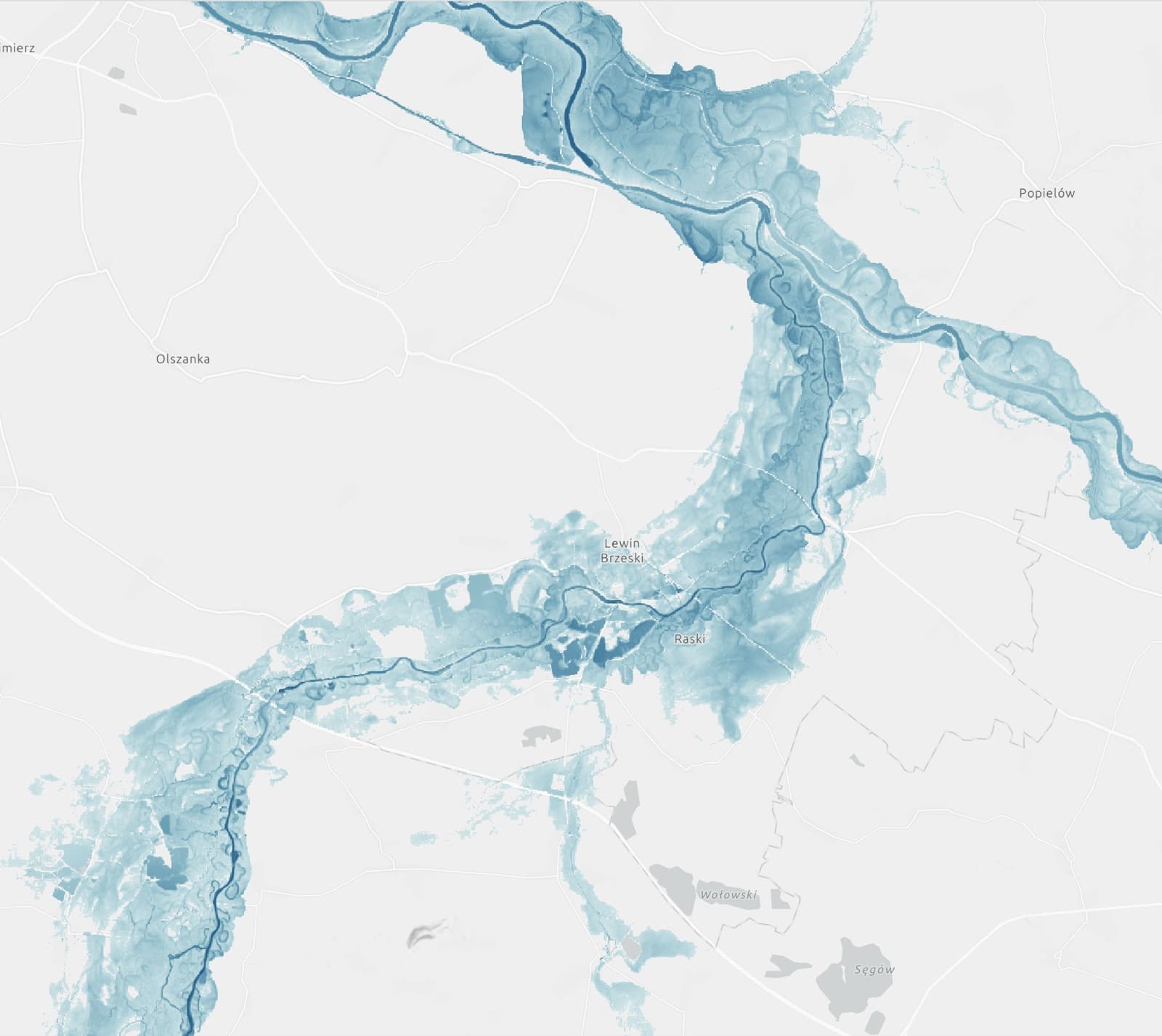
ICEYE's flagship natural-catastrophe product: SAR-derived flood extent, depth, and duration at building level, delivered as GIS layers and APIs for insurers, reinsurers, and emergency agencies. The same SAR stack supports wildfire building-level damage and hurricane rapid-impact maps. Unlike modelled flood surfaces, ICEYE sells observed water from its own constellation, including through cloud cover at night.
Commercially deployed with insurers including Swiss Re, Tokio Marine, and Sompo Japan (contract announced September 7, 2026). Government and utility users include Norway's NVE, Iberdrola, and a growing list of emergency-management agencies. An August 2026 partnership with The Water Institute adds the FloodID predictive platform to ICEYE's US flood stack.
What's Next
Ramp production to 100 satellites a year
ICEYE is manufacturing about 50 SAR satellites a year and has said repeatedly in mid-to-late 2026 that it is targeting 100 a year, about two satellites a week, by the end of 2027. CEO Rafal Modrzewski reaffirmed that cadence in a September 2026 SpaceNews interview, citing EUR 1.5 billion of backlog. Watch whether launched volume in 2027 actually doubles 2026's pace (14 launched through early July 2026) and whether the Espoo line plus in-country assembly in Germany, Japan, and Portugal can hold that rate.
Start German JV satellite production and deliver the Bundeswehr constellation
Rheinmetall ICEYE Space Solutions is scheduled to begin producing the first joint-venture SAR satellites in Neuss in Q3 2026 under the December 2025 SPOCK 1 contract. In September 2026 CEO Rafal Modrzewski said ICEYE signed a 40-satellite German Armed Forces constellation in mid-December 2025, to be built in-country and delivered in two years, which would put spacecraft in German service around late 2027. Watch for a first Neuss-built launch and whether the EUR 1.7 billion data-service contract converts into publicly counted satellites on orbit.
Launch the remaining IHI Japan pair
IHI's first two ICEYE-built SAR satellites were operational and delivering imagery by May 28, 2026. The remaining two of the initial four-satellite order were to be assembled and tested in Japan in summer 2026 for a launch scheduled in the first quarter of 2027. If the demonstration holds, IHI plans to exercise options toward a 24-satellite constellation by fiscal 2029.
Deliver the Swedish Armed Forces SAR system
The January 2026 FMV contract covers ICEYE satellites, data, software, and ground systems that Sweden will own and operate. Independent reporting puts the package at about 10 satellites and SEK 1.3 billion (about $142 million), with deliveries between 2026 and 2028. Watch for a first Swedish launch and whether the Nordic/Arctic ISR mission is federated with Finland's already-flying ICEYE satellites.
Deliver the ESA ARISE Earth Observation Governmental Service architecture study
On September 17, 2026 ESA selected ICEYE-led ARISE (Indra Space, Rheinmetall, HISDESAT, Starion, T-Systems, SafranAI, RISS, Creotech, CTI Aeroespacial, plus OroraTech and Unseenlabs as consultants) for a 12+8 month study that will define space, ground, user, CONOPS, security, and governance for the EU Earth Observation Governmental Service. Results are meant to inform EOGS implementation under the 2028-2034 EU budget. This is an architecture study, not a constellation contract.
Turn the Arianespace MoU into booked Ariane 6 launches
The September 9, 2026 MoU with Arianespace is an agreement to discuss booking Ariane 6 for European governmental ICEYE missions, not a firm launch contract. ICEYE still rides SpaceX Transporter missions for most spacecraft. A paid Ariane 6 manifest would be the first large European launch path for the production ramp.
Operations & Revenue
ICEYE is a profitable private SAR manufacturer and constellation operator headquartered in Otaniemi, Espoo, with more than 1,000 employees. It has launched 76 satellites as of July 7, 2026, is producing about 50 a year, and is targeting 100 a year by the end of 2027. Seven European governments have bought sovereign ICEYE systems, with Poland's POLSARIS constellation already in independent military operation. The Rheinmetall joint venture's German reconnaissance contract is the largest, with first JV satellites due into production in Neuss in Q3 2026. ICEYE US holds an NRO Radar Commercial Augmentation contract (base year through July 2027) and a NOAA SBEM IDIQ seat. ESA selected ICEYE-led ARISE on September 17, 2026 to design the EU's Earth Observation Governmental Service architecture. No launches have been announced after Transporter-17 as of September 18, 2026.
Revenue Streams
Turnkey, ITAR-free SAR constellations sold to governments as owned-and-operated systems, including satellites, mission ground segment, training, software updates, and optional ISR Cells. Poland, Portugal, the Netherlands, Greece, Finland, Sweden, and Germany are the named European buyers; IHI in Japan has an initial four-satellite order with a 20-satellite option toward 24 by fiscal 2029. ICEYE says a full system can go from contract to operations in 12 months.
SAR data, tasking, and US government imagery
Commercial and government tasking of ICEYE's own constellation, including Tactical Access (guaranteed slots, sub-hour delivery, optional in-country EDGE processing), NATO Situation Centre and Allied Command Operations data supply, and ICEYE US contracts with the NRO (Radar Commercial Augmentation) and NOAA (SBEM IDIQ). Customers can buy capacity without owning spacecraft.
Natural catastrophe intelligence
Flood Insights, wildfire, and hurricane products that turn SAR collections plus auxiliary data into building-level depth, extent, and damage layers for insurers, reinsurers, and emergency agencies. Named customers and partners include Swiss Re, Tokio Marine, Sompo Japan (September 2026), Iberdrola, Norway's NVE, KT SAT in Korea, and The Water Institute on predictive flood intelligence.
Key Metrics
- Employees
- 1,000+
- Est. Annual Revenue
- Unaudited 2025 revenue above EUR 250 million with EBITDA above EUR 100 million. ICEYE said it doubled in 2025 and is set to grow at a similar rate in 2026. Around those results, Bloomberg reported ICEYE targeting $1 billion of revenue the following year. 2026 figures have not been reported as of September 18, 2026. The company is private and the 2025 numbers are unaudited.
Timeline
On January 12, 2026 the Swedish Defence Materiel Administration (FMV) signs a multi-year contract for ICEYE SAR satellites, data, software, and ground systems that the Swedish Armed Forces will own and operate, aimed at all-weather ISR across the Nordics, the Arctic, and NATO's north-eastern flank.
On March 12, 2026 ICEYE reports unaudited 2025 results: revenue above EUR 250 million, EBITDA above EUR 100 million, cash above EUR 350 million, cash from operations above EUR 130 million, and a contracted backlog of EUR 1.5 billion. Management says the company doubled in 2025 and is set to grow at a similar rate in 2026.
On May 15, 2026 ICEYE hands Poland's MikroSAR radar reconnaissance system to the Polish Armed Forces, less than 12 months after the roughly EUR 200 million May 2025 contract. Four SAR satellites are on orbit as POLSARIS, Polish military operators run the constellation independently under ARGUS, and ICEYE cites the program as among the fastest sovereign space deployments on record.
On June 9, 2026 ICEYE raises EUR 450 million of primary Series F capital led by General Atlantic at a valuation above EUR 10 billion (about $12 billion). Solidium, Tesi, Varma, Ilmarinen, Lifeline Ventures, Nokia, QIA, and TCV participate; including secondary the round exceeds EUR 1 billion. Proceeds fund global expansion and a production ramp from 50 satellites a year toward 100.
On July 7, 2026 four more SAR satellites reach orbit on SpaceX Transporter-17, taking ICEYE's launched total to 76, including a Gen4 commercial spacecraft, ICEYE US-supported national-mission satellites, and the Finnish Defence Forces' third satellite. The company says production is doubling from 50 satellites a year to a target of 100 annually by 2027.
On August 5, 2026 the US National Reconnaissance Office awards operational Radar Commercial Augmentation contracts to Capella Space, ICEYE US, and Umbra after a multi-year Commercial Radar Capabilities evaluation. The one-year base runs through July 31, 2027 with two option years; values were not disclosed. ICEYE US is to deliver tasking, archive imagery, and derived products to the US intelligence community and Department of War.
Between July and August 2026 ICEYE establishes or staffs national entities in Germany (Philipp Herkelmann), Portugal (Rui Costa, Lisbon centre of excellence), India, the Netherlands (Amsterdam, tied to the Royal Netherlands Air and Space Force), and Korea (Eric Rhee), and names Christos Kolimenakis CEO of ICEYE UAE. The company presents the wave as the next stage of sovereignty: building satellites and supply chains in the customer's country, not only selling imagery.
On September 9, 2026 ICEYE and Arianespace sign an MoU to explore Ariane 6 launches for European government missions. On September 15 ICEYE US is selected under NOAA's Space-Based Environmental Monitoring IDIQ for flood, sea ice, and disaster monitoring. On September 17 ESA selects the ICEYE-led ARISE consortium (Indra Space, Rheinmetall, HISDESAT and others) for a 12+8 month architecture study of the EU Earth Observation Governmental Service, funded for the European Commission under European Resilience from Space.
On December 5, 2025 ICEYE closes a EUR 150 million Series E led by General Catalyst, plus a EUR 50 million secondary, at a EUR 2.4 billion valuation, and says it has launched 62 satellites. Generation 4 satellites reach 16 cm resolution, production is running toward one satellite a week, and ICEYE is a SAR data provider to NATO's Situation Centre and Allied Command Operations.
On December 18, 2025 Rheinmetall ICEYE Space Solutions, a joint venture based in Neuss, wins a roughly EUR 1.7 billion gross order from BAAINBw to supply the German Armed Forces with exclusive SAR reconnaissance data through 2030, with options that can take the total above EUR 2.7 billion. The constellation stays JV-owned; first joint-venture satellites are scheduled to enter production in Q3 2026.
ICEYE unlocks 25 cm resolution imaging and signs landmark sovereign contracts, including a two-satellite deal with Greece's Hellenic Space Center, the Greek Ministry of Digital Governance, and ESA. A Solidium-led growth round plus a year-end extension take 2024 fundraising to $158 million.
In August 2022 ICEYE signs a contract that gives Ukraine's armed forces access to a SAR satellite, its first major defence partnership and a live demonstration that commercial radar can support tactical operations. The same year it expands from selling imagery to selling complete satellite missions that governments can own and operate.
On January 12, 2018 ICEYE-X1, a roughly 70 kg radar satellite, reaches orbit on an ISRO PSLV from Satish Dhawan, becoming both the world's first SAR satellite under 100 kg and Finland's first commercial satellite. ICEYE-X2 follows on a Falcon 9 in December 2018.
Funding
Cumulative disclosed raise · dated rounds