Amazon Leo - Amazon's satellite division, launched as Project Kuiper in 2019 and rebranded November 13, 2025 - is a low Earth orbit broadband network for customers and communities beyond the reach of existing terrestrial infrastructure.
Led by VP Rajeev Badyal from Redmond, Washington, it combines thousands of satellites built at a Kirkland factory (up to five per day), a global ground network integrated with AWS, and a three-terminal hardware lineup: Leo Nano, Leo Pro, and Leo Ultra. The enterprise beta went live April 8, 2026 with partners including Verizon, AT&T, Vodafone, JetBlue, and NASA; after ULA's final Atlas V flight (LA-08) on July 2, 2026, about 396 production satellites are in orbit and Amazon says it has enough capacity to open commercial service in late 2026, though it is still waiting for satellites to reach assigned ~600 km operating orbits. No Leo mission has flown since July 2 as of October 18, 2026. On September 9, 2026 AT&T Business said it is the first major U.S. telecom to fold Amazon Leo into a single managed architecture with its fiber and 5G networks for enterprise and public-sector customers, with pricing and availability still to come after a phased reliability deployment. On September 22, 2026 Amazon named Uztelecom affiliate UZ-SAT as an authorized Leo distributor in Uzbekistan. The FCC granted a waiver June 5, 2026 for missing the July 30 50%-deployment milestone (1,618 of 3,236 satellites), imposing a temporary spectrum-priority reduction on post-July-30 satellites until March 2028. With Vulcan Centaur and New Glenn still grounded, Amazon on September 9, 2026 ordered six more Ariane 64 launches from Arianespace - taking that contract from 18 to 24 missions, with the new flights starting in 2029 and running through 2031. Arianespace on October 14, 2026 set VA271/LE-04, 36 satellites on Ariane 64, no earlier than November 23, with the final window still unset and the mission not flown. ULA has not posted a Vulcan LV-01 date. The Uzbekistan page, rechecked October 18, still describes a private preview and initial service later this year, with no public price or named opening market. The $11.57B Globalstar acquisition (expected to close 2027) adds direct-to-device capability, Delta signed for a 500-aircraft Wi-Fi rollout beginning 2028, and a July 2026 deal makes South Africa's Herotel the first African ISP to distribute Leo residential service ('evry, powered by Amazon Leo', launching 2027).
Reapply for India satcom authorization under the Telecom Act
Mint reported September 9, 2026 that India's Department of Telecommunications cancelled Amazon Leo's pending GMPCS application under the new Telecom Act 2023 authorization regime, so the company must file a fresh request before it can offer satellite broadband in India. Starlink, OneWeb and Jio already hold licenses and will migrate later. Watch for a new DoT filing and any last-mile distribution partner, after Mint said Amazon Leo has been scouting partners including Tata's Nelco.
Sustain an aggressive 2026-2027 launch cadence toward the 50% milestone
After the July 2, 2026 LA-08 mission (ULA's final Atlas V 551) lifted the production fleet to about 396 satellites, Amazon has not flown another Leo mission as of September 19, 2026. Cadence for the rest of 2026 still depends heavily on two grounded rockets: ULA's Vulcan Centaur, which was to fly its first Leo mission (LV-01, ~40-45 satellites) around September 2026, has been grounded since a recurring GEM 63XL solid-rocket-booster nozzle anomaly on the February 12, 2026 USSF-87 mission, and in August 2026 Blue Origin traced New Glenn's May pad explosion to a separate, shared BE-4 engine main-oxygen-valve defect that also requires a retrofit on Vulcan's BE-4 engines before ULA can return to flight - the company still targets before end of 2026 but has not confirmed a date; and Blue Origin's New Glenn, grounded since its first stage exploded during a May 28, 2026 static-fire test at LC-36, is retrofitting BE-4 engines and rebuilding launch access via a simplified wheeled-transporter-and-crane method rather than the destroyed pad infrastructure, still targeting return to flight before end of 2026. On September 9, 2026 Amazon added six Ariane 64 missions (18 to 24 total, new flights from 2029 through 2031), a longer-dated capacity add rather than a 2026-2027 cadence fix. Independent trackers list the next Ariane 6 flight (LE-04) no earlier than October 7, 2026 (date TBD). Near-term cadence still leans on remaining Ariane 6 slots and Falcon 9. Reaching the 1,618-satellite 50% threshold would recover the spectrum priority temporarily lost by missing the July 30, 2026 FCC deployment milestone.
Transition from enterprise beta (live since April 8, 2026) to limited commercial service by the end of 2026. Amazon's September 22, 2026 Uzbekistan announcement said the company is testing with employees and select enterprise customers in a private preview and still expects to begin rolling out initial service in certain locations later this year. At the September 9-10 Paris International Space Summit, Amazon Leo vice president Chris Weber still said the company plans to begin limited commercial service by year-end despite launch-vehicle issues that have slowed deployment. Amazon told PCMag in early September 2026 that it is still waiting for satellites to reach assigned operating orbits around 600 km; astronomer Jonathan McDowell said only 299 of the roughly 396 deployed satellites were in operational orbit, with most of the rest expected by November. No satellites have launched since July 2 and Vulcan Centaur and New Glenn remain grounded, which is a risk to that year-end window. On September 9, 2026 AT&T Business separately said it would sell Leo as part of a managed fiber, 5G and satellite offer, with pricing and availability still unannounced after a phased reliability deployment.
UZ-SAT, a Uztelecom subsidiary, is now an authorized Amazon Leo distributor for Uzbekistan. Watch for service launch dates, terminal mix, and pricing as Amazon still runs a private preview and targets initial commercial service in some locations later this year.
Demonstrate multi-vendor interconnectivity for the Space Force's Space Data Network
TargetQ1-Q2 2027 (6-9 month demo)
Amazon Leo for Government is one of five companies - alongside Lockheed Martin, Northrop Grumman, Rocket Lab, and York Space Systems - that the U.S. Space Force's Space Systems Command awarded $60M total ($12M each) on August 13, 2026 to demonstrate how satellites from multiple vendors can connect to its Space Data Network, the military communications architecture whose core backbone SpaceX builds. Each award splits across a fixed-price prototype contract to test interconnectivity across the SDN backbone and an OTA agreement to seed development of Space Exchange Point satellites, with six-to-nine-month periods of performance. As of September 10, 2026 neither Space Force nor Amazon has published demo results or a later award, so the original 6-9 month window still points to Q1-Q2 2027.
Close the $11.57B Globalstar acquisition and integrate D2D capabilities
Complete the Globalstar transaction (announced April 14, 2026 at ~$11.57B / $90 per share, expected to close 2027) and fold Globalstar's 100+ country spectrum licences, Band 53/n53 spectrum, 24 LEO satellites, and direct-to-device expertise into an advanced Amazon Leo D2D network planned for 2028 - while preserving Globalstar's support of Apple's Emergency SOS service. On July 24, 2026, Amazon Leo filed an application with the FCC seeking authorization for a 5,105-satellite Direct-to-Device constellation flying in five orbital shells between 510 and 580 km using L-band and S-band spectrum tied to the Globalstar deal, putting a concrete satellite count and spectrum plan behind the 2028 D2D target. The US antitrust (HSR) waiting period on the Globalstar merger expired July 17, 2026; the deal remains under review at the FCC (GN Docket 26-134) and other international/foreign-investment regulators as of September 19, 2026, with a single petitioner (Yippy, Inc., citing an unrelated contract dispute) opposing the FCC license transfer, and closing still also conditioned on Globalstar achieving certain HIBLEO-4 replacement-satellite milestones.
Begin installing Amazon Leo hardware on 500 Delta Air Lines aircraft for a 2028 rollout and on selected JetBlue aircraft for 2027 - together covering two of the U.S.'s largest carriers with next-generation in-flight connectivity powered by Leo and integrated with AWS services. Blue Origin's New Glenn, grounded since its May 28, 2026 pad explosion, was slated to fly a large share (12+15-option missions) of the remaining Leo constellation buildout; as of September 19, 2026 Amazon has not revised the Delta/JetBlue timelines, but New Glenn's continued grounding is a risk to the satellite density needed to support both rollouts on schedule.
AT&T Business and Amazon Leo said they will fold Leo LEO broadband into AT&T's fiber and 5G networks as one managed architecture for U.S. enterprise and public-sector customers. Watch for pricing, availability and product configurations after the phased reliability deployment, and whether AT&T remains the first major U.S. carrier to sell Leo that way.
Amazon executives told Ars Technica the Kirkland factory has manufactured its 1,000th Leo satellite and can now build 27 a week, up from 27 in the first six months. VP Chris Weber said 396 satellites are in orbit and still raising, with initial commercial service still planned in 2026. Rajeev Badyal said Amazon is weeks away from a Vulcan launch, then Arianespace and at least one more Vulcan this year.
Amazon Leo said UZ-SAT, a subsidiary of Uzbekistan's state telecom Uztelecom, will be an authorized distributor, bringing Leo satellite internet to remote mountain and desert communities that fiber cannot reach economically. The companies announced the deal at the Tashkent International Investment Forum during ICT Week 2026. Amazon said it has launched nearly 400 satellites, is running a private preview with employees and select enterprise customers, and still expects initial service in some locations later this year.
United Launch Alliance is preparing to return Vulcan to flight on an Amazon Leo mission, but Space Systems Command will run a separate review of data from that commercial launch before putting the rocket back on the national security manifest, a senior Space Force acquisition official said at the AFA conference in National Harbor on September 16. Vulcan has been barred from national security missions since a Northrop Grumman GEM 63XL solid rocket booster nozzle anomaly on the February 12 USSF-87 flight, the second booster nozzle failure on the vehicle since its second test flight in October 2024. The pause has left SpaceX as the only provider actively flying National Security Space Launch payloads, and trackers still list the first Vulcan Amazon mission, LV-01, as no earlier than late September.
Mint reported September 9, 2026 that India's Department of Telecommunications cancelled Amazon Leo's pending GMPCS application under the new Telecom Act 2023 authorization regime, so the company must file a fresh request. An official said DoT is not bound to notify applicants of the cancellation. Starlink, OneWeb and Jio already hold licenses and will migrate later; Amazon Leo is also scouting last-mile partners in India and did not comment.
AT&T Business said on September 9, 2026 it has agreed a strategic partnership with Amazon Leo to offer low Earth orbit satellite broadband to U.S. enterprise and public-sector customers, becoming the first major U.S. telecom to combine Leo with its fiber and 5G networks as one managed architecture. The companies are running a phased deployment to validate business-grade reliability before wider availability. Pricing, availability and specific product configurations will be announced in the coming months.
Arianespace said Amazon Leo ordered six more Ariane 64 launches, lifting that contract from 18 missions to 24 through 2031. The add-on was announced at the International Space Summit in Paris. Arianespace has already flown three Ariane 6 missions for Leo in 2026, placing 100 satellites into orbit.
Amazon told PCMag it is still waiting for Leo satellites to reach assigned operating orbits around 600 km before opening commercial service, missing the mid-2026 target CEO Andy Jassy had set. Astronomer Jonathan McDowell said only 299 of the roughly 396 deployed satellites have reached operational orbit, with most of the rest expected by November. Amazon said it is expanding closed-beta testing with employees and select enterprise customers and did not give a new public launch date.
Bloomberg reported September 3, 2026 that Blue Origin has hired at least 47 veterans of Amazon's Leo satellite venture over the past year, many now working on TeraWave, Blue Origin's planned enterprise-focused constellation. Recruits include satellite-testing, networking, avionics, radio, optical and software engineers, plus a TeraWave recruiting director and at least two vice presidents who left Amazon Leo since March. Neither company commented. TeraWave is seeking FCC authority for thousands of satellites, with first deployments targeted around late 2027.
The U.S. Space Force's Space Systems Command awarded $60 million on August 13 to five companies, Amazon Leo for Government, Lockheed Martin, Northrop Grumman, Rocket Lab and York Space Systems, to demonstrate how satellites from multiple vendors can connect to its Space Data Network, the military communications architecture whose core backbone is built by SpaceX. Each company received $12 million split across a fixed-price prototype contract to test multi-vendor interconnectivity across the SDN backbone and an OTA agreement to seed development of Space Exchange Point satellites, with six-to-nine-month periods of performance.
Amazon Leo filed an application with the FCC on July 24 seeking authorization for a 5,105-satellite direct-to-device constellation that would deliver voice, messaging, data, and emergency connectivity straight to standard smartphones and IoT devices. The satellites would fly in low Earth orbit between 510 and 580 km using spectrum tied to Amazon's pending Globalstar acquisition, with deployment planned to begin in 2028 alongside Amazon Leo's existing broadband network. The filing puts Amazon in more direct competition with SpaceX's Starlink Direct to Cell service.
Amazon said on July 2 that it has now deployed enough satellites to begin offering commercial Leo broadband service later in 2026, after a United Launch Alliance Atlas V added 29 spacecraft to bring the low-Earth-orbit constellation to roughly 396 satellites. The milestone moves Amazon closer to competing directly with SpaceX's Starlink, which operates about 10,000 satellites and serves more than 12 million customers. Amazon plans an eventual fleet of more than 3,000 satellites and has lined up launches with ULA, Arianespace, Blue Origin and SpaceX.
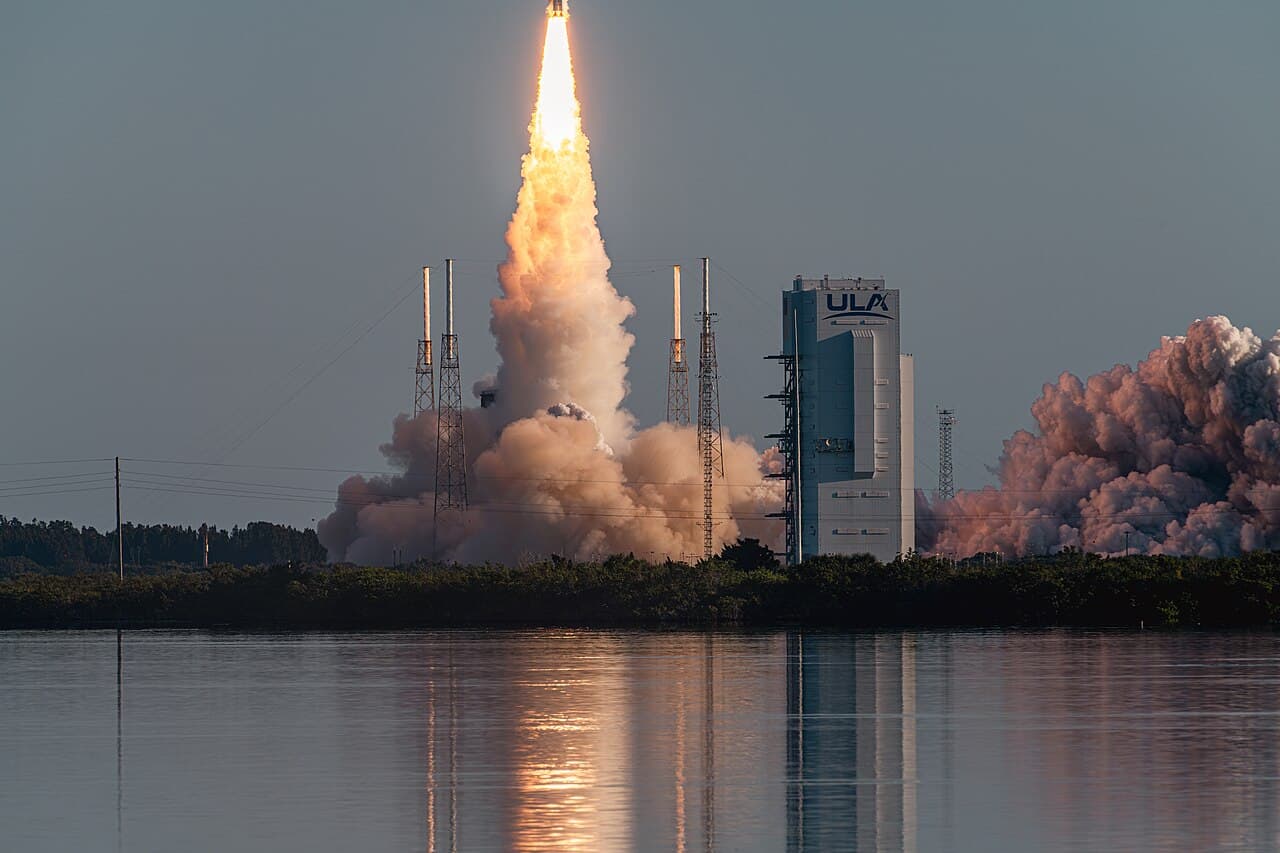
United Launch Alliance launched the last Atlas V in its powerful 551 configuration in the early hours of July 2 from Space Launch Complex 41 at Cape Canaveral, carrying 29 Amazon Leo broadband satellites - a roughly 18-ton payload that tied the record for the heaviest load ever flown on an Atlas V. It was Amazon Leo's eighth and final launch on Atlas V, with future constellation flights shifting to ULA's next-generation Vulcan Centaur. Amazon said its low-Earth-orbit network stood at about 367 satellites before the mission, on the way to a planned fleet of more than 3,000.
Arianespace launched 36 Amazon Leo broadband satellites aboard an Ariane 64 from Europe's Spaceport in French Guiana on June 17 - four more than each of the two previous Amazon missions and the heaviest payload ever flown by an Ariane rocket. The flight debuted the launcher's upgraded P160C solid boosters and was the third Ariane 6 mission dedicated to Amazon's constellation, deploying the spacecraft to roughly 465 km. The added capacity matters as Amazon races to build out its Leo network while Blue Origin's New Glenn remains grounded after a May 28 pad explosion.
United Launch Alliance launched its Vulcan rocket on the USSF-106 mission for the U.S. Space Force on June 11, the rocket's first national security launch and ULA's 101st national security mission overall. The flight followed an anomaly investigation into a Vulcan solid rocket booster issue, resolved after a successful Northrop Grumman GEM 63XL static fire test in mid-April. ULA expects to fly 20 to 25 missions in 2026, including a September Vulcan launch carrying 45 Amazon Leo satellites on an optimized Centaur V upper stage.
In an order dated June 5, the FCC waived Amazon Leo's requirement to place half of its 3,232-satellite Gen1 constellation - 1,616 spacecraft - in orbit by July 30, 2026, after Amazon said in January it could not meet the interim milestone and asked for a two-year extension. Rather than grant the extension, the agency eliminated the half-deployment deadline while keeping the July 30, 2029 full-deployment requirement intact, and imposed a penalty: Amazon temporarily loses priority spectrum status for any satellites not operational by July 30, 2026, with the chance to reclaim it in March 2028 or once it hits the 50% milestone. The relief matters because Amazon's deployment leans on Blue Origin's New Glenn and ULA's Vulcan, and New Glenn remains grounded after a May 28 pad explosion.
VP Chris Weber still said at the September 9-10 Paris International Space Summit that limited commercial service is planned by year-end, though no satellites have launched since July 2, 2026 and two of Amazon's five contracted launch vehicles (Vulcan Centaur, New Glenn) remain grounded, both now traced in August 2026 to a shared BE-4 engine main-oxygen-valve defect requiring retrofit; Delta Airlines (500 planes, 2028) and JetBlue aviation deals represent future large revenue streams
Satellites Deployed
~396 deployed after LA-08 on July 2, 2026, but only 299 in operational orbit as of early September 2026 per Jonathan McDowell, with most of the rest still raising or relocating toward ~600 km; no launches since July 2 as of September 19, 2026 (the next ULA mission, Vulcan LV-01, remains grounded pending a BE-4 engine valve retrofit; independent trackers list Arianespace LE-04 no earlier than October 7, 2026, date TBD)
Initial Constellation
3,236 satellites
(Gen1); FCC authorization unchanged as of September 19, 2026
Launch Manifest
100+ missions secured
(15 flown): 9 Atlas V (complete), 38 ULA Vulcan (first, LV-01, still listed by third-party trackers as September 2026 TBD - grounded since a Feb 12, 2026 SRB nozzle anomaly, and Blue Origin's August 2026 finding that a shared BE-4 main-oxygen-valve defect caused New Glenn's May pad explosion means Vulcan's BE-4 engines also need a valve retrofit before return to flight; ULA still targets RTF before end of 2026 but had not confirmed a date as of September 19, 2026), 24 Ariane 6 (was 18; Amazon ordered six more Ariane 64 missions on Sept 9, 2026, with those added flights starting in 2029 and running through 2031; Arianespace has already flown three Leo missions in 2026 carrying 100 satellites; independent trackers list the next flight, LE-04, no earlier than October 7, 2026, date TBD), 12+15-option New Glenn (grounded since the May 28, 2026 pad explosion, root-caused in August 2026 to the same BE-4 oxygen-valve defect; Blue Origin is retrofitting engines and rebuilding LC-36 access via a simplified wheeled-transporter-and-crane method rather than the damaged original pad infrastructure, still targeting return to flight before end of 2026), 13 Falcon 9
Factory Output
Up to 5 satellites/day peak capacity
(Kirkland, WA - 172,000 sq ft); Amazon has said it has adjusted weekly production targets to reflect launch-vehicle readiness rather than the plant's build capacity, with hundreds of flight-ready satellites reported on standby awaiting launch. The Sept 9, 2026 Ariane 64 add-on does not change factory output; the bottleneck remains getting built satellites off the ground.
Committed Investment
$10B+
FCC Spectrum Status
Amazon missed the July 30, 2026 50%-deployment deadline (1,618 of 3,236 satellites) with only ~394-396 in orbit; under the FCC's June 5, 2026 waiver, satellites launched after July 30 carry reduced spectrum priority until Amazon reaches 50% deployment or until March 30, 2028 (reducible to October 30, 2027 if Amazon certifies the remaining satellites are built and launches booked), whichever comes first. Unchanged as of September 19, 2026, with no launches since July 2 and the next launch (Vulcan LV-01) still grounded.
Commercial service
Still a private preview with employees and select enterprise customers as of 2 Oct 2026; official page still says initial service in certain locations later this year
Last Leo launch
LA-08 on 2 July 2026 remains the last flight (Wikipedia: 15 flights, 396 operational production satellites)
Last Leo launch / next Ariane 6
LA-08 on 2 July 2026 remains the last flight. Arianespace on 14 Oct 2026 set VA271/LE-04 no earlier than 23 Nov 2026, 36 satellites on Ariane 64. Not flown. ULA's Amazon Leo index still tops out at the 6 Aug wet-dress post and the 2 July launch; no official Vulcan LV-01 date.
Commercial service
Still a private preview with employees and select enterprise customers as of 18 Oct 2026. The official Uzbekistan page still says initial service in certain locations later this year. No public price or named opening market.
Satellites manufactured / weekly output
1,000th satellite built at Kirkland
27 per week now versus 27 in the first six months (Badyal, Oct. 8, 2026)
06
Operations & revenue
Operating status
Enterprise beta; LE-04 dated, not flown
As of 18 Oct 2026 no Leo mission has flown since LA-08 on 2 July. Arianespace on 14 Oct set VA271/LE-04, 36 satellites on Ariane 64 from French Guiana, no earlier than 23 Nov 2026, with the final window still to be set. The campaign is underway. ULA's Amazon Leo index still shows the 6 Aug wet-dress note and the 2 July Atlas V, with no Vulcan LV-01 date. Amazon's Uzbekistan page still describes an employee and select-enterprise private preview and initial service later this year. No price and no first commercial market have been published by Amazon.
Revenue streams
Residential and Small-Business Broadband
Consumer and SMB subscriptions delivered through Leo Nano and Leo Pro terminals for locations that lack reliable terrestrial broadband coverage - sold directly and through ISP distribution partners, starting with South Africa's Herotel ('evry, powered by Amazon Leo', launching 2027).
Enterprise and Government Connectivity
Private networking, direct cloud connectivity, and managed broadband services for enterprise and public-sector customers using Leo Pro and Leo Ultra hardware.
Telecom Backhaul
Backhaul and network-extension services for carriers and connectivity providers, including AT&T in the U.S. and Vanu's rural Africa deployments.
Aviation Connectivity
In-flight connectivity for commercial airlines. Delta Air Lines signed March 31, 2026 for a 500-aircraft rollout starting 2028, integrating Leo with AWS and AI for the full travel experience. JetBlue also signed for a 2027 hardware installation program. Delta is the largest airline customer and chose Leo over Starlink. Amazon has not revised either airline timeline as of September 19, 2026.
Maritime Connectivity
Reseller-led connectivity services for ships and offshore operations through Amazon Leo's first maritime channel partners, ELCOME and MTN.
07
Track record
How past announced dates turned out.
1/2announced dates hit on time
1 Hit
1 Slipped
0 Missed
Hit
Arianespace publishes an official Amazon Leo LE-04 launch date
Target Remaining 2026 window after production-line checks; date unpublished · Resolved Oct 14, 2026
Arianespace published VA271/LE-04 on 14 Oct 2026 as no earlier than 23 Nov 2026, 36 satellites on Ariane 64. The mission has not flown, and a final window is still unset.
The mid-2026 commercial launch CEO Andy Jassy targeted in his shareholder letter did not happen; after the early-July 2026 Atlas V launch brought the constellation to 396 satellites, Amazon said initial commercial service is now expected 'later this year'. The milestone was rescheduled to late 2026.
On 14 Oct 2026 Arianespace set Ariane 6 flight VA271, Amazon Leo LE-04, for no earlier than 23 Nov 2026 from French Guiana. The mission would carry 36 satellites on Ariane 64 and, if successful, would bring Arianespace's Leo deployments to 136. A final window is still unset and the mission has not flown. ULA has not posted a Vulcan LV-01 date. Amazon's Uzbekistan page still describes a private preview and initial service later this year, with no price or named opening market.
Kirkland factory builds the 1,000th Leo satellite
In an Oct. 8, 2026 Ars Technica interview, Rajeev Badyal, Paul Palcisco, and Chris Weber said Amazon recently manufactured its 1,000th Leo satellite at Kirkland. Badyal said the plant can now make 27 satellites a week, versus 27 in the first six months, and that Amazon is weeks away from launching on Vulcan, then Arianespace and at least one more Vulcan this year. Weber restated 396 satellites in orbit still raising and initial service planned in 2026. No public price or named opening market was given.
Ariane 6 LE-04 does not fly after the 7 Oct NET
Independent trackers had listed Amazon Leo LE-04 no earlier than 7 Oct 2026. After that date, Wikipedia still shows LA-08 on 2 July as the last flight and LE-04 only as October 2026. Arianespace has not published an LE-04 launch kit; its latest flown Ariane 6 remains VA270 in August. ArianeGroup and Arianespace had already said on 21 Sep that the 2026 mission schedule would be adjusted for production-line checks.
Verge reports Ariane 6 remainder-2026 disruption for Leo
The Verge reported on 28 Sept 2026 that Amazon had gone 12 weeks without a Leo launch after Atlas V LA-08 on 2 July, that an unspecified Ariane 6 component issue was expected to disrupt launches for the remainder of 2026, and that a planned October 36-satellite Ariane 64 mission had been scrubbed from the European spaceport website. Next Spaceflight still listed LE-04 no earlier than 7 Oct 2026 and not flown. Amazon has not published a matching launch-delay notice. This is independent reporting, not a company confirmation.
Names UZ-SAT as Uzbekistan distributor
Amazon Leo said UZ-SAT, a subsidiary of Uzbekistan's leading telecom Uztelecom, will serve as an authorized distributor, using Leo to reach mountain and desert communities where terrestrial networks are hard to deploy. The companies announced the agreement at the Tashkent International Investment Forum during ICT Week 2026. Amazon said it has launched nearly 400 satellites, is testing with employees and select enterprise customers in a private preview, and still expects to begin initial service in some locations later this year.
India cancels pending GMPCS filing; Amazon Leo must reapply
Mint reported September 9, 2026 that India's Department of Telecommunications cancelled Amazon Leo's pending GMPCS application after the Telecom Act 2023 replaced licenses with authorizations, so the company must file a fresh request. An official said DoT is not bound to notify applicants of the cancellation. Starlink, OneWeb and Jio already hold licenses and will migrate later; Amazon Leo is also scouting last-mile partners in India and did not comment.
AT&T Business to sell Amazon Leo with fiber and 5G
On September 9, 2026 AT&T Business said it had agreed a strategic partnership with Amazon Leo to offer LEO satellite broadband to U.S. enterprise and public-sector customers as part of a single managed architecture with AT&T fiber and 5G. AT&T called itself the first major U.S. telecom to combine Amazon Leo that way. The companies are running a phased deployment to validate business-grade reliability; pricing, availability and product configurations will be announced in the coming months.
Orders six more Ariane 64 launches, taking Arianespace deal to 24
On September 9, 2026 at France's International Space Summit in Paris, Amazon Leo ordered six additional Ariane 64 launches from Arianespace, lifting that contract from 18 missions to 24 through 2031. Reuters reported the new flights begin in 2029. Arianespace has already flown three Ariane 6 missions for Leo in 2026 (100 satellites). The add-on comes while ULA's Vulcan Centaur and Blue Origin's New Glenn remain grounded, leaving Ariane 6 and Falcon 9 as the near-term cadence path.
2026
Amazon says Leo is still raising satellites to operating orbits
Amazon told PCMag in early September 2026 that commercial Leo service is still waiting on satellites reaching assigned operating orbits around 600 km, after missing CEO Andy Jassy's mid-2026 launch target. Astronomer Jonathan McDowell said only 299 of the roughly 396 deployed satellites had reached operational orbit, with most of the rest expected by November; Amazon said it is expanding closed-beta testing with employees and select enterprise customers and did not give a new public launch date.
Space Force awards Amazon Leo for Government a Space Data Network demo contract
On August 13, 2026, the U.S. Space Force's Space Systems Command awards Amazon Leo for Government a $12M contract (split between a fixed-price prototype award and an OTA agreement) as one of five companies - alongside Lockheed Martin, Northrop Grumman, Rocket Lab, and York Space Systems - selected to demonstrate multi-vendor satellite interconnectivity with the Space Data Network, the military communications architecture whose core backbone SpaceX builds. Total awards across the five companies are worth $60M.
Amazon Leo files for 5,105-satellite Direct-to-Device constellation
On July 24, 2026, Kuiper Systems LLC (Amazon Leo's operating subsidiary) files an FCC application for an Amazon Leo Direct-to-Device network of up to 5,105 satellites across five orbital shells between 510 and 580 km, using L-band and S-band spectrum tied to the pending Globalstar acquisition, to deliver voice, messaging, and data directly to unmodified smartphones alongside Amazon Leo's broadband network. Amazon Leo VP Chris Weber says D2D deployment is planned to begin in 2028.
Herotel to bring Amazon Leo to South Africa
On July 15, 2026 Amazon Leo signs Herotel - South Africa's largest fixed ISP, with 350,000+ customers across 550+ towns - to distribute Leo residential service under the brand 'evry, powered by Amazon Leo', launching commercially in 2027. It is the first agreement of its kind in Africa and beats Starlink into the South African market.
Amazon says Leo has enough satellites to start service in 2026
On July 2, 2026, following the ULA Atlas V launch that brought the constellation to roughly 396 satellites, Amazon said it had deployed enough satellites to begin offering commercial Leo broadband service later in 2026 - its clearest signal yet of readiness to compete with SpaceX's Starlink, which operates about 10,000 satellites and serves 12M+ customers. Amazon plans an eventual fleet of more than 3,000 satellites.
ULA flies final Atlas V 551 for Amazon Leo (LA-08)
On July 2, 2026, United Launch Alliance launched 29 Amazon Leo satellites from Cape Canaveral aboard the last Atlas V flown in its 551 configuration - a roughly 18-ton payload that tied the record for the heaviest load ever carried by an Atlas V. It was Amazon Leo's eighth and final launch on Atlas V, lifting the in-orbit production fleet to about 396 satellites; future constellation missions move to ULA's next-generation Vulcan Centaur.
Ariane 6 launches 36 satellites in record payload (LE-03)
On June 17, 2026, Arianespace launches 36 Amazon Leo satellites aboard an Ariane 64 from French Guiana - the heaviest payload ever flown by an Ariane rocket and the first flight of the launcher's upgraded P160C boosters - lifting Amazon's in-orbit production fleet to about 367 satellites. It is the third Ariane 6 mission dedicated to the constellation as Amazon works to accelerate deployment amid limited launch-vehicle availability.
FCC grants waiver on 50% deployment deadline with spectrum conditions
On June 5, 2026, the FCC grants Amazon Leo a limited waiver allowing it to miss the July 30, 2026 deadline to have 50% of its 3,236-satellite constellation (1,618 satellites) operational - Amazon had only 331 deployed due to launch-vehicle availability constraints. As a condition, any satellite launched after July 30 loses spectrum priority status until March 30, 2028, or until Amazon reaches the 50% milestone sooner. The full 3,236-satellite requirement by July 30, 2029 remains unchanged.
Amazon Leo's enterprise beta goes live April 8, 2026 with Verizon, AT&T, Vodafone, JetBlue, NBN Co, Vrio, NASA, Hunt Energy, and Crane Worldwide as beta partners. By May 2026, 331 production satellites are in orbit. CEO Andy Jassy's shareholder letter targets mid-2026 for broader commercial launch. An Ariane 64 mission (LE-03) carrying 36 satellites is scheduled June 17, 2026.
Delta Airlines signs for 500-plane Wi-Fi rollout starting 2028
Delta Air Lines signs a multi-year agreement with Amazon Leo on March 31, 2026 to roll out in-flight Wi-Fi to an initial 500 aircraft starting in 2028. Delta - the largest airline to adopt Amazon Leo - joins JetBlue as an aviation customer and integrates Amazon's Leo, AWS, and AI capabilities into its wider travel-experience platform.
Constellation passes 300 satellites and $11.57B Globalstar deal announced
Amazon follows LA-05 with LA-06 and LE-02 in late April, lifting total production satellites launched to about 302. On April 14, 2026 Amazon announces it will acquire Globalstar for approximately $11.57B ($90/share, expected to close 2027), catapulting Amazon Leo into the direct-to-device race with plans for an advanced D2D network in 2028.
2025
Project Kuiper becomes Amazon Leo
Amazon retires the Project Kuiper code name on November 13, 2025, adopts the Amazon Leo brand, and opens enterprise preview so select business customers can begin testing the network ahead of a wider rollout in 2026.
Production deployment begins
Amazon starts full-scale deployment on April 28, 2025, when the first 27 production satellites launch aboard a ULA Atlas V. The company says the initial constellation will require more than 100 deployment missions.
2024
Kirkland satellite factory opens
Amazon opens its 172,000 sq ft satellite factory in Kirkland, Washington in April 2024, designed to produce up to five satellites per day at peak - one of the few high-volume satellite manufacturing lines in the world.
2023
Prototype mission validates system design
After launching KuiperSat-1 and KuiperSat-2 on October 6, 2023, Amazon reports a 100% success rate across key prototype mission objectives and uses the learnings to prepare for production deployment.
2020
FCC authorization for 3,236 satellites
The FCC approves Amazon's initial Project Kuiper constellation of 3,236 satellites, and Amazon says it will invest more than $10 billion to build the network and its ground infrastructure.
2019
Project Kuiper announced
Amazon announces Project Kuiper as a low Earth orbit broadband initiative aimed at extending reliable, affordable internet access to unserved and underserved communities.