Saronic designs and mass-produces autonomous surface vessels for the US Navy and allied navies, and in 2026 became the first American company whose uncrewed boats both rescued aircrew and struck a target in combat. A Corsair recovered two downed US Army aviators off Oman on June 8, 2026, the first publicly reported personnel recovery by an unmanned surface vessel, and three Corsairs hit Iran's Bandar Abbas naval base on July 12, 2026 in the first combat use of USVs by American forces. Founded in 2022 by former Navy SEAL Dino Mavrookas, it closed a $1.75B Series D on March 31, 2026 at a $9.25B valuation, holds a $392M Navy production contract for the 24-foot Corsair awarded in December 2025, and in mid-September 2026 won a firm-fixed-price Prototype Other Transaction to build crewed Landing Craft Utility 1700 hulls as the first program at Port Alpha. It builds a family of eight vessel classes from the six-foot Spyglass to the 180-foot Marauder on a single autonomy stack, Echelon. Its industrial bet is bigger than any one hull: a $300M expansion of the Franklin, Louisiana shipyard it bought from Gulf Craft (topped out August 25, 2026, designed for up to 20 Marauders a year), a central Texas Corsair plant whose line CEO Dino Mavrookas showed at 2,000 boats a year on a September 7, 2026 factory tour, and a $3.2B Port Alpha shipyard at Brownsville, Texas that is meant to break ground in 2026 and open in 2028 for hulls up to 850 feet, with LCU production targeted to start in 2028 and first deliveries in 2029. A sealed Court of Federal Claims challenge to a bundled Navy LCS/sUSV sustainment award remains pending, with the government asking for a merits decision by October 1, 2026. A strategic collaboration with Nvidia, announced October 2025, pairs Nvidia's AI computing and simulation tools with Saronic's Echelon autonomy stack to speed up software development and, longer term, ship design and production.
On September 29, 2026 Saronic said it won a firm-fixed-price Navy production Other Transaction for its 180-foot Marauder autonomous surface vessel after an at-sea evaluation covering more than 140 scenarios over eight days. Trade reporting that quoted Navy officials said Saronic, Huntington Ingalls Industries and Galliano Marine Services each received agreements for 10 Medium Unmanned Surface Vessels at an average cost of about $40 million, with first deliveries targeted before the end of fiscal 2027. Saronic itself did not disclose award value or hull count to gCaptain, and a navy.mil production press release was not retrieved.
The US Navy awarded Saronic a firm-fixed-price Prototype Other Transaction to build Landing Craft Utility 1700 hulls as the first program at Port Alpha, the company's planned Brownsville, Texas shipyard. The award is part of $280.5 million in OTAs covering seven prototype craft across Saronic, Conrad Shipyard, and Master Boat Builders, with each yard building two or three boats to validate a production-ready technical data package. CEO Dino Mavrookas said Port Alpha will produce the crewed LCUs alongside autonomous surface vessels; Saronic expects production to start in 2028 and first deliveries in 2029.
Saronic held a keel-laying ceremony on August 22 for a 150-foot Marauder autonomous surface vessel at its Franklin, Louisiana shipyard, which trade outlets described as the start of series production for the class. The uncrewed vessel carries a 40-metric-ton payload and can travel up to 3,500 nautical miles or loiter for more than 30 days, and will be built alongside Saronic's larger 180-foot Marauder variant at the same shipyard, where the company is completing a $300 million, 3,200-job expansion.
Saronic Technologies and builders JE Dunn Construction and Alberici Constructors placed the final structural beam on August 25 in a topping-out ceremony for the $300 million expansion of Saronic's Franklin, Louisiana shipyard. The expansion adds more than 300,000 square feet, including three new slips, added warehouse capacity and a dedicated production line for Saronic's 180-foot Marauder autonomous vessels, and is scheduled for completion in early 2027 after reaching a peak workforce of about 200 construction workers.
Saronic announced August 9 that it has taken a 30,000-plus-square-foot facility at the Port of Gulfport, Mississippi, dedicated to on-water testing and commissioning of its 180-foot Marauder unmanned surface vessel before delivery. The company's first Marauder arrived at the site in mid-July and has logged hundreds of hours of trials running 12-plus hours a day, with additional hulls built at its Franklin, Louisiana shipyard set to transfer there as production increases.
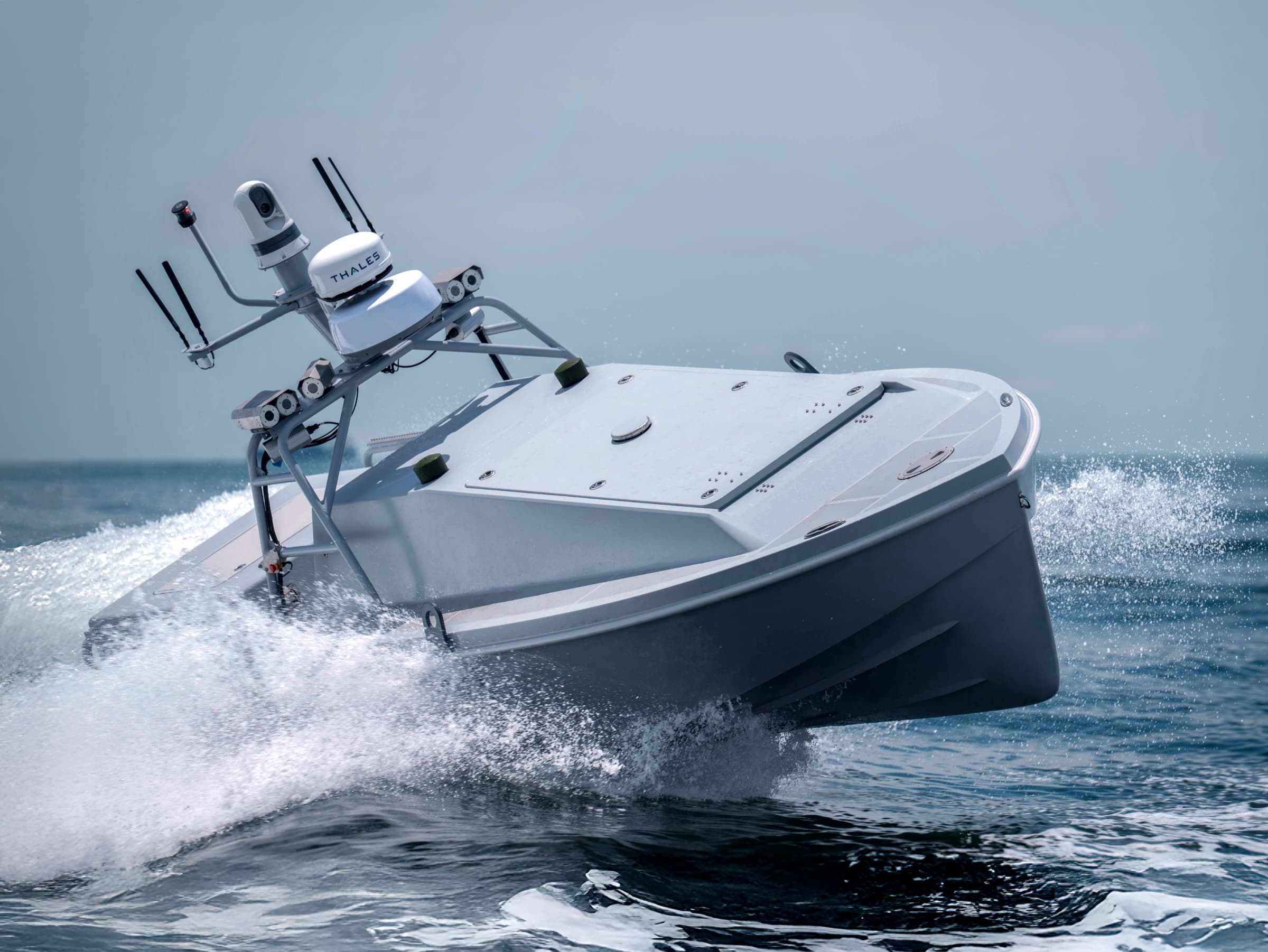
The 24-foot autonomous surface vessel that carries Saronic's combat record. Official specs: 1,000 pounds of payload, 1,000-plus nautical miles, and 35-plus knots. Corsairs deployed to the Middle East with Task Force 59 in March 2026, recovered two downed Army aviators off Oman on June 8, and three struck Iran's Bandar Abbas naval base on July 12 in the first combat use of USVs by US forces.
In production in central Texas under a $392M Navy contract and operationally deployed with the US Navy. Official spec page still lists 24 ft, 1,000+ nm, 35+ kts, and 1,000 lb payload.
Length24 ft
Payload1,000 lbs
Range1,000+ nautical miles
Top Speed35+ kts
Production Contract$392M US Navy award, December 2025
A 52-foot (16-meter) dual-use autonomous surface vessel launched July 2, 2026, sitting between the Corsair and the Marauder and pitched at both defense and commercial customers. Saronic said in July 2026 it could build hundreds a year.
First hull on the water as of July 2026; official spec page live. No production contract disclosed as of September 2026.
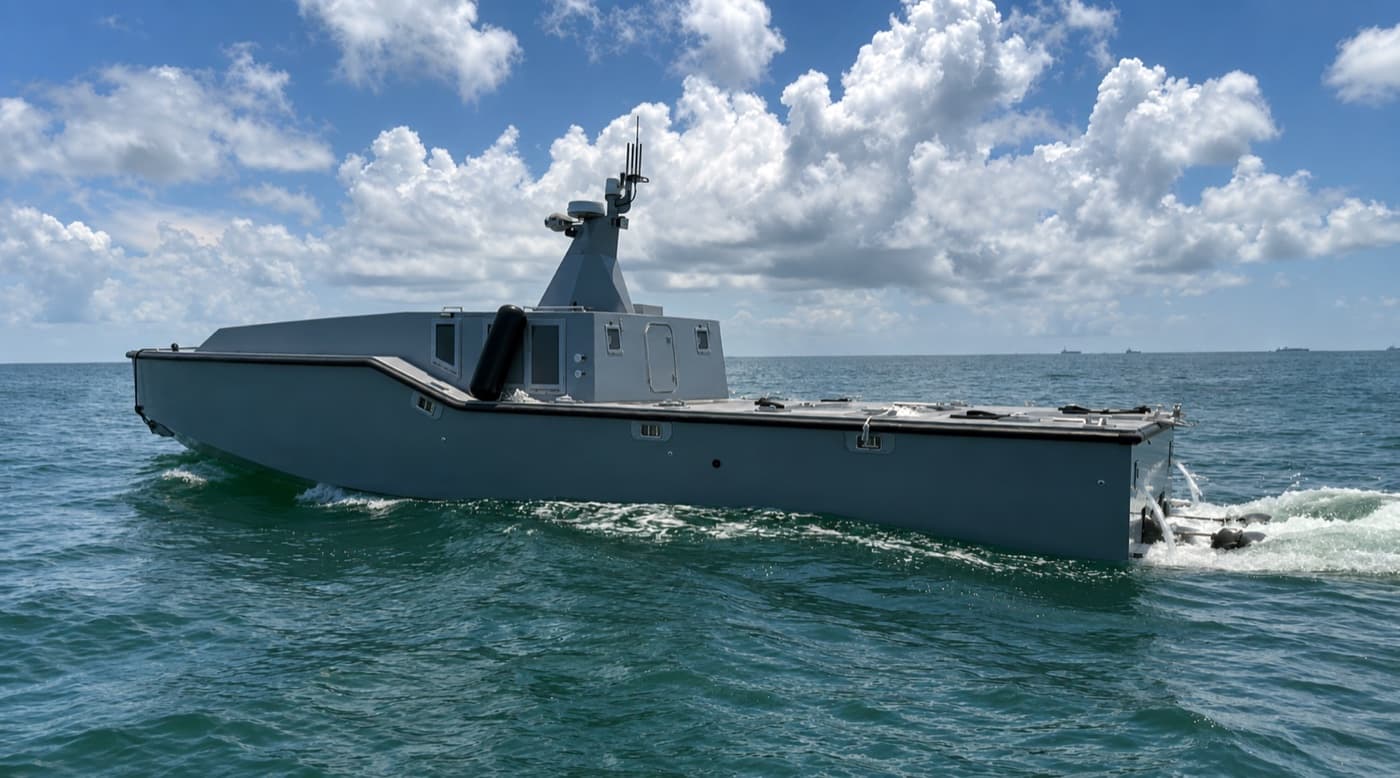
Saronic's Medium Unmanned Surface Vessel, designed from the keel up for autonomous operation and high-rate production: 180 feet, 25-plus knots, up to 5,400 nautical miles of range, and 150 metric tons of modular payload. First unveiled in April 2025 as a 150-foot design, the first hull was designed, built, and launched in under a year at Franklin, Louisiana, with three more under construction. It is one of seven designs in the at-sea testing phase of the Navy's MUSV Marketplace.
First hull built at Franklin, Louisiana and undergoing on-water trials at the Port of Gulfport, Mississippi since mid-July 2026; CCO Rob Lehman said it had logged over 300 hours by mid-August. Still in Navy MUSV Marketplace at-sea demonstrations running to October 2026, with no production contract disclosed.
Length180 ft
Speed12 kt cruise / 25+ kt sprint
Range5,400 nm at 25 MT base load; 4,100 nm at 150 MT max load
Payload150 metric tons, modular (4x40' or 8x20' ISO)
Gulfport Trial HoursOver 300 hours as of mid-August 2026 (CCO Rob Lehman)
The single command-and-control layer across everything Saronic builds. Operators plan, simulate, and execute missions for one vessel or a whole fleet from one interface, and the same autonomy stack runs on every class from the six-foot Spyglass to the 180-foot Marauder, which is what lets Saronic scale hull sizes without rebuilding the software each time. A strategic collaboration with Nvidia announced October 2025 pairs Nvidia's AI computing, software, and simulation tools with Echelon, which Saronic says has cut autonomy software training and deployment cycles from days to hours.
Shipping across the deployed fleet as the common autonomy and fleet-management layer.
CoverageAll 8 vessel classes on one autonomy stack
What's Next
Pass Navy MUSV Marketplace at-sea testing with the Marauder
Saronic is one of seven companies advanced to the at-sea demonstration phase of the Navy's MUSV Marketplace, each paid $15 million, with demonstrations running to October 2026 and follow-on eligibility for designs that pass. This remains the gate between Saronic's small-boat Corsair production plus the new crewed LCU 1700 prototype OTA and becoming a Navy shipbuilder on the Marauder class, and it puts a four-year-old startup directly against established primes including HII.
October 2026
Break ground and open Port Alpha
Port Alpha at the Port of Brownsville is Saronic's $3.2 billion bet on rebuilding American shipbuilding capacity: 835 acres to start with room toward 4,400, hulls up to 850 feet initially and potentially past 1,200 feet later, up to 10,000 direct jobs over a decade, backed by an $80 million Texas Enterprise Fund grant and a 95% Cameron County tax abatement conditioned on filling 35% of positions locally. Groundbreaking is set for 2026 and operations for 2028. The Navy's mid-September LCU 1700 Prototype Other Transaction names Port Alpha as the first build, so the yard now has a named first hull class before it has broken ground.
2028
Start LCU 1700 production at Port Alpha
Saronic's first Port Alpha program is a crewed Landing Craft Utility 1700, awarded as a firm-fixed-price Prototype Other Transaction alongside Conrad Shipyard and Master Boat Builders. The three yards share $280.5 million for seven prototypes, two or three per yard, to validate a production-ready technical data package for the class that will replace 50-plus-year-old LCU 1610 craft. Saronic said it expects to begin LCU production at Port Alpha in 2028, with first deliveries in 2029. Watch whether groundbreaking holds in 2026 so that 2028 production window is real, and whether Saronic's individual hull count and dollar share are later disclosed.
2028 (production); 2029 (first deliveries)
Demonstrate a hypersonic missile launch from an unmanned surface vessel
Saronic and Castelion are integrating Castelion's hypersonic strike missile with a Saronic medium USV, with a demonstration launch from the vessel planned for 2027. If it works, it moves the USV category from surveillance, logistics, and one-way attack into long-range strike from an uncrewed hull. No launch from a Saronic hull has been reported as of September 2026.
2027
Scale Franklin and Austin output toward company production targets
Three more Marauder hulls are under construction at Franklin, Louisiana, where Saronic's $300 million shipyard expansion (construction started November 2025, topped out August 25, 2026) is designed to support up to 20 Marauders a year once complete, on track for early 2027. On a September 7, 2026 factory tour, CEO Dino Mavrookas walked a 420,000-square-foot Austin Corsair line that he described as having capacity for 2,000 boats a year - the same figure previously framed as a new-line target on top of a 400-500 Corsair rating. In July 2026 Saronic said it could eventually produce hundreds of Mirages and thousands of Corsairs a year. These are company projections, so demonstrated delivery rates are the thing to watch rather than stated capacity.
Early 2027 (Franklin expansion complete); 2027+ (full production ramp)
Resolve the court challenge to the Navy's bundled LCS/sUSV sustainment award
Saronic is contesting a NAVSEA solicitation worth up to $1.57 billion that bundles operations-and-sustainment work for Littoral Combat Ship mission modules with small unmanned surface vessels, arguing in a US Court of Federal Claims complaint filed March 4, 2026 (Saronic Technologies, Inc. v. United States, No. 1:26-cv-00358, Judge Elaine Kaplan) that the bundled structure favors large, non-commercial primes. The Navy planned a single award around October 29, 2026. In a March 16 joint status report the United States asked the court for a merits decision no later than October 1, 2026, to avoid disrupting essential services. No ruling has been published as of September 17, 2026. The outcome decides whether Saronic can compete for a sustainment revenue stream well beyond its existing Corsair production contract.
October 1, 2026 (government-requested merits decision)
Turn allied partnerships into foreign orders
Saronic launched UK operations and expanded in Australia in 2026, promoted Matthew Tracey to VP of International, appointed retired Rear Admiral Lee Goddard as a strategic advisor in Australia, partnered with Lloyd's Register to get its vessels classed for the UK, Europe, and Australia, and signed an MOU with Taiwan's National Chung-Shan Institute of Science and Technology. None of that has yet converted into a disclosed foreign production contract as of September 2026.
2026-2027
Deliver first Marauder MUSVs to the Navy
Prior to end of FY2027; USNI says as early as Q4 FY2027
Track Record
2 of 2 announced dates hit
Get the first Marauder hull on the water
Target 2026 · Resolved Jul 24, 2026
The first Marauder was designed, built, and launched in under a year from the April 2025 unveiling at Saronic's Franklin, Louisiana shipyard, then moved to the Port of Gulfport, Mississippi in mid-July 2026 for sustained on-water trials, with three additional hulls under construction. The delivered vessel came in at 180 feet, larger than the 150-foot design originally shown.
Hit
Select a site for the Port Alpha shipyard
Target 2026 · Resolved Jul 16, 2026
Saronic named the Port of Brownsville, Texas on July 16, 2026, committing to an initial 835-acre site in Cameron County with room to expand toward 4,400 acres, at an estimated cost of $3.2 billion. Texas contributed an $80 million Enterprise Fund grant and Cameron County approved a roughly two-decade 95% tax abatement tied to local hiring.
Hit
Operations & Revenue
StatusOperational; Marauder in Navy MUSV production
The Navy DRPM RAS press release of September 29, 2026 is the primary source for the MUSV production Other Transaction. It awards production OTAs to Galliano Marine Services, HII, and Saronic Technologies. Each agreement includes 10 MUSVs at an average procurement cost of $40,000,000 per vessel, with first deliveries scheduled prior to the end of Fiscal Year 2027. That matches the 10-vessel, about $40 million average figure from the Navy roundtable. The $40 million figure is an average; the Navy did not publish Saronic's individual firm-fixed-price. USNI, quoting acting DRPM RAS Chris Miller, said production begins immediately at Franklin, Louisiana, with deliveries as early as the fourth quarter of FY2027. Saronic confirmed a firm-fixed-price award under 10 U.S.C. 4022(f) and said it has flipped a third Marauder hull, without disclosing value or hull count. The December 2025 $392 million Corsair award remains the largest fully disclosed production contract. Homepage still leads with the Hormuz rescue. Vessel specs are unchanged. A COFC merits decision requested by October 1, 2026 in 1:26-cv-00358 had not appeared in published opinions through September 29, 2026.
Revenue Streams
US Navy Vessel Production
The core business: production contracts for autonomous surface vessels, anchored by the $392 million Corsair award of December 2025 and extended by the MUSV Marketplace at-sea testing phase, which pays $15 million per selected company with follow-on eligibility for designs that pass. In mid-September 2026 the Navy also awarded Saronic a Prototype Other Transaction for crewed LCU 1700 landing craft at Port Alpha, one of three yards sharing $280.5 million for seven prototypes.
Allied and International Sales
Saronic launched UK operations and expanded in Australia in 2026, appointing a VP of International and a retired Australian rear admiral as strategic advisor, and signed a Lloyd's Register partnership to get its vessels classed for the UK, Europe, and Australia. It has also signed an MOU with Taiwan's National Chung-Shan Institute of Science and Technology.
Commercial Maritime Autonomy
The Mirage class is explicitly dual-use, aimed at commercial maritime work as well as defense missions, and the Samsung Heavy Industries partnership extends Saronic's automation into commercial shipbuilding processes.
Key Metrics
Employees
1,300+ (company statement, March 2026); reported at 1,400 by Fast Company in July 2026. Careers listings in September 2026 still show a large open-role book, including a dedicated Port Alpha hiring track, with no newer official census
Est. Annual Revenue
~$200M in 2025 per independent research firm Sacra, anchored by the $392M Navy Corsair production award; Saronic is private and does not disclose revenue. Sacra models roughly $480M at a full-capacity 600 boats a year across all lines at about 45% gross margins. No newer company disclosure as of September 2026.
Valuation
$9.25B post-money (Series D, March 31, 2026)
Total Raised
~$2.6B across Series A through D
Headcount
1,300+ (March 2026 company statement); reported at 1,400 by Fast Company in July 2026. September 2026 careers listings show a large open-role book including a Port Alpha hiring track. No newer official census as of September 17, 2026
Largest Navy Contract
$392M Corsair production award (December 2025), nearly $200M obligated up front. Still the largest disclosed production award as of September 20, 2026; the mid-September LCU 1700 OTA is a prototype award split across three yards at $280.5M total, with Saronic's share undisclosed
LCU 1700 Navy OTA
Firm-fixed-price Prototype Other Transaction for crewed LCU 1700 hulls as Port Alpha's first build. Part of $280.5M across Saronic, Conrad, and Master Boat Builders for seven prototypes (two or three per yard). Production targeted 2028, first deliveries 2029. Saronic's individual dollar share not disclosed
Vessel Family
8 classes on one autonomy stack, from the 6-foot Spyglass through Cutlass, Corsair, Mirage, and Cipher to the 180-foot Marauder. Official spec pages for Corsair (24 ft, 1,000 lb, 1,000+ nm, 35+ kts), Mirage (52 ft, 3,500 lb, 2,500+ nm, 35+ kts) and Marauder (180 ft, 150 MT, 5,400 nm base load) were unchanged as of September 17, 2026
Combat Record
First personnel recovery by a USV (June 8, 2026, off Oman) and first combat use of USVs by US forces (July 12, 2026, Bandar Abbas). Homepage still leads with the Hormuz rescue; no newer combat event found as of September 2026
Production Capacity
On a September 7, 2026 factory tour, CEO Dino Mavrookas walked a 420,000-square-foot Austin Corsair line that he described as having capacity for 2,000 autonomous boats a year. That is the same 2,000-unit figure previously framed as a new-line target on top of a 400-500 Corsair rating. In July 2026 Saronic said it could build hundreds of Mirages and thousands of Corsairs annually. The Franklin, Louisiana shipyard's $300M expansion, which began construction in November 2025 and topped out August 25, 2026, is designed to support up to 20 Marauders a year and is on track for completion in early 2027. All are company projections, not demonstrated delivery rates
Sea Miles Demonstrated
100,000+ nautical miles across the fleet in real-world conditions (company homepage figure, still live September 2026)
MUSV production OTA
10 Marauders; Navy average $40M per vessel (Saronic FFP undisclosed)
Timeline
2026Challenges a bundled Navy sustainment procurement in federal court
Saronic files a sealed pre-award complaint with the US Court of Federal Claims on March 4, 2026 (a redacted version made public March 13), asking the court to permanently enjoin a NAVSEA solicitation that bundles operations-and-sustainment work for Littoral Combat Ship mission modules together with small unmanned surface vessels into a single award worth up to $1.57 billion. Saronic argues the bundled structure limits the vendor pool to large, non-commercial defense primes and violates a statutory preference for commercial contracting.
2026$1.75B Series D at a $9.25B valuation
Saronic closes a $1.75 billion Series D on March 31, 2026 at a $9.25 billion valuation, led by Kleiner Perkins with Advent International, Bessemer Venture Partners, DFJ Growth, and BAM Elevate joining, and 8VC, Caffeinated Capital, Andreessen Horowitz, Elad Gil, and Franklin Templeton following on. Headcount passes 1,300, the Austin headquarters grows past 500,000 square feet, and new hubs open in San Diego, Washington D.C., the UK, and Australia.
2026Navy selects seven MUSV designs, Saronic among them
On May 22, 2026 the Navy picks seven Medium Unmanned Surface Vessel designs to enter the prototype phase of its MUSV Marketplace, with Saronic's Marauder alongside entries from established shipbuilders including HII.
2026First personnel recovery by an unmanned surface vessel
On June 8, 2026, after an AH-64 Apache went down off Oman near the Strait of Hormuz, the Navy's Task Force 59 sent a Saronic Corsair to the crash site. The Corsair picked up both US Army aviators within about two hours and carried them to a point where a helicopter hoisted them clear; both were reported in stable condition. It is the first publicly reported personnel recovery by a USV.
2026Marauder enters on-water trials and the MUSV Marketplace
Saronic's first Marauder starts on-water trials at Franklin, Louisiana, designed, built, and launched in under a year, with three more hulls under construction. In June 2026 the Navy advances Saronic to the at-sea testing phase of the MUSV Marketplace, one of seven companies each receiving $15 million with follow-on eligibility for those that pass, with demonstrations running to October 2026.
2026First Mirage hits the water
Saronic launches its first Mirage on July 2, 2026, a 52-foot (16-meter) dual-use autonomous surface vessel that becomes the third flagship platform alongside Corsair and Marauder, aimed at both defense and commercial missions.
2026First US combat use of unmanned surface vessels
On July 12, 2026 three Saronic Corsairs struck Iran's Bandar Abbas naval base, the country's main facility overlooking the Strait of Hormuz, hitting a submarine and ship maintenance area. US Central Command described it as the first combat use of unmanned surface vessels by American forces, turning the Corsair from a surveillance and logistics platform into a one-way attack weapon in operational use.
2026Port Alpha sited at Brownsville, Texas
On July 16, 2026 Saronic names the Port of Brownsville as the home of Port Alpha, a shipyard it puts at $3.2 billion, starting on 835 acres in Cameron County with room to expand toward 4,400. It is designed to build vessels up to 850 feet initially, comparable to a Wasp-class amphibious assault ship, and potentially beyond 1,200 feet later. Groundbreaking is set for 2026 and operations for 2028, with up to 10,000 direct jobs projected over a decade, an $80 million Texas Enterprise Fund grant, and a 95% county tax abatement tied to local hiring.
2026Samsung Heavy Industries partnership
On July 23, 2026, at the launch of the Korea-US Shipbuilding Partnership Center in Washington D.C., Saronic and Samsung Heavy Industries announce a partnership pairing Saronic's autonomy with Samsung's large-scale shipbuilding and production engineering, including robotics-based process automation across Saronic's Texas and Louisiana yards.
2026Gulfport, Mississippi test site opened for the Marauder
Announced August 9, 2026, Saronic takes a 30,000-plus square foot facility at the Port of Gulfport with port access, offices, and warehouse space, dedicated to end-of-line testing and on-water commissioning of the 180-foot Marauder before delivery. The first Marauder arrived mid-July and has logged hundreds of hours of trials at 12 hours a day, seven days a week. Additional hulls built at Franklin, Louisiana will transfer to Gulfport as production increases.
2026Franklin, Louisiana shipyard expansion tops out
Builders JE Dunn Construction and Alberici Constructors place the final structural beam on August 25, 2026 in a topping-out ceremony for the $300 million expansion of Saronic's Franklin shipyard. The expansion adds more than 300,000 square feet, including three new slips, added warehouse capacity and a dedicated Marauder production line, and is on track for completion in early 2027.
2026CEO shows Austin Corsair line at 2,000 boats a year
On a September 7, 2026 factory tour, CEO Dino Mavrookas walked Saronic's 420,000-square-foot Austin plant and described the Corsair production line as having capacity for 2,000 autonomous boats a year. The tour also showed the 52-foot Mirage, still in sea trials after its July 2 launch, and restated Port Alpha as an 800-acre Brownsville shipyard with room past 4,000 acres.
2026Navy awards Saronic LCU 1700 work as Port Alpha's first build
The US Navy awarded Saronic a firm-fixed-price Prototype Other Transaction to construct Landing Craft Utility 1700 vessels, which Saronic said will be the first build at Port Alpha in Brownsville, Texas. The award is one of three competitive OTAs totaling $280.5 million for seven prototype craft across Saronic, Conrad Shipyard in Orange, Texas, and Master Boat Builders in Coden, Alabama, with each yard building two or three boats to validate a production-ready technical data package. CEO Dino Mavrookas said Port Alpha is designed to produce large autonomous surface vessels alongside currently manned ships; Saronic expects LCU production to start in 2028 and first deliveries in 2029.
2026Navy awards Marauder MUSV production Other Transaction
On September 29, 2026 Saronic said the Navy awarded a firm-fixed-price production Other Transaction for the 180-foot Marauder after an at-sea evaluation of more than 140 scenarios over eight days in the MUSV Marketplace. Defence Industry Europe, quoting Navy officials, said Saronic, HII and Galliano Marine Services each received agreements for 10 vessels at an average cost of about $40 million, with first deliveries targeted before the end of fiscal 2027. Saronic did not disclose value or quantity in its comments to gCaptain.
2026Navy DRPM RAS primary confirms 10 Marauder MUSVs at $40M average
On September 29, 2026 the Navy's Direct Reporting Program Manager for Robotic and Autonomous Systems published the primary press release awarding production OTAs to Galliano Marine Services, HII, and Saronic Technologies. Each agreement includes 10 MUSVs at an average procurement cost of $40,000,000 per vessel, with first deliveries scheduled prior to the end of Fiscal Year 2027. That matches the 10-vessel, about $40 million average figure from the Navy roundtable. USNI, quoting acting DRPM RAS Chris Miller, said the Navy did not specify how much each company received, that production begins immediately at Franklin, Louisiana, and that deliveries can start as early as the fourth quarter of FY2027. Saronic confirmed a firm-fixed-price award under 10 U.S.C. 4022(f) and said it has flipped its third Marauder hull, without disclosing its individual price.
2025Gulf Craft acquired, Marauder unveiled
In April 2025 Saronic buys the Franklin, Louisiana shipyard Gulf Craft, a nearly 100-acre Gulf Coast yard, and unveils the Marauder, then described as a 150-foot autonomous surface vessel. It commits more than $250 million to upgrading the yard, later raised to $300 million, moving the company from small-boat manufacturing into real shipbuilding.
2025Strategic collaboration with Nvidia
On October 23, 2025 Saronic and Nvidia announce a strategic collaboration pairing Nvidia's AI computing, software, and simulation tools with Saronic's autonomy stack and shipbuilding processes. Saronic says the partnership has shortened its development cycles, letting it train, verify, and deploy new autonomy software in hours instead of days, and extends into AI-based methods for ship design and production as part of reindustrializing US shipbuilding.
2025$392M Navy production contract for the Corsair
Announced at the Reagan National Defense Forum in early December 2025, the Navy awards Saronic a $392 million production contract for the 24-foot Corsair, with nearly $200 million obligated up front. Secretary of the Navy John Phelan framed it as a procurement benchmark: prototype to production in under 12 months.
2024$175M Series B makes Saronic a unicorn
An Andreessen Horowitz-led $175 million Series B closes July 19, 2024 at a $1 billion valuation, with 8VC, Caffeinated Capital, Elad Gil, and NightDragon participating. The money goes into in-house manufacturing capacity and higher production rates across the Spyglass and Cutlass lines.
2023$55M Series A to build autonomous ships for the Navy
Saronic raises a $55 million Series A in October 2023 to develop and manufacture autonomous surface vessels aimed squarely at the US Navy and aligned defense partners, starting with the small Spyglass and Cutlass classes.
2022Founded by a former Navy SEAL and a SEAL Team 6 core team
Dino Mavrookas founds Saronic in Austin, Texas after 11 years and eight combat tours as a Navy SEAL, an MBA at Wharton, and five years as a software investor at Vista Equity Partners. Co-founders Doug Lambert (COO), Rob Lehman (CCO), and Vibhav Altekar (CTO) join, several of them out of SEAL Team 6 and the Marine Corps. The company signs its first Navy contract within 90 days of launch.