Shield AI sells the pilot, not the plane. Its Hivemind autonomy software flies aircraft that have lost GPS and communications; co-founder Brandon Tseng said in September 2026 that it has been used on more than 40 platforms, up from the company's earlier 30-plus count. In June 2026 the Air Force put Hivemind on contract for Collaborative Combat Aircraft mission autonomy: six vendors hold baseline six-year contracts, but only Shield AI, Anduril and RTX Collins Aerospace were funded for the first of two six-month competitive phases that decide the program's primary autonomy provider by summer 2027. The company was founded in San Diego in 2015 by former Navy SEAL Brandon Tseng, his brother Ryan Tseng, and Andrew Reiter, and is run since March 2025 by CEO Gary Steele, formerly of Proofpoint and Splunk. Its hardware business is the MQ-35 V-BAT, a 165-pound tail-sitting VTOL drone flown by five US services and militaries from Ukraine to Japan, selected in April 2026 to compete for up to $800 million in Navy contractor-operated ISR task orders. Taiwan's Navy in August 2026 published a NT$36 billion 2026-2029 budget to buy 280 V-BATs, the largest planned order to date, though a signed contract has not been confirmed; Shield AI has a Taipei 101 office and told Taipei Times it plans to double local staff next year. On August 6, 2026 it and Taiwan's NCSIST flew a three-aircraft Mighty Hornet III autonomous search, then expanded the Hivemind contract. Its bet on the future is X-BAT, an autonomous VTOL fighter with a GE F110 engine and a refurbished 1990s AVEN thrust-vectoring nozzle: GE completed more than 100 hours of ground tests and shipped the nozzle in early September 2026, and Shield AI is now targeting a tethered vertical hover from a 180-foot crane by the end of 2026, then mission capability in 2028 and production in 2029. At MSPO in September 2026 Shield AI, PGZ and WZL-2 signed a five-year letter of intent to design, produce, deliver and sustain X-BAT in Poland, also covering Hivemind, V-BAT, MRO, training and technology transfer. Shield AI raised $2 billion in March 2026 at a $12.7 billion valuation, more than doubling its prior mark, and is projecting more than $540 million of revenue in 2026 against roughly $300 million the prior fiscal year. The counterweight to all of it is reliability: a June 2026 Reuters investigation documented more than 50 V-BAT crashes in 18 months and an injury to a Romanian navy officer during training, and whistleblower complaints alleging safety concerns were dismissed.
Shield AI and untracked UK boatbuilder Kraken Technology Group said two Hivemind-enabled K3 SCOUT uncrewed surface vessels ran a coordinated ISR search in Portsmouth on September 28, using radar, cameras and AIS to classify a vessel of interest, escort it, then replan. Shield AI called it its first UK maritime autonomy demonstration. The firms plan further joint trials with UK and NATO partners in contested environments over the coming year; Kraken recently delivered 20 K3 SCOUTs to the Royal Navy under Project BEEHIVE.
Shield AI, Polish Armaments Group (PGZ) and Military Aircraft Works No. 2 (WZL-2) signed a five-year letter of intent at MSPO covering design, production, delivery and sustainment of the X-BAT autonomous VTOL fighter in Poland. The LOI also covers Hivemind software, V-BAT, MRO, training, supply-chain participation and technology transfer, with a detailed work-share still to be negotiated. CEO Ryan Tseng said PGZ and WZL-2 already maintain Polish combat aircraft and that the industrial base should build and support X-BAT for Poland and export.
GE Aerospace is shipping its refurbished Axisymmetric Vectoring Exhaust Nozzle to Shield AI for the F110-129E-powered X-BAT vertical-takeoff collaborative combat aircraft after more than 100 hours of integrated engine-plus-nozzle tests at Peebles, Ohio, Aviation Week reported September 3, 2026. The 1990s F-16 agility nozzle was never fielded; Shield AI and GE rewrote the control software and kept nearly all of the original hardware for the prototype. Defense One said the next gate is a crane-tethered hover by year-end, with the aircraft hanging from a 180-foot crane to prove hover stability before free flight.
Shield AI said on September 1, 2026 that L3Harris has licensed its Tracker C-UAS software to equip the VAMPIRE counter-drone platform with passive, AI-powered detection. Tracker uses computer vision on electro-optical and infrared video to detect and track unmanned aircraft without radar or radio emissions. VAMPIRE systems have logged more than 350,000 operational hours and shot down hundreds of hostile drones in combat since 2023, Shield AI said.
Shield AI, Sedaro and NOVI Space announced on August 24 the first on-orbit flight of Shield AI's Hivemind AI pilot, running aboard a NOVI satellite in low Earth orbit as the lead of a simulated six-satellite constellation. Over a 24-hour experiment validated by Sedaro's SAFE edge-safety framework, Hivemind autonomously generated and executed 189 commands covering imaging tasking, spacecraft health diagnostics, battery state of charge and pointing, without real-time ground operator intervention, marking Hivemind's first deployment beyond aircraft, ground vehicles and drone boats.
A 165-pound tail-sitting drone that takes off and lands vertically from a small deck or a clearing, then flies horizontally for 12-plus hours at up to 18,000 feet on a single heavy-fuel engine. Hivemind runs onboard with visual odometry, so it keeps navigating when GPS and communications are jammed, which is why it has stayed useful in Ukraine where cheaper drones have not. Shield AI now advertises fully unassisted launch and land, a 40-pound payload, and deployment on nearly every class of US Navy ship plus all seven Marine Expeditionary Units. It is flown by five US services plus a widening list of allied navies and armies.
In serial production and operationally deployed; competing for up to $800M in Navy ISR task orders since April 2026. Poland's roughly $16M Navy order is still scheduled for delivery by the end of 2026. Taiwan's 280-aircraft budget remains a funded program, not a signed Shield AI contract.
Endurance12+ hours with EO/IR payload (company spec)
Gross Weight165 lb (75 kg)
Service Ceiling18,000 ft
Operational Record100,000+ lb of narcotics interdicted and hundreds of targeting operations flown in Ukraine (company figures)
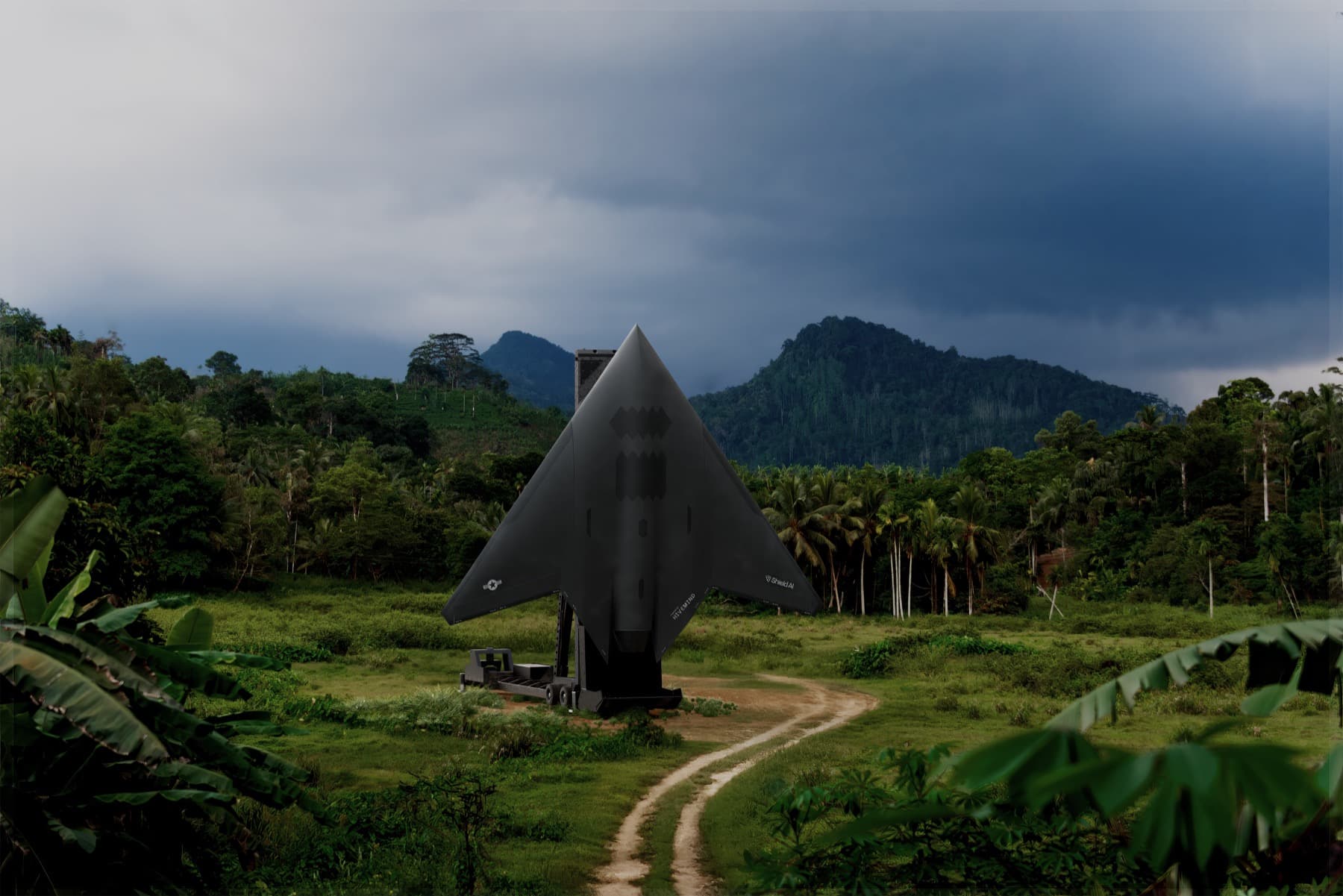
An autonomous VTOL fighter meant to erase the runway from the problem: it takes off and lands vertically from a truck bed, a clearing, or a ship, then flies more than 2,000 nautical miles at above 50,000 feet with internal and external weapons bays for air-to-air, air-to-surface, and electronic warfare missions. Propulsion is a GE Aerospace F110-GE-129E with the AVEN thrust-vectoring nozzle, integrated and light-off tested on July 20, 2026. Three fit in the deck space of one legacy fighter, and one commander is meant to direct a team of them through Hivemind.
GE shipped the AVEN nozzle in early September 2026 after 100-plus hours of ground tests. The X-BAT page still lists first VTOL flights in 2026, mission capability in 2028 and production in 2029. Air & Space Forces Magazine reported in August 2026 that the jet has not flown yet and that the Air Force has not put money into the airframe, leaving Navy/DIU RIMES as the funded path.
Range2,000+ nautical miles
Ceiling50,000+ ft
Wingspan39 ft
EngineGE Aerospace F110-GE-129E with AVEN thrust-vectoring nozzle
Combat radius / internal payload1,000 nautical mile combat radius; up to 2,000 lb of ordnance in internal bays sized to F-35 dimensions (Defence24, September 2026)
Quoted unit costAbout $27 million, near the Air Force CCA price target (company figure reported August 2026; not a contracted price)
The autonomy stack that is the actual company. Hivemind flies aircraft with no GPS, no waypoints, and no remote pilot. Co-founder Brandon Tseng said in September 2026 that it has been used on more than 40 platforms, including F-16s, helicopters, drone boats, ground vehicles, NCSIST Mighty Hornet III, and a first on-orbit satellite test in August 2026. It descends from the Heron Systems agent that beat a human F-16 pilot 5-0 in DARPA's AlphaDogfight trials. Hivemind Enterprise packages it as a developer platform for other manufacturers, and the Hivemind Foundation Model for Defense is trained in simulation, which is what the March 2026 Aechelon acquisition bought.
Fielded across US military programs and on Air Force contract for CCA mission autonomy since June 2026. On August 6, 2026 NCSIST flew three Mighty Hornet IIIs under Hivemind and expanded the Taiwan contract. Company marketing lists space as a Hivemind mission domain alongside CCA, weapons, rotary wing and maritime; the only disclosed on-orbit flight remains the August 24, 2026 NOVI demonstration.
Vehicle ClassesMore than 40 platforms piloted to date (Tseng, September 2026)
CCA StatusOne of three funded autonomy providers; primary provider chosen by summer 2027
A computer-vision counter-drone software product that runs on electro-optical and infrared video for passive detection, without radar or radio emissions. Shield AI licenses it onto platforms operators already field rather than selling a dedicated interceptor.
On September 1, 2026 Shield AI said L3Harris licensed Tracker C-UAS for the VAMPIRE counter-drone platform. The companies had previously demonstrated Tracker with L3Harris WESCAM MX-Series sensors. Shield AI said VAMPIRE systems have logged more than 350,000 operational hours and shot down hundreds of hostile drones in combat since 2023.
Launch customerL3Harris VAMPIRE (license announced September 1, 2026)
What's Next
Fly X-BAT vertically for the first time
X-BAT still has not flown. Air & Space Forces Magazine reported in August 2026 that Shield AI is targeting a first test flight before year-end. Defense One, writing from GE's Lynn factory in early September, said the next gate is a tethered vertical hover from a 180-foot crane so engineers can buy down hover-stability risk before free flight. Until it hovers, the runway-free fighter thesis is a render and a test stand.
Late 2026
Win the CCA primary mission-autonomy selection
The Air Force is running two six-month competitive phases, with Shield AI, Anduril and RTX Collins Aerospace funded for the first, before naming a primary mission-autonomy provider for CCA Increment 1 by summer 2027. Whoever wins supplies the brain for a fleet the Air Force now intends to grow to at least 500 CCAs in service by 2032, on airframes built by General Atomics and Anduril, so this single decision is worth more to Shield AI than any hardware program it owns. Hivemind has already flown on Anduril's YFQ-44A, completing a full set of mission-autonomy test points on February 26, 2026 and handing control back and forth mid-flight with Anduril's own Lattice stack, while Collins' rival Sidekick software has flown on General Atomics' YFQ-42A.
Summer 2027
Reach X-BAT mission capability, then production
Shield AI's published schedule, still current on the X-BAT page as of September 21, 2026, puts first VTOL flights in 2026, full-system flight testing and operational validation in 2028, and production in 2029. That is a fast timeline for a fighter-class aircraft from a company that has never built one.
2028
Hit a $1B revenue run rate
CEO Gary Steele has targeted 70% to 100% annual growth to reach $1 billion in revenue by the fiscal year ending March 2028, from roughly $300 million in the year ended March 2025 and a projected $540 million-plus in 2026. No newer company figure has been published as of September 21, 2026.
March 2028
Deliver X-BAT under the Navy's RIMES prototype award
The US Navy, the Defense Innovation Unit and PAE Aviation are putting $50 million into X-BAT under the Runway Independent Maritime Expeditionary Strike (RIMES) program for ship-based, runway-free strike. Air & Space Forces Magazine reported on August 19, 2026 that the Air Force is still holding off: Increment 1 Collaborative Combat Aircraft are runway-dependent, and the service has not committed money to X-BAT itself. Shield AI has not flown the jet yet; it still targets a first test flight before the end of 2026 and has quoted a roughly $27 million unit cost. No RIMES hardware delivery date has been published.
Unspecified
Scale Hivemind's orbital autonomy demonstrations toward a real constellation
Hivemind's first on-orbit flight remains the August 24, 2026 NOVI/Sedaro test: one LEO satellite standing in as lead of a simulated six-satellite constellation, executing 189 Hivemind-generated, Sedaro SAFE-approved commands over 24 hours. No follow-on test with multiple real satellites has been announced. Shield AI's Hivemind page now lists space as a mission domain alongside CCA, weapons, rotary wing and maritime, but the product is still a single-spacecraft demonstration rather than a fielded constellation.
Unspecified
Convert Taiwan's 280-aircraft V-BAT budget into deliveries
Taiwan's Navy published a 2026-2029 budget line of NT$36 billion for 280 V-BATs, 140 control systems and 82 transport vehicles, with Army Recognition reporting a 40-aircraft first tranche in 2026. Taipei Times reported on September 14 that Shield AI wants local logistics, maintenance, training and some assembly so airframes would not have to return to the US. The next gate is still a signed contract and the first deliveries.
2026-2029
Double Taiwan staff after the NCSIST Hivemind expansion
After the August 6, 2026 Mighty Hornet III three-drone autonomous search with NCSIST, Shield AI said the partnership expanded. Taipei Times reported on September 14 that the Taipei 101 office is hiring and that the company plans to double local staff next year, alongside a push for local logistics, maintenance, training and some assembly. Watch whether the headcount doubling and local assembly actually show up in 2027, and whether Taiwan's still-unsigned 280-aircraft V-BAT budget converts into deliveries.
2027
Convert the Poland X-BAT letter of intent into production agreements
The five-year MSPO letter of intent with PGZ and WZL-2 covers design, production, delivery and sustainment of X-BAT in Poland, plus Hivemind, V-BAT, MRO, training and technology transfer. Defence24 said the companies will now negotiate a detailed work-share. Watch whether that becomes a funded Polish production and export program, distinct from Poland's already-signed V-BAT Navy buy.
2026-2031
Demonstrate Hivemind-controlled LUCAS drone swarm
Shield AI is integrating Hivemind onto the Pentagon's LUCAS one-way attack drone, a roughly $35,000, Shahed-136-derived munition built by SpektreWorks, so a single operator can coordinate a swarm of ten or more. An operational demonstration is still planned for fall 2026. As of September 21, 2026 no public result of that demo has been reported, so the first real test of Hivemind swarming on cheap expendable hardware is still ahead.
Fall 2026
Run UK or NATO contested-environment maritime trials with Kraken
Over the coming year from 28 September 2026
Operations & Revenue
StatusOperational
The 28 September Portsmouth demo remains a demonstration, not a production or integration contract. Shield AI and Kraken said they plan future joint trials in contested environments with UK and NATO partners over the coming year, with no calendar date, named exercise or NATO customer. Kraken's delivery of 20 K3 SCOUTs to the Royal Navy under Project Beehive is a separate Kraken hardware award, not a Shield AI Hivemind production buy. The X-BAT page still says first VTOL flights in 2026, mission capability by 2028 and production in 2029; the aircraft has not flown. The /news index still tops out in 2025 even though the Kraken release is on a dedicated URL. Wikipedia lists about 1,500 employees as of March 2026 (Revelio), matching the record. LUCAS swarm demo remains fall 2026.
Revenue Streams
V-BAT aircraft sales and ISR services
Direct sales of MQ-35 V-BAT systems to US and allied militaries, plus contractor-owned, contractor-operated ISR services where Shield AI flies the missions itself: a $198M Coast Guard COCO contract awarded in 2024 and selection in April 2026 to compete for up to $800M in Navy ISR task orders.
Hivemind autonomy programs
Government contracts for the autonomy software itself, now anchored by the six-year Air Force CCA mission-autonomy production contract awarded June 2026, with a primary-provider down-select due by summer 2027.
Hivemind Enterprise licensing
Selling the autonomy developer platform to other manufacturers, governments, and robotics companies rather than only flying it on Shield AI hardware. This was the stated purpose of the March 2025 F-1 round, which brought L3Harris and Hanwha Aerospace in as strategic investors. On September 1, 2026 L3Harris licensed Shield AI's Tracker C-UAS computer-vision software to equip the VAMPIRE counter-drone platform, extending the L3Harris relationship from equity into a fielded C-UAS product license.
International sales and local manufacturing
Allied procurement is scaling: Poland's roughly $16M Polish Navy order in June 2026, 12 systems for the Royal Netherlands Navy across eight vessels, a $90M manufacturing joint venture with JSW Defence in India, Taiwan's Navy budgeting NT$36 billion for 280 V-BATs from 2026 through 2029, and an August 2026 NCSIST contract expansion after a three-aircraft Mighty Hornet III Hivemind swarm.
Low-cost munitions autonomy (LUCAS)
A new line into expendable one-way-attack drones rather than reusable aircraft: since May 2026 Shield AI has been integrating Hivemind onto the Pentagon's LUCAS program, a roughly $35,000 Shahed-136-derived munition built by SpektreWorks, so a single operator can coordinate a swarm of ten or more; an operational demonstration is still planned for fall 2026, with no public result as of September 21.
Key Metrics
Employees
~1,500 (Revelio Labs, March 2026)
Est. Annual Revenue
Roughly $300M in the fiscal year ended March 2025, with the company projecting more than 80% growth to at least $540M in 2026 and CEO Gary Steele targeting $1B by the fiscal year ending March 2028. Shield AI is private and these are company projections rather than audited figures. No later company figure has been published.
Valuation
$12.7B post-money (March 26, 2026), up roughly 140% from $5.3B a year earlier
CCA Autonomy Contract
One of six vendors holding baseline six-year Air Force mission-autonomy contracts, and one of three funded for the first competitive phase (June 17, 2026); primary provider for Increment 1 selected by summer 2027
Navy ISR Ceiling
Up to $800M in contractor-owned, contractor-operated ISR task orders to compete for (April 2026)
Hivemind Reach
Used on more than 40 platforms, from F-16s and helicopters to drone boats, ground vehicles, NCSIST Mighty Hornet III and a first on-orbit satellite test (Brandon Tseng, September 2026)
V-BAT Operators
Five US services plus Ukraine, Japan, the Netherlands, Romania, Greece, Indonesia, Poland and others. Taiwan's Navy has budgeted 280 aircraft for 2026-2029, the largest planned buy to date. Shield AI has a Taipei 101 office and says it will double local staff next year.
Reliability Record
More than 50 V-BAT crashes in 18 months and two propeller injuries to service members (April 2024, May 2026) documented by Reuters in June 2026
Kraken maritime follow-on (Sep 2026)
Portsmouth demo only. Coming-year UK/NATO contested-environment trials planned with no date. No disclosed production or integration contract.
Timeline
2026Hivemind flies its first CCA flight test on Anduril's YFQ-44A
On February 26, 2026, over the Mojave Desert, Hivemind completes a full set of mission-autonomy test points aboard Anduril's YFQ-44A Fury, with the aircraft switching control mid-flight between Hivemind and Anduril's own Lattice for Mission Autonomy stack under the Air Force's new Autonomy Government Reference Architecture, the interface standard meant to let multiple companies compete to fly the same airframe.
2026$2B raised at a $12.7B valuation, Aechelon acquired
On March 26, 2026 Shield AI announces $2 billion of new capital: a $1.5 billion Series G led by Advent International and co-led by JPMorganChase's Strategic Investment Group, plus $500 million of preferred equity from Blackstone and a further $250 million delayed-draw facility. Valuation reaches $12.7 billion, up roughly 140%. In the same announcement it acquires Aechelon Technology, a high-fidelity simulation company, to train the Hivemind Foundation Model for Defense in simulation.
2026Selected to compete for up to $800M in Navy ISR services
On April 20, 2026 the Navy selects Shield AI to compete for task orders under an up-to-$800 million contractor-owned, contractor-operated ISR program flown with V-BAT. The company cites more than 100,000 pounds of narcotics interdicted, hundreds of targeting operations in Ukraine, and prior Coast Guard and Marine Corps deployments as the track record behind the selection.
2026Selected to bring Hivemind swarm autonomy to the Pentagon's LUCAS drone
On May 19, 2026 the Pentagon's Office of the Under Secretary of War for Research and Engineering selects Shield AI to integrate Hivemind onto LUCAS, a roughly $35,000 one-way attack drone derived from Iran's Shahed-136 and built by SpektreWorks, so a single operator can coordinate a swarm of ten or more of the low-cost munitions in real time. It is Shield AI's first publicized move into expendable one-way-attack munitions rather than reusable aircraft, with an operational demonstration planned for fall 2026.
2026Former employee sues alleging safety-data manipulation and harassment
Jacob Miller, a former member of Shield AI's Mishap Review Board who reviewed drone-crash and injury investigations, files a lawsuit reported by Bloomberg on May 29, 2026 alleging he was placed on retaliatory administrative leave after raising aircraft-safety complaints, that safety data was manipulated, and that a senior director's harassment of staff went unaddressed. The suit also describes an unauthorized July 2025 test flight in which a pilot's child was injured during an evasive maneuver and says the incident went unreported to the Mishap Review Board.
2026Reuters documents V-BAT crashes and a training injury
A Reuters investigation published June 5, 2026 reports more than 50 V-BAT crashes over 18 months, an incident on May 12, 2026 in which a Romanian navy officer lost two fingers to a V-BAT propeller during a training exercise off the Texas coast, and whistleblower complaints alleging that employees raising safety concerns were pushed out. It follows an April 2024 incident in which a V-BAT partially amputated three fingers of a US Navy service member, after which Shield AI developed unassisted launch and recovery.
2026Air Force puts Hivemind on contract for CCA mission autonomy
On June 17, 2026, alongside the FQ-42A and FQ-44A airframe production awards, the Air Force sets up Collaborative Combat Aircraft mission autonomy as its own competition. Six vendors receive baseline six-year contracts (Anduril, General Atomics, Lockheed Martin, Northrop Grumman, RTX Collins Aerospace and Shield AI), and three of them, Shield AI among them, win competitive production awards funding the first of two six-month phases, leading to the selection of a primary autonomy provider for Increment 1 by summer 2027. Treating autonomy as a separately competed capability rather than a subsystem of the airframe is what puts a software company on equal footing with the airframe primes.
2026Aechelon Technology acquisition completed
Shield AI completes its acquisition of Aechelon Technology on June 22, 2026, three months after announcing the deal alongside the Series G round. Aechelon's high-fidelity visual simulation and physics-based sensor-modeling technology, used on national-security programs including the Pentagon's Joint Simulation Environment, is folded into the Hivemind Foundation Model for Defense training pipeline.
2026X-BAT engine lights off with thrust-vectoring nozzle
On July 20, 2026 Shield AI and GE Aerospace complete integration, actuation, and engine light-off of the F110-GE-129E with AVEN, an axisymmetric vectoring exhaust nozzle originally built for an F-16 thrust-vectoring program in the 1990s and refurbished for X-BAT. GE calls it the first fully integrated test campaign of its kind since that program, and it clears the propulsion path to vertical flight.
2026Poland buys V-BAT for its navy
In June 2026 Poland signs a roughly $16 million deal for MQ-35 V-BAT systems for the Polish Navy, with deliveries due by the end of the year. It follows the Royal Netherlands Navy declaring V-BAT operational in March 2026 after shipboard trials aboard HNLMS Johan de Witt off northern Norway, with 12 systems bought for eight vessels.
2026Hivemind flies in orbit for the first time
On August 24, 2026 Shield AI, Sedaro and NOVI Space demonstrate the first on-orbit flight of Hivemind, running aboard a NOVI satellite in low Earth orbit as lead of a simulated six-satellite constellation. Over a 24-hour experiment validated by Sedaro's SAFE edge-safety framework, Hivemind autonomously generates and executes 189 commands covering imaging tasking, health diagnostics, battery state and pointing, extending Hivemind beyond aircraft, ground vehicles and drone boats into space.
2026L3Harris licenses Tracker C-UAS for the VAMPIRE counter-drone platform
On September 1, 2026 Shield AI said L3Harris licensed Tracker C-UAS, a computer-vision counter-drone software product, to equip the VAMPIRE platform with passive AI detection on electro-optical and infrared video, without radar or radio emissions. The companies had previously demonstrated Tracker with L3Harris WESCAM MX-Series sensors. Shield AI said VAMPIRE systems have logged more than 350,000 operational hours and shot down hundreds of hostile drones in combat since 2023, and that Tracker is available for licensing on other platforms operators already use.
2026GE ships the X-BAT AVEN nozzle after 100-plus hours of ground tests
On September 3, 2026 Aviation Week reported that GE Aerospace was shipping the refurbished Axisymmetric Vectoring Exhaust Nozzle to Shield AI after more than 100 hours of ground tests on the F110-GE-129E at Peebles, Ohio. Defense One, writing from GE's Lynn factory on September 4, said the next gate is a tethered vertical hover by year-end, with the prototype hanging from a 180-foot crane so engineers can buy down hover-stability risk before free flight. Shield AI's X-BAT page still lists first VTOL flights in 2026, mission capability in 2028, and production in 2029.
2026Taiwan budgets 280 V-BATs, the largest planned order to date
On August 31, 2026 Taiwan's Central News Agency reported that the Navy's 2026-2029 public defense budget includes NT$36 billion to buy 280 shipborne V-BAT aircraft, 140 control systems and 82 transport vehicles, after the program was moved out of the classified budget. Army Recognition, citing Liberty Times, said the buy is worth about $1.14 billion and is phased 40 aircraft in 2026, 110 in 2027, 64 in 2028 and 66 in 2029, larger than Shield AI's entire late-2024 delivered fleet. This is a funded procurement program, not a confirmed signed contract with Shield AI.
2026Hivemind flies a three-drone NCSIST swarm, then Taiwan expands the contract
On August 6, 2026 Shield AI and Taiwan's National Chung-Shan Institute of Science and Technology announced a coordinated autonomous search with three NCSIST Mighty Hornet III UAVs. NCSIST engineers, with Shield AI support, put Hivemind on the aircraft in less than three months; the software launched, teamed, routed around a no-fly zone, and landed the three drones. The demo closed the original February 2026 integration contract and produced a significant expansion to use Hivemind more broadly across NCSIST programs. Taipei Times reported on September 14 that Shield AI has a Taipei 101 office, plans to double local staff the following year, and that co-founder Brandon Tseng said Hivemind has been used on more than 40 platforms.
2026Signs five-year Poland LOI to produce X-BAT with PGZ and WZL-2
At MSPO, Shield AI, Polish Armaments Group (PGZ) and Military Aircraft Works No. 2 (WZL-2) signed a five-year letter of intent covering cooperation on design, production, delivery and sustainment of X-BAT in Poland, plus Hivemind, V-BAT, MRO, training, supply-chain participation and technology transfer. Defence24 reported the detailed work-share and sites will be set in follow-on agreements. WZL-2 is already expanding F110 engine maintenance, the same engine family that powers X-BAT. CEO Ryan Tseng said the industrial base should build and support X-BAT for Poland and export. The LOI is not a production contract.
2026First UK maritime Hivemind demo on two Kraken USVs
On September 28, 2026 Shield AI and Kraken Technology Group demonstrated two Hivemind-enabled K3 SCOUT uncrewed surface vessels running a coordinated ISR search in Portsmouth, using radar, cameras and AIS to classify a vessel of interest, escort it, then replan. Shield AI called it its first UK maritime autonomy demonstration and said the firms plan further joint trials with UK and NATO partners in contested environments over the coming year. Kraken, which is not in the catalog, recently delivered 20 K3 SCOUTs to the Royal Navy under Project BEEHIVE.
2025Gary Steele becomes CEO, $240M raised at $5.3B
On March 6, 2025 Shield AI raises $240 million in an F-1 round at a $5.3 billion valuation, with strategic money from L3Harris and Hanwha Aerospace alongside Andreessen Horowitz, aimed at selling Hivemind Enterprise to other manufacturers rather than only flying it in-house. Days later, on March 12, enterprise-software veteran Gary Steele is named CEO, with co-founder Ryan Tseng moving to president.
2025X-BAT unveiled, GE Aerospace signed as propulsion partner
In October 2025 Shield AI reveals X-BAT, an autonomous VTOL fighter with more than 2,000 nautical miles of range and a 50,000-foot ceiling, designed so three fit in the deck space of one legacy fighter. GE Aerospace is selected as propulsion partner in November 2025, and a flight-test site is stood up at Newton City/County Airport in Kansas.
2021Martin UAV and Heron Systems acquired
Shield AI buys Martin UAV, which brings the V-BAT airframe, and Heron Systems, whose AI agent had beaten a human F-16 pilot 5-0 in DARPA's AlphaDogfight trials. The two purchases turn a small-drone company into an autonomy company with a Group 3 aircraft to sell.
2015Founded after a SEAL deployment in Afghanistan
Brandon Tseng, a Navy SEAL who watched his unit take casualties clearing buildings blind in Uruzgan province, starts Shield AI in San Diego with his brother Ryan Tseng and engineer Andrew Reiter, on $100,000 from friends and family. The founding product is Nova, a quadcopter that maps and searches buildings on its own with no GPS and no operator stick time.
Funding
Cumulative disclosed raise · dated rounds
Round
Date
Amount
Investors
Source
Series E
2022
$165M
Existing and new investors; $2.3B valuation
Series F
2023
$200M
Andreessen Horowitz, Breyer Capital and others; $2.7B valuation
Series F-1
March 2025
$240M
L3Harris and Hanwha Aerospace (strategic), Andreessen Horowitz, US Innovative Technology, Washington Harbour; $5.3B valuation
Series G
March 2026
$2B
Advent International (lead) and JPMorganChase Strategic Investment Group (co-lead) on a $1.5B Series G, plus $500M preferred equity from Blackstone and a $250M delayed-draw facility; Snowpoint Ventures, InnovationX, Riot Ventures, Disruptive, Apandion; $12.7B valuation