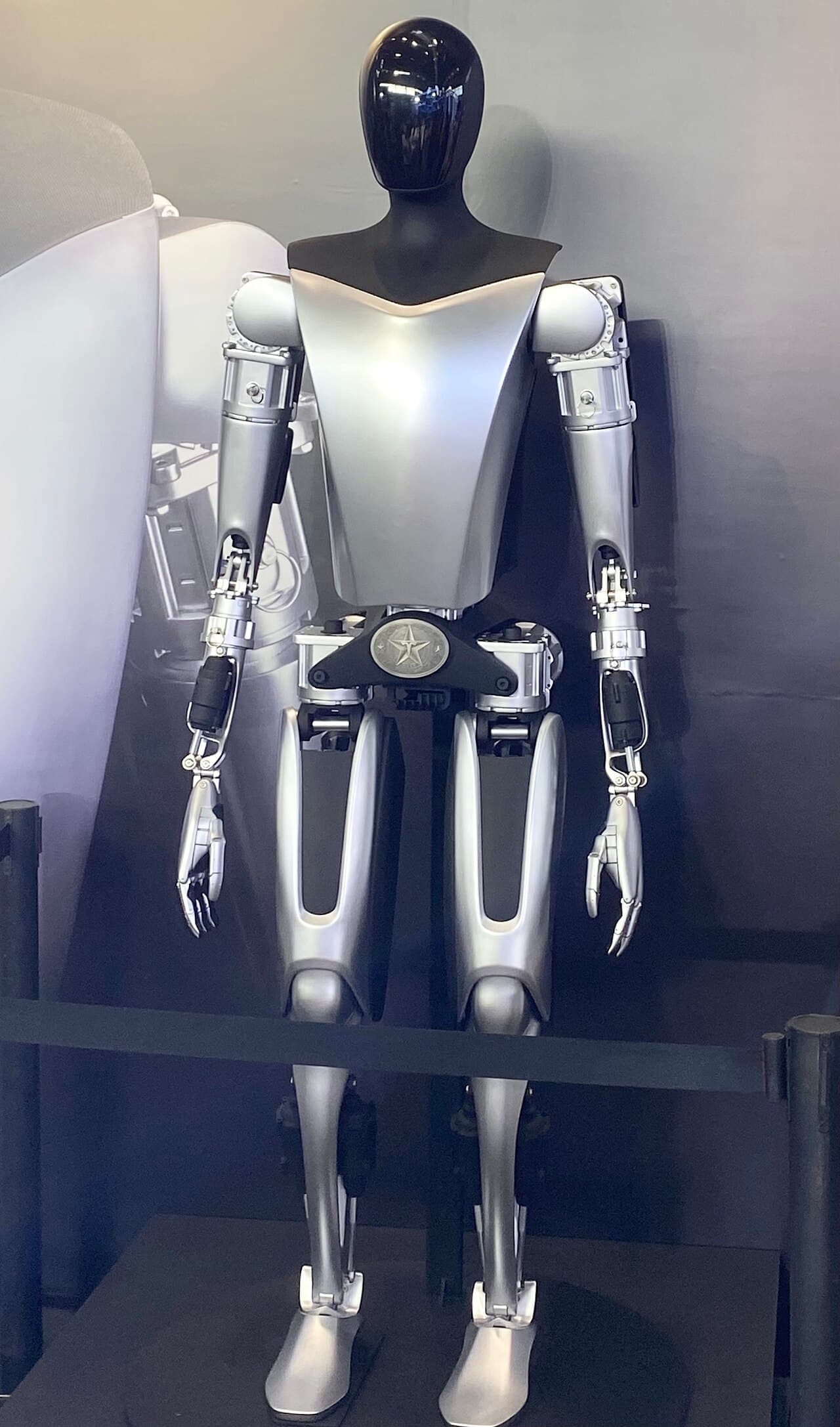
Tesla's general-purpose autonomous humanoid robot program. Tesla describes Optimus as a bi-pedal robot meant to handle unsafe, repetitive, or boring tasks and says the same AI foundation used for vehicle autonomy underpins its robotics work. Optimus V3 - featuring doubled hand dexterity (22 DOF), Tesla's AI5 chip, and a target price of $20-30K at scale - is slated for a late-July/August 2026 reveal with first volume production targeted for summer 2026.
Optimus entered production on Fremont's converted first-generation line, confirmed in reporting dated August 27-28, 2026 - about four months after the space finished building its last Model S/X (May 10, 2026). Output is intentionally slow at the start (Musk describes a 'flat and long' initial S-curve), and the earliest units go to Tesla's internal 'Optimus Academy' training/data-collection program and factory tasks rather than customer sale; independent reporting pegs realistic external/commercial sales starting as early as 2H 2027. The line targets about 1M units/year long-term, with a dedicated Giga Texas second-generation line designed for up to 10M units/year. Musk has called Optimus the hardest product Tesla has tried to scale, citing roughly 10,000 unique parts and no existing supply chain.
02
Specifications5
Product Goal
General-purpose autonomous humanoid robot
V3 Reveal
Still no public date as of September 13, 2026
The July 22 earnings call set none, and Tesla has not shown Optimus V3 since; Musk has said Tesla is holding the public reveal until closer to volume production so competitors cannot copy the design frame-by-frame
Fremont Line
Model S/X lines decommissioned
(final units built May 10, 2026); first-gen Optimus line entered production around Aug 27-28, 2026, feeding the internal Optimus Academy (~1M units/yr design capacity)
Giga Texas Long-Term Capacity
Up to 10M units/yr (Gen-2 line)
AI5 Compute Chip
Taped out
production split between Samsung's Taylor, TX fab (2nm) and TSMC (3nm) as of mid-July 2026; Musk says volume output for vehicles/robots is not expected until mid-2027
Announced next steps from Tesla that mention Optimus.
Late 2026-2027
Scale Optimus past pilot output and hold the V3 public reveal
With production started on the Fremont Gen-1 line (confirmed in reporting dated August 27-28, 2026), the next milestones are volume and disclosure. Output is starting deliberately slow - Musk has called the initial S-curve 'flat and long' - and the first robots are earmarked for Tesla's internal 'Optimus Academy' training and data-collection program rather than sale; independent reporting frames external/commercial Optimus sales as realistic starting in 2H 2027, with the Fremont line's long-term design capacity around 1M units/year and a second-generation Giga Texas line planned for up to 10M units/year. Chinese media said a Tesla team arrived in Ningbo around September 16 to audit Sanhua, Joyson and Tuopu ahead of an Optimus ramp. Tuopu and Sanhua told Yicai on September 18 they had not been notified of a new inspection, while confirming ongoing robotics work (Tuopu on linear, rotary and dexterous-hand actuators; Sanhua on joint actuators for a major client). Tesla has not confirmed the visits or a 2026 unit target. The Optimus V3 public reveal remains undated as of September 20, 2026; Tesla has not shown V3 publicly since the July 22 earnings call. Tesla's AI5 chip has taped out and begun production at Samsung's Taylor, TX fab (2nm) and TSMC (3nm), though Musk says volume AI5 output for vehicles and robots is not expected until mid-2027.
Build Terafab, a joint Tesla-SpaceX chip factory in Texas
Tesla and SpaceX confirmed on August 6, 2026 that their jointly developed Terafab semiconductor factory will be sited in Grimes County, Texas (Gibbons Creek Reservoir, outside College Station), with an initial investment phase of $16.8 billion and at least 3,000 jobs planned. The vertically integrated, roughly 100-million-square-foot plant, to be operated by SpaceX as the high-volume production site, is designed to make, package and test advanced logic and memory chips, supplying Optimus and Cybercab compute alongside SpaceX's space-based AI data center needs; total investment could reach $119 billion if further phases are built out. Intel joined the project in April 2026 as its named foundry partner, committing its next-generation 14A process node to the effort - Intel's first major external 14A customer, and a validation its foundry business had publicly said it needed. Tesla separately runs a smaller 'Advanced Technology Fabrication' R&D pilot line at Giga Texas in Austin, complementing existing AI5 chip production at Samsung's Taylor, TX fab and TSMC. The local tax incentives underpinning the Grimes County site cleared their remaining hurdles in July 2026, when the Iola and Anderson-Shiro Consolidated Independent School Districts approved a combined $1.66 billion in property-tax abatements under the Texas JETI program, following Grimes County commissioners' earlier 4-1 vote for a reinvestment zone and 100% county tax abatement; SpaceX has said it is ready to begin construction now that the incentive package is in place, though no groundbreaking date, completion date, or first-output target has been formally announced by either company.
Tesla began producing its Optimus humanoid robot at the Fremont factory around August 29, 2026, converting the former Model S and Model X assembly area as part of more than $20 billion in 2026 capital spending. Elon Musk said output will be extremely slow at first since it is an entirely new manufacturing process, with the line ultimately designed for about 1 million robots a year and a larger Texas line planned later. The first units are earmarked for Tesla's internal Optimus Academy training program rather than sale, with outside commercial units still expected starting in 2027.
Tesla and SpaceX confirmed on August 6 that their jointly developed Terafab semiconductor factory will be built in Grimes County, Texas, with an initial phase of $16.8 billion in investment and at least 3,000 jobs planned. The vertically integrated, 100-million-square-foot facility is designed to make, package and test advanced logic and memory chips to supply Tesla's Optimus robots and Cybercabs as well as SpaceX's space-based AI data centers, with total investment potentially reaching $119 billion if further phases proceed.
In its second-quarter shareholder update on July 22, Tesla said it has decommissioned the Model S and Model X assembly lines at its Fremont, California factory and begun installing the first-generation production lines for its Optimus humanoid robot, with production anticipated later this year. CEO Elon Musk cautioned that initial output will be slow and called Optimus the hardest product Tesla has ever tried to scale, noting the robot has roughly 10,000 unique parts and no existing supply chain to draw on. The earliest units will be used internally to collect training data and refine functionality rather than sold to customers.
JPMorgan on June 5 upgraded Tesla from Underweight to Neutral and raised its price target from $145 to $475 - a 227% revision - in the first major call from incoming lead auto analyst Rajat Gupta, who replaced longtime bear Ryan Brinkman in early May. Gupta's framework reframes Tesla as a vertically-integrated technology platform rather than an EV manufacturer, with robotaxi, Optimus, and FSD licensing projected to drive roughly half of an estimated $203B revenue base and $7.50 EPS by 2030, ending one of Wall Street's longest-running bearish institutional positions.