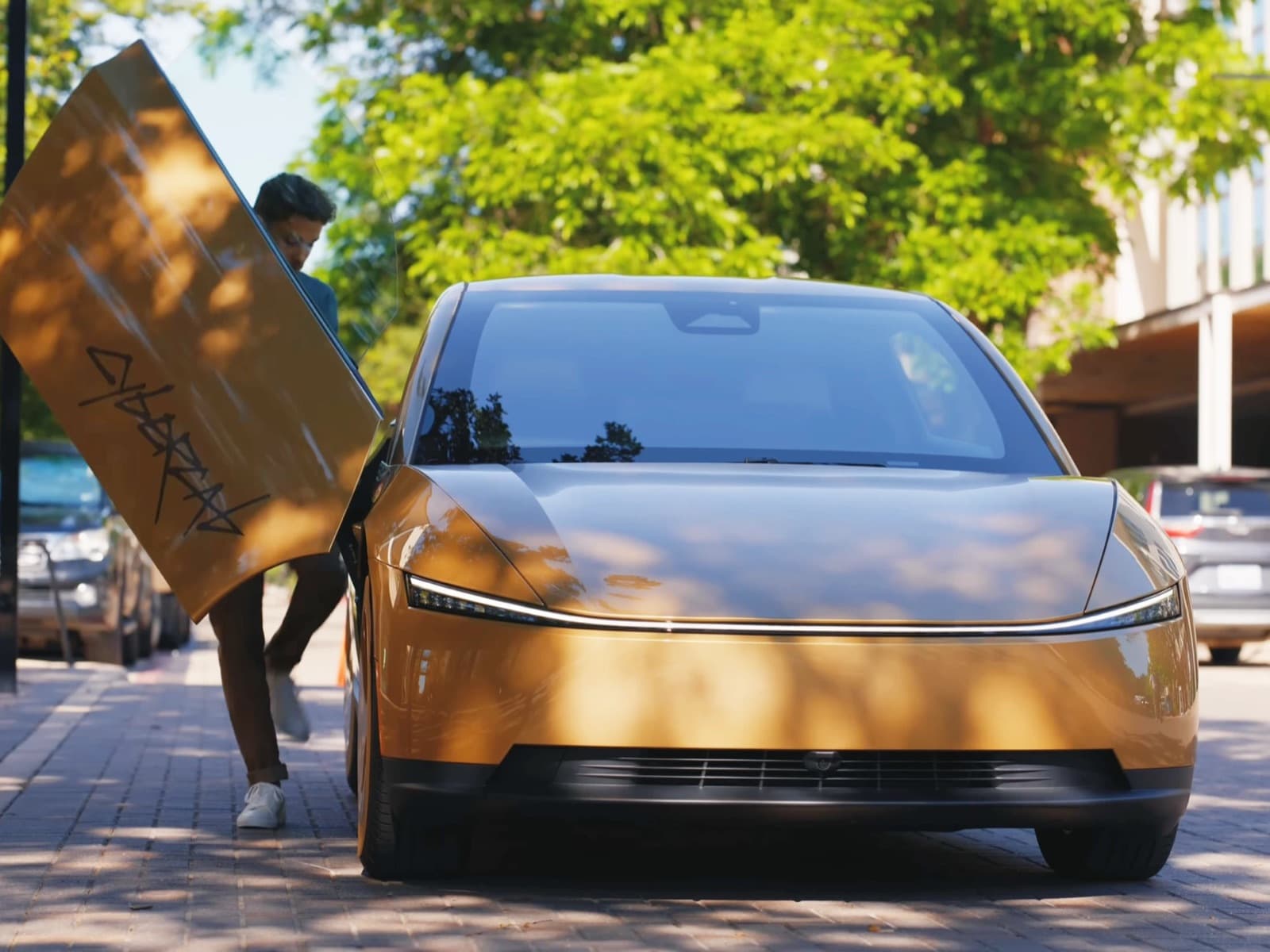
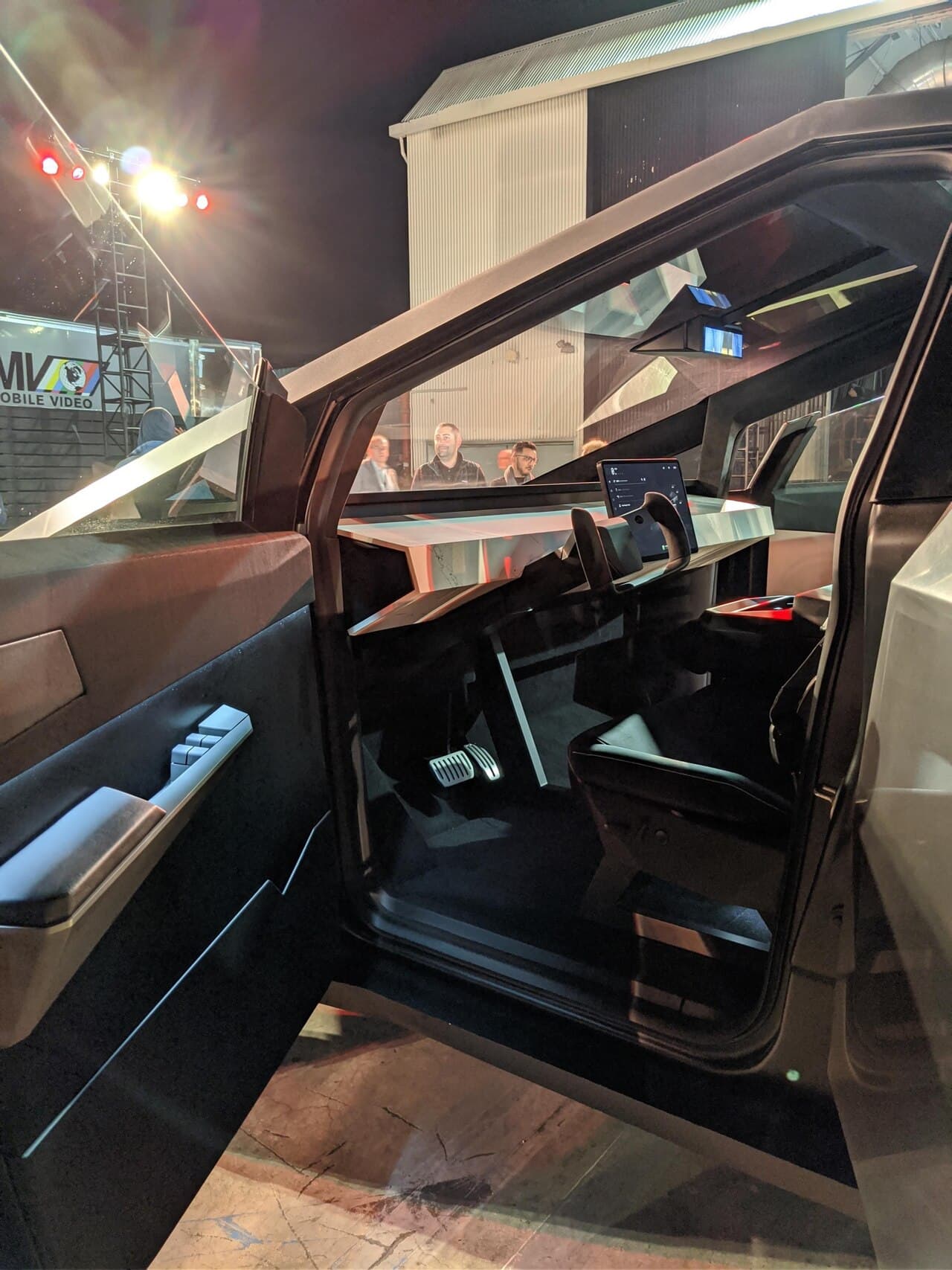
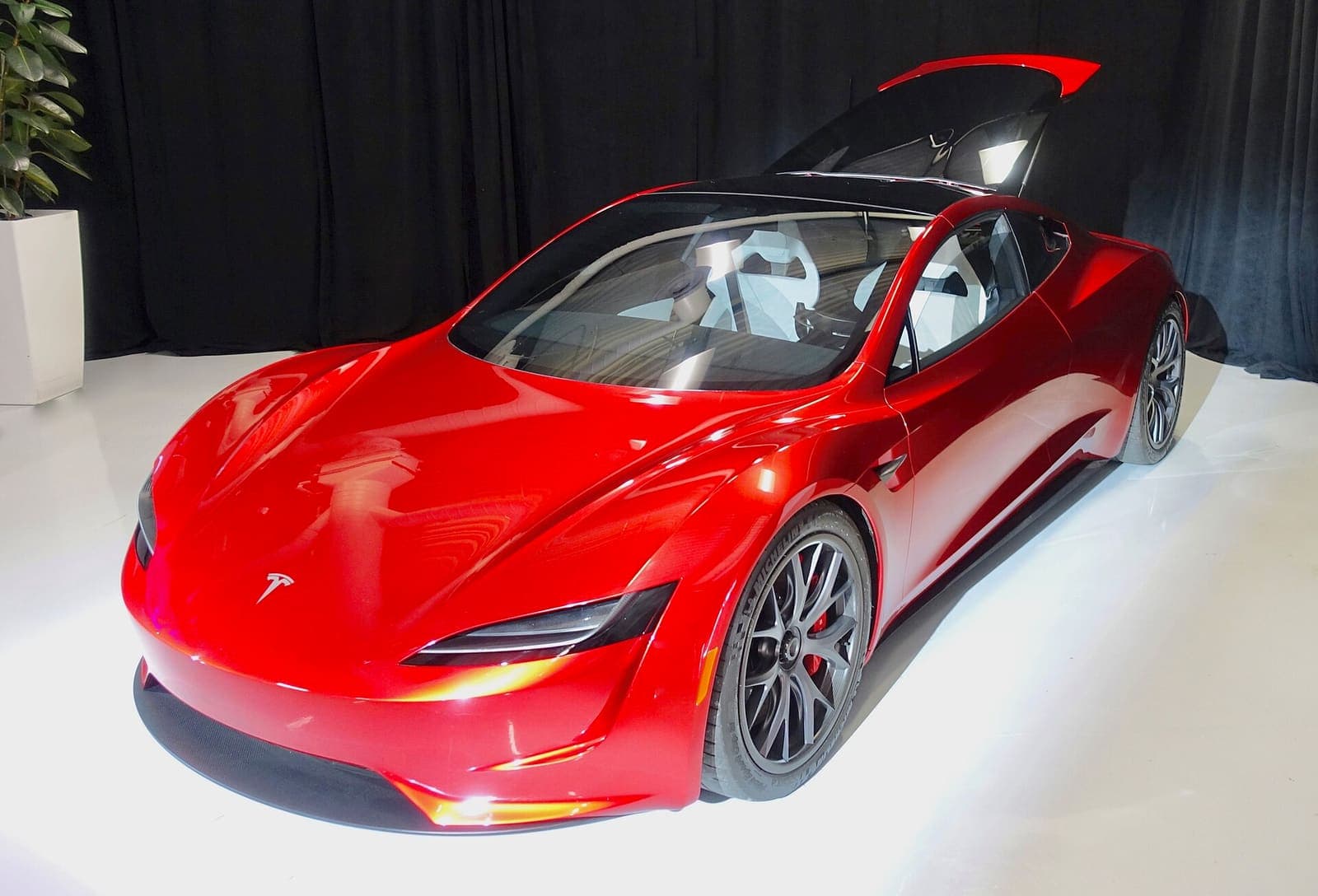
Tesla's purpose-built two-seat autonomous vehicle for its Robotaxi network - no steering wheel, no pedals, vision-only FSD. Designed as an income-generating asset on the Tesla Network at a sub-$30,000 target price and ~$0.20/mile operating cost. tesla.com/robotaxi now lists Cybercab as a live fleet vehicle alongside Model Y, with unsupervised rides in Austin, Dallas, Houston, Miami, Orlando, and Tampa.
Tesla began commercial Cybercab rides in Austin on September 3, 2026, and tesla.com/robotaxi lists Cybercab as a live two-seat fleet vehicle (no steering wheel or pedals) alongside Model Y across Austin, Dallas, Houston, Miami, Orlando, and Tampa. MotorTrend's September 8 first-ride report said the Robotaxi app opened Cybercab hails to the public on September 4 in Austin only, with 45 Cybercabs registered in the area, surface-street routing, no airport service yet, and sample fares around $2.93 per mile. NHTSA Open Audit Query AQ26002, opened September 3, covers an estimated 1,000 Cybercabs; on September 10 the agency issued a Special Order requiring sworn answers by September 30 on how Tesla self-certified the design against FMVSS, including the foot-brake rule, without a Part 555 exemption. Tesla China said Cybercab will go on display in Beijing, Shanghai, and other cities from mid-September to show design and tech, not as a China sale or China robotaxi launch.
02
Specifications10
Production Start
First unit Feb 17, 2026
continuous from April 2026
Production Location
Gigafactory Texas (Austin)
Target Price
Under $30,000
Robotaxi Cities (Model Y today)
Six unsupervised metros on tesla.com/robotaxi: Austin, Dallas, Houston, Miami, Orlando, and Tampa; San Francisco Bay Area still operates with a safety monitor. Las Vegas is permitted but not listed as live
Texas Robotaxi Fleet Registered
420 vehicles, including 45 Cybercabs
Sept. 2, 2026 Texas DMV records
Active Unsupervised Fleet (Austin)
~17 vehicles as of Jul 21, 2026, down from a ~25-vehicle peak in late April despite geofence and city expansion
Cybercabs Staged at Giga Texas
245+ (record, as of Jul 19, 2026)
Employee Driverless Rides
Began Jul 10, 2026
Giga Texas campus only, not public roads
Unsupervised Fleet Size (Pre-Launch Surge)
Grew roughly 7x in about three weeks to nearly 200 vehicles operating without a safety monitor across Austin, Dallas and Houston by early September 2026, up from 57 vehicles on June 30, per crowdsourced Robotaxi Tracker data compiled just ahead of the September 3 Cybercab event
Cumulative Unsupervised Miles vs. Waymo
Tesla had logged about 380,000 cumulative unsupervised Robotaxi miles as of early September 2026, versus Waymo's 450,000-500,000 paid driverless rides per week across 10+ US cities - underscoring the scale gap even as Tesla's own fleet count accelerates
Announced next steps from Tesla that mention Cybercab (Robotaxi).
Oct 2026
Move Robotaxi to 24/7 hours
Tesla's paid Robotaxi network currently runs 6 a.m. to 10 p.m. across Austin, Dallas, Houston, Miami, Orlando, and Tampa. AI lead Ashok Elluswamy said on September 4, 2026 that round-the-clock service could arrive in about a month once the next Full Self-Driving v15-plan technology merges. He did not name cities or say whether overnight hours would cover Cybercab, Model Y, or both. Las Vegas is still not listed on tesla.com/robotaxi.
Expand Robotaxi geography and grow the unsupervised fleet
Tesla's official robotaxi page lists unsupervised rides in six US metros - Austin, Dallas, Houston, Miami, Orlando, and Tampa - plus a San Francisco Bay Area service that still uses a safety monitor. tesla.com/robotaxi now treats Cybercab as a live fleet vehicle alongside Model Y and is soliciting fleet-operator interest. Las Vegas is not listed: the August 20 Nevada permit still allows up to 5,000 driverless vehicles in Clark County, with Tesla's ~30-day commercial-start comment pointing to mid-to-late September and a 120-day commence-by deadline around December 18, 2026, but paid rides have not started. Tesla AI lead Ashok Elluswamy said on September 4 that 24-hour service could arrive 'next month or so' once the next v15-plan tech merges (paid hours today run 6 a.m. to 10 p.m.). The Cybercab Asia display tour is underway as a static showcase: Japan opened in Tokyo on September 11, Hong Kong displayed on September 9, Beijing runs September 17-27, and Shanghai runs September 17-21. The central watch items are whether Las Vegas rides go live inside the permit window, whether overnight hours actually start around October, and whether the Asia tour stays display-only.
Build Terafab, a joint Tesla-SpaceX chip factory in Texas
Tesla and SpaceX confirmed on August 6, 2026 that their jointly developed Terafab semiconductor factory will be sited in Grimes County, Texas (Gibbons Creek Reservoir, outside College Station), with an initial investment phase of $16.8 billion and at least 3,000 jobs planned. The vertically integrated, roughly 100-million-square-foot plant, to be operated by SpaceX as the high-volume production site, is designed to make, package and test advanced logic and memory chips, supplying Optimus and Cybercab compute alongside SpaceX's space-based AI data center needs; total investment could reach $119 billion if further phases are built out. Intel joined the project in April 2026 as its named foundry partner, committing its next-generation 14A process node to the effort - Intel's first major external 14A customer, and a validation its foundry business had publicly said it needed. Tesla separately runs a smaller 'Advanced Technology Fabrication' R&D pilot line at Giga Texas in Austin, complementing existing AI5 chip production at Samsung's Taylor, TX fab and TSMC. The local tax incentives underpinning the Grimes County site cleared their remaining hurdles in July 2026, when the Iola and Anderson-Shiro Consolidated Independent School Districts approved a combined $1.66 billion in property-tax abatements under the Texas JETI program, following Grimes County commissioners' earlier 4-1 vote for a reinvestment zone and 100% county tax abatement; SpaceX has said it is ready to begin construction now that the incentive package is in place, though no groundbreaking date, completion date, or first-output target has been formally announced by either company.
Show Cybercab in Beijing, Shanghai and other Asian cities
The Asia display tour is underway as a static showcase, not a sale or a robotaxi launch. Tesla Japan opened the Cybercab Japan Tour in Tokyo on September 11, 2026 (Aoyama through Sept 14), with later stops in Osaka (Sept 17-20), Nagoya (Sept 22-23), and Tokyo Shinjuku (Sept 26-28). Hong Kong displayed Cybercab on September 9. Beijing runs September 17-27 at the Huamao Tesla Experience Center and Shanghai runs September 17-21 at HKRI Taikoo Hui. Tesla has said the tour does not mean Cybercab will be sold in those markets or that commercial robotaxi service will start there.
Host the Tesla Semi factory inauguration event in Nevada
Tesla is still pointing to an invite-only Semi Rollout on September 24, 2026 at the dedicated ~1.7M-square-foot Semi factory in Sparks, Nevada, with factory tours and ride-alongs. Creator invites were still landing as of September 7-8, 2026, and no postponement has been announced. RSVPs were due September 2; attendees must be 21+ with ID checked. The event is ceremonial rather than the start of manufacturing - the first truck left the line on April 29, 2026 - and it is not clear whether Tesla will livestream it after the muted September 3 Cybercab event.
Respond to NHTSA Cybercab Special Order and expand paid service
TargetSeptember 30, 2026 (Special Order answers); 2026-2027 (service expansion)
Commercial Cybercab rides started in Austin on September 3, 2026 via the paid Robotaxi app. NHTSA opened Open Audit Query AQ26002 the same day, then on September 10 issued a Special Order requiring sworn answers by September 30 on temporary driver controls, occupant touchscreen controls, speed and geofence limits, and how Tesla self-certified a vehicle with no foot brake against still-in-force FMVSS. Tesla has no Part 555 exemption of the kind NHTSA granted Zoox in July. MotorTrend's September 8 first-ride report said the app opened Cybercab hails to the public on September 4 in Austin only. The next watch items are Tesla's sworn reply and whether paid Cybercab rides leave Austin.
The Tesla Robotaxi account said on Oct. 10, 2026 that more than 300 Cybercabs were serving Austin, an eightfold increase in 30 days after public rides opened Sept. 4. AI software head Ashok Elluswamy named Dallas as the next city for public Cybercab rides, without a date. Texas AV tracker showed 319 registered Cybercabs after a 150-vehicle add, while a community tracker counted 105 Cybercabs in unsupervised Austin service; NHTSA Cybercab audit query remains open.
Tesla's Robotaxi account said on September 23 that the company built its first Cybercab using cathode material from what it called the first cathode plant in the Americas, at Giga Texas. Tesla North America said in August that the large-scale cathode line was already operating as part of 4680 cell production. Tesla did not publish a production rate or say how many Cybercabs will use in-house cathode; the first-vehicle claim is company-only.
The U.S. National Highway Traffic Safety Administration said on September 15 that Tesla must answer by September 30 whether it properly self-certified the steering-wheel-free Cybercab against federal motor vehicle safety standards. Electrek reported the agency issued a Special Order on September 10 requiring sworn answers on temporary driver controls, occupant touchscreen controls, speed and geofence limits, and how Tesla certified a vehicle with no foot brake. NHTSA approved a Part 555 exemption for Amazon's Zoox in July; Tesla has no such exemption and began paid Austin Cybercab rides on September 3.
Tesla China said Cybercab will go on public display in Beijing, Shanghai and other cities from mid-September 2026 to show the two-seat robotaxi's design and technology. The company said the tour does not mean Cybercab will be sold in China or that Tesla will start commercial robotaxi service there. The display follows the September 3 start of paid Cybercab rides in Austin.
Tesla began commercial Cybercab rides in Austin on September 3, 2026, adding the steering-wheel-free two-seater to its paid Robotaxi app alongside Model Ys, and said it plans to expand the service gradually. The same day, NHTSA opened Open Audit Query AQ26002 covering an estimated 1,000 Cybercabs, asking how Tesla self-certified the vehicle against federal safety standards that assume a steering wheel, pedals and mirrors. Texas records still showed 45 Cybercabs among 420 Tesla robotaxis authorized in the state.
Tesla is holding an invite-only Cybercab launch event in Austin on September 3, 2026 for its two-seat, steering-wheel-free robotaxi. Texas Department of Motor Vehicles records showed 45 Cybercabs authorized for driverless operations out of 420 Tesla robotaxis registered in the state as of September 2, CNBC reported, up from roughly 300 vehicles days earlier. Tesla has not said when Cybercabs will enter the paid Robotaxi app for regular riders after the event.
Waymo published a blog post on August 26 by VP of Onboard Software Srikanth Thirumalai, titled '10 AI Lessons from Driving 200+ Million Fully Autonomous Miles,' arguing that camera-only self-driving hits a false summit where early gains plateau well short of the safety level required for driverless robotaxis, and that only redundant sensing across cameras, lidar, and radar closes the gap. The post, published a week before Tesla's planned September 3 Cybercab unveiling, is widely read as a rebuttal to Tesla's vision-only approach and Elon Musk's past dismissal of lidar as a fool's errand.
Tesla confirmed it will hold an invite-only, livestreamed event on September 3 in Austin to unveil the production version of its Cybercab, the steering-wheel-free, pedal-free two-seat robotaxi built to run on Full Self-Driving software. The confirmed date replaces Tesla's earlier internal target of an Austin public rollout sometime in August, which had not been officially confirmed.
Tesla has told employees it is gearing up for a Cybercab public rollout in Austin as soon as August 2026, The Information reported August 17. The plan starts with staff rides on public roads before folding Cybercabs into the existing Austin Robotaxi service days later, following months of employee rides confined to the private Giga Texas campus where more than 245 units have been staged; the internal end-of-August target could still slip.
Tesla began public-road testing of its production Cybercab - a purpose-built two-seat robotaxi with no steering wheel or pedals - on Austin, Texas streets in late June, the first time the dedicated vehicle has driven in live traffic rather than a retrofitted Model Y. The cars are running as engineering test vehicles with a safety monitor in the passenger seat, relying entirely on cameras and onboard AI rather than the radar and lidar used by rival Waymo. Tesla is targeting paid Cybercab rides in Austin before the end of 2026.
Tesla started public-road engineering tests in Austin on June 30 of its first production Cybercab units, purpose-built two-seat vehicles with no steering wheel and no pedals rather than retrofitted Model Ys. A safety monitor rides along during this phase, and the Texas Department of Transportation confirmed the controlless design is authorized for testing. The camera-only autonomy approach contrasts with the lidar-and-radar stacks used by rivals such as Waymo.
The National Highway Traffic Safety Administration proposed on June 25 to amend federal motor-vehicle safety standards to remove the requirement for manual brake controls in vehicles designed solely for fully autonomous (SAE Level 4/5) operation. The change would clear a regulatory hurdle for purpose-built robotaxis without steering wheels or pedals, such as Tesla's Cybercab, while keeping braking-performance and stopping-distance standards intact. Public comments run through July 27, 2026.